
The useful question about AI technology in healthcare is not whether clinicians should trust it in general. That question is too broad to guide a bedside decision, a procurement vote, or a study design. The better question starts the moment someone reads a performance claim: what, exactly, has this evidence proved?
A model can perform well on a dataset and still fail to improve care. It may classify images accurately under retrospective test conditions, yet arrive too late in the workflow, trigger too many unhelpful alerts, shift work to already overloaded staff, or produce information clinicians cannot safely act on. Technical performance matters. It is simply not the same thing as clinical value.
That distinction is now becoming an explicit evidence standard. In an April 2026 Nature Medicine editorial, journal editors called for evidence expectations that are proportional to the claims made for medical AI: stronger claims about improved decisions, outcomes, safety, or efficiency require stronger clinical evidence than claims about pattern detection or technical accuracy alone.[1] The editorial is not original empirical research, but it is an important signal from a venue that sees the quality of submitted AI evidence across specialties. It gives a name to a problem many hospitals already recognize.

The claim determines the evidence
A hospital committee can save itself considerable confusion by separating AI claims into levels before it debates adoption. The same model output may be described in several ways, and each description carries a different burden of proof.
| Claim being made | What the evidence must show | What would not be enough |
|---|---|---|
| The tool detects or classifies a pattern | Reliable technical performance on appropriate data, including validation beyond the development set | A high AUC from one retrospective internal dataset |
| The tool supports clinical decisions | Performance in the intended population, comparison with current practice, and evidence that clinicians can interpret and use the output safely | Standalone sensitivity and specificity without workflow testing |
| The tool improves workflow or efficiency | Prospective evidence that the tool changes time, task burden, throughput, or handoffs in the real setting | Vendor demonstrations or simulated time savings |
| The tool improves patient outcomes or safety | Prospective comparative evidence against standard of care, with patient-relevant endpoints and monitoring for unintended harms | Model accuracy alone, even when externally validated |
This is not an argument that every AI tool needs a randomized trial before anyone may use it. A low-risk scheduling tool that predicts appointment no-shows does not make the same kind of claim as a diagnostic aid used to influence cancer workup. A model embedded in a back-office process may need rigorous technical validation, fairness checks, and local monitoring. A tool promoted as improving diagnosis, triage, treatment selection, or patient outcomes needs evidence closer to the clinical consequence it claims to affect.
The proportional standard is demanding because it asks vendors, researchers, and health systems to stop hiding behind the strongest-looking metric available. If the claim is technical, technical metrics are appropriate. If the claim is clinical, the evidence has to cross into clinical conditions.
Why retrospective performance is useful but incomplete
Retrospective evaluation is often where medical AI evidence begins. Researchers train or test a model on existing data, then report metrics such as sensitivity, specificity, and area under the receiver operating characteristic curve. Sensitivity measures how often the tool correctly identifies cases with the condition or feature of interest. Specificity measures how often it correctly identifies those without it. AUC summarizes discrimination across thresholds.
Those metrics are not trivial. A model that cannot discriminate in retrospective testing is unlikely to become useful merely by being installed in a clinical system. Strong technical validation can reveal whether a model learned a robust signal, whether performance changes across subgroups, and whether it generalizes beyond the development environment.
But retrospective metrics do not answer several questions that determine clinical value. They do not show whether clinicians will see the output at the right moment. They do not show whether the alert changes a decision. They do not show whether the changed decision helps the patient. They do not show whether the tool creates new work for nurses, informatics teams, or specialists asked to adjudicate ambiguous outputs. They also do not show whether performance will remain stable after local practice patterns, coding behavior, imaging equipment, patient mix, or disease prevalence changes.
This is where many evaluations overreach. A retrospective AUC can support a statement that a model discriminated between categories in a dataset. It cannot, by itself, support a claim that clinicians should change practice.
Deployment is where weak claims become operational problems
The gap between validation and deployment is not only philosophical. A scoping review of barriers to AI adoption in health care identified recurring obstacles that include workflow integration, trust, implementation burden, data quality, lack of real-world validation, and organizational readiness.[2] These are not decorative concerns added after the “real” science is done. They are mechanisms by which an apparently strong model can fail to produce value.
Workflow mismatch is one of the most common ways that promise disappears. An output that arrives after the decision point may be technically correct and clinically useless. An alert that appears inside the electronic health record but requires several extra clicks may be ignored during a busy clinic. A triage score that no one owns may create delay rather than prioritization. If the model changes who must review, document, explain, or override a recommendation, the labor has not vanished; it has moved.
Trust is also more specific than enthusiasm. Clinicians do not need to “believe in AI” as a category. They need to know when the tool was tested, on whom, against what comparator, at what threshold, and with what failure modes. They need a process for escalation when the output conflicts with clinical judgment. They need to know whether the institution will monitor drift or whether each clinician is expected to notice degradation one patient at a time.
The implementation burden often lands on teams that were not visible in the performance paper. Informatics staff must connect the model to data feeds, manage updates, audit performance, and investigate unexpected behavior. Quality and safety committees must decide whether AI-related incidents fit existing reporting pathways. Clinicians must explain AI-assisted recommendations to patients even when the evidence behind the tool was never designed to answer patient-facing questions.
Regulatory clearance is not the same as demonstrated value
Regulatory pathways matter. In the United States, AI- and machine learning-enabled medical devices may reach the market through routes such as 510(k), De Novo, or premarket approval, depending on risk and predicate status. The FDA maintains a public list of AI/ML-enabled medical devices, and secondary compilations drawing on FDA and related records have reported roughly 1,250 such devices cleared by May 2025.[3] The precise count should be treated as a moving figure because clearances continue and device categorization changes over time.
The scale is still instructive. Many AI tools can become available for purchase or clinical consideration before published evidence shows that they improve real-world outcomes, reduce workload, or change decisions safely. Clearance can establish that a device met regulatory requirements for its intended use. It does not automatically establish that a hospital should buy it, that clinicians should rely on it, or that patients will benefit in a local care pathway.
This distinction is easy to blur in procurement discussions. A cleared device may be described as “validated,” while the evidence package may primarily address analytical or technical performance. A committee then has to ask whether the claim before it is the same claim the regulator evaluated. If a vendor presents clearance as evidence of improved clinical outcomes, the committee should ask for the outcome evidence, not argue about whether regulation matters.
The same caution applies outside the United States. European regulatory frameworks, including the EU Medical Device Regulation, can address safety and performance requirements, but they do not remove the need for health systems, journals, specialty societies, and payers to define what level of clinical evidence is sufficient for adoption in a specific care context.
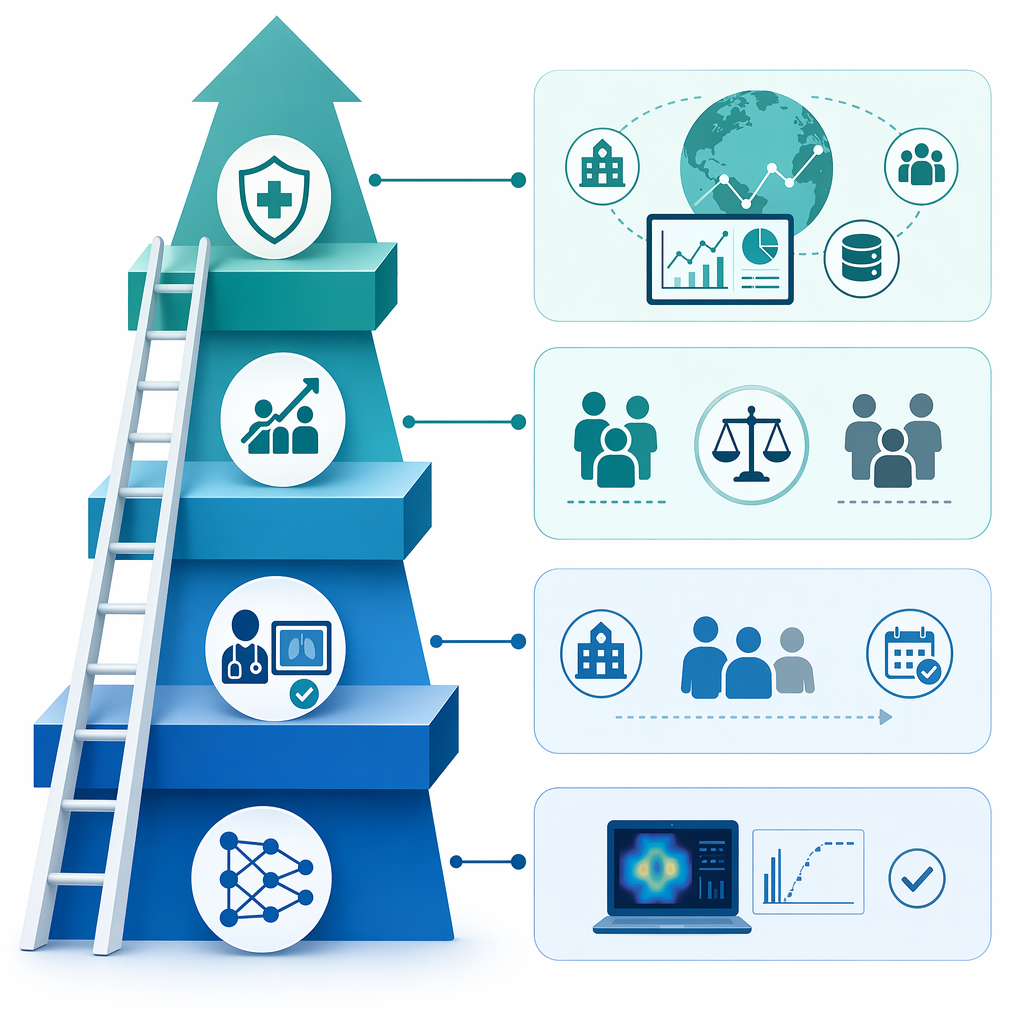
A practical evidence ladder for clinical review
The first review question should be almost literal: what sentence would we allow someone to say about this tool? If the sentence is “the model identifies a radiographic pattern with high sensitivity in an external test set,” the evidence can be judged as technical validation. If the sentence is “the tool reduces missed diagnoses,” the evidence must show an effect on missed diagnoses under clinical use. If the sentence is “the product saves clinician time,” the study must measure clinician time in the workflow where the product will be used.
A proportional review can move through several questions without turning every purchase into a full clinical trial:
- Define the intended use in operational terms: the patient population, setting, user, decision point, and action that follows the output.
- Match the evidence to the claim: technical detection, decision support, workflow improvement, safety improvement, or patient outcome improvement.
- Check validation depth: internal testing, external validation, prospective silent-mode evaluation, prospective clinical use, or comparative study against standard of care.
- Look for workflow evidence: who sees the output, when it appears, what action is expected, and what new work is created.
- Require a monitoring plan: performance drift, subgroup performance, alert burden, override patterns, safety reports, and responsibility for review.
The ladder matters because evidence can be adequate at one level and inadequate at the next. External validation may make a technical claim more credible. It still does not prove that using the model improves outcomes. A prospective silent-mode study can show how the model would have behaved in the live environment without influencing care. It still does not show what happens when clinicians respond to the output. A prospective comparative study can get closer to clinical value because it observes care with and without the tool, but even then the endpoints must match the claim.
For low-risk operational AI, the appropriate standard may be local validation plus monitoring. For a diagnostic or triage tool that changes who is seen first, who receives additional testing, or who is reassured, the standard should rise. For a tool marketed around patient benefit, patient-relevant outcomes cannot remain implied.
Patients are already bringing AI into the visit
The evidence question is no longer confined to institutional AI purchases. A Wolters Kluwer survey reported that 52% of patients were using AI for health-related research, while 60% of clinicians said they spent appointment time reviewing AI-generated information that patients brought into visits.[4] Those figures do not prove that patient-facing AI improves or worsens care. They do show that clinicians are already being asked to adjudicate AI-shaped information during clinical encounters.
That pressure changes the practical stakes. A clinician may be evaluating an institutionally approved tool in one moment and correcting a consumer-generated summary in the next. The same discipline applies: identify the claim, ask what evidence supports it, and decide what action is safe. If the output suggests a diagnosis, the clinician needs evidence relevant to diagnosis. If it suggests urgency, the evidence must be relevant to triage. If it merely summarizes general information, the risk profile is different, though not zero.
This does not mean every clinic needs to become an AI literacy classroom. It does mean that health systems cannot treat AI evaluation as a procurement-only function. The evidentiary habits used to review institutional tools will increasingly shape how clinicians respond to AI-derived information that enters through patients, documentation systems, call centers, and remote monitoring platforms.
Who should enforce the standard?
Regulators are necessary, but they are not sufficient. Journals decide which AI studies are published and how claims are framed. Health systems decide what to buy, where to deploy it, and whether monitoring is funded after go-live. Professional societies can define specialty-specific endpoints, reporting expectations, and appropriate comparators. Procurement committees can require that vendor claims be rewritten into testable statements before review.
The Nature Medicine editorial’s call for proportional evidence standards places part of the responsibility on the institutions that sit between invention and use.[1] That is the right location for much of the work. Regulators may clear a device for an intended use, but a hospital still has to decide whether the tool fits its patients, staffing, data infrastructure, safety processes, and clinical priorities. A journal may publish a strong retrospective validation study, but a specialty society may still need to say what evidence is required before the output should influence care.
The hard part is that enforcement is unglamorous. It means refusing to let a model-performance slide stand in for a clinical-value claim. It means asking vendors for unpublished implementation details. It means budgeting for post-deployment surveillance, not only licensing. It means deciding in advance who reviews drift, who can suspend a tool, and how clinicians report suspected AI-related harm.
It also means accepting that some evidence gaps are acceptable only if the claim is narrowed. A hospital may reasonably pilot a tool under controlled conditions while studying its local effect. It should not describe that pilot as proof of outcome improvement before the outcome has been measured. A vendor may accurately say a model performed well in external validation. It should not let that statement imply improved survival, reduced diagnostic error, or safer triage unless those claims have been tested.
A usable standard for trust
Clinicians should trust AI technology in healthcare only to the extent that the evidence matches the claim. That standard is neither anti-innovation nor permissive. It allows useful low-risk tools to be evaluated without demanding outcome trials they do not need. It also prevents diagnostic, triage, safety, and outcome claims from resting on retrospective technical performance alone.
The most defensible review does not begin with enthusiasm or suspicion. It begins by translating the claim into an evidence requirement. What is the tool supposed to do? Who is supposed to act on it? What comparator matters? What endpoint would show value? What monitoring will detect failure after deployment?
Impressive model performance, regulatory clearance, and adoption narratives can all be relevant. None should be treated as a substitute for demonstrated clinical value when clinical value is the claim.
References
- Show us the evidence for the value of medical AI, Nature Medicine, April 2026, link
- Barriers and facilitators to the implementation of artificial intelligence in healthcare: a scoping review, PMC, link
- Artificial Intelligence and Machine Learning (AI/ML)-Enabled Medical Devices, U.S. Food and Drug Administration, link
- Wolters Kluwer survey on patients using AI for health research and clinicians reviewing patient-sourced AI information, Wolters Kluwer, link
Comments
Join the discussion with an anonymous comment.