
Melbourne’s 2016 thunderstorm asthma event is the place to begin because it shows what “early warning” has to beat. Over roughly 30 hours, hospital asthma presentations rose about 10-fold across the city and surrounding areas, turning a weather event into a respiratory emergency for emergency departments, ambulance services, and people who may have thought they were dealing with hay fever until they suddenly could not breathe properly.[1]
That is the practical test for AI in thunderstorm safety and public health. A model that produces an impressive risk score after the waiting room is full is a retrospective explanation. A warning that arrives early enough to change rosters, check reliever supply, send targeted public messages, or activate a respiratory surge plan is a different kind of tool.

The hard part is that thunderstorm asthma is not simply asthma plus bad weather. The dangerous convergence involves high airborne pollen exposure, storm dynamics that can rupture pollen grains into respirable particles, wind patterns that move those particles into populated areas, and a susceptible population that includes people with known asthma as well as people with allergic rhinitis who may not think of themselves as at risk. Hospital presentations are the late signal. The earlier signals sit in the air, the forecast, and sometimes in what people start reporting before the health system has counted them.
The first useful AI signal may come from the public, not the hospital
CSIRO Data61’s analysis of Twitter data from the Melbourne event is compelling for one narrow reason: speed. In that retrospective analysis, three of 18 algorithms detected the outbreak up to nine hours before the first official report and before any news report.[2] Nine hours is not enough to build a respiratory service from scratch. It may be enough to call in additional staff, prepare triage areas, brief call centers, push warnings to patients with asthma, and alert pharmacies or primary care networks that demand may rise.
The finding should not be inflated. It does not show that Twitter surveillance would have prevented deaths, reduced intubations, or emptied emergency departments. It shows that social signals can appear before official reporting channels during a sudden respiratory surge. That matters because public health reporting often depends on events that have already happened: ambulance calls, emergency presentations, admissions, and mortality reviews. Social data, if handled carefully, can sit closer to the beginning of the impact curve.
It is also a messy signal. People do not post uniformly across age, language, geography, or illness severity. A burst of online discussion may reflect symptoms, fear, media attention, or all three. For an operational warning system, social data is best treated as one input among others, not as a stand-alone diagnostic instrument.
Victoria’s forecast system is closer to clinical translation
The more important example is Victoria’s Epidemic Thunderstorm Asthma Risk Forecast. It is not just a model sitting behind a paper. It is a public warning apparatus that runs during the state’s grass pollen season from October through December, uses a green, orange, and red risk scale, and combines pollen forecasting with thunderstorm type prediction.[1]
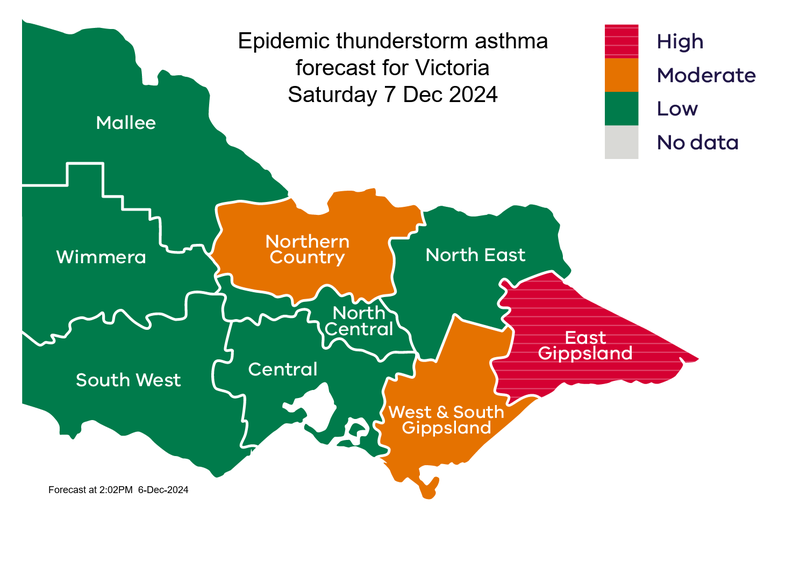
That seasonal boundary is not a weakness to be hidden. It is part of why the system can be used. A forecast that declares where and when it operates is easier for hospitals, ambulance services, general practices, pharmacies, schools, and the public to interpret. It tells them that the warning is tied to a known risk period, a known pollen ecology, and a defined weather pattern rather than to an all-purpose claim that respiratory risk is “elevated” whenever the weather looks unsettled.
The operational logic is straightforward enough for a busy service to act on, even though the inputs are complex. A low-risk day does not demand major surge behavior. A moderate-risk day can prompt closer monitoring, internal reminders, and public messaging to people already known to be at risk. A high-risk day is different: respiratory equipment, staffing, call handling, public alerts, and escalation pathways all deserve attention before the storm reaches the suburbs.
| Input | Why it matters operationally |
|---|---|
| Grass pollen forecast | Identifies whether enough allergenic material is likely to be present for a thunderstorm asthma event to become plausible. |
| Thunderstorm type prediction | Distinguishes ordinary storms from storm conditions more likely to generate and move respirable allergen particles. |
| Automated pollen counters | Reduces dependence on slow manual counting and helps maintain a more current picture across the monitored area. |
| Regional risk scale | Translates technical inputs into a public and health-service signal that can be used without reading a modeling paper. |
| Seasonal operating window | Keeps the forecast anchored to the period when grass pollen risk is expected to matter in Victoria. |
Victoria has also deployed automated pollen counters across seven locations to feed the forecast system.[1] That is a material improvement over relying only on manual pollen counting, which is labor-intensive and can lag behind the conditions that patients are actually breathing. AI-enhanced pollen monitoring can also draw on satellite-estimated grass coverage, wind, temperature, rainfall, and relative humidity to improve estimates of when pollen exposure is likely to become clinically relevant.[3]
For emergency planning, the value is not that a neural network has discovered pollen. It is that meteorology, aeroallergen monitoring, and geography can be fused into a signal that reaches people who can act. The forecast has to be simple enough for public communication and specific enough that services do not ignore it. Green, orange, and red are not elegant science. They are usable operations.
What an alert can change before patients arrive
The clinically meaningful chain has several links. First, the system must identify risk before the surge. Second, the alert must reach the right organizations and the public. Third, those recipients must trust the signal enough to do something. Fourth, the action must happen early enough to affect patient flow, symptom severity, or both. Most discussions of AI stop after the first link.
For a hospital, an orange or red forecast can justify checking whether respiratory assessment areas are ready, confirming supplies of bronchodilators and spacers, briefing triage staff, and reviewing escalation capacity. For ambulance and urgent care systems, it can support call-center scripting, situational awareness, and earlier coordination with emergency departments. For public health units, it can trigger region-specific messaging rather than broad seasonal advice that arrives too often to be noticed.
For patients, the plausible actions are narrower and should stay that way. A warning can remind people with asthma to follow their existing asthma action plans, keep reliever medication available, avoid avoidable outdoor exposure during high-risk storm periods, and seek urgent care when symptoms are severe or not responding as expected. That is not individualized medical advice, and it should not replace a clinician’s plan. It is the kind of public message that can move earlier than the ambulance queue.
The system also has to protect credibility. If too many days are flagged orange or red without a visible event, clinicians become slower to change staffing and the public becomes less likely to adjust behavior. False alarms are not just a statistical inconvenience; they are a workforce and communication cost. A warning system that is technically sensitive but operationally noisy may fail at the point where it matters most.
Why southeast Australia cannot simply be copied elsewhere
Victoria offers the strongest operational model because its system is built around a real seasonal hazard, a defined geography, a public risk scale, and data streams that health agencies can use. But that strength is also the boundary. The evidence base is concentrated in southeast Australia, where rye grass pollen season and particular thunderstorm patterns shape the risk.
A U.S. deployment would need more than a translated interface. Ragweed, mountain cedar, and other regional pollen profiles behave differently from rye grass. Climate zones differ in storm structure, humidity, wind patterns, and seasonal timing. Urban form changes exposure. Health systems differ in how alerts move from public agencies to hospitals, pharmacies, schools, and patients. A threshold that is tolerable in Melbourne may produce too many warnings, or too few, in another region.
Machine learning is already being studied as a way to predict health risks from climate-sensitive extreme weather events, and that broader field is useful for thinking about heat, smoke, storms, and respiratory vulnerability together.[4] Thunderstorm asthma, however, is not a generic climate-health endpoint. The model has to know which pollen matters, when it peaks, which storm features are relevant, and which population behaviors determine whether a warning becomes protection.
The missing evidence is outcome evidence
The current evidence supports a careful, practical claim: AI can help detect thunderstorm asthma risk earlier when it combines meteorological data, pollen data, and sometimes social signals in a region where the hazard is well characterized. It does not yet support the stronger claim that AI warnings reduce emergency department visits, intubations, or mortality. No prospective study in the provided evidence base shows that causal link.
That distinction matters for adoption. Health systems often adopt early warning tools because the operational logic is convincing before randomized outcome evidence exists. That can be reasonable when the intervention is low-risk, the hazard is severe, and the actions are already part of good preparedness. But evaluation should be built in from the start: alert frequency, lead time, staffing changes, public message reach, medication supply disruptions, ED presentations, intensive respiratory interventions, and mortality all belong in the audit trail.
The most credible systems will be explicit about their limits. They will state the operating season, geography, pollen assumptions, weather inputs, alert thresholds, and expected actions. They will track false alarms as seriously as missed events. They will separate model performance from public health performance, because a correct forecast that reaches no one is not a working warning system.
Victoria shows what clinical translation can look like when prediction is embedded in a public health workflow rather than treated as a dashboard novelty. The next question for any region considering a similar system is not whether AI can produce a risk score. It is whether the system can produce enough timely, trusted, region-specific signal to change what clinicians, public health agencies, and patients do before the storm arrives.
References
- Epidemic thunderstorm asthma risk forecast — Victoria Department of Health.
- AI picks up first rumblings of thunderstorm asthma — Puffnstuff.
- Machine Learning Can Predict the Weather — and Human Health — Harvard Medicine.
- Use of machine learning tools to predict health risks from climate-sensitive extreme weather events — PLOS Climate, 2024.
Comments
Join the discussion with an anonymous comment.