
The reason epilepsy warnings in movies matter is not that every flashing scene is dangerous. It is that a small, well-defined class of visual patterns can turn ordinary media into a neurological hazard before anyone in the audience has a chance to react. Photosensitive epilepsy is uncommon: estimates put it at about 1 in 4,000 people overall, while photosensitivity affects a minority of people with epilepsy, often cited in the range of roughly 3% to 5%. The most established danger zone is flash rates around 3 to 30 Hz, especially when bright contrast, color, screen area, and repetition line up badly.[1][2]
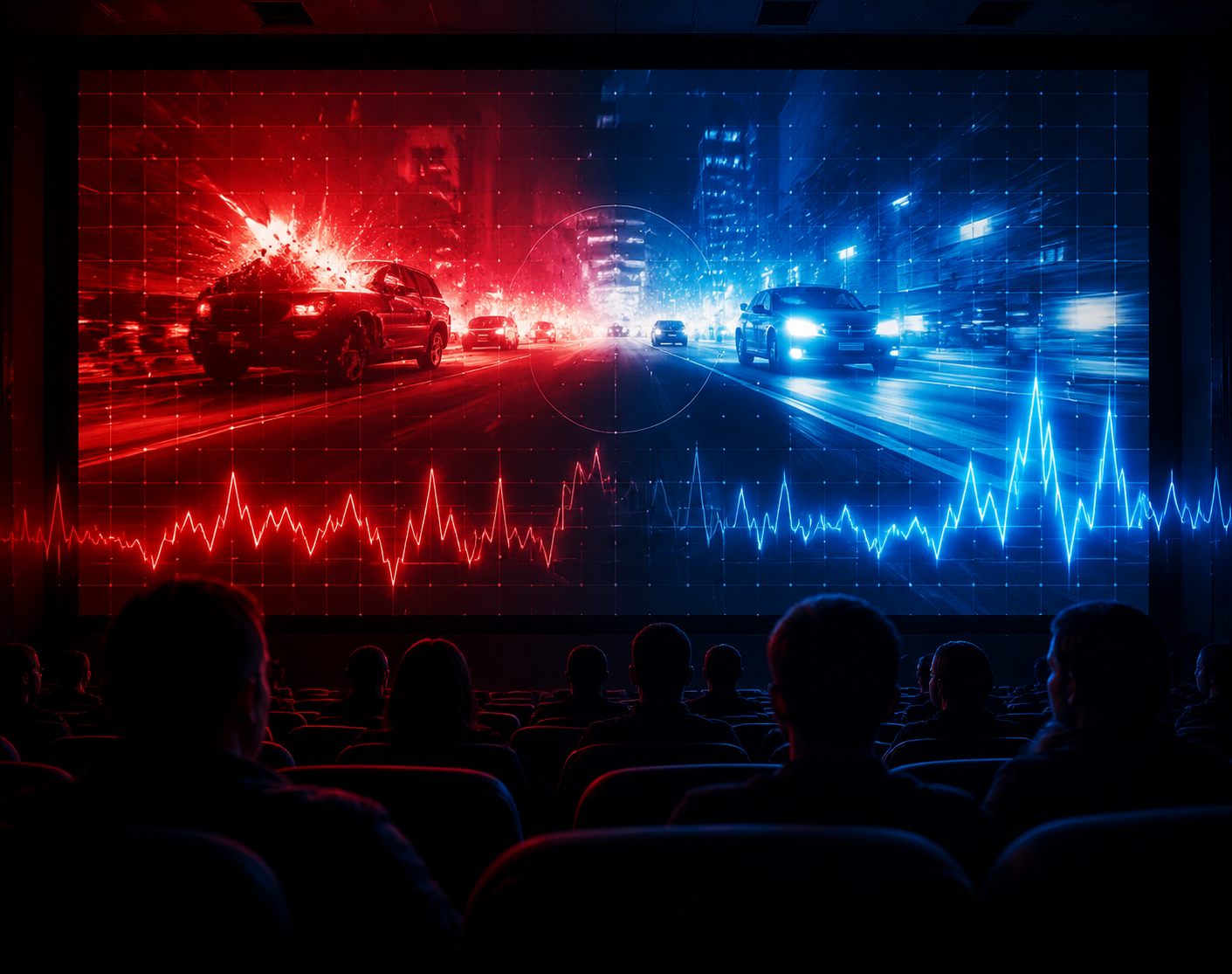
That is a narrow risk, but not a trivial one. On December 16, 1997, a four-second sequence of rapidly alternating red and blue flashes in the Pokémon episode “Dennō Senshi Porygon” was associated with 685 children being hospitalized in Japan and more than 12,000 reports of milder symptoms. The sequence flashed at about 12 Hz, directly inside the known risk band.[3] It remains the kind of incident safety committees remember for the right reason: a few seconds of content created a mass medical event.
Modern automated detection systems grew up around that practical problem. The goal is not to diagnose epilepsy, predict individual seizures, or make a movie safe for every possible viewer. The goal is narrower and more operational: find visual sequences that violate photosensitive epilepsy, or PSE, guidelines before a broadcaster, streamer, studio, or platform puts them in front of the public.
From Frame-by-Frame Review to Pass/Fail Testing
Before automated PSE tools became routine, checking a risky sequence meant asking a trained human reviewer to inspect video frame by frame. One commercial overview describes the older workload as 30 to 60 minutes of manual analysis for a single minute of potentially hazardous content.[4] That is exactly the kind of safety process that fails under production pressure: slow, specialized, easy to postpone, and least visible when it works.
The HardingFPA changed the center of gravity. In use since 2001, it became the de facto standard PSE testing system by implementing guidelines from bodies including Ofcom, ITU, NAB-J, and ISO.[5] Its importance is not that it uses a fashionable form of AI. Its importance is that it turned vague caution about flashing images into repeatable analysis: measure the video, identify risky flashes and patterns, and produce a compliance result that can be acted on before release.
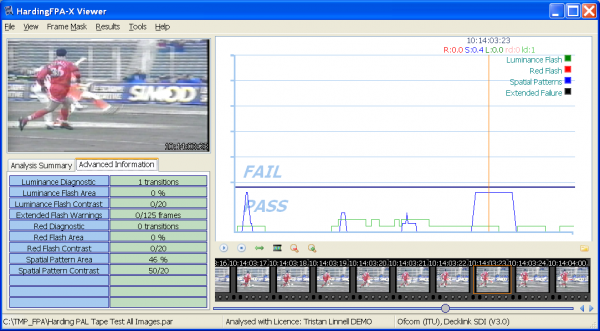
That pass/fail character matters. A warning label after publication asks the viewer to manage the risk. A production-side test changes who carries the burden. Editors, QC vendors, distributors, and platform operators can catch a failed sequence while it is still fixable: dim it, slow it, alter the color transition, reduce the affected area, or hold the content until it passes the relevant guideline.
HardingFPA’s analysis engine has also been licensed into commercial quality-control platforms, including Telestream Aurora, Interra Baton, and Venera Pulsar.[4] That is one marker of maturity in this field. A safety method is not fully operational just because a paper describes it or a demo detects flashes on sample clips. It becomes operational when it sits inside the tools that production teams already use to approve, reject, transcode, localize, and deliver video.
| Environment | Typical safety action | What the tool can credibly claim |
|---|---|---|
| Broadcast or professional streaming production | Test before delivery or release against a defined PSE guideline | Detect guideline violations and support compliance decisions |
| User-generated social video | Screen uploads or feeds and warn, suppress, or skip flagged content | Reduce exposure to detected flashing patterns, depending on platform design |
| Open-source or developer tools | Identify likely flashing risks during editing, testing, or accessibility review | Help flag hazards, but not necessarily certify international compliance |
What These Systems Actually Look For
Automated PSE detection starts with video, not with a patient. The system analyzes changes across frames: brightness shifts, color alternations, contrast, frequency, area of the screen affected, and patterns likely to fall within guideline thresholds. In practical terms, it is asking whether the visual signal crosses a known danger boundary, not whether a specific viewer will have a seizure.
That distinction is easy to lose in casual language about “AI epilepsy warnings.” A detection tool can say that a sequence appears to violate Ofcom, ITU, NAB-J, ISO, or another implemented standard. It can flag the timecode and give production staff something to repair. It cannot prove that no viewer will be affected, and current materials do not establish clinical-outcome evidence showing that automated screening has reduced seizure incidence in real audiences.
This is still meaningful safety infrastructure. Many hospital and public-health systems run on this kind of evidence tier: validated detection of a known hazard, embedded into workflow, with a conservative threshold and an auditable action. The limitation is not a reason to dismiss the tools. It is a reason to keep the claim precise.
Netflix Shows the Professional Pipeline Version
In a professional production pipeline, PSE testing can be made mandatory rather than optional. Netflix requires photosensitive epilepsy testing for all original animated and anime productions, using approved tools and thresholds aligned with ITU BT.1702 specifications.[6] That requirement is narrow in a useful way: it applies to content categories where rapid flashes, stylized effects, energy bursts, and high-contrast motion are common enough to justify a formal gate.
The workflow implication is more important than the brand name. A studio does not merely attach a generic warning at the end of postproduction. It has to submit material that can pass testing under specified thresholds. If the content fails, the sequence becomes a production problem, not a viewer’s problem. Someone must revise it, retest it, and document that it meets the requirement.
That is the quiet virtue of standards-based testing. It converts a neurological safety concern into something media teams can schedule, budget, assign, and verify. No one should confuse that with comprehensive medical protection. But as a control point before release, it is far stronger than relying on viewers to recognize a risky pattern in the first second or two and avert their eyes in time.
TikTok Moves the Problem Into Real-Time Feeds
User-generated platforms are harder. A broadcaster can test a finished episode before transmission. A short-video platform receives a continuous stream of uploads from people who are not trained in accessibility, do not know PSE thresholds, and may not even realize that a filter, edit, or game clip could be hazardous.
TikTok’s 2020 photosensitivity feature is therefore an important workflow shift. The company said it would automatically screen user-uploaded content for effects that could trigger photosensitive epilepsy, show warnings, and offer a “Skip All” option so users could bypass flagged videos entirely. TikTok said it consulted the Epilepsy Foundation and Epilepsy Society in developing the feature.[7]
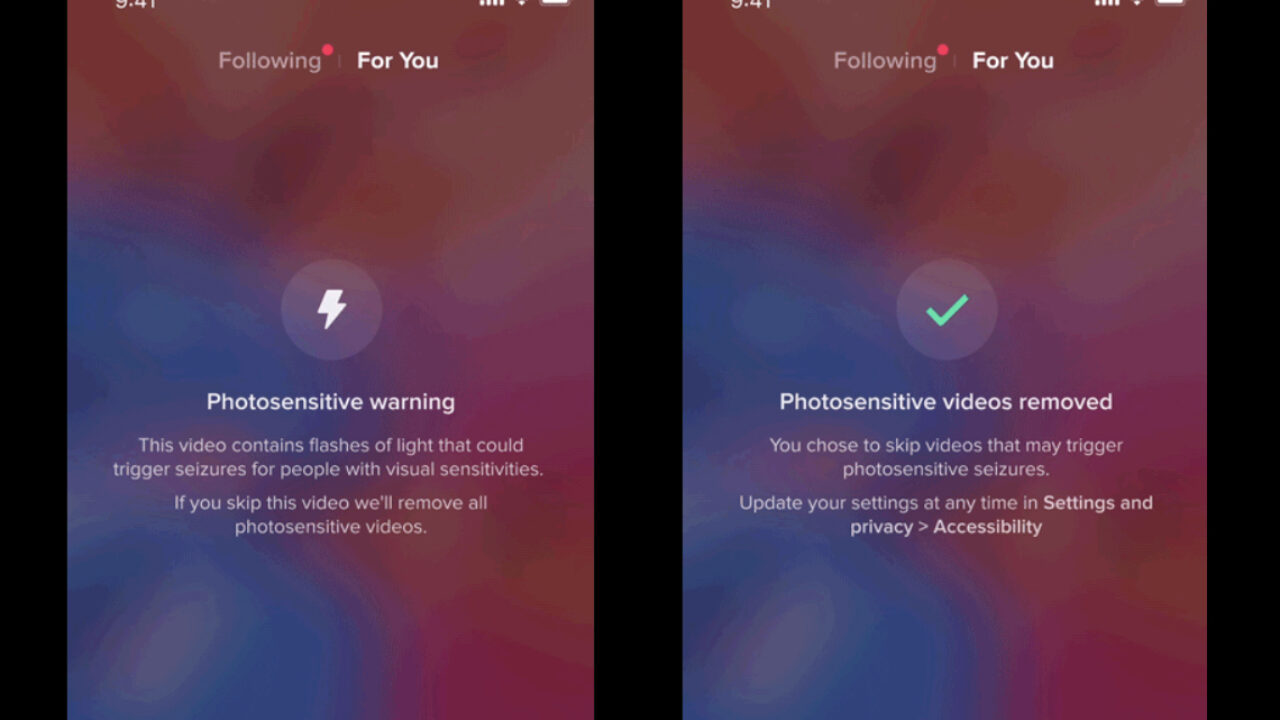
That model is not the same as certifying a movie or episode before release. It is mitigation inside a live recommendation environment. The safety action may be a warning, a skipped video, or a feed-level preference rather than a formal compliance pass. For user-generated content, that may be the only scalable option, but it also changes what can be claimed. The system is reducing exposure to detected risks; it is not proving that the entire platform is PSE-safe.
The user-facing design also matters. A one-time warning still asks a photosensitive user to make repeated decisions in a fast feed. A “Skip All” setting is more protective because it removes some of that moment-by-moment burden. In accessibility terms, that is not a cosmetic distinction. It changes the default from “notice and avoid” to “do not show me this class of risk.”
Open Tools Broaden Access, With Caveats
The tool landscape is broader than broadcast QC. Apple released VideoFlashingReduction as an open-source tool in 2023. Electronic Arts released IRIS as an open-source tool in 2023. FFmpeg includes a photosensitivity filter. These are useful signs that PSE detection is not confined to one vendor or one media sector, but available summaries of the Harding test note that these tools do not strictly follow international PSE standards.[5]
That caveat should not be read as a dismissal. Open tools can help game studios, app teams, research groups, independent filmmakers, and accessibility reviewers find flashing risks earlier than they otherwise would. They can fit into development environments where a full broadcast compliance platform would be unrealistic. The problem comes when “detects flashing” is treated as equivalent to “passes Ofcom, ITU, NAB-J, or ISO-aligned PSE compliance.” Those are different claims.
PEAT, the Photosensitive Epilepsy Analysis Tool associated with TRACE RERC at the University of Maryland, is another example of a tool meant to help evaluate web and computer-based content for seizure risk.[8] Its presence matters because PSE hazards do not respect the old boundaries between television, film, games, web animation, and social feeds. The safety question follows the flashing pattern, not the distribution channel.
Regulation Still Does Not Cover the Whole Screen
The regulatory map is uneven. The United Kingdom and Japan have enforceable broadcast standards, while the United States has no federal regulation requiring PSE testing for television or film. Ofcom recorded 30 broadcast violations of PSE guidelines from 2005 through 2021.[5] That number does not show how often risky content reaches viewers in every environment; it shows that violations still occur even in a jurisdiction with an established standard.
The UK has also moved beyond accidental exposure in one specific context. The Online Safety Act 2023 includes Zach’s Law, Section 183, making it a criminal offense to deliberately send flashing images intended to cause harm, with penalties of up to five years’ imprisonment.[9] That law addresses malicious targeting rather than ordinary production QC, but it reflects the same underlying recognition: flashing-image exposure can be weaponized, not merely disliked.
For U.S. film and television, the absence of a federal mandate leaves PSE testing dependent on platform policy, distributor requirements, internal standards, and vendor practice. A studio delivering to a platform with strict requirements may test. Another piece of content in another channel may not face the same gate. From a safety-infrastructure perspective, that patchwork is the weak point.
HDR, VR, and the Standards Gap
The next problem is not simply more content. It is different content geometry. High dynamic range video changes brightness behavior. VR and AR change field of view, immersion, and the amount of the visual field that can be occupied by a flashing stimulus. A 2024 gap analysis by Gregg Vanderheiden and colleagues warned that VR headsets with fields of view of 90 degrees or more could create a 100% estimated response rate among people with photosensitive epilepsy if 25% of the screen flashes, while noting that no specific PSE standards exist for VR or AR content.[10]
The same analysis identified gaps that sound technical until they appear in a real edit bay: current guidelines do not account for flash transition duration, for which the authors proposed a working value of 66 milliseconds, or for synchronicity of flashing areas across frames, for which they proposed a 20 millisecond window.[10] These are not decorative parameters. They describe how quickly a flash reaches full intensity and whether separate flashing regions combine into a larger synchronized hazard.
That is where standards often lag behind media formats. A rule designed around broadcast video can be valuable and still incomplete for HDR displays, immersive headsets, game engines, short-form feeds, and mixed-reality overlays. Automated detection can only enforce the hazard model it has been given. When the viewing environment changes, the model needs to be revisited rather than treated as settled.
What a Mature Claim Should Sound Like
The credible claim for automated PSE systems is strong but bounded. They are mature enough to be part of media safety infrastructure. They can analyze video at scale, implement recognized guidelines, produce timecoded failures, support pre-release remediation, and reduce reliance on slow manual inspection. In professional workflows, they can stop a hazardous sequence before it ships.
The unsupported claim would be that AI has solved photosensitive seizure risk in movies, television, social media, games, and immersive environments. The evidence base described here is primarily technical and compliance-oriented. It supports detection of guideline-defined flashing hazards. It does not yet support broad clinical claims about reduced seizure incidence across viewer populations.
That boundary is not a failure. It is the normal shape of a safety control that has moved from scandal response to routine infrastructure. The work now is to keep the infrastructure honest: specify which guideline is being applied, test where testing can prevent release, design platform controls that do more than warn after exposure, and update standards for the displays and formats where flashing hazards now occur.
References
- Photosensitive epilepsy, Wikipedia.
- Photosensitive epilepsy, Epilepsy Society.
- Dennō Senshi Porygon, Wikipedia.
- Photosensitive Epilepsy Testing, Venera Technologies.
- Harding test, Wikipedia.
- Photosensitive Epilepsy Testing, Netflix Partner Help Center.
- TikTok adds a photosensitivity feature to help users skip videos with flashing lights, TechCrunch, November 19, 2020.
- Photosensitive Epilepsy Analysis Tool (PEAT), TRACE RERC, University of Maryland.
- Online Safety Act 2023, UK legislation, 2023.
- International Guidelines for Photosensitive Epilepsy: Gap Analysis and Recommendations, PMC, 2024.
Comments
Join the discussion with an anonymous comment.