
The cautious answer is no: AI tools for extreme heat health safety are not ready to be relied on as routine emergency department decision-support systems. The more useful answer is that the evidence is now strong enough to take seriously. Three retrospective ED studies from Japan, Taiwan, and China have reported machine learning models that predict death or severe heatstroke with performance good enough to justify prospective trials, governance planning, and controlled pilots. What they have not shown is the harder thing: that a model can run in real time, fit into ED work, change escalation decisions, and improve outcomes without adding unsafe noise.
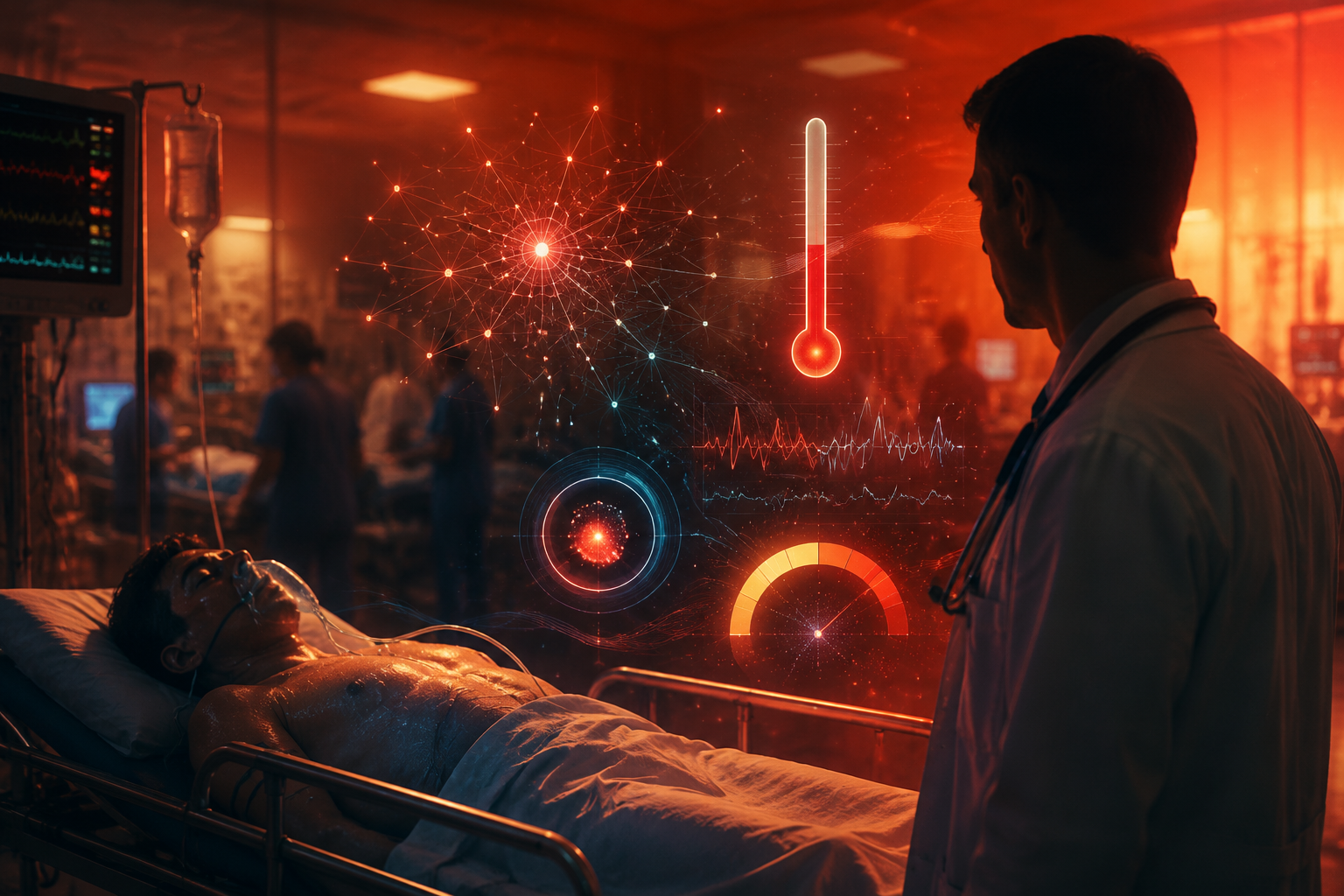
That distinction matters because heat-related illness does not always arrive as a clean textbook presentation. The profoundly altered, hypotensive, hyperthermic patient usually declares risk early. The harder operational question is the middle: the patient who looks concerning but not yet catastrophic, the lab work still pending, the department crowded, the decision about ICU consultation or observation not obvious. A model that only rediscovers what every clinician already sees may still publish an impressive AUROC. A model that improves discrimination in that middle zone would be much more valuable.
The retrospective signal is real, but uneven
The strongest evidence starts with Hirano and colleagues’ Japanese registry study, which trained an XGBoost mortality prediction model in 2,393 patients with heat-related illness. The model reached an AUROC of 0.926, but the more clinically interesting result was its area under the precision-recall curve: 0.528, compared with 0.287 for APACHE-II.[1]
That AUPR comparison deserves attention because mortality prediction is often an imbalanced problem. When deaths are relatively uncommon, AUROC can look reassuring while the model still produces too many false alarms at the point where a clinician has to act. Precision-recall performance asks a more awkward question: among the patients the model flags, how many are truly high risk? Hirano’s result does not prove bedside utility, but it does suggest the model may be doing more than dressing up a conventional severity score.
Kuo and colleagues’ Taiwan ED study is even more striking on paper. Using a LightGBM model with 11 features in 820 patients, the authors reported an AUC of 0.991, sensitivity of 1.000, and specificity of 0.975 for mortality prediction. SpO2 and Glasgow Coma Scale score were the strongest predictors.[2]
A sensitivity of 100% is the sort of number that should make an ED reader pause twice: once because missing a patient who will die is the failure everyone fears, and again because perfect sensitivity in a retrospective single-country dataset is fragile until repeated elsewhere. The result is notable. It is not yet a procurement argument.
Zeng and colleagues add a different kind of evidence. Their multi-center Chinese study included 691 patients across 24 hospitals and reported an AUROC of 0.836 for a gradient boosting model. The performance is less spectacular than Kuo’s, but the interpretability work is clinically useful: SHAP analysis identified CK-MB, thrombin time, and lactate as top predictors.[3]
That lab-centered signal changes the feel of the model. GCS and oxygen saturation are immediate bedside cues; CK-MB, thrombin time, and lactate bring the model closer to the downstream physiology of heatstroke severity. They also imply a workflow question. If the model depends on labs, it may be most useful after the first evaluation but before disposition is settled, rather than at triage alone.
| Study | Setting and sample | Model | Reported performance | What matters clinically |
|---|---|---|---|---|
| Hirano et al. | Japan registry; n=2,393 | XGBoost | AUROC 0.926; AUPR 0.528 vs APACHE-II AUPR 0.287 | The AUPR advantage is important for rare-event mortality prediction. |
| Kuo et al. | Taiwan ED; n=820 | LightGBM | AUC 0.991; sensitivity 1.000; specificity 0.975 | The result is impressive but needs external and prospective testing. |
| Zeng et al. | China multi-center study; n=691 across 24 hospitals | GBM with SHAP interpretability | AUROC 0.836 | Lab predictors may support escalation decisions after initial workup. |
What these models appear to add beyond bedside severity cues
The encouraging pattern is that three independent teams, using different boosting approaches and different East Asian ED cohorts, all found that machine learning could discriminate mortality or severe disease in heat-related illness. The models are not random signal chasers. Their important variables line up with clinical intuition: mental status, oxygenation, and markers of physiologic injury.
That same alignment narrows the claim. GCS emerging as a dominant predictor is reassuring because altered mental status is central to severe heat illness. It also raises the possibility that part of the model’s apparent value comes from a variable clinicians already weigh heavily. For an obtunded patient with shock physiology, the model may confirm urgency rather than change it.
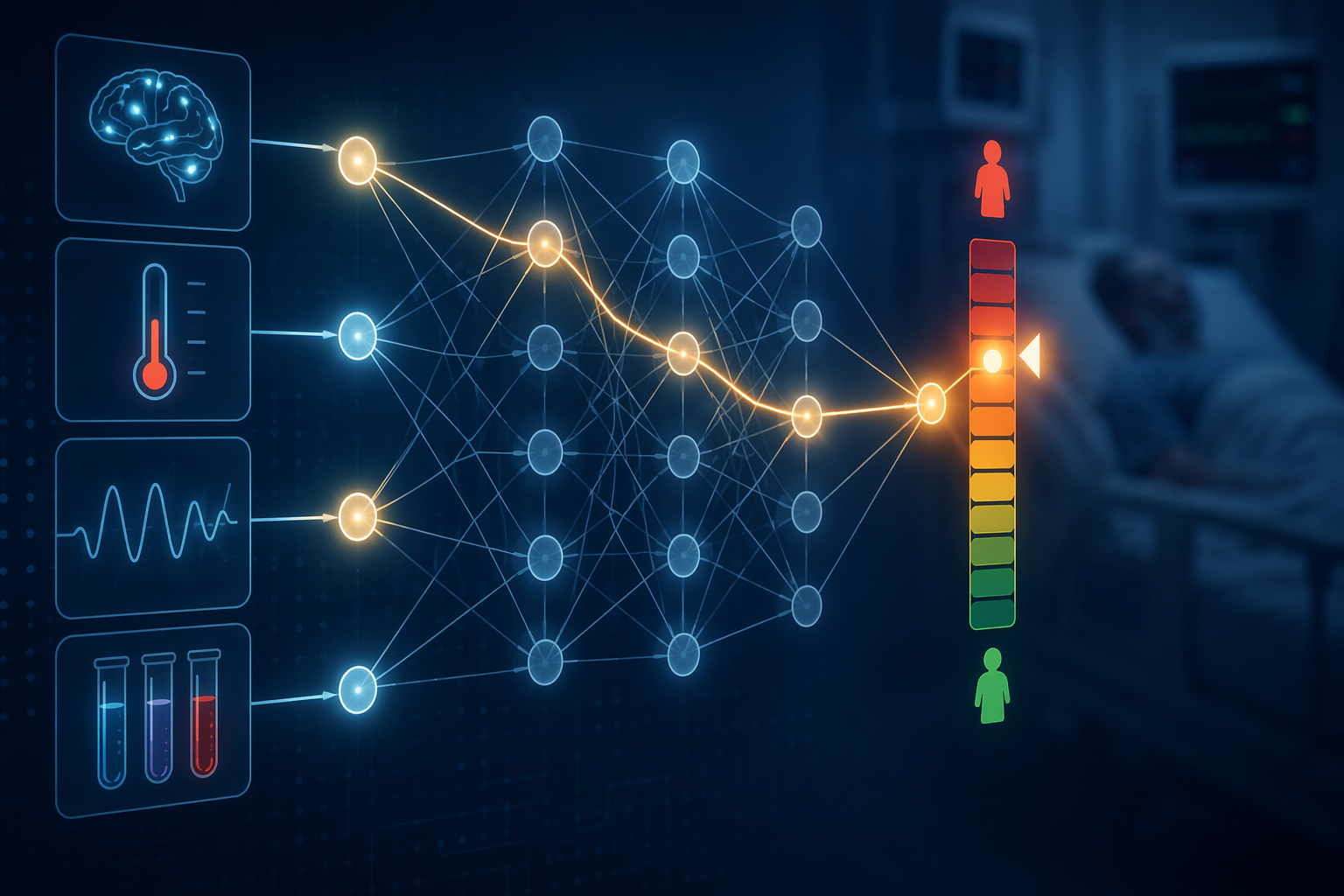
The likely value-add is more specific: patients whose risk is not yet obvious, patients whose early vitals and mental status sit in an ambiguous band, and patients whose lab trajectory suggests organ injury before the disposition decision has hardened. That is where an ED decision-support tool could earn its screen space. It would need to help the clinician decide who needs more aggressive monitoring, earlier critical care involvement, or less confidence in a seemingly stable presentation.
The studies do not yet prove that use case. They report discrimination, not changed decisions. A model can correctly rank patients by retrospective mortality risk and still fail as an alert if it fires too late, depends on unavailable inputs, overwhelms clinicians during heat surges, or creates false reassurance below a threshold.
Why AUROC is not enough for a 2 a.m. ED alert
AUROC is useful for comparing how well a model separates higher-risk from lower-risk patients across thresholds. It is not the same as knowing what happens when the model is turned into a real ED alert. At the bedside, someone must choose a threshold. That choice determines how many alerts appear, how many high-risk patients are captured, how many lower-risk patients are escalated unnecessarily, and how much burden lands on nurses, physicians, and bed managers.
Hirano’s AUPR result is valuable because it speaks more directly to the rare-event problem than AUROC alone. If mortality is uncommon, the precision of a high-risk flag matters operationally. An ED cannot treat every alert as an ICU-level emergency if most alerts are false positives, especially during a regional heat event when patient volume is already stressed.
Kuo’s reported sensitivity and specificity, meanwhile, pose the opposite interpretive challenge. A model that catches every death in the retrospective sample while maintaining very high specificity would be clinically compelling if reproduced prospectively. But before that, the appropriate reaction is scrutiny: how many deaths were in the dataset, how stable is the threshold, how well does the model travel to another hospital, and does it keep performance when data are missing or delayed?
Zeng’s lower AUROC should not be dismissed automatically. A multi-center model with interpretable lab predictors may be closer to implementation planning than a higher-scoring model whose performance depends on a narrower validation environment. For ED use, the best retrospective leaderboard is less important than calibrated, explainable, transportable performance at the moment a decision is actually being made.
The readiness gap is still large

No machine learning model for heat-related illness in this evidence base has been prospectively validated in real-time ED deployment. None has been shown to reduce mortality, shorten time to ICU admission, improve escalation decisions, or safely decrease unnecessary admissions. None has FDA 510(k) clearance, CE marking, or equivalent regulatory status for this specific clinical use.
That leaves the field in a pre-commercial research phase. The missing work is not administrative polish; it is the work that determines whether the model is medicine or merely retrospective analytics.
- Prospective validation: the model must run on current ED patients, with real missingness, real delays, and predefined thresholds.
- Workflow testing: the alert must appear at a time when it can change monitoring, consultation, cooling intensity, or disposition.
- Clinical impact evaluation: studies must measure whether the tool changes clinician actions and patient outcomes, not only whether it predicts risk.
- Governance and safety monitoring: hospitals need ownership of threshold selection, alert review, drift monitoring, and false-positive consequences.
- Regulatory pathway: any productized use would need the appropriate clearance or authorization for clinical decision support.
The governance burden is not theoretical. If a heat illness model flags a patient as high risk, someone must decide whether that means more frequent vitals, immediate labs, ICU consultation, active cooling escalation, or admission. If it does not flag the patient, the clinician still owns the decision. A useful model should make that ownership better informed, not blur it.
Generalizability is the largest unanswered clinical question
All three models were developed and tested in East Asian populations: Japan, Taiwan, and China.[1][2][3] That is not a flaw in the studies. It is a boundary around what they can support. Their performance in Western, African, Middle Eastern, or other health systems remains unvalidated.
Transportability matters because heat-related illness is shaped by more than core temperature and a diagnosis label. Case mix, occupational exposure, baseline comorbidity, age distribution, cooling protocols, ambulance pathways, lab timing, ICU capacity, and coding practices can all affect the data a model sees and the decision it is supposed to support. Even when the biology is shared, the operational environment may not be.
A hospital evaluating these models should therefore avoid the simplest interpretation: that an AUROC from one country transfers directly into its own ED. The first question is not whether the model is impressive. It is whether the model has been tested in patients who resemble the hospital’s patients, using inputs available on the hospital’s timeline, under thresholds the hospital can defend.
What a controlled pilot would need to prove
The next credible step is not broad deployment. It is a controlled pilot or prospective trial designed around ED decisions rather than model performance claims. The model should be silent at first, running in the background to test calibration, missing data behavior, and subgroup performance. Only after that should a site consider clinician-facing alerts.
The pilot should define the action attached to risk. A high-risk prediction without an agreed response becomes an anxiety generator. A better design specifies what the alert asks the team to consider: earlier senior review, repeat lactate, critical care discussion, intensified cooling, closer observation, or reassessment before discharge. Those actions must be auditable.
It should also watch for harm. False positives may consume scarce ICU attention or prolong ED stays. False negatives may create misplaced reassurance. Alert fatigue may make clinicians ignore the signal precisely during a heat surge. Calibration drift may appear when a new season, new population, or new lab process changes the data distribution.
For administrators, the procurement question should stay downstream of this evidence. A vendor demo built around retrospective discrimination is not enough. The decision to buy or build should wait for prospective performance, local validation, regulatory clarity, and a clear clinical workflow in which the model’s output changes something specific.
A practical standard for ED use
The current evidence supports cautious optimism. Hirano’s AUPR advantage over APACHE-II suggests meaningful discrimination in an imbalanced mortality task.[1] Kuo’s LightGBM results are unusually strong and deserve replication rather than dismissal.[2] Zeng’s interpretable lab predictors point toward a model that could fit a real clinical reasoning pathway.[3]
But an ED should not rely on these models yet for routine care. The standard should be higher than retrospective accuracy. A heat-related illness model should prove that it performs across populations, works with real-time data, fits the pace of emergency care, survives regulatory and governance review, and helps clinicians make better escalation decisions without pretending to replace bedside judgment.
References
- Machine learning-based mortality prediction model for heat-related illness, Scientific Reports, 2021
- Utilizing machine learning for predicting mortality in patients with heat-related illness who visited the emergency department, International Journal of Medical Informatics, 2025
- Enhancing heatstroke prediction accuracy with interpretable machine learning: a multi-center data-driven approach, PMC, 2025
Comments
Join the discussion with an anonymous comment.