
The most convincing example of AI tools for homeless health services and legal issues does not start with a diagnostic model or a hospital chatbot. It starts with a legal aid clinic in Tennessee using ChatGPT to help prepare expungement petitions. In one one-day clinic, the Legal Aid Society of Middle Tennessee reported 324 charges expunged for 98 people.[1] For someone trying to get approved for housing, hired for a job, or stabilized after a medical crisis, that kind of legal work can change what care planning even has a chance to accomplish.
That is the practical bridge between the health and legal halves of the search phrase. Current AI deployments are not, in any mature sense, solving homelessness, delivering medical care, and representing clients in court through one integrated system. The stronger claim is narrower: AI is beginning to expand the capacity of legal aid organizations and medical-legal partnerships to address legal determinants of health, especially criminal record barriers, housing instability, benefits access, and legal information triage.

The urgency is not theoretical. Among homeless Californians, nearly a quarter reported unmet medical care needs, only 39% had a primary care provider, and half rated their health as poor or fair, a share described as four times higher than in the general U.S. population.[2] Those numbers do not prove that legal services alone improve health. They do show why a missed legal appointment, an unresolved benefits problem, or a housing denial can land inside the health system as worsening illness, avoidable emergency care, or a discharge plan with nowhere to go.
Where AI Is Actually Entering the Work
The useful distinction is between AI as a public-facing substitute for professional help and AI as a capacity layer inside an accountable service model. The first framing is risky, especially for people who may not know whether an eviction notice, benefits cutoff, or criminal record question requires immediate legal action. The second framing is where the more credible work is appearing: legal aid staff use AI to reduce repetitive drafting, triage, and information-delivery burdens, while trained people and institutions remain responsible for the service.
| AI-supported task | What changes operationally | Why it matters for homeless or unstably housed people |
|---|---|---|
| Expungement petition drafting | Staff can prepare more record-clearance documents in a clinic setting | A criminal record can block housing, employment, and income stability |
| Legal information triage | A virtual assistant can respond outside office hours and direct people toward issue-specific resources | Legal aid calendars and intake lines often cannot absorb the full volume of need |
| Housing resource navigation | Users can reach housing-related information without waiting for a live intake slot | The timing of a housing crisis rarely matches clinic hours |
| Benefits-related guidance | Organizations can explain common pathways and next steps at scale | Public benefits often affect access to care, medication, food, and shelter options |
This is also where the word "access" needs to be handled carefully. A tool has not created legal access just because it answered a question. It has helped only if the person receives information they can understand, in time to use it, with a path to human review when the stakes require more than general guidance.
The Tennessee Expungement Example Shows the Capacity Case
Expungement work is a good test case because it is concrete. Eligibility has to be checked. Petitions have to be drafted. Court processes have to be followed. The outcome is not an inspirational dashboard; it is a filed legal action that may remove a barrier from a person's housing or employment record.
In the Tennessee clinic described by Thomson Reuters, the Legal Aid Society of Middle Tennessee used a ChatGPT-based system to support expungement petition preparation, contributing to 324 charges expunged for 98 people in a single day.[1] That volume matters because expungement clinics are usually constrained by staff time, document preparation, and the number of people who can be screened and served before the day ends.
The reported result should not be stretched beyond what it shows. It does not establish, by itself, that the AI-generated documents were more accurate than attorney-drafted documents, that clients later obtained housing, or that health outcomes improved. It does show that a repetitive legal task can be accelerated in a way that produces completed legal work for a group of people whose records may be part of a larger instability cycle.
There is also a source caveat worth keeping in view. Thomson Reuters has a commercial interest in legal AI adoption, so its case study should not be treated like an independent clinical trial. Still, the figures are attributable to specific legal aid deployments, and they are useful for understanding what legal services organizations are already attempting.[1]
Legal Information at Scale Is Helpful, but It Is Not Representation
Legal Aid of North Carolina's AI Legal Information Assistant, known as LIA, shows a different kind of scale. The organization reported more than 400,000 annual requests and more than 95,000 housing resource views over five months.[1] Those numbers are far beyond what a typical walk-in clinic, hospital-based legal desk, or hotline could personally answer one by one.
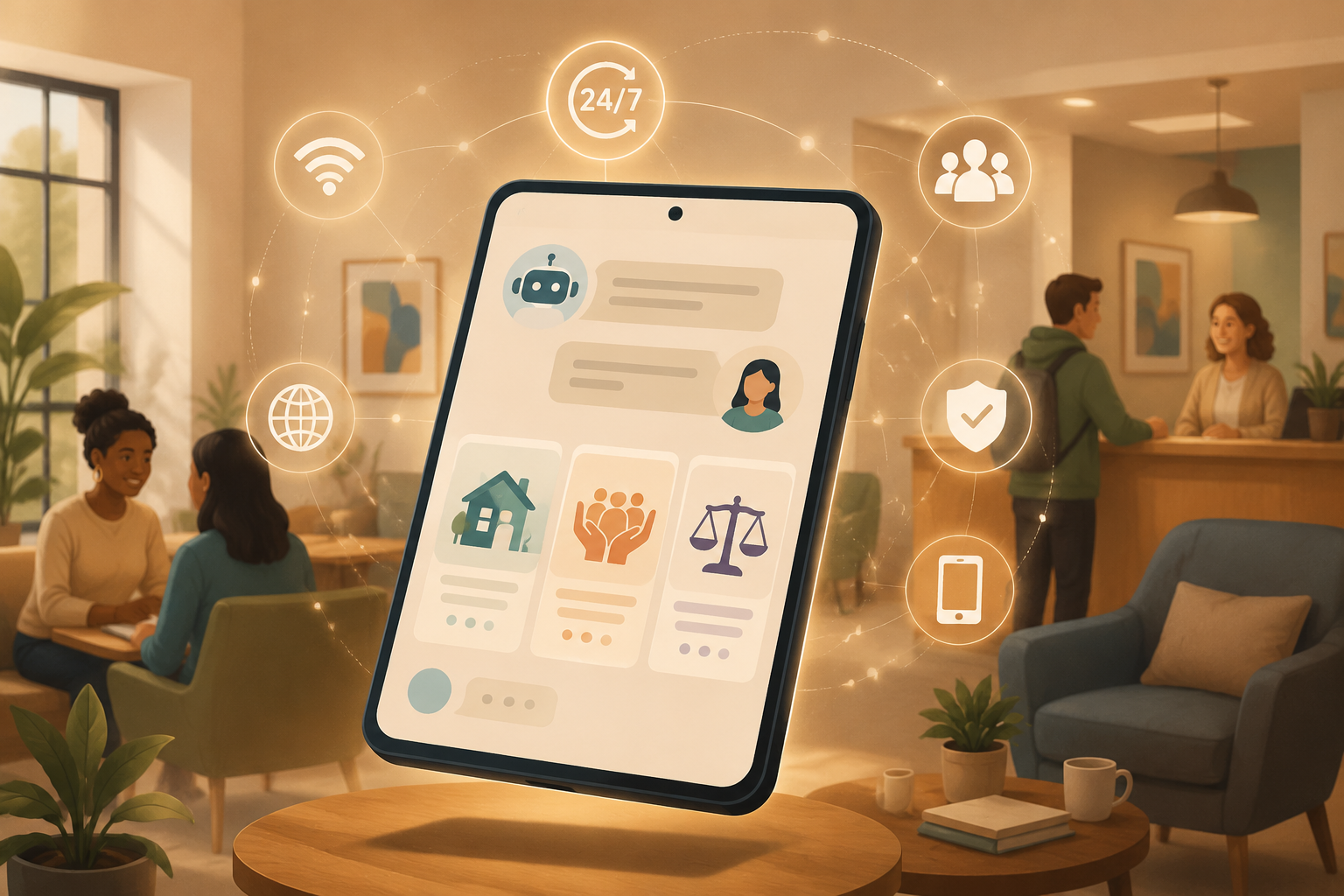
For unstably housed users, the value of a 24/7 legal information assistant is easy to see. A shelter intake worker may not know the answer to a benefits question. A clinic social worker may identify an eviction risk after legal aid intake has closed. A patient may need to understand what documents to gather before anyone can open a file. A well-designed assistant can reduce the dead space between recognizing a legal problem and taking the next practical step.
But information access and legal representation are different services. A chatbot can help someone sort an issue, find resources, or prepare for intake. It should not be described as a lawyer, a case strategy, or a safe substitute for review when a deadline, court filing, protective order, eviction, immigration issue, or benefits termination is involved. The more vulnerable the user, the less acceptable it is to blur that line.
The implementation question is therefore not simply whether the assistant is available. It is whether the assistant knows when to stop, where it sends people next, how it handles emergency or high-stakes issues, and whether the organization monitors the answers it gives. In a healthcare-adjacent setting, that handoff matters as much as the software.
Why Medical-Legal Partnerships Are the Right Delivery Frame
Medical-legal partnerships give AI-supported legal aid a plausible home in health services because they already treat legal needs as part of patient care. The model connects healthcare teams with legal professionals who can address problems such as unsafe housing, denied benefits, family instability, debt, and other civil legal issues that can worsen illness or block care plans.
The case for this bridge is stronger when it comes from outcomes work rather than general language about social determinants. The National Center for Medical-Legal Partnership reports that homeless veterans who received more MLP services showed greater improvements in housing stability and mental health.[3] That does not mean an AI tool caused those improvements. It means legal services delivered through a health-connected framework can be associated with changes in outcomes that healthcare systems already care about.
AI belongs in that framework only if it helps the partnership carry more of the legal workload without weakening accountability. In a clinic, the relevant question is rarely, "Can the model answer a legal question?" It is closer to, "Can this help the legal partner screen more patients, prepare more documents, update more referrals, or keep more people from falling out of the process before a lawyer or advocate can act?"
That distinction keeps the technology in its proper place. The bridge between health services and legal issues is institutional, not technological. Health systems, legal aid organizations, community clinics, shelters, and advocacy teams provide the trust, intake pathways, professional boundaries, and escalation routes. AI can make parts of that work faster. It cannot create the partnership by itself.
What an Accountable Workflow Looks Like
A cautious workflow starts before the AI tool ever reaches a client. The organization has to choose a narrow use case, define what the tool is allowed to do, and assign responsibility for review. Expungement drafting, plain-language legal information, referral routing, and document checklists are more defensible starting points than open-ended legal advice.
- Screen the legal issue first: identify whether the need is criminal record clearance, housing, benefits, debt, family safety, or another civil legal matter.
- Match the issue to the permitted AI use: drafting support, triage, resource navigation, or preparation for human intake.
- Require human review where the output affects a filing, deadline, eligibility determination, or legal strategy.
- Document the handoff: make clear who reviews, who follows up, and what the client is expected to do next.
- Track failures as service failures, not just software errors: wrong referrals, confusing instructions, missed escalation, or abandoned intakes all matter.
This may sound less exciting than a fully automated legal assistant, but it is closer to how high-need services actually work. People rarely arrive with one clean problem. A person seeking help with housing may also need identification documents, benefits reinstatement, medical records, transportation, child support information, or record clearance. A tool that handles one task well can still be useful, as long as the service model does not pretend that one task is the whole case.
The Digital Access Problem Cannot Be Treated as a Footnote
The people most likely to need legal help around housing, benefits, and medical stability may also be the least able to use a digital-first tool. Unstable phone access, limited data plans, lost documents, public Wi-Fi dependence, low digital literacy, disability, language barriers, and distrust of institutions can all keep an AI assistant from reaching the person it was meant to help.
That does not make digital legal tools useless. It does mean they should be placed where people already seek help: community health centers, street medicine teams, shelters, libraries, courthouse help desks, benefits enrollment sites, and medical-legal partnership clinics. A patient advocate or intake worker sitting beside someone with a shared screen can turn a digital tool into assisted access. A link printed on a discharge form may do very little.
Design choices matter here. The tool should work on low-bandwidth connections, avoid unnecessary account creation, provide plain-language next steps, support language access where the organization can responsibly maintain it, and make it clear when a person needs direct legal help. If the only pathway assumes a private smartphone, stable internet, and enough confidence to navigate legal language alone, it will miss many of the people whose health is most affected by legal instability.
Document Accuracy Is the Other Hard Stop
Legal document generation is attractive because it attacks a real bottleneck. It is also where error tolerance should be low. A wrong name, wrong statute, missing charge, incorrect eligibility assumption, or misfiled form can cost a client time, money, housing opportunity, or confidence in the only legal help they managed to reach.
The available public examples show promising deployment, not a settled evidence base on accuracy. The expungement case demonstrates throughput, but the public record does not yet show formal peer-reviewed studies validating AI-generated expungement documents for this use case. That gap should shape implementation. The safer posture is supervised drafting, not autonomous legal production.
For health systems considering these partnerships, procurement should include more than privacy and cybersecurity review. Administrators should ask how the legal partner audits outputs, how often staff override or correct the tool, what happens when the tool is uncertain, and whether clients are told what is legal information, what is legal advice, and who is responsible for the final work product.
What Health Systems Should Take From the Early Evidence
For healthcare organizations, the lesson is not to build a general-purpose AI tool for homelessness. The more realistic path is to strengthen legal determinant interventions that already fit within patient care. If a clinic routinely sees patients whose asthma is worsened by unsafe housing, whose medication access depends on benefits, or whose discharge plan collapses because of unresolved legal barriers, then an MLP can define which legal workflows deserve added capacity.
The Tennessee and North Carolina examples show where that added capacity may appear first: high-volume document preparation and high-volume legal information routing.[1] The VA MLP evidence explains why those legal workflows belong in a healthcare conversation at all: more MLP services for homeless veterans were linked with greater improvements in housing stability and mental health.[3] Put together, the evidence supports cautious integration, not technological substitution.
A clinic-based version of this work might look modest. A clinician screens for housing instability. A social worker identifies a possible legal issue. A legal aid partner uses an AI-assisted intake or drafting tool to move the case faster. A lawyer or trained advocate reviews the output. The patient leaves with a petition, referral, document checklist, or scheduled next step rather than another phone number and a hope that someone calls back.
That is a meaningful clinical application, even if it does not resemble a traditional medical AI product. The intervention is legal, the delivery setting is healthcare-adjacent, and the intended health value comes through housing stability, income access, reduced stress, and fewer unresolved barriers sitting between the patient and care.
A Narrower, More Useful Definition of the Tool
The phrase "AI tools for homeless health services and legal issues" can make the field sound more unified than it is in Q3 2026. The better description is AI-supported legal aid for health-harming legal needs, delivered through medical-legal partnerships and related community service models. That wording is less tidy, but it is more honest.
The current evidence supports targeted use: expungement drafting that helps clinics process more eligible petitions, legal information assistants that absorb large volumes of housing and benefits questions, and MLP workflows that connect legal help to measurable health-adjacent outcomes. It does not yet support a claim that AI can independently provide legal representation, solve digital exclusion, or deliver integrated medical and legal care through one tool.
AI-enhanced legal aid can scale services that matter for housing stability and health when it is embedded in accountable MLPs, checked for document accuracy, and designed around the access constraints of people living without stable housing. Without those conditions, the tool may still look busy on a dashboard while the person who needed help remains outside the door.
References
- AI for legal aid: Empowering clients, Thomson Reuters
- Akido street medicine AI, CalMatters
- Homelessness and Health, National Center for Medical-Legal Partnership
Comments
Join the discussion with an anonymous comment.