AI can already support traumatic injury recovery and critical care in a narrow but meaningful way: as a risk signal that helps clinicians notice deterioration earlier, prioritize scarce attention, and challenge an initial impression. It cannot yet be trusted to autonomously triage a trauma patient, redirect transport, activate massive transfusion, or determine ICU treatment. The distinction matters because the strongest trauma AI studies now report impressive discrimination, including AUROCs in the 0.82–0.94 range, but none of the cited models has shown in a published implementation trial that its use improves mortality, morbidity, or clinician action at the bedside.
The useful question is no longer whether an algorithm can find statistical patterns in trauma data. Several can. The harder question is where the model sits in the chain of care: in an ambulance with missing vital signs, in an emergency department where hemorrhage is still unfolding, or in an ICU where sepsis risk evolves across hours. A prediction that arrives too late, too vaguely, or without a responsible handoff is not real-time care. It is a score looking for an owner.
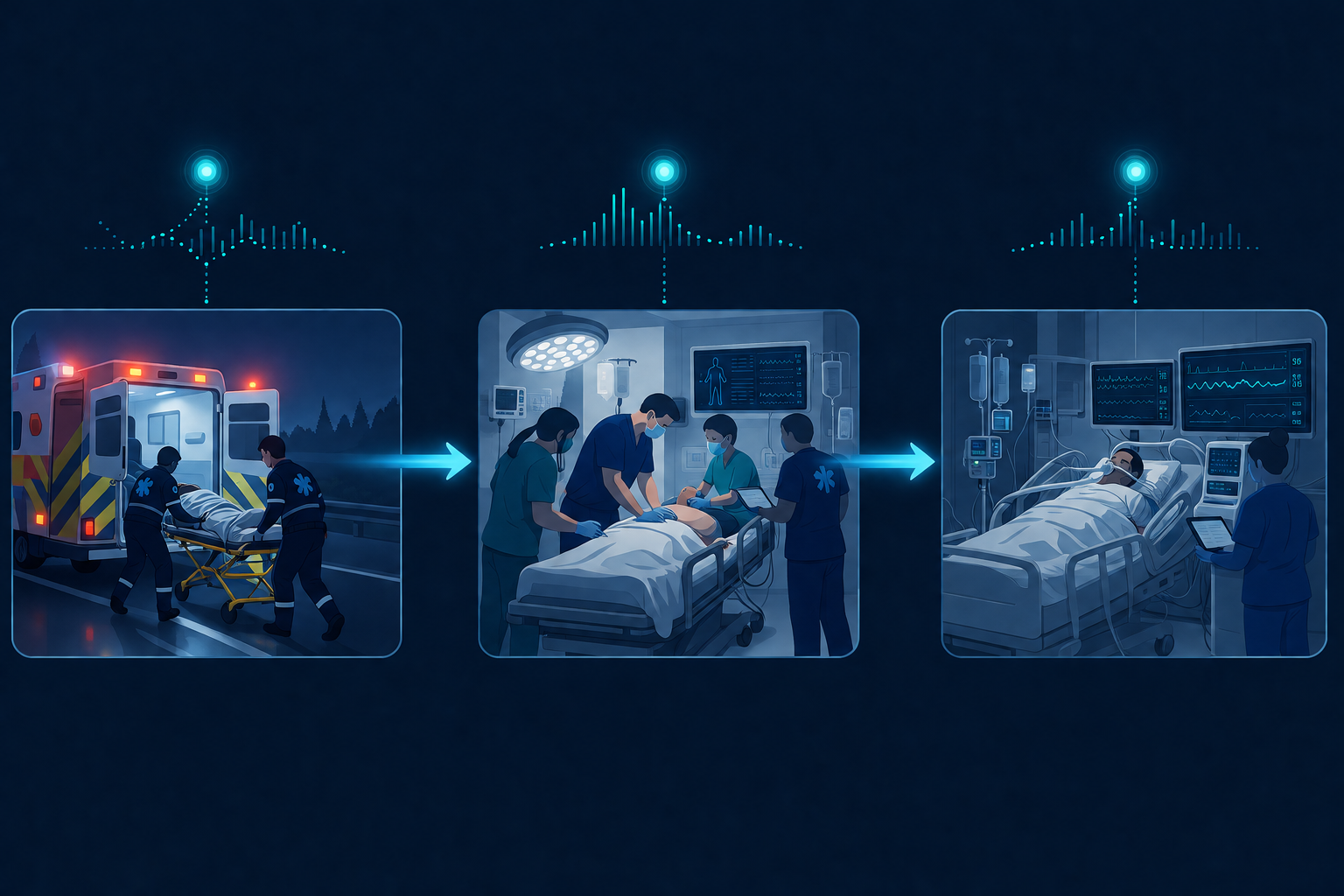
The strongest current evidence starts before the hospital
The most instructive trauma AI evidence is the 2025 Nature Communications study of a prehospital real-time AI model for trauma mortality prediction. The model was trained on 204,189 patients from the Korean Trauma Database and used an ensemble of XGBoost, LightGBM, and Random Forest models to predict emergency department mortality from prehospital data.[1]
Its performance was strong, but the details are more important than the headline. The internal AUROC was 0.943. External validation across Korean centers ranged from 0.925 to 0.956. In an Australian cohort, the AUROC fell to 0.895 despite 75% missing physiologic data.[1] Those are not interchangeable numbers. Internal performance tells us how well the model behaves near the data environment where it was built. Korean external validation tests whether the signal survives across centers within a related national trauma system. The Australian validation asks a more operational question: what happens when the model meets a different prehospital system, different documentation habits, and large gaps in the variables it expects?
That Australian result is both encouraging and humbling. An AUROC of 0.895 under heavy missingness suggests the model did not collapse when confronted with the kind of incomplete physiologic record that paramedics and receiving trauma teams know well.[1] At the same time, the performance drop from the internal Korean result is exactly the kind of dataset shift that should stop a hospital from treating a published AUROC as a local deployment guarantee.
| Validation setting | What it measures | Why it matters clinically |
|---|---|---|
| Internal Korean development data: AUROC 0.943 | Performance close to the training environment | Useful for model building, but most vulnerable to optimism if treated as bedside proof [1] |
| External Korean centers: AUROC 0.925–0.956 | Performance across related institutions | Stronger evidence that the signal is not confined to one site [1] |
| Australian cohort: AUROC 0.895 with 75% missing physiologic data | Performance in a different national setting with substantial missingness | Clinically relevant because prehospital data are often incomplete, but also a warning about transferability [1] |
For prehospital trauma, that is the current best-case pattern: large derivation data, multi-institutional validation, multinational testing, and visible degradation when the model crosses environments. It is much more useful than a single-center benchmark. It is still not the same as showing that a paramedic changed destination choice appropriately, that a trauma activation happened earlier without overwhelming the receiving center, or that mortality improved.
ED prediction is closest to action, which raises the stakes
Once the patient reaches the emergency department, the prediction problem becomes less abstract. Hemorrhage risk, shock recognition, operating room readiness, blood bank communication, interventional radiology availability, and ICU bed planning all compete for attention. A model warning that a patient is likely to deteriorate can be valuable only if it lands in a workflow where someone knows what to do with it and what not to do with it.
One cited hemorrhagic shock model used vital signs, complete blood count, and arterial blood gas data to detect hemorrhagic shock risk 30–90 minutes before clinical recognition.[2] That time window is clinically tempting. Thirty minutes can matter when a patient is bleeding, but the model’s usefulness depends on whether the warning arrives before the team has already acted, whether the required labs are available quickly enough, and whether the alert changes the response without increasing false escalation.
APPRAISE-HRI is important for a different reason. It is an AI-enabled software tool for hemorrhage risk triage that received FDA 510(k) clearance in 2024 for U.S. Department of Defense operational use, making it one of the few trauma-specific AI tools with a concrete regulatory milestone.[2] Clearance is not trivial. It means the tool has passed a defined regulatory pathway for its cleared use. It does not, by itself, prove that routine deployment improves trauma outcomes or that civilian hospitals can import the same workflow without local testing.
Field triage models for specific mechanisms show the same tension. A machine-learning gunshot-wound triage model reported AUROCs of 0.82–0.89 and demonstrated that AI can outperform traditional triage scores for a defined injury population.[3] That is useful evidence for risk stratification. It does not settle the operational question of how transport teams should handle a high-risk output when the nearest trauma center is saturated, radio communication is poor, or the model’s input fields are incomplete.

ICU risk stratification extends the timeline, not the evidence standard
In the ICU, traumatic injury recovery and critical care shift from immediate triage to evolving risk: sepsis, organ dysfunction, ventilation decisions, infection surveillance, and competing priorities during rounds. Prediction models may fit this environment better than the ambulance or trauma bay because more longitudinal data are available. But more data do not remove the need for external validation and proof that clinicians can act on the output.
A 2025 International Journal of Surgery study developed a LightGBM model to predict sepsis among patients with major trauma, defined as Injury Severity Score of at least 16. The model reported an internal AUC of 0.913 and external validation on MIMIC-IV with an AUC of 0.886.[4] Again, the external number is the one to watch. It suggests the model retained substantial discrimination outside its development setting, while also showing the modest performance loss that should be expected when a model crosses datasets.
Sepsis prediction is a familiar cautionary domain for emergency and critical care teams. A high-risk label can prompt earlier review, cultures, antimicrobials, source-control thinking, or hemodynamic reassessment. It can also produce alarm fatigue, anchoring, or unnecessary treatment if the model is poorly calibrated for local practice. Readers who have followed broader sepsis AI deployment will recognize the same problem: validation metrics do not tell us who receives the alert, how fast they respond, what action is expected, or how disagreement with bedside judgment is resolved. The methodological concerns overlap with those discussed in AI-based sepsis prediction at ED triage and prospective critiques of deployed sepsis models.
What the published models prove, and what they do not
The current trauma AI literature proves that machine-learning models can discriminate risk across multiple points in the trauma continuum. It does not prove autonomous readiness. That gap is not semantic. A model can rank patients correctly in a retrospective validation set and still fail to improve care if it alerts the wrong person, fires after the decision has already been made, performs worse in an underrepresented subgroup, or creates a burden that clinicians quietly route around.
| Care point | Supported task | Current evidence signal | Missing proof |
|---|---|---|---|
| Prehospital | ED mortality prediction | Large Korean training cohort, Korean external validation, Australian validation with AUROC 0.895 despite 75% missing physiologic data [1] | Implementation evidence that transport or activation decisions improve outcomes |
| Emergency department | Hemorrhagic shock risk | Reported detection 30–90 minutes before clinical recognition in a model using vital signs, CBC, and ABG data [2] | Prospective workflow evidence showing safe changes in resuscitation behavior |
| Operational trauma triage | Hemorrhage risk triage | APPRAISE-HRI FDA 510(k) clearance in 2024 for U.S. Department of Defense operational use [2] | Generalizable outcome evidence beyond the cleared context |
| Mechanism-specific field triage | Gunshot-wound triage | AUROC 0.82–0.89 and performance above traditional triage scores for the studied task [3] | Transport workflow testing across systems with different resources |
| ICU | Sepsis prediction after major trauma | LightGBM AUC 0.913 internally and 0.886 on MIMIC-IV validation [4] | Evidence that alerts improve morbidity, mortality, or treatment timing |
The most important missing category is not another AUROC. It is implementation evidence. No model in this evidence set has a published trial showing that real-world use changed clinician behavior in the intended direction or improved patient outcomes. For emergency medicine and critical care, that is a high bar, but it is not an optional one. A mortality prediction model that never changes the timing of trauma activation, transfusion preparation, senior review, ICU admission, or handoff priority has not yet shown clinical utility.
Critical care implementation guidance increasingly emphasizes governance, monitoring, integration into clinical workflow, and ongoing evaluation rather than one-time model installation.[5] Trauma AI needs the same discipline. A model that performed well in a paper should still be locally validated, monitored for calibration drift, and constrained by a clear description of intended use. The receiving clinician should know whether the output is a probability, a risk tier, a transport recommendation, or merely an informational flag.
The equity gap is operational, not decorative
The available evidence is concentrated in high-income health systems, with studies originating from settings such as South Korea, Taiwan, China, and the United States; the reviewed evidence did not include data from low- or lower-middle-income countries, where trauma burden is highest.[6] That limits generalizability in a very practical way. Injury mechanisms, transport times, trauma center density, documentation patterns, blood availability, and ICU access all shape what a prediction means.
There is also a subgroup performance problem. The reviewed models did not assess performance across demographic subgroups such as race, ethnicity, or socioeconomic status.[6] In trauma care, that omission is not a footnote. If a model is less accurate for groups that already face delayed access, different injury exposure, or different receiving-hospital pathways, then the model can quietly widen disparities while still reporting an acceptable overall AUROC.
Local validation should therefore mean more than rerunning a global AUC. It should ask whether calibration holds across age, sex, race and ethnicity where collected, injury mechanism, geography, transport mode, and missing-data patterns. A system using the model should also know what happens when the model is silent. Missingness is not random in emergency care; it may reflect patient acuity, scene constraints, device failure, or documentation burden.
Confidence boundaries are part of the intervention
If AI is used in trauma today, the safest framing is adjunctive decision support with explicit confidence boundaries. That means the model should disclose when it is operating outside its validated population, when required inputs are missing, when calibration is uncertain, and when the output should not be used for a particular decision. The boundary is not a legal disclaimer pasted onto a screen. It is part of the clinical intervention.
A useful trauma prediction output should be attached to a responsible moment. In prehospital care, that may be destination planning or early trauma center notification. In the ED, it may be hemorrhage review, blood bank preparation, or escalation to senior decision-makers. In the ICU, it may be sepsis surveillance or structured reassessment. If no one owns the response, the alert becomes another unclaimed signal in a noisy room.
The model also needs a plan for being wrong. False reassurance may be more dangerous than a false alarm when a bleeding patient is deteriorating. False positives may still harm patients by consuming team attention, blood products, imaging capacity, or ICU beds. Overconfidence in a model trained elsewhere can be especially risky when local workflows differ from the development environment. The Australian validation of the prehospital model is valuable precisely because it makes this issue visible rather than hiding it behind a single benchmark.[1]
A realistic readiness judgment
AI prediction in traumatic injury recovery and critical care has moved beyond speculative promise. The best models now show external validation, clinically relevant prediction targets, and in one case a trauma-specific FDA clearance milestone. The prehospital mortality model is especially important because it demonstrates strong performance across institutions and countries while also showing the performance drop that comes with dataset shift.[1] That is what mature evidence begins to look like.
Routine bedside deployment, however, should remain bounded. These tools are plausible as monitored adjuncts where governance, local validation, workflow ownership, calibration surveillance, and confidence limits are in place. Autonomous triage or treatment decisions remain unsupported until implementation trials show improved clinical outcomes, subgroup validation addresses equity and safety, and testing expands beyond the high-income health systems that currently dominate the evidence.
References
- Prehospital real-time AI for trauma mortality prediction: a multi-institutional and multi-national validation study — Nature Communications, 2025.
- Ghost in the Machine: Leveraging artificial intelligence in the trauma bay — PMC.
- A Machine Learning Trauma Triage Model for Critical Care Transport — JAMA Network Open.
- Prediction of sepsis among patients with major trauma using artificial intelligence — International Journal of Surgery, 2025.
- Implementing Artificial Intelligence in Critical Care Medicine: a consensus of 22 — Critical Care, 2025.
- Artificial intelligence in trauma care: applications, ethical challenges — PMC.
Comments
Join the discussion with an anonymous comment.