
The first usable fact in a mass shooting rarely arrives as a clean data point. It comes through a caller who may not know how many people are down, a dispatcher trying to separate background noise from clinical detail, a radio channel already filling with unit traffic, and an EMS crew that will soon have more patients than hands. For clinical AI in mass shooting response, that is the right place to begin: not with the model, but with the handoff.
A triage tool is only useful if it fits into one of those handoffs without adding another delay. Dispatch needs early pattern recognition, but the information is thin. EMS needs scene sorting, but the environment is unstable. Transport decisions need some way to flag occult hemorrhage before the patient declares themselves. The trauma bay needs the story to arrive in a form that can still be acted on after it has passed through sirens, radio compression, and competing priorities.
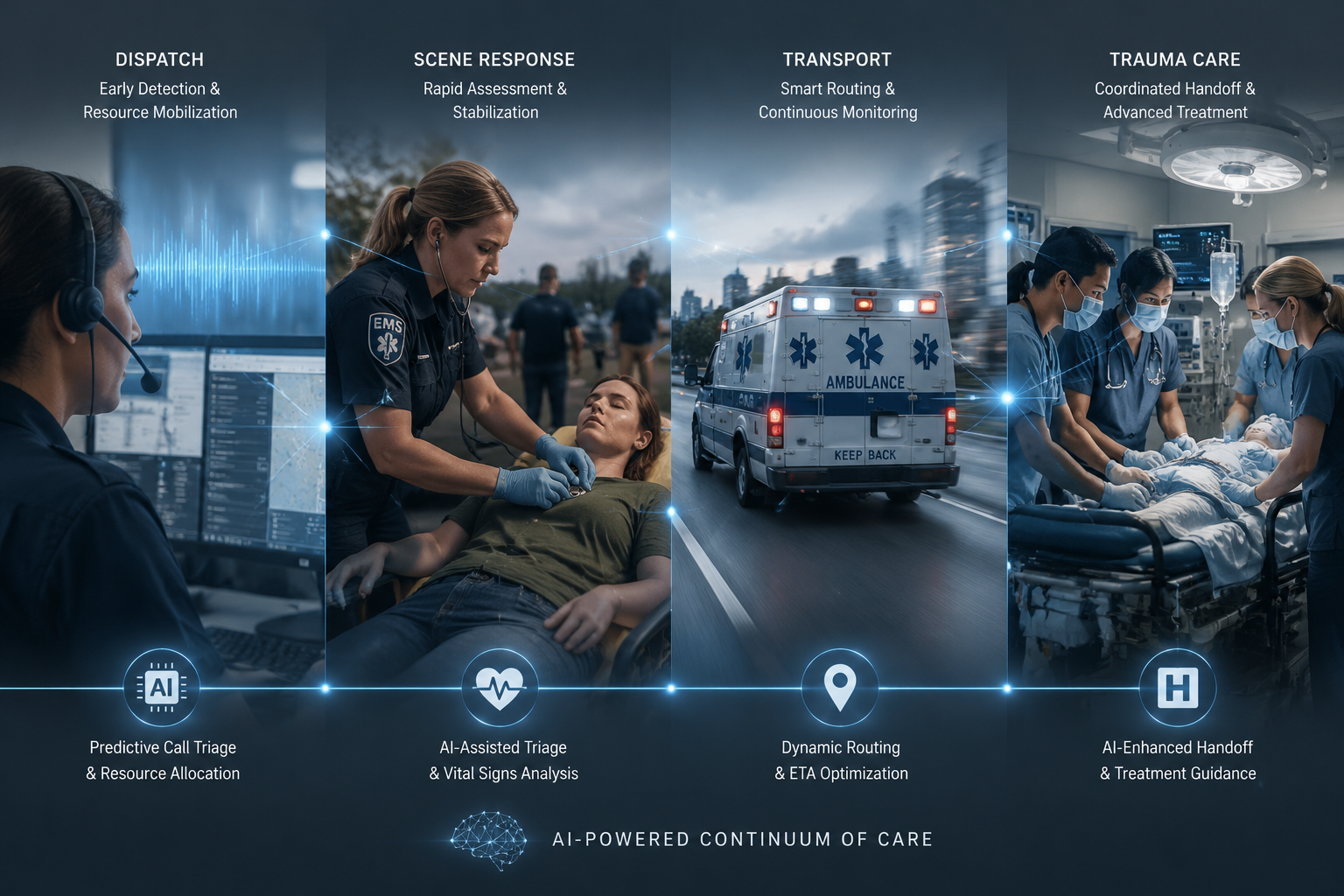
By Q3 2026, the evidence is not evenly distributed across that chain. The strongest clinical case sits in prehospital hemorrhage risk stratification. The most immediately recognizable workflow problem is EMS-to-trauma-team communication. Scene assessment by computer vision is technically promising, but still closer to feasibility testing than deployment. In-hospital and remote mass-casualty triage models show meaningful performance signals, yet most have not been tested prospectively inside actual mass shooting operations.
| Response point | What AI is being asked to help with | Evidence maturity in Q3 2026 |
|---|---|---|
| Dispatch and early incident recognition | Extract clinical signal from incomplete calls and early reports | Conceptually important, but limited direct mass shooting validation |
| Scene assessment | Detect people, posture, and possible casualty distribution using visual systems | Proof-of-concept feasibility, not operational readiness |
| Prehospital and transport triage | Stratify hemorrhage risk quickly from physiology | Strongest deployment-adjacent evidence, including FDA-cleared APPRAISE-HRI |
| EMS-to-trauma-bay communication | Compress and preserve key handoff information | Recent clinical study suggests improved correction of mis-triage, but narrow setting |
| ED and trauma bay triage | Support critical care transport and resource prioritization | Retrospective model performance is encouraging; prospective MCI use remains unsettled |
The dispatch problem is signal before structure
Emergency dispatch is the first clinical bottleneck, even before anyone calls it clinical. The dispatcher may hear “shots,” “bleeding,” “not breathing,” or only screaming and movement. In a mass shooting, the earliest triage information is distributed across callers who each see a fragment. AI could, in principle, help surface repeated phrases, locations, injury clues, and changes in incident scale faster than a human team can manually reconcile them.
That promise should be kept narrow. The research base supplied here does not establish a validated dispatch AI system for civilian mass shooting triage. Dispatch-facing AI remains part of the response-chain logic because it is where the first evidence appears, but the more defensible evidence begins later, after patient-level physiology or EMS communication enters the record.
The operational lesson is still useful: if early AI is introduced at dispatch, it should be judged by whether it improves the next handoff. Does it help EMS understand likely casualty distribution? Does it preserve uncertainty rather than turning partial reports into false precision? Does it flag a possible hemorrhage-heavy event without pretending to know which patient needs a tourniquet? A model that produces a confident incident summary from chaotic calls may look efficient and still be unsafe if it hides what is unknown.
Computer vision can see the scene, but that is not the same as triage
Scene assessment is the part of the AI conversation that most easily drifts into command-center imagery: drones, camera feeds, automated casualty maps. The more modest evidence is worth taking seriously, but not overselling. A systematic review of AI in emergency and disaster triage describes work integrating OpenPose and YOLO with UAVs and 5G to support real-time human detection and posture recognition at mass casualty scenes.[1]
That is useful feasibility work. A system that can help locate people or identify whether bodies are upright, prone, or moving could improve the first scene picture, especially when the area is unsafe or too large for rapid manual assessment. But posture recognition is not hemorrhage control. Person detection is not transport priority. A camera does not know whether the quiet patient is exsanguinating, intoxicated, trapped, dead, or hiding.
The deployment gap matters because mass shooting scenes are not just visually complex; they are operationally contested. Lighting, smoke, building layout, law-enforcement perimeters, connectivity, and patient movement can all degrade the clean assumptions behind a demonstration. Computer vision belongs in the response-chain discussion as a possible way to accelerate scene awareness, not as a validated substitute for EMS triage.
Hemorrhage risk is where the evidence becomes more concrete
The strongest current example is APPRAISE-HRI, an AI hemorrhage-risk tool developed to stratify trauma patients into Low, Average, or High risk within 10 minutes using vital-sign data alone.[2] That last phrase is not a technical footnote. In the prehospital chain, “vital-sign data alone” means the tool does not require a CT scanner, laboratory turnaround, or a fully assembled narrative of the injury. It asks for physiology at a moment when physiology may be the only structured information available.
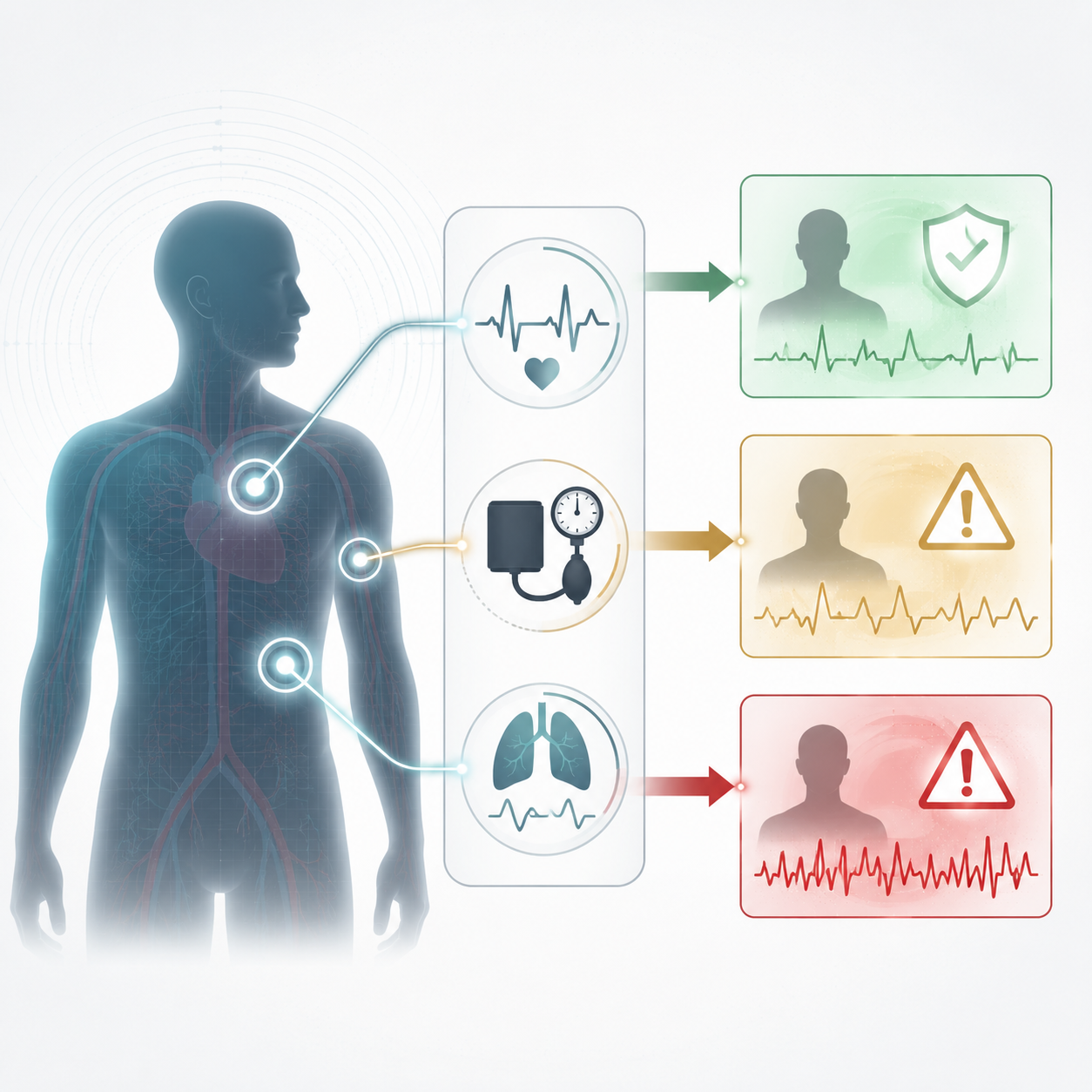
APPRAISE-HRI is described as the first FDA-cleared AI for hemorrhage triage, with validation across more than 6,000 trauma patients at 9 clinical sites.[2][3] For emergency medicine, that combination changes the conversation. This is not merely a retrospective score published as a promising model. It has a regulatory milestone, trauma-specific validation, and a time window that matches the practical tempo of early triage.
The Low/Average/High output is also clinically sensible because it supports prioritization without pretending to make the entire decision. A High-risk flag can push a patient toward earlier senior review, blood-product preparation, rapid destination confirmation, or a more urgent trauma-team communication. A Low-risk output may help protect attention for patients more likely to deteriorate, though it should not become a reason to ignore mechanism, mental status, wound location, or field concern. Average risk is often the hardest operational category, because it still requires a team to look at the trend, not just the label.
This is exactly where AI can be useful in a mass shooting response: not by replacing triage tags, but by catching a physiologic pattern that might be missed when crews are managing multiple patients, incomplete histories, and destination pressure. Penetrating trauma patients can look deceptively stable before they do not. A tool that watches early vital signs for hemorrhage risk gives the next team a reason to prepare before the patient arrives pale, hypotensive, and late.
The caveat is not small. APPRAISE-HRI’s clearance and development context are tied to combat casualty care, and the evidence supplied here does not show direct validation in civilian mass shooting incidents. Combat trauma and civilian gunshot wound patterns can overlap, especially around hemorrhage, but they are not interchangeable populations. Injury mechanisms, evacuation timelines, prehospital resources, and hospital distribution can differ. The right conclusion is that APPRAISE-HRI is deployment-adjacent for hemorrhage risk support, not that it has already proven mass shooting performance.
The handoff may be as important as the prediction
A trauma bay often does not suffer from having no information. It suffers from receiving too much of the wrong information and too little of the sentence that would have changed the room. “Tourniquet placed.” “No radial pulse.” “Mental status declined en route.” “Two units are bringing additional critical patients.” These details may exist in EMS communication and still fail to land with the person assigning the bay, calling blood bank, or deciding whether to activate another team.
That is why the July 2026 LLM-based EMS communication study is more relevant to mass shooting readiness than its narrow study population might suggest. In a single-institution pediatric trauma activation study with 133 cases, an LLM compressed EMS call transcripts by about 80% while preserving clinical accuracy, and exposure to the LLM output tripled the odds that trauma staff corrected an initial mis-triage decision.[4]
The result should not be inflated into adult mass shooting proof. Pediatric trauma activations are not the same as a multi-patient penetrating-trauma incident. A single institution is not a regional trauma system. A transcript study is not the same as live use during radio congestion, patient surges, and simultaneous arrivals. Still, the outcome points at a real weak point in the response chain: triage errors can persist because the corrective information is buried in the handoff.
The value of transcript compression is not that it makes EMS communication shorter for its own sake. It is that it may preserve the clinically decisive content while removing the noise that delays recognition. In a mass shooting, the receiving team may be listening to several incoming reports while assigning rooms, mobilizing blood, and preparing for patients whose identifiers are incomplete. A concise, accurate extraction of mechanism, physiology, interventions, and deterioration could reduce the chance that a critical patient is received as routine or that a lower-acuity patient consumes the first available trauma slot.
This is also where human review remains non-negotiable. The LLM output should be treated as a structured aid to the trauma team’s decision, not as the decision itself. If the model omits a qualifier, misreads negation, or over-compresses uncertainty, the consequence falls on the patient and the team inheriting the summary. The useful design question is whether AI can make the handoff easier to audit in real time: what did EMS say, what did the model extract, what did the trauma team see, and what changed because of it?
Remote and in-hospital triage models show promise, with the usual prospective gap
Once patients are moving toward hospitals, the triage problem changes again. The question is no longer just who is injured; it is who needs critical care transport, who should bypass a closer facility, who needs a trauma bay first, and how much surge capacity remains. Machine learning models can help here because they can combine structured patient data in ways that traditional scores may not.
A 2024 JAMA Network Open study reported a deep neural network model for remote mass casualty incident triage with an AUC of 0.89, outperforming the Revised Trauma Score.[5] That is a meaningful performance signal, especially because RTS-style scoring remains familiar in trauma systems and disaster planning. If a model can better identify patients needing higher-level care from remote triage inputs, it could support destination decisions and early hospital notification.
The word “could” has to stay in the sentence. AUC measures discrimination in the studied data; it does not prove that the model improves outcomes during an actual mass casualty response. It does not answer whether medics will have time to enter the required data, whether connectivity will hold, whether the model behaves well when documentation is sparse, or whether clinicians will over-trust the output when it conflicts with scene judgment.
For the trauma bay, AI-assisted triage should be judged against the decisions that actually strain the system: activating additional teams, allocating operating rooms, preparing massive transfusion resources, sequencing imaging, and deciding which patient can safely wait. Models that perform well retrospectively are useful candidates for prospective testing, but they are not yet evidence that an integrated AI pathway can manage a civilian mass shooting from first call through definitive care.
What selective readiness looks like
The uneven evidence does not make AI irrelevant to mass shooting care. It makes blanket claims unsafe. Hemorrhage-risk stratification has the clearest case because APPRAISE-HRI is time-bound, trauma-specific, FDA-cleared, and validated across multiple sites. EMS communication support is close behind because the July 2026 LLM study addresses a known failure mode: important triage information getting lost before the receiving team acts on it. Remote triage models are promising, particularly where they outperform familiar scoring systems, but they still need prospective testing under real operational constraints.
Computer vision for scene assessment belongs further back in the readiness line. It may help responders understand where people are and how they are positioned, but the evidence supports feasibility more than clinical triage deployment. Dispatch AI is similarly important in theory and underdeveloped in direct validation for mass shooting incidents. Fully integrated pathway coordination remains a synthesis goal, not a proven system.
Hospitals and EMS agencies evaluating these tools should ask where the model enters the handoff and who bears the consequence if it is wrong. A hemorrhage-risk flag can be tested against activation timing, blood readiness, under-triage, and deterioration after arrival. An LLM handoff summary can be tested against missed EMS details and corrected triage level. A camera-based scene tool should be tested against responder situational awareness, not marketed as patient-level triage until it can support that claim.
The defensible Q3 2026 position is selective readiness. AI support is no longer hypothetical across the mass shooting response chain, but the practical evidence is strongest where the task is narrow, the data are already available, and the output helps a clinician or responder make a faster handoff decision. The tools closest to use are the ones that respect the compression of the event: vital signs in the first minutes, EMS words before they are lost, and triage outputs that make the next team look sooner rather than think less.
References
- Systematic review: AI in triage for emergencies and disasters
- FDA clearance of APPRAISE-HRI — MRDC health.mil
- Case study of APPRAISE-HRI FDA clearance
- UB LLM triage study — University at Buffalo, July 2026
- ML trauma triage model for critical care transport — JAMA Network Open, 2024
Comments
Join the discussion with an anonymous comment.