
The promise of focal therapy for prostate cancer has always depended on a narrow bargain: treat the clinically meaningful cancer while leaving enough normal gland, sphincter function, neurovascular tissue, and urinary anatomy undisturbed to make the morbidity advantage real. That is why discussions of focal therapy for prostate cancer side effects cannot stop at whether a man avoids radical prostatectomy or whole-gland radiation on day one. The harder question is whether selection is good enough to keep him from needing another, more morbid treatment later.
The side-effect rationale is not trivial. In the focal therapy complications literature, pad-free continence after focal treatment is reported at 95% to 100%, erectile dysfunction ranges from 0% to 46% depending heavily on baseline function and treatment location, and urinary tract infection or acute urinary retention can occur in up to 17% of patients, usually as manageable events rather than permanent functional losses.[1] In the PART feasibility randomized trial, high-intensity focused ultrasound showed an odds ratio of 22.9 for incontinence preservation compared with radical prostatectomy.[2]
Those numbers explain why patients are willing to consider a prostate-preserving strategy. They also explain why poor selection is not a minor technical problem. If focal therapy misses biologically or anatomically important disease, the patient may still face recurrence surveillance, repeat biopsy, additional focal treatment, or salvage whole-gland therapy. The same literature that reports favorable functional outcomes also describes variable failure-free survival across studies, from 65% to 97%, and notes that salvage settings can carry worse complication profiles, including severe complications reported up to 10%.[1]

Selection Is Where the Side-Effect Advantage Is Won or Lost
Most focal therapy eligibility conversations still lean on familiar clinical markers: Grade Group, PSA density, MRI suspicion, lesion location, biopsy distribution, and whether disease appears unilateral and targetable. These remain necessary. But they are imperfect proxies for the feature that matters operationally once an energy source is selected: how much cancer is actually being treated, and whether the ablation field can cover it without turning a focal procedure into a disguised whole-gland treatment.
The prospective UCLA cryoablation trial by Brisbane and colleagues is important because it tested that question directly rather than treating tumor volume as an attractive image annotation. The study included 204 men undergoing focal cryoablation and evaluated whether artificial intelligence-derived tumor volume could predict treatment success.[3] In that setting, AI-derived tumor volume was not merely associated with outcome; it outperformed the usual clinical predictors.
At 6 months, AI-derived tumor volume had an adjusted odds ratio of 6.14 for focal cryoablation success, with an area under the curve of 0.72.[3] By contrast, Grade Group performed little better than chance in the reported comparison, with an AUC of 0.51.[3] PSA density and PI-RADS score were also weaker than the AI volume estimate in the trial’s predictive analysis.[3]
That is the clinically interesting part. The model is not being asked to declare whether a man has prostate cancer, replace biopsy, or make a treatment decision in isolation. It is being used to sharpen a boundary clinicians already have to draw: whether the visible and sampled cancer burden is small enough for focal cryoablation to remain focal and still be oncologically plausible.
What the AI Is Measuring
Unfold AI combines multiparametric MRI, PSA, and systematic biopsy core information to generate a 3D cancer map and estimate intraprostatic tumor volume.[4] The platform received FDA 510(k) clearance in December 2022, according to UCLA’s description of the technology used in the trial.[5] Its relevance here is not that it makes imaging look more sophisticated. It gives clinicians a quantitative estimate of cancer extent that can be tested against treatment outcome.
The mapping work behind this approach reported stronger correlation with histopathology volume than conventional PI-RADS regions of interest: R²=0.76 for the AI estimate versus R²=0.33 for PI-RADS ROI volume.[4] That distinction matters because a PI-RADS lesion is not the same thing as a treated cancer volume. In focal therapy planning, that gap can become the difference between treating the true lesion and undertreating its edge.
There is a useful comparison here with broader AI work in oncology and pathology. Many models report diagnostic performance; fewer change a treatment boundary in a way that can be audited against downstream patient outcomes. That is why AI tumor volume estimation sits closer to treatment planning than to generic image interpretation, even though it belongs in the same larger conversation as AI in computational pathology.
The 1.5 cc Threshold Is a Trade-Off, Not a Magic Number
The most provocative finding in the UCLA study is the proposed 1.5 cc tumor-volume cutoff. Applied retrospectively within the prospective cohort, that threshold would have prevented 72% of treatment failures.[3] For a patient trying to avoid the urinary and sexual side effects of whole-gland therapy, preventing failure is not an abstract statistical win. It may mean avoiding the sequence of focal therapy, recurrence anxiety, repeat imaging, repeat biopsy, and eventual salvage treatment.
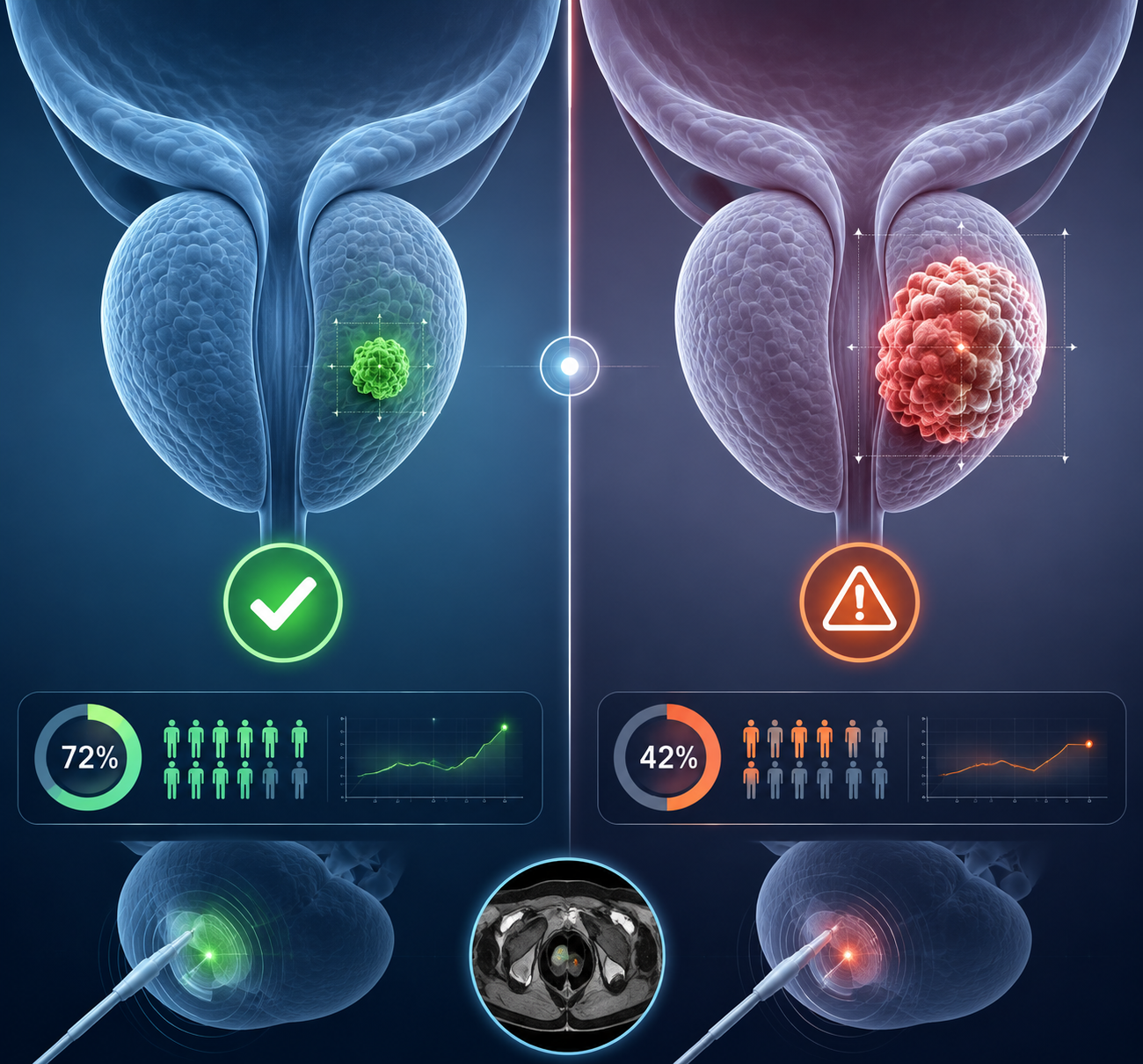
But the other half of the threshold deserves equal attention: the same cutoff would have excluded 42% of men who were treatment successes.[3] That is not a rounding error. It means a strict 1.5 cc rule would deny focal cryoablation to a substantial group of patients who, in this cohort, did well.
| Decision Point | What the UCLA Data Suggest | Clinical Meaning |
|---|---|---|
| AI-derived tumor volume as predictor | AUC 0.72; adjusted odds ratio 6.14 at 6 months | Stronger outcome signal than familiar clinical markers in this focal cryoablation cohort |
| Grade Group as predictor | AUC 0.51 | Weak discrimination for focal cryoablation success in the reported comparison |
| 1.5 cc eligibility threshold | Would prevent 72% of failures | May reduce avoidable recurrence and salvage-treatment exposure |
| Cost of the same threshold | Would exclude 42% of successes | May withhold a lower-morbidity option from some men who could benefit |
That is why the cutoff should be understood as a decision boundary rather than a biological law. Below the threshold, the odds of success appear more favorable in this dataset. Above it, the clinician should not pretend the risk is unchanged. But between a risk estimate and a treatment exclusion lies a counseling conversation: baseline urinary and sexual function, tumor location, patient priorities, tolerance for surveillance uncertainty, and willingness to accept salvage options if focal treatment fails.
The trial’s value is that it makes this conversation less vague. Instead of saying that a lesion seems “small enough” or “favorable,” the team can discuss a measured tumor-volume estimate and the failure trade-off observed at a defined cutoff. That does not remove judgment. It makes the judgment more visible.
Why Failure Changes the Side-Effect Conversation
Focal therapy side effects are often presented as a comparison between initial procedures: focal ablation versus prostatectomy, focal ablation versus radiation, focal ablation versus whole-gland treatment. That comparison is necessary, but it can be misleading if oncologic failure is treated as someone else’s endpoint.
A man who has a successful focal ablation may preserve continence and erectile function in a way that justifies the original choice. A man who fails focal therapy may face the cumulative burden of the first procedure plus salvage treatment. Even if the initial ablation caused only temporary urinary retention or irritative symptoms, the later treatment may carry the very functional risks he was trying to avoid.
This is where AI-derived tumor volume becomes more than a planning convenience. If a measured volume threshold can identify a group at meaningfully higher failure risk, it can reduce exposure to the worst version of focal therapy: undertreatment followed by escalation. The UCLA estimate that a 1.5 cc cutoff could prevent 72% of failures is therefore a side-effect finding indirectly, not because the AI reduces urinary retention or erectile dysfunction by itself, but because it may reduce the number of patients who travel from low-morbidity intent to salvage morbidity.[3]
What This Evidence Does Not Yet Prove
The UCLA trial should not be stretched beyond its design. It was a single-institution prospective study of focal cryoablation, not a multicenter randomized trial across focal therapy platforms.[3] The lead author declared no financial conflict, but technology developers were among the co-authors.[3] That does not invalidate the data; it does raise the standard for independent validation.
Nor does the study establish that the same 1.5 cc cutoff should govern HIFU, irreversible electroporation, laser ablation, or other focal modalities. Energy source, ablation margin, gland anatomy, lesion location, operator experience, and follow-up protocol all affect whether a given measured tumor volume is treatable with acceptable risk. Cryoablation data should not quietly become focal therapy data in general.
Current consensus criteria already limit focal therapy to a relatively small subset of intermediate-risk patients, approximately 10% to 15%. AI refinement may expand that pool for some men by reducing uncertainty, or contract it by revealing larger-than-expected disease extent. Either direction is plausible. The point is not to increase focal therapy volume; it is to reduce poorly selected treatment.
Long-term oncologic data also remain a constraint. Five-year focal HIFU outcomes have been reported in a 625-man series, but mature outcomes beyond 10 years across focal modalities are still developing.[6] A 6-month predictive endpoint can be clinically useful, especially for early treatment response, but it is not the same as proving durable cancer control over the time horizon that matters to younger or healthier patients.
How the Boundary Should Enter Counseling
The practical use of AI tumor volume estimation is not to hand the patient a binary verdict. It is to make the eligibility discussion more explicit. A clinician can say: this estimate places the tumor below or above a threshold that, in one prospective focal cryoablation cohort, separated many successes from failures. Then the same clinician has to say what the threshold cost was: some men above 1.5 cc still succeeded, and a strict cutoff would have excluded them.
- For a patient with excellent baseline urinary and sexual function, the risk of losing the focal therapy option may matter greatly.
- For a patient whose tumor volume is above the cutoff and whose priority is avoiding recurrence-driven salvage therapy, the same estimate may argue against focal treatment.
- For a clinician, the estimate should prompt closer review of MRI, biopsy mapping, ablation margins, and follow-up intensity rather than replace those steps.
- For a tumor board, the threshold is most useful when documented as part of the rationale, not hidden inside an AI report.
Transparent counseling matters because the trade-off is ethically uncomfortable. Preventing avoidable failures protects patients from recurrence and salvage morbidity. Excluding likely successes denies some patients the lower-morbidity option they came seeking. Both consequences are real. A useful decision tool should force both into view.
A More Concrete Role for AI in Focal Therapy
AI-derived tumor volume estimation appears to be one of the more clinically grounded AI uses in prostate cancer treatment planning because it addresses a specific weakness in focal therapy selection. In the UCLA focal cryoablation cohort, it predicted treatment success better than Grade Group, PSA density, or PI-RADS score, and a 1.5 cc threshold identified a large share of failures that might have been avoided.[3]
The finding should change the tone of the conversation, not close it. AI volume estimation may help preserve the low side-effect profile that makes focal therapy attractive by reducing undertreatment and downstream salvage exposure. The 1.5 cc cutoff, however, should remain a candidate decision boundary requiring multicenter validation, modality-specific evidence, and plain-language patient counseling before it is treated as a universal eligibility rule.
References
- Focal Therapy for Prostate Cancer: Complications and Their Treatment, Frontiers in Surgery, 2021.
- A multicentre, randomized trial of radical prostatectomy compared with focal therapy using high-intensity focused ultrasound for localized prostate cancer: the PART feasibility RCT, Lancet Oncology, 2018.
- Focal therapy of prostate cancer: Use of artificial intelligence to define tumour volume and predict treatment outcomes, BJUI Compass, 2025.
- Prediction and mapping of Intraprostatic tumor extent with artificial intelligence, PubMed.
- Artificial intelligence tool helps predict who will benefit from focal therapy for prostate cancer, UCLA Health.
- A Multicentre Study of 5-year Outcomes Following Focal Therapy in Treating Clinically Significant Nonmetastatic Prostate Cancer, European Urology, 2018.
Comments
Join the discussion with an anonymous comment.