
The useful question about ai in vaccine distribution and rollout is not whether a model can draw a cleaner network diagram. It is whether the forecast changes the purchase order early enough, whether a hub location shortens the route, whether cold-storage pressure shows up before doses expire, and whether clinic staff are spared another round of emergency rescheduling.
The headline numbers are strong enough to pay attention to, but they need their labels left on. A YU News summary of a Magara review of more than 100 studies reports that AI-driven strategies could reduce global vaccine waste from roughly 30% to 6% and raise on-time deliveries to nearly 99%.[1] A C3 AI biopharma case reports a 20% demand-forecasting accuracy improvement over baseline and a potential $20 million annual inventory reduction across three markets.[2] Pfizer says its AI-powered digital cockpit helped achieve a 99% service inventory level while improving manufacturing and supply visibility.[3] Those figures point in the same operational direction. They do not come from the same type of evidence.

Where the Signal Is Strongest
The most credible case for AI in vaccine logistics is not a single all-purpose claim that “AI improves supply chains.” It is a cluster of narrower mechanisms that already fit the pain points of vaccine distribution: demand forecasting, inventory positioning, anomaly detection, cold-chain monitoring, and routing. Each mechanism matters because vaccine supply chains fail in practical ways. A forecast is too high, and doses sit. A forecast is too low, and clinics cancel appointments. A refrigerator is full at the wrong moment. A shipment reaches the region but not the rural facility. A manufacturer sees a production issue after downstream allocation plans have already been made.
That is why the three deployment narratives worth examining are different from one another. C3 AI’s biopharma example is primarily about forecasting and inventory. Pfizer’s digital cockpit is about manufacturing and supply visibility, including anomaly detection and capacity simulation. Zipline’s model, as summarized in the Magara/YU News review, is about distribution architecture: decentralized hubs, drone delivery, and AI-supported coordination to reach facilities that conventional routes serve slowly or unevenly.[1][2][3]
Those differences matter. Waste, service inventory, on-time delivery, and delivery speed are not interchangeable metrics. A system can improve one and leave another unresolved. A warehouse can carry enough stock to meet service targets while still pushing workarounds onto the last mile. A faster route can help rural access without proving that national demand forecasts are better. A 99% figure is only useful when the metric behind it is clear.
Forecasting That Actually Changes Inventory
The C3 AI case is the cleanest example of a model tied to a supply-chain decision. In the vendor-published case study, a global biopharma company deployed AI demand forecasting and improved forecast accuracy by 20% over its baseline. The AI forecast was also reported to be 4% higher in accuracy than forecasts adjusted by human subject-matter experts. C3 AI says the improvement translated to a potential $20 million annual inventory reduction across three markets.[2]
The important part is not that software produced a better-looking forecast. It is that a better forecast can reduce the buffer stock a manufacturer or distributor feels forced to carry. In vaccine distribution, inventory is not a neutral comfort blanket. It occupies monitored space, depends on temperature control, and can age into waste if allocation does not match real demand. A forecast that is materially better can let planners hold less excess stock while still protecting service levels.
The caveat is just as important as the result. The client is unnamed, and the numbers are client-reported through vendor marketing material. That does not make the case useless. Supply-chain directors make decisions with vendor evidence all the time. But it does mean the result should be treated as directional deployment evidence rather than an independently audited benchmark for every vaccine program.
| Deployment narrative | AI function described | Reported logistics outcome | Evidence caveat |
|---|---|---|---|
| C3 AI global biopharma case | Demand forecasting | 20% forecast accuracy improvement over baseline; potential $20 million annual inventory reduction across three markets | Unnamed client; vendor-published, client-reported figures |
| Pfizer digital cockpit | Manufacturing and supply visibility, anomaly detection, capacity simulation | 99% service inventory level | Pfizer’s own operational narrative; independent validation not provided |
| Zipline model summarized in Magara/YU News review | Forecasting, decentralized hubs, and drone delivery coordination | Delivery times cut by nearly half; 4,800+ health facilities reached across Africa | Performance figures summarized in a review, not a single controlled trial |
| Magara/YU News synthesis | AI-driven distribution strategies and cold-chain monitoring | Projected waste reduction from roughly 30% to 6%; on-time deliveries nearly 99%; cold-chain losses reduced 15–20% with IoT and AI monitoring | Review of 100+ studies; projections and synthesis rather than one audited rollout |
Pfizer’s Cockpit Is About Seeing the Constraint Earlier
Pfizer’s digital cockpit sits in a different part of the chain. Its value is less about predicting clinic demand and more about giving the organization end-to-end visibility across manufacturing and supply. Pfizer describes an AI-powered system that detects production-line anomalies and uses deep-learning algorithms to simulate raw-material availability and cold-storage capacity. The company reports that the cockpit helped achieve a 99% service inventory level.[3]

For vaccine rollout, that kind of visibility matters because manufacturing and distribution constraints do not stay politely upstream. If a raw material becomes scarce or a production anomaly slows output, allocation plans can become fiction. If cold-storage capacity is not visible until shipments are already moving, the burden shifts to receiving sites. Staff then improvise transfers, split shipments, defer appointments, or absorb waste.
The 99% service inventory level deserves careful wording. It is not the same as saying 99% of all vaccine doses reached every patient appointment on time. It is a service inventory metric reported by Pfizer in the context of its own manufacturing and supply operations. That is still operationally meaningful, especially in a system where inventory availability is the difference between orderly scheduling and daily firefighting. But the metric should not be stretched beyond what Pfizer described.
Zipline Shows the Last Mile Is Also a Design Problem
The Zipline example is useful because it moves the conversation away from central inventory alone. As summarized in the Magara/YU News review, AI-optimized hybrid models that combine forecasting with decentralized hubs and drone delivery cut delivery times by nearly half and reached more than 4,800 health facilities across Africa.[1]
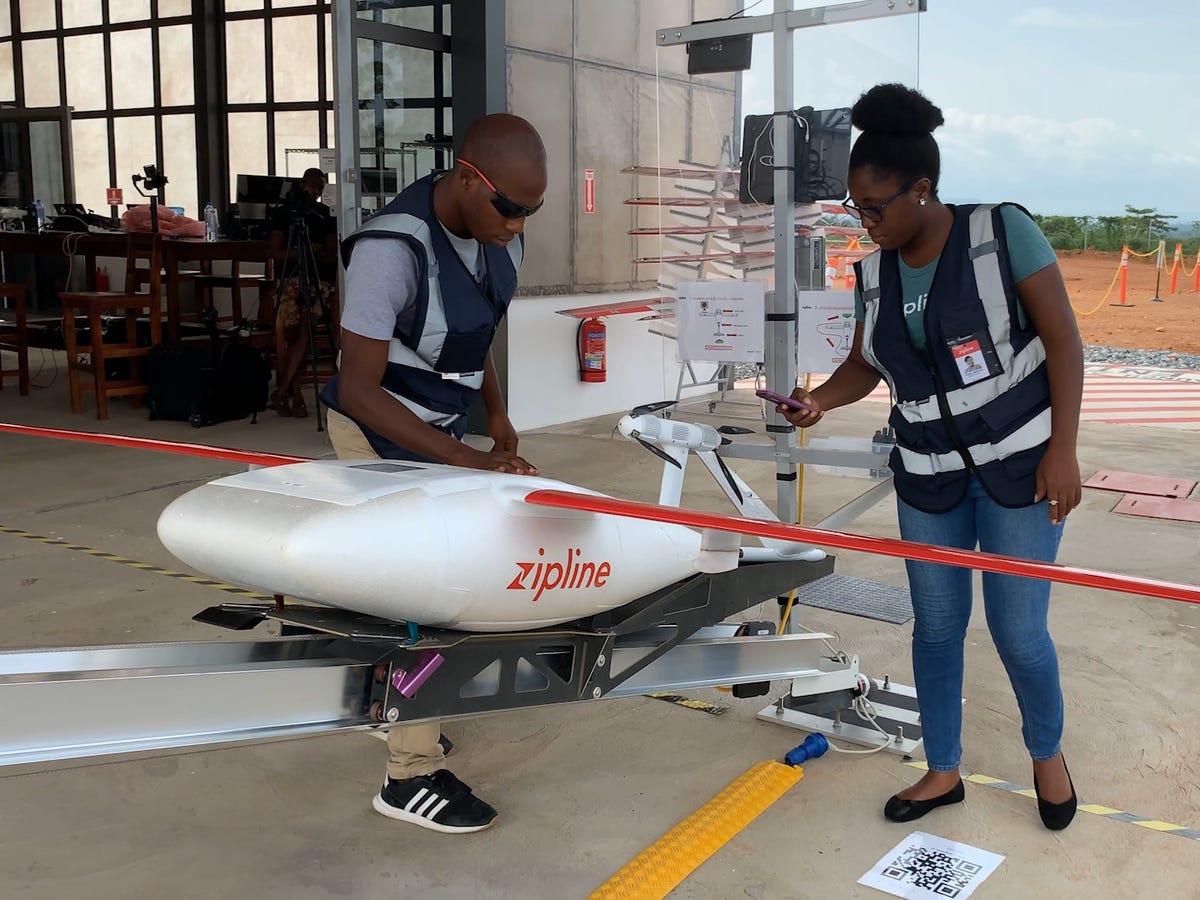
That is a different operating lever from a national forecast. A decentralized hub changes where inventory waits. Drone delivery changes which roads matter. AI-supported coordination can help decide what should move, when, and from which node. For rural sites, the operational value is not theoretical. Shorter delivery time can mean fewer missed immunization sessions, less pressure to overstock local refrigerators, and fewer calls asking a clinic to explain why doses are somewhere else.
Still, the evidentiary shape is not the same as a controlled comparison of vaccine delivery routes. The figures appear through a student review of more than 100 studies, not as a single independently audited Zipline trial in the material available here. The example supports the plausibility and reported scale of AI-supported drone logistics. It should not be used to claim that every drone-enabled vaccine program will cut delivery time by the same amount.
The Waste Number Is a Projection, Not a Receipt
The most eye-catching figure in the evidence base is the projected reduction in global vaccine waste from roughly 30% to 6%. It is also the figure most likely to be misused. The Magara/YU News review reports that AI-driven strategies could cut waste to that level and raise on-time deliveries to nearly 99% across the literature it examined.[1] That is a synthesis and projection, not proof that a single global rollout has already moved the waste rate from 30% to 6%.
The cold-chain finding is narrower and more operationally legible. The same review reports that IoT-based real-time monitoring with AI reduces cold-chain losses by 15–20%.[1] That mechanism is easy to understand: sensors see temperature excursions or storage conditions early; AI-supported monitoring helps flag risk; staff intervene before stock is unusable. The number still comes through the review, but the pathway is concrete.
This distinction matters because vaccine waste has many causes. Some waste comes from demand uncertainty. Some comes from cold-chain failures. Some comes from vial-opening policies, appointment no-shows, packaging constraints, or redistribution delays. AI can help with several of those failure points, but a global waste percentage does not tell a local immunization manager which cause has changed.
From Lab-to-Jab Framing to Distribution Work
The broader AI-and-vaccines story often starts with discovery, development, and pandemic response. Gavi’s VaccinesWork framing describes AI use across the COVID-19 vaccine journey “from lab to jab,” which is a useful reminder that distribution is only one part of a much larger system.[4] But for rollout performance, the action narrows quickly to supply-chain work: matching supply with demand, positioning stock, keeping cold storage within bounds, and coordinating delivery routes.
That narrower view is less glamorous, but it is where operational benefit becomes measurable. A demand model either reduces excess inventory or it does not. A cockpit either surfaces a capacity problem early or it does not. A drone network either reaches a facility faster or it does not. Those are the claims worth separating from general statements about digital transformation.
What the Evidence Supports—and What It Does Not
Taken together, the available material supports a grounded conclusion: AI-enabled forecasting and logistics coordination can improve vaccine distribution metrics at real-world scale. The C3 AI case connects forecasting to inventory reduction. Pfizer connects supply visibility and anomaly detection to high service inventory. Zipline, as summarized in the Magara/YU News review, connects decentralized delivery architecture to faster access for thousands of health facilities. The Magara review pulls these kinds of mechanisms into broader projections for waste, timeliness, and cold-chain loss.[1][2][3]
What the material does not provide is an independently validated, apples-to-apples trial showing that the same AI intervention reduced waste, improved on-time delivery, cut delivery time, and reduced inventory cost across the same vaccine rollout. It also does not resolve regulatory and validation questions for AI supply-chain tools in pharmaceutical environments. Those questions matter, especially when model outputs influence allocation, release timing, or storage decisions.
That boundary should not flatten the operational signal. Vaccine distribution has always punished late visibility. The deployments described here suggest that AI is most valuable when it gives planners earlier, more usable visibility into demand, inventory, manufacturing constraints, cold-storage capacity, and route options. The best numbers are promising, but they still sit inside brackets: vendor-reported cases, company narratives, unnamed clients, and literature projections rather than independent trials.
References
- Magara systematic review, YU News.
- C3 AI case study, C3 AI.
- Pfizer’s digital cockpit, Pfizer.
- VaccinesWork article on AI from lab to jab during COVID-19, Gavi/VaccinesWork.
Comments
Join the discussion with an anonymous comment.