
The pressure point for AI in vaccine safety analysis is not a futuristic diagnostic dashboard. It is the queue of post-market safety reports that has to be sorted before a signal can be investigated, dismissed, or escalated. COVID-19 vaccination intensified that queue: published pharmacovigilance work described more than 1.8 million new safety reports, a volume that exposed how poorly manual review scales when reporting surges after a mass rollout.[1]
In that setting, AI is most useful when it changes the surveillance workflow: claims records can be screened for patterns, clinical notes can be searched for cases that were never coded, spontaneous reports can be clustered into symptom neighborhoods, terminology mapping can be accelerated, and social media can be treated as a noisy early warning layer. None of those tasks is the same as deciding that a vaccine caused an event. They are ways to decide what deserves human review sooner.
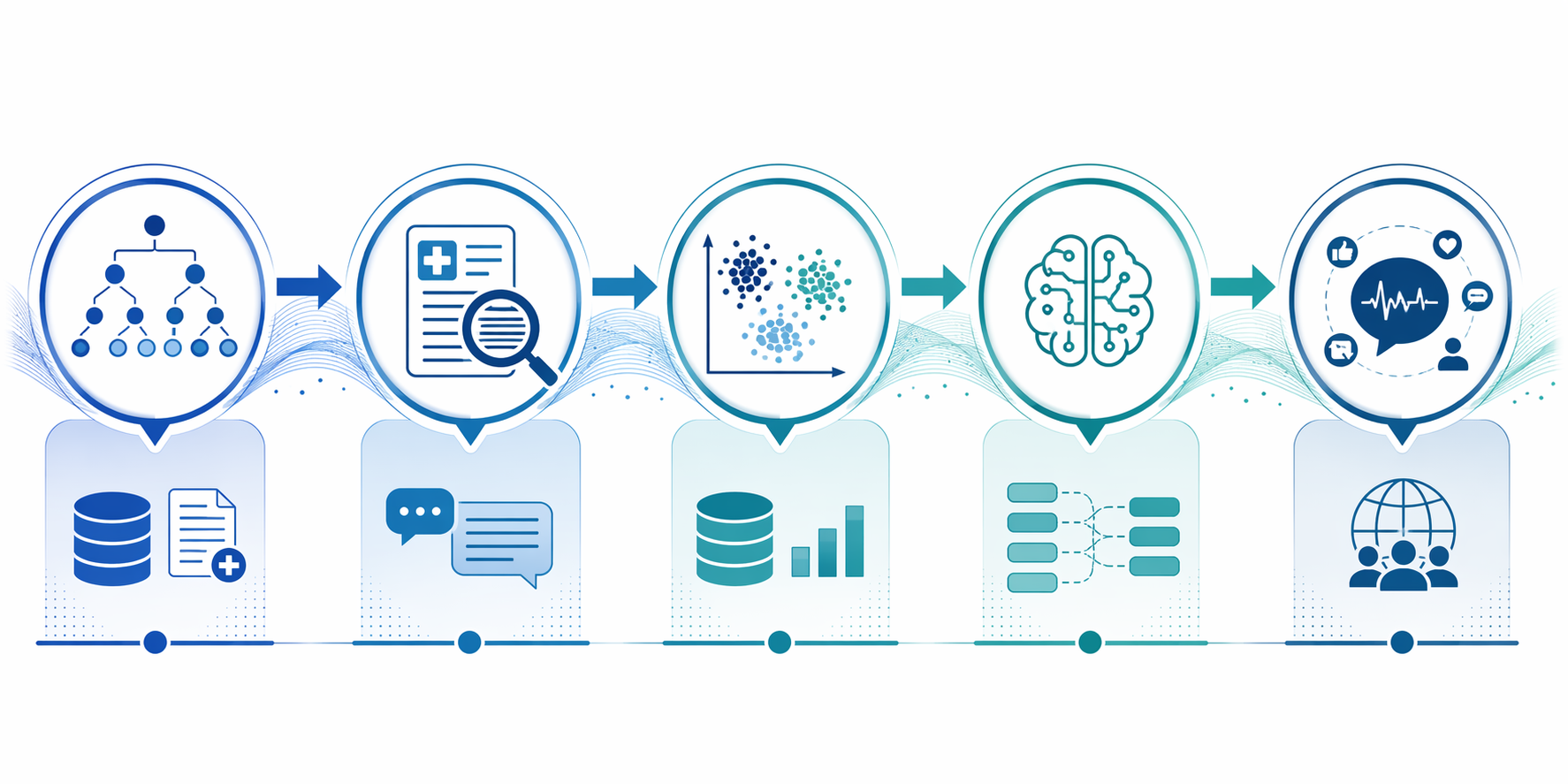
That distinction matters because the evidence is uneven in exactly the places deployment depends on. A model can look strong inside one claims database, one health system’s note format, or one adverse-event reporting vocabulary and still fail when moved into another surveillance environment. The practical standard is therefore source data first, task definition second, performance metric third, and validation setting always attached. That same problem appears across AI in clinical applications, but vaccine safety makes it especially visible because downstream decisions are reviewed by safety committees, regulators, and the public.
Claims Data Can Surface Patterns, But The Case Definition Still Carries The Burden
Structured claims data are a natural starting point because they already contain vaccination dates, diagnosis codes, medications, encounters, and longitudinal utilization. In a Korean national claims study, Kim et al. used random forest models to predict adverse events following immunization, including anaphylaxis and agranulocytosis, and reported about 70% accuracy for those outcomes. Vaccination ranked high in the model’s feature importance for anaphylaxis, with a reported ratio of 3.53.[2]
That is enough to show why claims-based machine learning is attractive for active surveillance: the model can work over large administrative datasets without waiting for every case to be manually noticed. But it is not enough to treat the output as a verified safety signal. Claims models inherit the coding habits of the claims system. They see what gets billed, not necessarily what a clinician suspected, ruled out, or documented in narrative form. They can help prioritize a slice of records for adjudication; they do not remove the need to inspect whether the outcome definition actually matches the adverse event of special interest.
The useful question is therefore not whether random forests are sophisticated. It is whether the model is being asked to find a code-defined proxy, a chart-confirmed clinical event, or a report-worthy adverse event. Those are different targets, and accuracy against one does not automatically transfer to another.
Clinical Notes Show Both The Promise And The Fragility Of NLP
The strongest cautionary case comes from rule-based NLP for anaphylaxis detection in the Vaccine Safety Datalink. Yu et al. tested an NLP system across five sites. At Kaiser Permanente Southern California, the system reached 75% sensitivity, 98.5% specificity, and 66.7% positive predictive value. At the non-KPSC sites, sensitivity was 0%, which the study attributed to differences in how notes were formatted.[3]
That result is more important than the high specificity figure by itself. Specificity says the tool avoided many false positives in the setting where it worked. The 0% sensitivity elsewhere says it missed every target case in other participating sites. For surveillance, that is not a small portability footnote; it is the failure mode that decides whether a system can be trusted outside the environment where it was tuned.
The same study also shows why abandoning NLP would be a mistake. Applied to 6.4 million vaccination visits without relevant diagnostic codes, the NLP approach identified 45 potential anaphylaxis cases, of which 8 were confirmed after review. Including those cases raised the estimated incidence from 1.70 to 2.55 per million doses.[3]
That is the surveillance value in plain terms: the tool found cases that diagnostic-code screening would not have surfaced. It expanded the net, then handed a smaller set of potential cases to reviewers. The reviewers still did the adjudication. In a real vaccine safety workflow, that handoff is the product.
The limitation is also plain. A note parser that depends on local formatting may perform well in a mature integrated system and collapse in another health system with different templates, abbreviations, section headers, or documentation habits. Newer language models may reduce some of that brittleness, but the cited multi-site evidence does not establish that they have solved it for this task. Claims about generalizability need local validation, not just a better internal score. This is the same kind of gap highlighted in broader work on methodological quality and reporting in AI clinical research.
Spontaneous Reports Need Organization Before They Need Interpretation
Spontaneous reporting databases such as VAERS create a different problem. They are rich in symptom narratives and temporal suspicion, but they are also affected by stimulated reporting, incomplete clinical detail, duplicate patterns, media attention, and variable reporter language. AI methods used here are often less about proving causality and more about organizing a corpus that is too large and uneven for line-by-line review.
Cheon et al. applied Word2Vec and DBSCAN clustering to 396,443 VAERS COVID-19 reports. The analysis used 1,560 symptom vectors and produced 25 symptom clusters. One cluster grouped terms including death, ICU, and cardiac arrest, and the authors reported that this cluster had distinct medication patterns and illness profiles.[4]
That kind of clustering can be operationally useful because it gives reviewers a way to move from hundreds of thousands of reports into more coherent symptom neighborhoods. It can show that a severe-outcome cluster has a different profile from a reactogenicity cluster or a nonspecific symptom cluster. But it is still an organizing layer. The cluster does not decide whether the vaccine caused the outcome, whether the reporting rate exceeds expectation, or whether the clinical cases meet a standardized definition.
| Surveillance source | AI task | What the cited evidence supports | Main deployment concern |
|---|---|---|---|
| National claims data | Random forest prediction of adverse-event patterns | About 70% accuracy for selected outcomes in Korean claims data | Outcome definitions depend on coding and billing behavior |
| Clinical notes and EHR data | Rule-based NLP case finding for anaphylaxis | Missed cases can be recovered from visits without relevant diagnostic codes | Sensitivity may collapse when note formats differ across sites |
| VAERS spontaneous reports | Symptom clustering with vectorization and density-based clustering | Large narrative datasets can be grouped into symptom clusters | Clusters organize reports but do not establish causality |
| Disproportionality signal outputs | LLM-assisted MedDRA mapping and known-event dismissal | Terminology mapping and triage can be partly automated | Reproducible mapping is not the same as validated safety judgment |
| Social media | Early signal listening | Potential concerns can be detected before formal review is complete | Signals require confirmation against healthcare utilization or clinical data |
LLMs Are Starting To Help With The Terminology Bottleneck
Terminology mapping is one of the less glamorous but more consequential tasks in vaccine safety surveillance. If a report narrative, literature mention, or signal term cannot be reliably mapped to a standardized MedDRA Preferred Term, downstream aggregation and disproportionality review become harder. This is where large language models have begun to look practically useful.
Dong et al. evaluated FACTA+ with GPT-3.5 for vaccine safety signal triage and MedDRA mapping. In their workflow, 17% of disproportionality signals were automatically dismissed as known adverse events following immunization. GPT-3.5 achieved 78% accuracy in MedDRA Preferred Term assignment and showed perfect reproducibility across 10 runs, with Cohen’s kappa of 1.0. The same study reported that eight traditional string-matching NLP techniques failed, with minimum overlap of 65%.[1]
Those numbers are meaningful because they describe a real bottleneck: safety teams do not only need models that identify dramatic new patterns; they need systems that can connect messy language to controlled terminology and remove signals already recognized as known adverse events. A 17% dismissal rate for known AEFIs can matter if it reduces repetitive review without hiding genuinely new patterns.
The boundary is equally important. Reproducibility across runs means the model gave the same answer repeatedly under the tested conditions. It does not mean the answer was clinically correct in every case, nor does it establish that the system can decide whether a disproportionality signal is causal, urgent, or explained by reporting artifacts. A terminology assistant can be consistent and still need safety reviewer oversight.
Adoption Evidence Is Thinner Than The Method Literature Suggests
The publication landscape also warns against treating method papers as proof of routine deployment. Painter et al., in an industry-attributed review from GSK, found that only 8.4% of published pharmacovigilance and machine learning papers from 2000 to 2021 were industry-attributed, representing 33 of 393 papers. Among those industry papers, real-world data and social media accounted for 63%, while signal detection and data ingestion made up 18%.[5]
That does not mean companies are not using AI internally; publication counts are an imperfect proxy for operational use. It does mean the openly published evidence base is weighted toward certain data sources and exploratory tasks. For a safety organization deciding whether to adopt a tool, the missing question is often not whether an algorithm exists, but whether its performance has been measured inside the organization’s actual intake, coding, review, and escalation process.
Social Listening Belongs At The Edge Of The System
Social media analysis sits at the outer edge of vaccine safety surveillance. It can detect public concern before formal systems have completed coding and review, but it is also exposed to rumor, amplification, changing platform behavior, and uneven population representation. It is a useful listening layer only if the next step is confirmation, not immediate inference.
A 2024 VaccinesToday report described Melbourne researchers using machine learning on social media to detect tinnitus and menstrual disruption signals during the COVID-19 vaccine rollout. The reported workflow did not stop at social media detection: the signals were then investigated against healthcare utilization data.[6]
That sequence is the right way to read social listening evidence. The AI system can help notice what people are reporting in public language and at public speed. The safety question still has to be tested against more reliable denominators, clinical definitions, and healthcare data. Social data can point; it should not adjudicate.
The Deployment Standard Is Local Validation, Not Algorithm Preference
Across these studies, AI is already useful for vaccine safety analysis in specific, bounded ways. It can prioritize records in claims data, recover possible cases from clinical notes, cluster symptom narratives in spontaneous reports, map terms into MedDRA, dismiss some known-event signals, and watch public channels for emerging concerns. That is a substantial change from purely passive manual review.
The evidence does not support treating any one method as portable by default. The Yu et al. finding is the clearest warning: 75% sensitivity at one site and 0% elsewhere is not a minor implementation detail; it is the difference between surfacing cases and missing them. The same logic applies to claims coding, VAERS narratives, MedDRA mapping, literature mining, and social media streams. Each source has its own language, incentives, omissions, and review path.
A defensible deployment should therefore ask a narrow set of questions before trusting the output: what source data trained or tuned the model, what exact safety task it performs, which metric measures that task, where validation occurred, and who reviews the cases that cross the threshold. If the local reporting system, EHR note style, coding practice, or safety workflow differs from the validation setting, the model needs local testing before it is allowed to shape escalation decisions.
AI can expand the surveillance net. It can also move noise, bias, and formatting assumptions through the pipeline faster than manual review ever could. The operational threshold is not full automation; it is a validated handoff between machine sorting and accountable safety judgment.
References
- GPT-3.5 for MedDRA Mapping. Dong et al., 2024.
- Random Forest for Active Surveillance. Kim et al., 2021.
- Rule-Based NLP for Anaphylaxis Detection. Yu et al., 2020.
- Unsupervised ML for Symptom Clustering. PLOS ONE, Cheon et al., 2023.
- Industry Adoption Gap. Frontiers in Drug Safety and Regulation, Painter et al., 2023.
- How machine learning supports vaccine safety. VaccinesToday, 2024.
Comments
Join the discussion with an anonymous comment.