
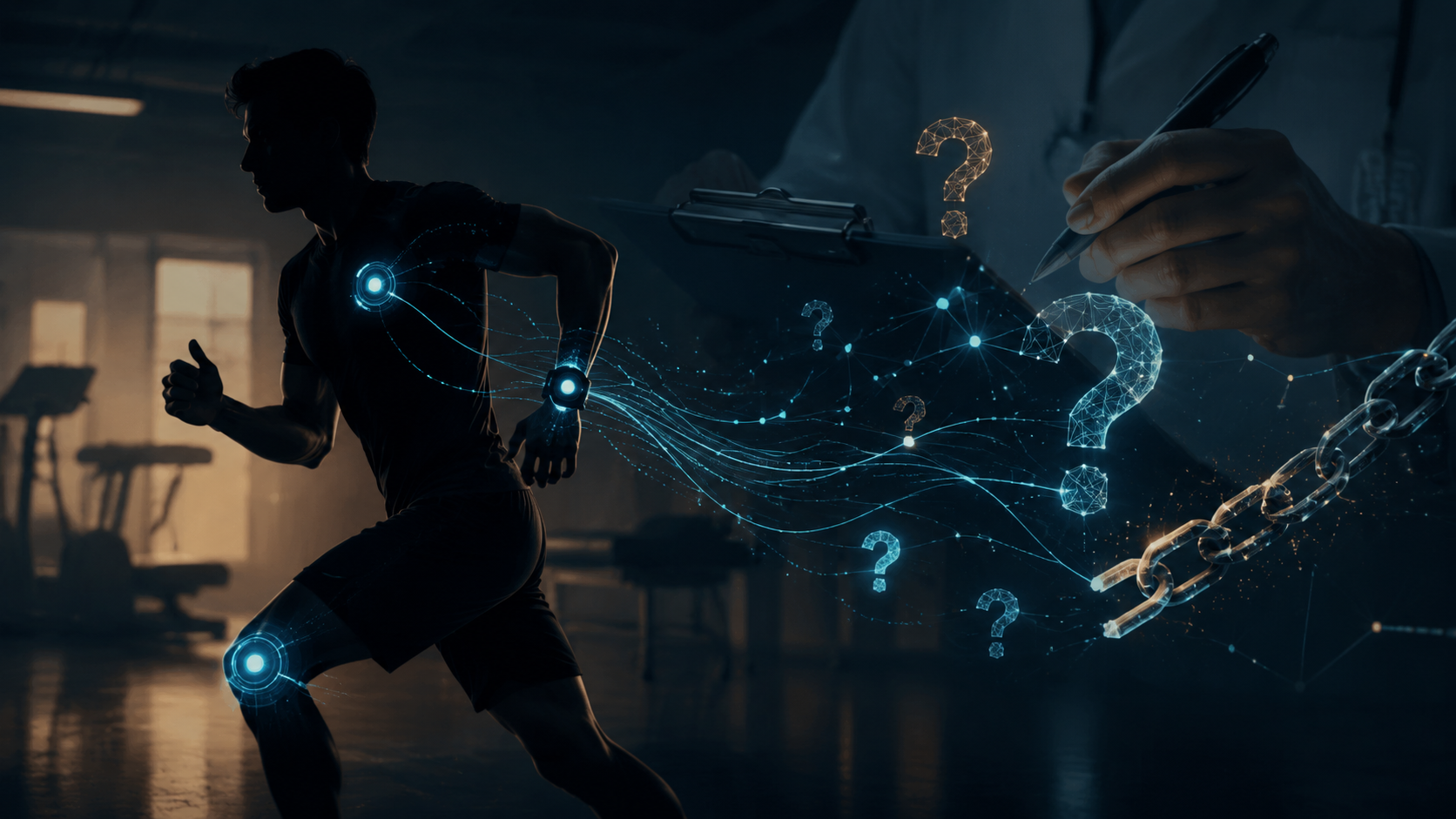
The hard moment for AI in sports injury treatment and recovery is not when a wearable collects clean movement data in a lab. It is when a risk flag appears before training, and someone has to decide whether it changes load, rehab progression, or return-to-sport clearance. At that point, “prediction” stops being a model output and becomes a clinical responsibility.
That distinction matters because the current evidence is impressive and thin in different places. A 2026 scoping review in BMC Medical Informatics and Decision Making found 97 studies using AI methods in musculoskeletal sports medicine; 70.1% were in orthopaedics, 57.7% involved predictive models, and reported AUC values ranged from 0.57 to 0.985. Yet only 4 studies used external validation datasets, and only 1 tested a prospective feedback-based intervention.[1]
That is the maturity gap in one sentence: AI wearables can produce compelling injury-risk signals, but the evidence base rarely shows that those signals travel safely beyond the athletes, devices, settings, and study designs that created them.
Why the technology is tempting
Wearable-AI systems are attractive because they make parts of sport visible that clinicians used to infer indirectly. Inertial measurement units can describe movement and loading patterns. Surface EMG can capture muscle activation. Heart-rate variability monitors can contribute autonomic and fatigue-related signals. Flexible electronics can extend monitoring into form factors that interfere less with training.[2]
The modeling layer is just as varied. Reviews of wearable sensors and AI describe approaches ranging from Random Forest and XGBoost to LSTMs, Transformers, and graph neural networks.[2] The practical difference is not simply “old” versus “new.” Tree-based models often fit structured, smaller, messier sport datasets with more tractable interpretation. Deep learning architectures may extract temporal or multimodal patterns that simpler models miss, but they usually demand more data, cleaner pipelines, and more careful validation before their outputs can be trusted in a training room.
The strongest benchmarks explain the excitement. Reported examples include a Bi-LSTM approach for ACL prediction reaching 96.5% MRI accuracy, XGBoost used for fatigue-related injury stratification with HRV and EMG inputs, and multimodal Transformer modeling for stress fracture risk.[2] Those numbers and examples are useful signals of technical possibility. They are not, by themselves, proof that a model should determine whether an athlete trains today.
The evidence problem starts after the model performs well
Within-sample performance answers a narrow question: can the model find patterns in data drawn from the same study environment? Clinical utility asks a harder set of questions. Will the model still work with a different team, a different wearable, a different sport, a different injury definition, and a different staff member interpreting the output under time pressure?
The Lindskog review makes that distinction difficult to ignore. Across 97 included studies, only 4 used external validation datasets.[1] External validation is not a decorative statistical extra. It is the basic test of whether a model has learned something portable rather than something local to a dataset, device, cohort, labeling practice, or lab protocol.
The prospective evidence is even thinner. Only 1 study in the review tested a prospective feedback-based intervention.[1] That means the field has far more evidence that models can classify or predict outcomes retrospectively than evidence that acting on those predictions improves injury prevention, rehabilitation management, or return-to-sport decisions.
This is where a clean model metric can mislead a clinical buyer. An AUC or accuracy estimate may describe discrimination inside a study. It does not show whether staff will follow the alert, whether athletes will tolerate the monitoring, whether coaches will change load, whether false positives will unnecessarily restrict participation, or whether false negatives will create false reassurance.
For a broader view of how this same evidence base affects sports medicine AI readiness, see Is AI Ready for Sports Medicine and Injury Recovery?. The wearable-specific issue is sharper: prediction depends not only on the model, but also on the sensor pipeline that feeds it.
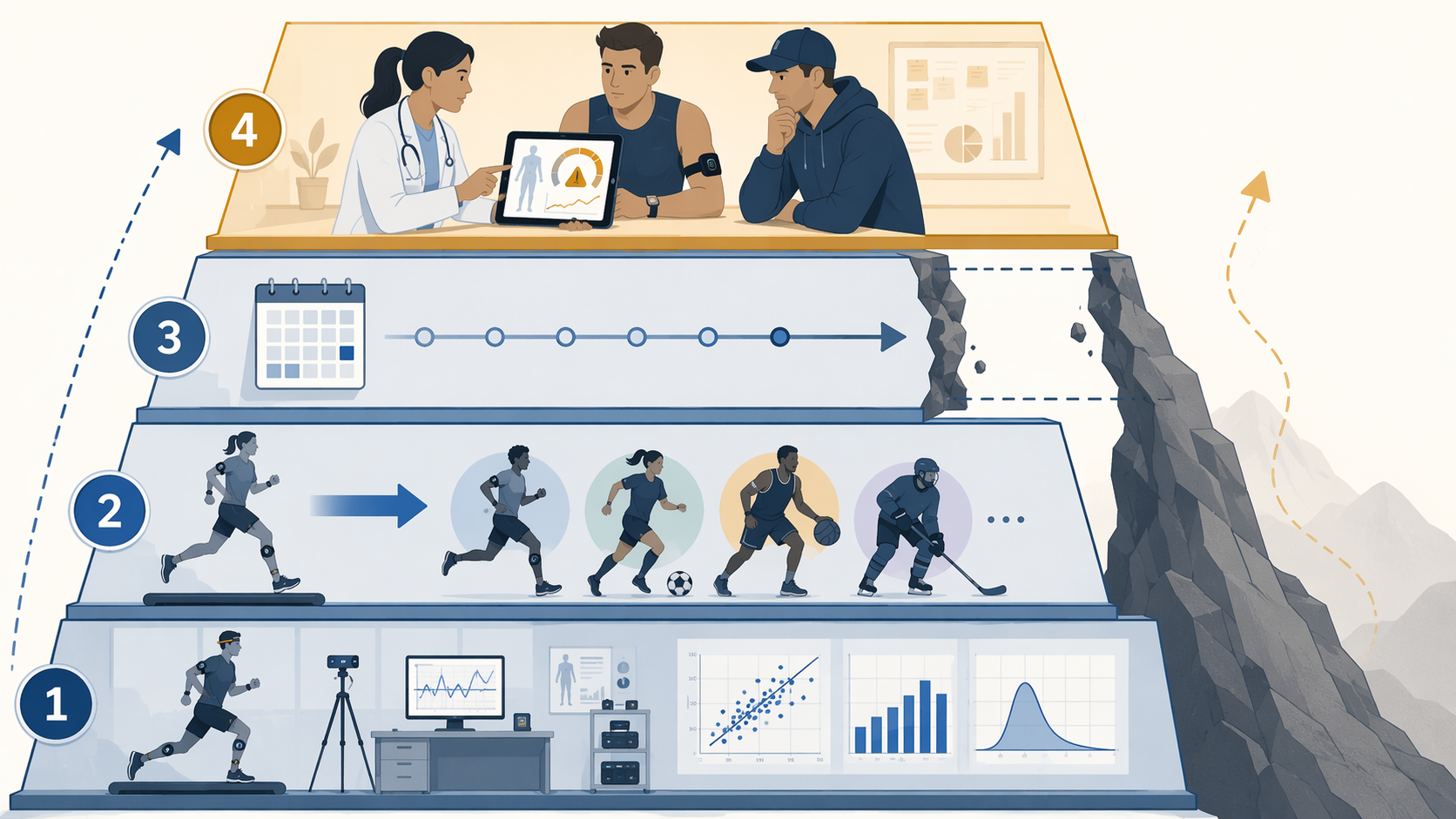
A readiness ladder for wearable-AI injury prediction
A useful evaluation starts with the least forgiving question and moves upward. The point is not to reject every tool that lacks perfect evidence. It is to decide what the tool is mature enough to do: support observation, guide discussion, trigger closer assessment, or influence a training and recovery decision.
| Readiness question | What it tells a clinician |
|---|---|
| Was the model externally validated? | Whether performance survived contact with data outside the original development setting. |
| Did it work across athletes, devices, sports, and settings? | Whether the signal is likely to generalize beyond a narrow cohort or sensor setup. |
| Was it tested prospectively? | Whether the model was evaluated in a forward-moving workflow rather than only against historical labels. |
| Did acting on the signal improve decisions or outcomes? | Whether the alert has evidence of clinical utility, not just predictive performance. |
| Can clinicians understand the signal enough to act responsibly? | Whether staff can explain, challenge, and contextualize the recommendation. |
| Does it fit real workflow and data infrastructure? | Whether monitoring, data transfer, review, and documentation can happen reliably. |
External validation comes first
If a wearable-AI model has not been externally validated, its best use is usually exploratory or adjunctive. It may help researchers generate hypotheses. It may help a clinical team notice patterns worth discussing. It should not carry the authority of a portable injury predictor.
The reason is simple and uncomfortable: sport datasets are local. A model trained on one population may encode the movement habits, training schedules, injury labels, imaging practices, or device characteristics of that environment. The Lindskog review’s finding that only 4 of 97 studies used external validation shows that the field has not yet done enough of the work required to separate generalizable signal from local fit.[1]
Generalizability is more than a larger sample
A larger dataset helps only if it broadens the right sources of variation. Wearable injury prediction has to survive differences in sport, sex, age, competition level, training surface, equipment, clinical definitions, and sensor placement. It also has to survive different manufacturers and data formats. A knee-mounted IMU signal from one system is not automatically interchangeable with another device’s processed output.
The research base also appears concentrated in higher-resource environments, including the USA, China, and the EU.[1] That does not invalidate the findings. It does mean the evidence should be applied cautiously in lower-resource settings, in clubs with fewer staff, and in programs where device maintenance, athlete compliance, and data review capacity are less stable.
This is also where commercial claims can get ahead of the literature. A model may be trained on impressive internal data and still lack independent evidence that it performs across sports medicine settings. For a closer look at that validation problem, see Why AI in Sports Injury Prevention Still Lacks Validation.
Prospective testing is the line between prediction and practice
Retrospective prediction can be useful science. It can show that certain movement, fatigue, or load signals were associated with later injury labels. But return-to-sport and injury-prevention decisions unfold forward. Staff see incomplete information, athletes have incentives to underreport symptoms, coaches have roster constraints, and the meaning of a risk score changes once people begin acting on it.
That is why the single prospective feedback-based intervention in the Lindskog review matters so much.[1] The issue is not that every model must immediately prove reduced injury rates before it can be studied in clinics. The issue is that a model used to alter training or rehab progression should eventually be tested in the kind of workflow where those decisions actually occur.
A prospective study can reveal failure modes that retrospective classification hides: alerts that arrive too late, risk categories that clinicians cannot translate into action, monitoring fatigue among athletes, missing data during travel, and disagreements between model output and physical examination.
Interpretability matters when the output changes an athlete’s day
A black-box model may be acceptable for low-stakes pattern detection. It is harder to defend when its output could reduce training, delay return, or change a rehabilitation plan. Clinicians do not need every coefficient memorized, but they do need enough explanation to know whether the signal is plausible: fatigue, asymmetry, workload change, neuromuscular activation, recovery trend, or something that looks like device noise.
This is one reason tree-based methods deserve practical respect even when deep learning produces stronger controlled-setting benchmarks. Random Forest and XGBoost models can be easier to interrogate in structured datasets, especially when teams need to understand which variables are influencing a risk category. Deep learning systems may still be appropriate, particularly for temporal or multimodal streams, but they carry a higher burden to explain why their output should be trusted.
Workflow can break a good model
Even a validated model can fail operationally. Dong et al. describe barriers including athlete compliance below 70%, device heterogeneity, limited generalizability across sports and settings, and insufficient interpretability for clinical users.[2] Those are not secondary implementation details. They directly affect whether the model sees enough reliable data to make a meaningful prediction.
A team can lose signal at several ordinary points: the athlete does not wear the device consistently, the sensor shifts during sport-specific movement, the vendor exports a proprietary format, the performance staff reviews the dashboard but the medical record never receives the relevant context, or the model flags risk without telling the clinician what action would be reasonable.
That pipeline problem is why wearable prediction cannot be separated from health IT. For the data-integration side of the question, see Why wearable data needs AI middleware to reach the EHR. A risk score that never reaches the right reviewer, or arrives without context, is not a clinical tool in any meaningful sense.
What clinicians can trust today
The most defensible use of AI wearables today is decision support, not autonomous prediction. A wearable-AI system can help identify athletes who deserve closer assessment, surface changes in fatigue or movement patterns, support longitudinal rehabilitation monitoring, or prompt a staff conversation about load. It should be interpreted alongside examination findings, athlete-reported symptoms, imaging when relevant, strength testing, sport demands, and the clinician’s knowledge of the athlete.
The less defensible use is treating a risk score as a stand-alone answer. A model that has not been externally validated should not independently determine return-to-sport status. A model that has not been prospectively tested should not be assumed to prevent injuries simply because it classified risk well in historical data. A model that cannot explain its signal should not be allowed to create an unexplained restriction that a clinician then has to defend.
For readers comparing model families and study-design limitations in injury prediction more broadly, How Reliable Is AI for Sports Injury Prediction? is the adjacent evidence question. The wearable layer adds another dependency: the model is only as reliable as the sensor data and workflow that produce its inputs.
The right standard is higher than technical promise
Digital twins, federated learning, and explainable AI are reasonable directions for the field. Digital twin frameworks could help model individual adaptation over time. Federated learning could let institutions collaborate without pooling raw athlete data. Explainable AI could make complex multimodal systems more usable for clinicians.[2] None of those directions changes the present evidentiary threshold.
The current literature supports a bounded conclusion. AI wearables are already useful research instruments and plausible clinical adjuncts in sports injury treatment and recovery, especially when their outputs are reviewed by clinicians who understand the athlete and the limits of the model. They are not yet mature autonomous predictors for injury prevention, rehabilitation progression, or return-to-sport decisions. The gap is not ingenuity. It is validation.
References
- Artificial intelligence in sports medicine: a scoping review. BMC Medical Informatics and Decision Making, 2026.
- Wearable sensors and artificial intelligence for sports injury prevention and rehabilitation. PMC, 2026.
Comments
Join the discussion with an anonymous comment.