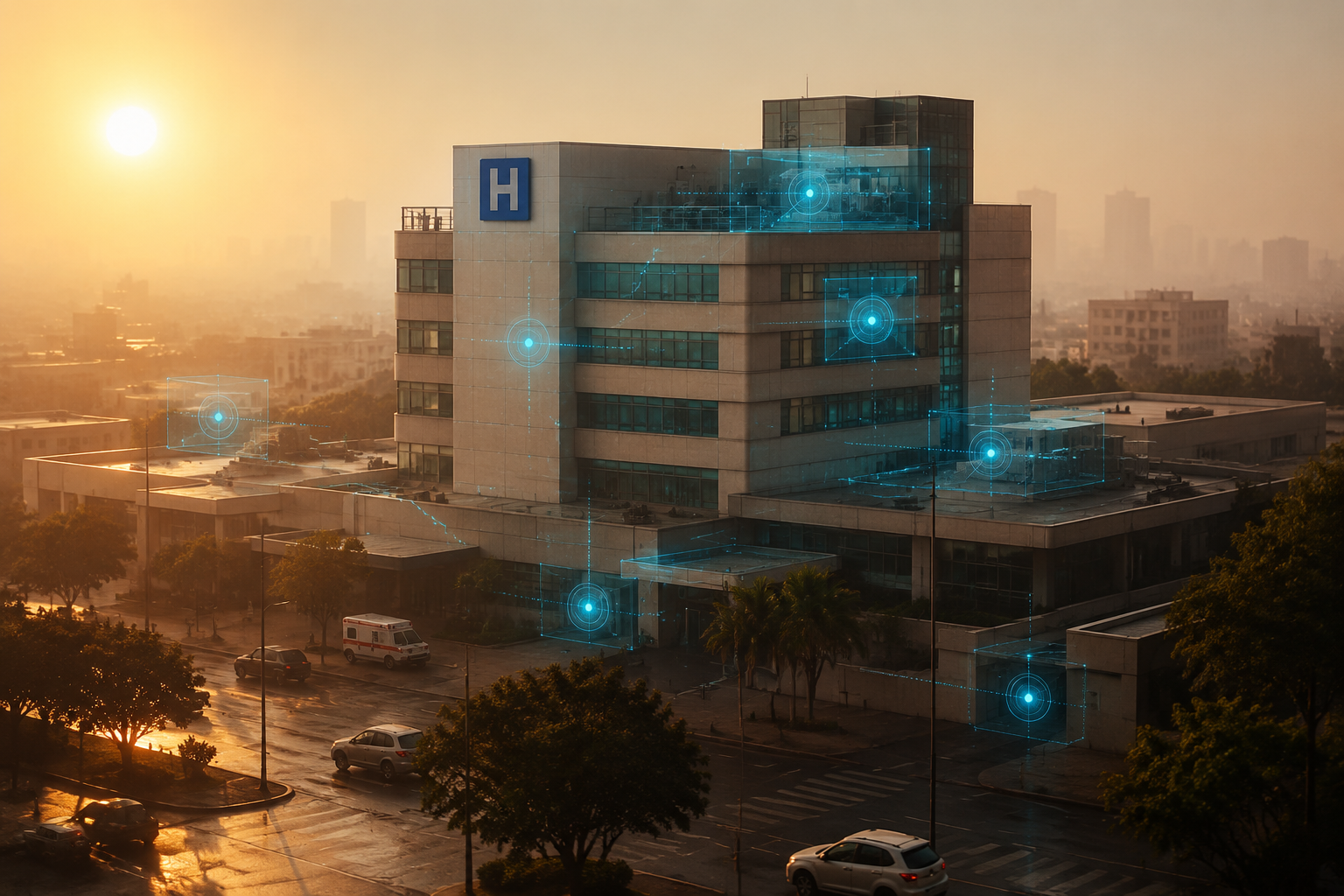
The 2021 Pacific Northwest heat dome is a useful place to start because it was not just a weather story. It was a hospital operations story. During the event, contingency plans built around familiar heat scenarios ran into conditions outside their reference envelope. The failures were not abstract: CT and MRI cooling systems became vulnerable, emergency departments faced pressure that was not matched by timely mass-casualty declaration, and leaders had to make escalation decisions without a clean precedent for the combined stress on clinical, facilities, staffing, and communications systems.[1]
That is the problem hidden inside many discussions of AI weather warning systems for public health emergencies. A forecast that says “extreme heat is coming” is not yet a hospital action plan. The useful question is narrower and harder: which hospital subsystem will cross a meaningful threshold first, who will see it, what action will be triggered, and how will that decision be defended after the event?
Where Scenario Planning Breaks
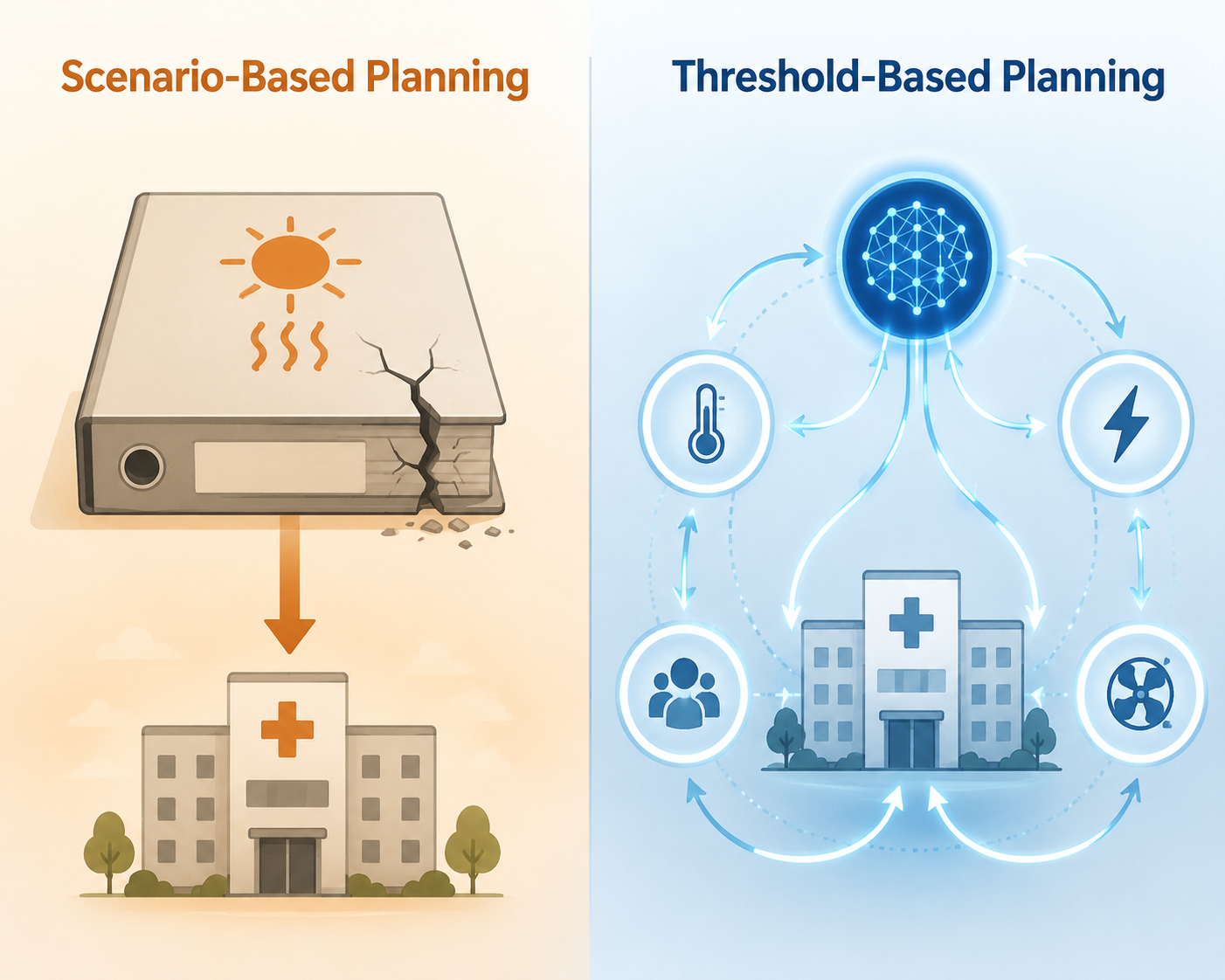
Scenario-based contingency planning has a legitimate place. It helps organizations rehearse roles, clarify notification chains, and expose obvious gaps before an incident. But its strength is also its weakness: it depends on recognizable reference scenarios. A heat plan, a smoke plan, an outage plan, and a surge plan can each look adequate in isolation while the real event arrives as a compound stressor.
The Nature npj Digital Medicine paper on agentic AI and hospital weather resilience describes this as a structural problem for “climatic black swans,” meaning extreme weather events that exceed the scenarios planners used as anchors.[1] The phrase matters less than the operational consequence. When the event is outside the planning envelope, staff are not merely missing a better checklist. They are trying to infer, under time pressure, which assumptions in the checklist have already failed.
In a hospital, those assumptions are scattered. Imaging suites depend on cooling. Medication storage depends on temperature control. Staff availability depends on roads, schools, family obligations, and fatigue. Ambulance diversion depends on neighboring facilities, not only on the hospital’s own census. Public messaging affects when people come in and what they expect when they arrive. Executive declaration of an emergency posture changes authority, resource use, and tolerance for disruption.
A tabletop exercise can name many of those pieces. It rarely keeps them visible together as they move. That is why the heat dome example is so uncomfortable: the critical issue was not a single missing hazard forecast. It was the inability of a scenario-based plan to track cascading operational thresholds across the hospital while the event was still evolving.[1]
Threshold-Based Planning Changes the Unit of Attention
Threshold-based planning, or TBP, shifts the center of planning from named scenarios to measurable limits. Instead of asking whether the hospital is in the “heat-wave scenario,” the system asks whether specific clinical, facilities, staffing, logistics, and governance thresholds are approaching or crossing conditions that require action. The Nature paper presents TBP as a proposed framework for hospitals using agentic AI, not as an already deployed emergency-management product.[1]
The distinction is important. Threshold thinking itself is not new. Humanitarian anticipatory action has long used forecasts and pre-agreed triggers to move resources before harm peaks. Columbia’s National Center for Disaster Preparedness frames AI as part of a broader movement toward early warning systems and anticipatory action, where forecasts become operational commitments rather than passive alerts.[2] The hospital-specific contribution of TBP is to push that logic inside the building and across subsystems that usually live in different dashboards, departments, and escalation cultures.
| Planning question | Scenario-based contingency planning | Threshold-based planning |
|---|---|---|
| What starts the response? | A recognized event type or scenario | A monitored operational threshold approaching or crossing a limit |
| What gets watched? | The scenario playbook and assigned roles | Subsystem conditions across clinical operations, facilities, staffing, logistics, and governance |
| What changes during the event? | Staff adapt the plan manually as assumptions fail | The system updates recommended actions as thresholds and dependencies change |
| What must be explainable afterward? | Whether staff followed or deviated from the plan | Why a threshold mattered, what recommendation followed, and who accepted responsibility |
An agentic AI system, in this context, is not just a model that produces a heat-risk score. It is a software architecture that can monitor inputs, compare them with goals and thresholds, generate or revise plans, and recommend actions across multiple steps. The promise is not that the AI “knows” emergency management better than the people in the command center. The promise is that it may keep more dependencies in view than a stressed team can hold at once.
What a Hospital AI Weather Warning System Would Actually Monitor
The practical version of TBP begins with a threshold database. That database would need to describe the conditions under which hospital assets, workflows, and governance processes become unsafe, degraded, or unavailable. For heat, that could include thermal tolerances for equipment, cooling capacity assumptions, indoor temperature limits for patient-care areas, staffing trigger points, supply-chain constraints, ambulance diversion criteria, and escalation thresholds for declaring an altered operating posture. The Nature paper emphasizes that such a database would have to cover hospital subsystems rather than only the external hazard.[1]
That is a different kind of warning system from a public alert or a weather dashboard. The weather input still matters, but the hospital does not run on weather variables alone. It runs on chiller performance, generator assumptions, imaging availability, bed flow, nurse staffing, vendor access, communications capacity, and executive decision authority. A warning system that cannot translate climate signals into those operational terms will be admired and then ignored.
In a hypothetical heat event, the system might detect that forecast conditions are approaching a level associated with cooling stress in a particular facility zone. It would not need to wait for the emergency department to be overwhelmed before recommending protective action. It could flag the imaging dependency, show which clinical services rely on that equipment, identify the staffing groups affected if imaging throughput slows, and prompt leadership to consider escalation before the loss becomes visible as patient backlog.
The hypothetical matters because it shows both the appeal and the burden of TBP. The system is not simply predicting heat. It is creating an argument for action. That argument has to be specific enough for an emergency physician, a facilities director, an incident commander, and an administrator to recognize the same risk from their different seats.
The Thresholds Are Not Only Technical
Some thresholds belong to machines: temperature, cooling load, backup power, network availability, equipment function. Others belong to organizations: when to stop elective procedures, when to open surge space, when to request mutual aid, when to activate crisis communications, when to declare a mass-casualty or similar emergency posture. The 2021 heat dome case is instructive because under-declaration was part of the operational failure described in the Nature paper.[1]
Hospitals often treat declaration thresholds as leadership judgment, and they should. But judgment improves when the underlying conditions are visible. If an AI system recommends a higher emergency posture, the useful output is not a dramatic alert. It is a traceable chain: which thresholds are threatened, what dependencies are likely to be affected, what actions are available, what tradeoffs those actions create, and which human authority must decide.
Early Warning Is Already Moving in This Direction
The broader early-warning field is not waiting for hospitals to solve this on their own. The WHO Foundation has described the failure to connect climate predictions with health risks as a missed opportunity for health resilience.[3] United Nations University describes AI contributions across hazard monitoring, impact forecasting, risk communication, and anticipatory action.[4] Those categories map well to the hospital problem, but they do not solve the last mile.
Hazard monitoring can identify the external threat. Impact forecasting can estimate likely consequences. Risk communication can move warnings to the people who need them. Anticipatory action can commit resources before the worst point of the event. Inside a hospital, however, the difficult work is translating those functions into local thresholds and accountable operational moves.
A heatwave preparedness review in Springer also places AI-based preparedness within the larger discussion of sustainable healthcare and heat-related health impacts.[5] That kind of review is useful context, especially for institutions still treating extreme heat as a seasonal nuisance. But for hospital resilience leaders, the sharper test is whether an AI-supported system can identify the point at which a manageable weather event becomes a clinical operations failure.
The Hard Part Is Making the Recommendation Defensible
Explainability is the first barrier because hospital emergency decisions are reviewed after the fact. A model that says “escalate now” without a reasoned account will not survive contact with clinicians, executives, regulators, or lawyers. The Nature paper identifies explainability as a significant implementation challenge for agentic AI in this setting.[1] The challenge is sharper than it is for a single prediction model because an agentic system may make dynamic, multi-step recommendations as conditions change.
A defensible recommendation needs more than a confidence score. It should expose the triggering thresholds, the data sources used, the assumed dependencies, the available alternatives, and the expected operational consequences. If the system recommends diverting ambulances, delaying imaging, moving patients, pre-positioning staff, or declaring an emergency posture, the hospital must be able to reconstruct why that recommendation appeared when it did.
This is where many AI conversations become too casual. In a crisis review, “the AI recommended it” is not an explanation. It is a liability exposure. The explanation has to be understandable to people who were not watching the dashboard during the event and who may be judging the decision with the benefit of hindsight.
Legacy Systems Decide Whether the Architecture Is Real
Integration is the second barrier. TBP depends on current information from hospital systems that were not necessarily designed to talk to one another: facilities management, electronic health records, bed management, staffing platforms, supply systems, imaging operations, incident command tools, communications systems, and external weather or hazard feeds. The Nature paper flags legacy integration as one of the major challenges for operational use.[1]
If those connections are brittle, delayed, or manual, the agentic layer becomes theater. A hospital cannot dynamically adjust preparation around cooling thresholds if facilities data arrive late or are not trusted. It cannot model staffing strain if staffing systems show scheduled coverage but not actual availability. It cannot recommend diversion or surge actions responsibly if it lacks visibility into neighboring capacity and internal bottlenecks.
This is also why procurement language matters. Buying an “AI resilience platform” is not the same as building operational visibility. The threshold database, data feeds, alert governance, downtime procedures, and human approval paths are part of the system. Without them, the AI layer has little to act on and less to explain.
Goal Alignment Is Not a Philosophical Detail
An agentic system needs goals. In hospital resilience, those goals can conflict. Protecting imaging capacity may compete with patient throughput. Preserving staff safety may reduce available surge staffing. Avoiding ambulance diversion may increase internal crowding. Delaying elective activity may protect emergency capacity while creating downstream clinical and financial consequences.
The Nature paper identifies goal alignment as a challenge for agentic AI in this setting.[1] That is not a theoretical worry. If the system is optimized around the wrong objective, it may recommend actions that look efficient in one subsystem while worsening another. Hospitals already live with these tradeoffs; TBP would make some of them more explicit. That is useful only if leadership has agreed in advance which objectives dominate under which conditions.
The right governance question is not whether the AI is allowed to decide everything. It should not be. The question is which recommendations can be automated, which require human confirmation, which require incident command approval, and which require executive authorization because they change the institution’s risk posture.
Trust Will Be Built in Boring Places
Organizational trust will not come from a polished command-center screen. It will come from repeated evidence that the system knows local reality. Does it understand that one imaging unit is more vulnerable than another? Does it know which units overheat first? Does it distinguish planned staffing from actual coverage? Does it show when a recommendation is based on strong data and when it is extrapolating from incomplete feeds?
Hospitals should expect skepticism from the people who will carry the consequences of an AI-supported recommendation. Emergency physicians will want to know whether escalation came too late. Facilities teams will want to know whether equipment tolerances were modeled correctly. Administrators will want to know whether the system created a defensible record. Those are not adoption barriers to be “managed.” They are design requirements.
Liability Cannot Be Left Until After Deployment
Liability is the barrier that tends to arrive last in product demonstrations and first after a bad outcome. If an AI-supported system recommends an action that worsens a downstream constraint, who owns the decision? The vendor that built the model, the hospital that configured the thresholds, the leader who accepted the recommendation, or the department that supplied incomplete data?
The research-stage nature of TBP makes that question more urgent, not less. The Nature paper presents a plausible architecture for unprecedented weather preparedness, while also identifying liability as an implementation challenge.[1] Before deployment, hospitals would need decision logs, approval rules, model-change controls, downtime procedures, and clear responsibility for threshold maintenance.
What Would Have to Change Inside the Hospital
For AI weather warning systems to become useful in public health emergencies, hospitals would have to do work that is less glamorous than AI but more important than any model demo. They would need to inventory operational thresholds, validate them with clinical and facilities staff, connect live data feeds, define escalation authority, and rehearse AI-supported recommendations the same way they rehearse human command decisions.
- Build and maintain a hospital-specific threshold database for relevant hazards, starting with the subsystems most likely to fail under local conditions.
- Separate warning thresholds from action thresholds, so staff know when to watch, when to prepare, and when to change operations.
- Connect thresholds to named decision owners rather than leaving alerts to circulate without authority.
- Require explanations that show data sources, assumptions, dependencies, and alternatives for major recommendations.
- Test the system against compound events, not only the clean scenarios already covered in binders.
Different hazards would require different threshold databases. The heat dome case does not prove that the same thresholds would work for floods, wildfires, smoke events, winter storms, or outages. It does show why a single reference scenario is too thin for events that move through hospital infrastructure, staffing, patient demand, and governance at the same time.[1]
The serious claim for agentic AI is therefore limited but meaningful. It can help hospitals move from static scenario binders toward dynamic operational awareness if it is grounded in trustworthy thresholds and connected to real systems. It is not yet a finished answer to climatic black swans. It becomes a serious alternative only when its escalation logic is specific enough to act on during the event and explainable enough to defend afterward.
References
- Agentic AI can help hospitals prepare for unprecedented weather, npj Digital Medicine, 2026
- AI for Early Warning Systems and Anticipatory Action, Columbia National Center for Disaster Preparedness, 2026
- AI for Health Resilience, WHO Foundation, 2025
- 5 Ways AI Can Strengthen Early Warning Systems, United Nations University, 2025
- A comprehensive study of health impacts of heatwaves and AI-based preparedness for sustainable healthcare, Springer, 2026
Comments
Join the discussion with an anonymous comment.