
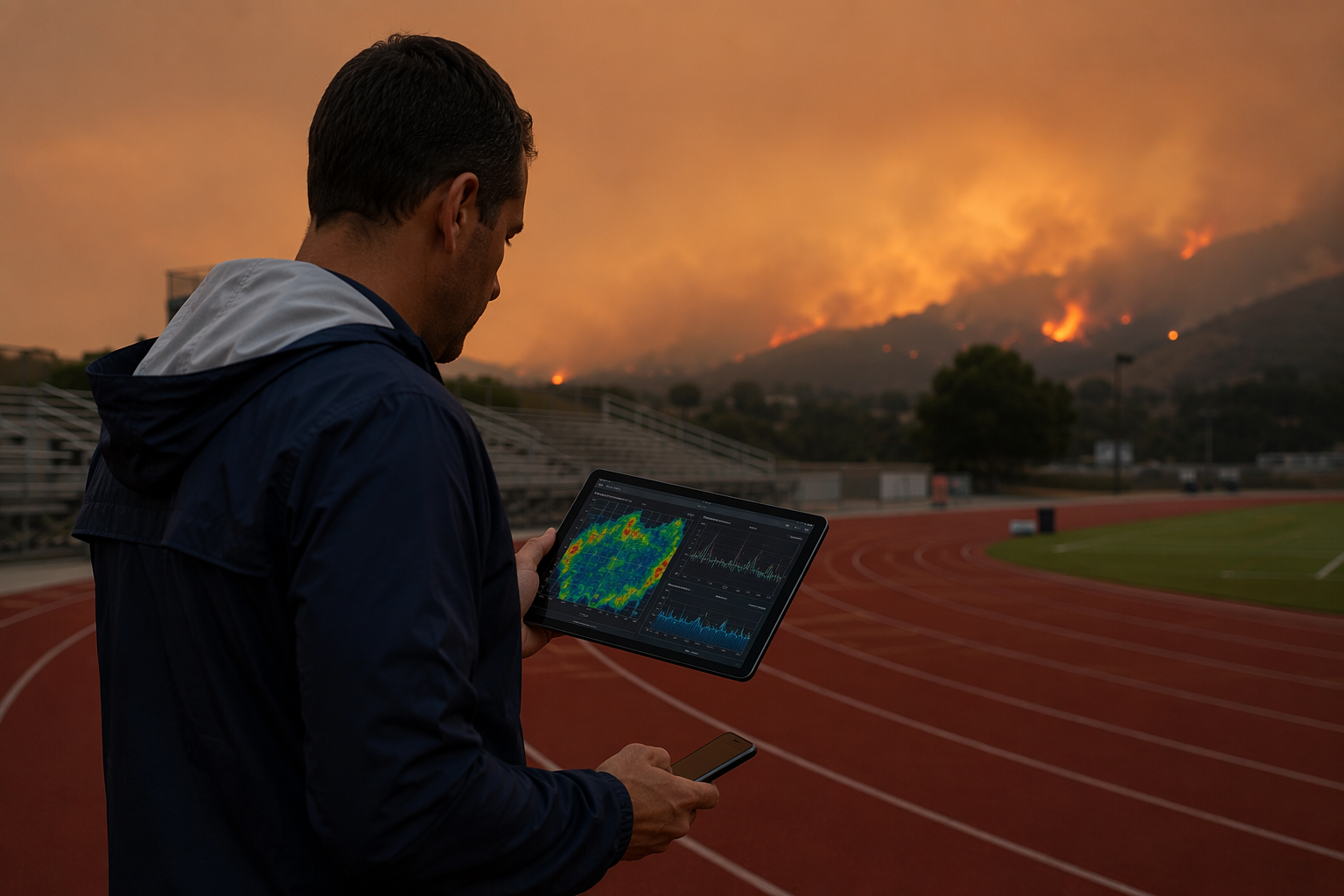
The hard part is not noticing that smoke is in the air. The hard part is deciding what to do at 6:20 a.m., when a regional AQI feed looks tolerable, a sensor closer to the track is drifting upward, a cleaner route may exist a few miles away, and athletes are already warming up. A coach can move a tempo run indoors, shorten intervals, reroute cyclists, delay rowing practice, or cancel. Each choice has a cost. The impact of wildfire smoke on athlete health and performance becomes an operational problem before it becomes a publishable clinical endpoint.
That is where AI air-quality forecasts, hyperlocal sensors, and wearables are useful, but not in the same way. Forecasting models try to predict where smoke will move. Local sensors show what is happening near a facility or route. Wearables attempt to capture how an individual body is responding. Together, they can make a training-day decision less blind. They do not yet prove that a tool-guided decision protects athlete health or preserves performance.
Three Tools, Three Different Decisions
A useful smoke workflow separates the tools by the decision they can plausibly support. Forecasts help staff plan the next day or the next training block. Hyperlocal sensors help decide whether the current venue or route is acceptable. Wearables may help flag unusual physiological strain in an individual athlete. Treating all three as one “AI solution” is how organizations buy impressive dashboards without knowing who is supposed to act on them.
| Tool type | What it can improve | What it does not prove |
|---|---|---|
| Environmental AI forecasting | Planning around expected smoke movement before a session | That the forecast is accurate during extreme wildfire smoke or clinically actionable for athletes |
| Hyperlocal PM2.5 sensors | Detecting local variation near tracks, fields, boathouses, roads, and routes | That low-cost readings match reference monitors without calibration and correction |
| Wearables | Capturing individual physiological signals during or around smoke exposure | That algorithms remain accurate during smoky, high-intensity exercise or that interventions improve outcomes |
The difference matters because athlete exposure is not only a city-level condition. It is a combination of location, intensity, duration, ventilation rate, indoor filtration, travel, and timing. A regional monitor can be correct for its location and still be the wrong basis for a runner doing repeats near a smoke pocket or a cyclist descending into a valley where particulates have settled.
Forecasting Is Better Than Guessing, But Smoke-Specific Validation Matters
AI forecasting is most attractive when staff still have time to change the plan. If a model suggests that smoke will thicken over a training area by late afternoon, an operations lead can move an outdoor session earlier, reserve indoor space, shift location, or reduce the intensity target. The tool is valuable because it changes work before athletes arrive.
The procurement trap is assuming that a general air-quality AI forecast performs well when the atmosphere is dominated by wildfire smoke. A 2024 MIT evaluation found that AI models not trained on wildfire-specific data can produce inaccurate forecasts during extreme smoke events.[1] For sports organizations, that is not a minor technical footnote. The days when a forecast is most consequential are also the days when a poorly matched model may be least trustworthy.
A better direction is domain-specific modeling. The University of Utah reported in 2025 that its scientists developed an AI-powered wildfire-smoke forecasting tool that combines physics-based predictive analytics with machine learning, and that the hybrid approach improved accuracy over either method alone.[2] That does not make it an athlete-health tool. It does suggest why wildfire smoke should be modeled as a physical, chemical, and meteorological event rather than treated as another generic prediction problem.
For an athletic department, the practical questions are specific: Was the model trained and tested on wildfire-smoke events similar to the ones the team faces? How is it calibrated against local measurements? Does performance degrade during extreme events? Can staff see uncertainty, or only a clean-looking map? Does the system account for the places athletes actually spend time, including indoor facilities and transit? If those answers are missing, the forecast may still help with awareness, but it should not be described as a validated protection strategy.
The Case for Trackside and Route-Level Sensors
Hyperlocal sensors are less glamorous than AI forecasts, but they are often closer to the decision. World Athletics has committed to installing 1,000 air-quality sensors at athletic tracks worldwide, and the University of Oregon’s Hayward Field already hosts both a Kunak sensor associated with World Athletics and a PurpleAir sensor.[3] That is the kind of infrastructure that can make a smoke discussion less abstract for the people deciding whether to train at a particular venue.

The operational value is straightforward. A regional monitor may say conditions are acceptable, while a trackside sensor shows a worse local pocket. Or the reverse may happen: a regional reading may look poor while a specific route or facility is materially cleaner. PurpleAir has described crowdsourced hyperlocal sensor data showing AQI variations of more than 50 points within a few miles, which can help athletes identify cleaner training routes that official monitoring stations would not capture.[4]
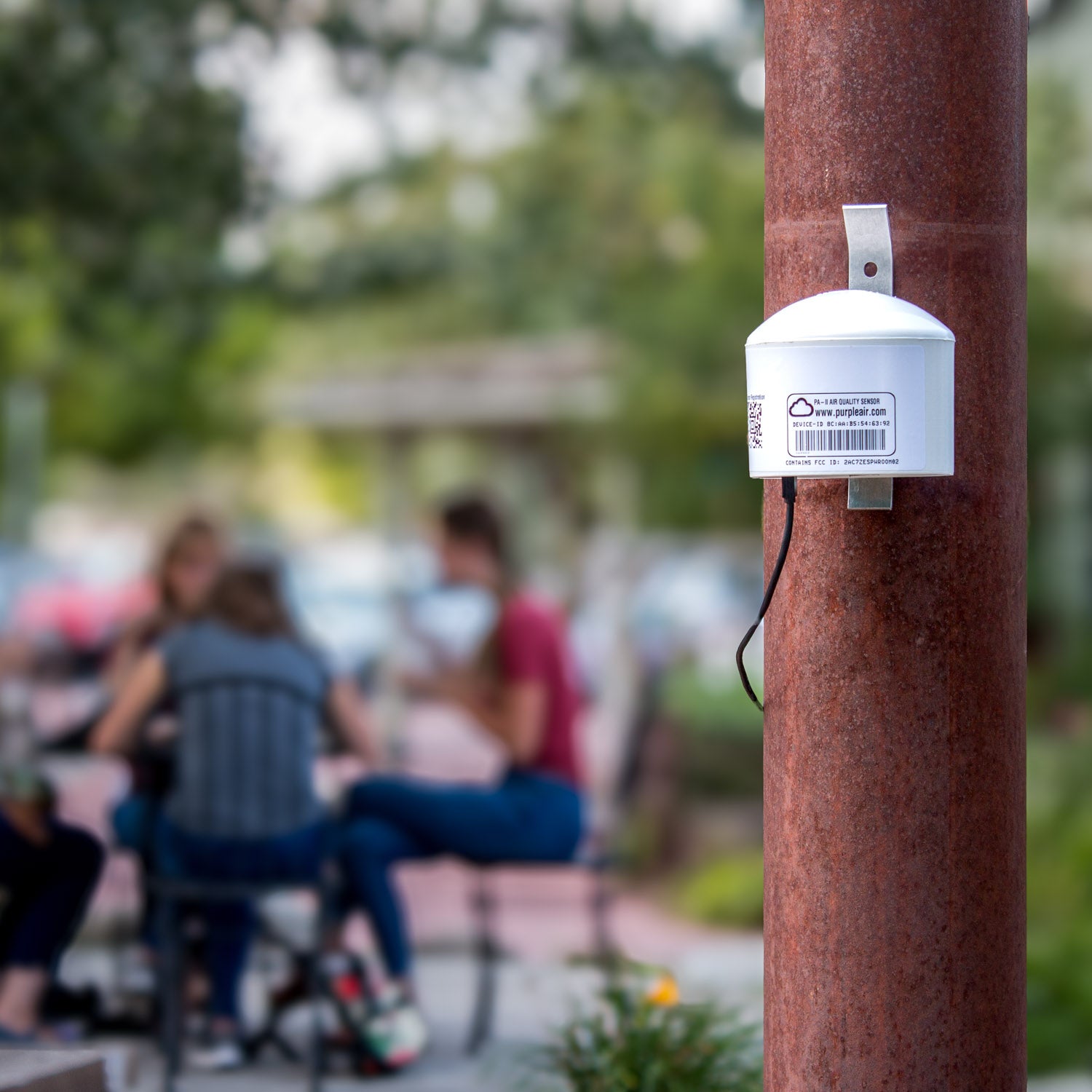
That kind of variation is exactly why regional AQI alone feels too blunt for endurance training. A few miles can be the difference between running into a plume and choosing a cleaner loop. It can also determine whether a team starts warmups outdoors, holds athletes inside, or changes the order of a session.
The limitation is measurement quality. Government reference monitors and low-cost sensors do not use identical measurement standards, and low-cost sensor readings may require correction factors. Those factors can vary with smoke composition. A sensor map with dense dots can therefore give a false sense of precision if the organization has not thought through calibration, siting, maintenance, and how readings will be interpreted alongside official guidance.
The practical answer is not to ignore low-cost sensors. It is to treat them as local situational-awareness tools, not as stand-alone clinical instruments. Their strongest use is comparative: Which venue is worse right now? Is the track trending upward? Is a route consistently cleaner than another route nearby? Those questions can change training operations without pretending that the sensor has diagnosed risk in an individual athlete.
Wearables Get Closer to the Athlete, But Not Yet to a Clinical Decision Rule
Wearables are the most tempting part of the workflow because they seem to answer the question staff actually care about: how is this athlete responding? The evidence is moving in that direction, but it is not there yet.
A 2025 study in Circulation: Arrhythmia and Electrophysiology used two wearable devices simultaneously to capture real-time individual wildfire PM2.5 exposure and correlate that exposure with resting heart rate. It has been described as the first wearable-enabled wildfire health monitoring study of its kind.[5] That is important because it moves beyond ambient exposure at a distant monitor and begins to pair individual exposure with a physiological signal.
But correlation with resting heart rate is not the same as an athlete-specific intervention threshold. It does not show that a coach who changes a workout based on wearable readings prevents symptoms, reduces cardiopulmonary risk, improves recovery, or preserves performance. It also does not settle whether the same algorithms remain accurate when an athlete is exercising hard in smoky air, sweating, changing posture, and moving through variable microenvironments.
The MDPI Sensors 2025 field-testing study is also relevant because it tested multi-parametric wearable technologies during wildfire events and captured cardiac, respiratory, and environmental data simultaneously.[6] That kind of combined capture is closer to the data structure sports medicine staff would want: exposure plus physiological response rather than exposure alone.
Still, field capture is not clinical validation. Most wearable algorithms for heart rate, respiratory rate, and related metrics were developed and validated in cleaner conditions, not necessarily during the combined stress of wildfire smoke and high-intensity exercise. A device can be directionally useful for flagging strain and still be unfit to decide whether a specific athlete should continue a maximal workout.
What These Tools Miss
The most obvious blind spot is total exposure. A runner may spend the session on a relatively clean route, then ride in a poorly filtered vehicle, sit in an indoor facility without adequate filtration, or sleep in housing where smoke infiltrates. Most monitoring setups capture outdoor location-specific conditions better than they capture the full exposure day.
The second blind spot is intensity. The same PM2.5 concentration does not mean the same dose when one athlete is walking to a meeting and another is completing threshold intervals. Ventilation rate, session duration, underlying airway sensitivity, recent illness, and recovery status all affect what the exposure may mean. A dashboard that lacks training context may support operations, but it does not become sports medicine.
The third blind spot is accountability. If staff receive multiple signals, someone has to decide which one wins. A forecast says conditions will improve. The facility sensor says they are worsening. A wearable shows elevated strain in one athlete. Without a protocol, more data can slow the decision rather than improve it.
A Sensible Workflow for Q3 2026
The safest current use is a tiered risk-management workflow. Forecasting informs planning. Hyperlocal sensors verify local conditions near the training decision. Wearables add athlete-level context, especially when a person’s response appears out of proportion to the group. None of those layers should be asked to carry more evidence than it has.
- Before the session: use smoke-specific forecasts to identify likely windows, venues, and backup plans.
- At the venue: compare local sensor readings with official guidance and nearby sensors rather than relying on one data point.
- During activity: watch for athlete-level physiological strain and symptoms, especially when intensity is high.
- After the session: document the data source, decision, exposure context, symptoms, and training modification.
- For procurement: require evidence on wildfire-smoke training data, calibration methods, uncertainty display, and sensor maintenance.
The documentation step is not bureaucracy for its own sake. It is how teams learn whether their protocols are consistent, whether certain venues repeatedly perform better, and whether some athletes report symptoms at lower exposure levels. Over time, that operational record may be more useful than a vendor dashboard that cannot show how its outputs changed decisions.
What Would Count as Clinical Evidence?
For athlete health and performance, the missing evidence is not another map. It is a controlled test of whether tool-guided decisions improve outcomes compared with standard practice. That could include fewer respiratory symptoms, fewer missed sessions, better recovery markers, safer return to full intensity, or preserved performance under comparable smoke conditions. The endpoints would need to match the sport and the exposure pattern.
The trial design would also need to distinguish adoption from effectiveness. A team may use sensors frequently because staff find them helpful. That does not prove that athletes are healthier. Athletes may report feeling reassured by a wearable or local map. That does not prove that the intervention reduced dose or risk. Conversely, a tool may be imperfect and still improve decisions compared with no local information. The standard should be practical clinical validity, not perfection.
Until that evidence exists, language matters. These systems can support environmental awareness, operational planning, route selection, and risk documentation. They should not be marketed to athletic organizations as validated clinical decision tools for smoke-related athlete health or performance.
Where This Leaves Athletic Organizations
As of Q3 2026, the best argument for AI forecasts, hyperlocal sensors, and wearables is not that they solve the wildfire-smoke problem for athletes. It is that they make the problem more visible at the scale where decisions are made. A regional AQI feed alone cannot tell a coach whether a specific track, route, or training window is the least bad option. A local sensor network and a smoke-aware forecast may help.
The best argument against overreliance is just as clear. Forecasting models can fail during extreme smoke if they were not trained for that context. Low-cost sensors can vary from reference measurements and require correction. Wearables can capture useful signals without being validated for smoky high-intensity exercise. Indoor and transit exposure can remain invisible. The output may look real-time, but the clinical inference is still uncertain.
That makes these tools worthwhile for situational awareness and risk management, especially when staff have clear protocols for acting on the data. It does not make them validated health interventions. Readers tracking the broader evidence problem in sports medicine AI may find a similar pattern in AI-assisted sports injury rehabilitation, where the useful question is not whether the technology is impressive, but whether it changes care in a way that can be measured.
References
- MIT evaluation, MIT, 2024.
- U scientists develop AI-powered tool to forecast wildfire smoke, University of Utah, 2025.
- Hayward Field sensors to advance UO wildfire smoke initiative, University of Oregon.
- PurpleAir for Athletes blog, PurpleAir.
- Circulation: Arrhythmia and Electrophysiology wearable wildfire PM2.5 exposure study, Circulation: Arrhythmia and Electrophysiology, 2025.
- Field Testing Multi-Parametric Wearable Technologies for Wildfire Smoke Exposure, Sensors, MDPI, 2025.
Comments
Join the discussion with an anonymous comment.