
Wildfire smoke has become the kind of clinical problem that arrives before the patient does. A hospital may see it first as a plume on a map, then as messages to call centers, then as inhaler refills, chest pain visits, oncology concerns, staff absences, and bed-pressure decisions that do not fit neatly into one service line. The practical question behind wildfire smoke health effects is no longer whether smoke is harmful. It is whether health systems can see enough, early enough, to act before the emergency department becomes the sensor.
That is where AI is beginning to matter. Not as a generic label attached to climate risk, and not as a substitute for public health judgment, but as a way to change the timing and granularity of preparedness. A useful model can turn smoke from a same-day air-quality alert into a planning variable: which neighborhoods may be exposed, which clinics should expect calls, which patients may need outreach, which pharmacy and staffing assumptions are likely to fail, and which warnings should go out before certainty is comfortable.
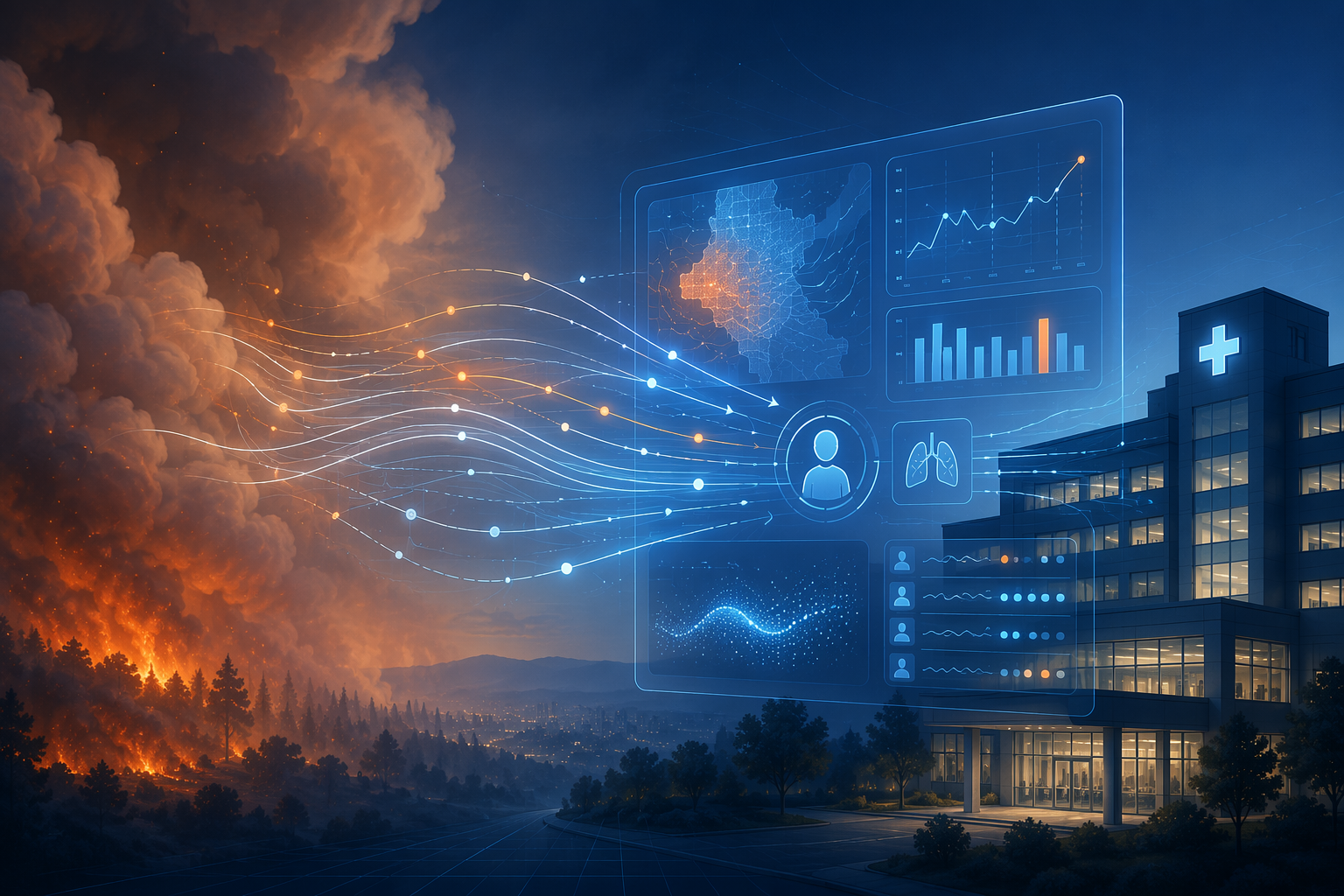
The strongest current evidence sits upstream of bedside care. Machine learning is improving smoke PM2.5 estimation, exposure reconstruction, and sub-seasonal emissions forecasting. Health-outcome studies built on those exposure estimates are sharpening the clinical stakes. What has not yet arrived, at least in peer-reviewed form, is an end-to-end, validated, EHR-integrated wildfire smoke clinical decision support framework that takes a forecast, maps it to patients, recommends actions, and tracks outcomes.
The Planning Window Is the Clinical Breakthrough
For health systems, the most important feature of a smoke model is not elegance. It is whether the forecast horizon is long enough to change operations. A same-day alert can trigger messaging and triage scripts. A multi-day forecast can adjust clinic staffing, respiratory therapy availability, discharge planning, and community outreach. A sub-seasonal signal can move smoke preparedness into the same conversation as surge planning, supply chain review, and public information coordination.
The Stanford Environmental Change and Human Outcomes Lab model is important because it helps quantify smoke exposure at a resolution that starts to look operationally meaningful. The model produces daily, 10 km-resolution estimates of smoke PM2.5 across the contiguous United States from 2006 onward, with reported R² of 0.67, and Climate Central’s 2025 analysis using that work found that per-person U.S. smoke exposure during 2020–2024 was four times higher than during 2006–2019.[1]
That fourfold change is the kind of number that should make hospital leaders stop treating smoke as an episodic communications issue. It implies a background condition that is becoming recurrent enough to deserve standing governance: who watches the signal, who has authority to activate protocols, which patient groups are included, and how actions are documented.
The more provocative development is the CIRES/NOAA AI system announced in January 2026. It integrates data from seven global fire-emission inventories to predict wildfire emissions 35 to 45 days in advance, with the stated goal of advancing sub-seasonal air-quality forecasting.[2] A 35-day window is not just a better weather report. It is a different administrative object. It gives a hospital time to pre-position patient lists, review oxygen and inhaler access pathways, prepare call-center language, coordinate with public health, and decide which clinics need contingency plans.
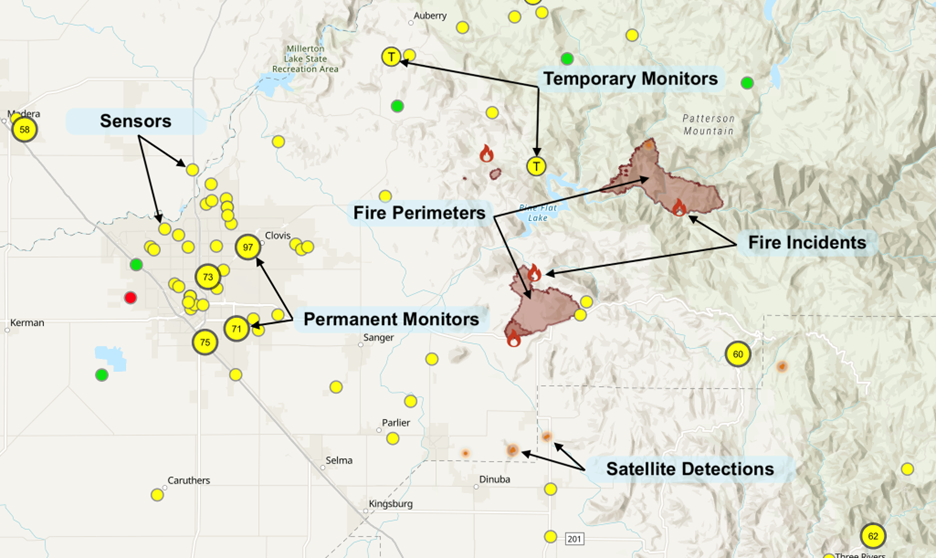
The operational baseline already exists in public air-quality infrastructure. EPA’s AirNow platform provides public air-quality information, and its Fire and Smoke Map combines monitoring and smoke information during wildfire events.[3] For clinicians, the gap is not that no one is forecasting or mapping smoke. The gap is that those signals often remain outside the systems where patient risk is reviewed, outreach is assigned, and clinical work is tracked.
Smoke Exposure Models Are Becoming Health-System Inputs
A high-resolution smoke estimate does two jobs. First, it helps public agencies and hospitals understand what is happening now or soon. Second, it gives researchers a way to connect exposure to outcomes after the fact. That second function matters because it is how the field moves from visible smoke to quantified clinical risk.
The health-effects evidence is broad enough that smoke preparedness cannot belong only to pulmonology. A Harvard Chan School and Mount Sinai study published in Epidemiology in May 2025 found that medium-term wildfire smoke PM2.5 exposure, measured up to three months after a fire, was associated with increased hospitalization risks for ischemic heart disease, hypertension, arrhythmia, and asthma, with larger effects in disadvantaged neighborhoods.[4]
That finding is clinically disruptive in a useful way. Same-day air-quality alerts are still necessary, but they are not enough if hospitalization risk persists after the smoke has cleared from the skyline. It means population health teams may need to think in weeks and months, not just in alerts and cancellation notices. It also means an equity lens cannot be bolted on later; the neighborhoods most affected may require different outreach channels, transportation assumptions, and follow-up capacity.
The acute cardiovascular signal is also hard to ignore. The American Heart Association cited research reporting that within one day of dense smoke exposure, heart attack emergency room visits increased by 42%, while ischemic heart disease visits increased by 22%.[5] Those are not metrics that can be handled only by telling patients with asthma to stay indoors. They affect ED triage, chest pain pathways, ambulance expectations, and advice to patients with known cardiovascular disease.
Nor is PM2.5 from wildfire smoke interchangeable with every other particle exposure. Stanford researchers reported in January 2025 that wildfire smoke is about 10 times more toxic than fossil-fuel PM2.5.[6] The exact clinical translation of that toxicity depends on exposure, susceptibility, and context, but the direction is clear enough for preparedness: smoke should not be treated as merely another bad-air day when it reaches vulnerable patients.
Cancer care adds another layer. UC Davis reported that among more than 18,000 lung cancer patients, higher wildfire PM2.5 exposure was associated with a 20% greater risk of death, and stage 4 nonsmokers faced a 55% increase.[7] A separate Lancet Planetary Health study reported in 2026 linked wildfire smoke exposure to elevated risks for lung, colorectal, breast, bladder, and blood cancers.[8] These findings do not mean an oncology clinic should automatically generate individual treatment changes from a smoke forecast. They do mean oncology should be part of the preparedness table, especially when smoke threatens patients already navigating frailty, transportation barriers, immunosuppression, or limited physiologic reserve.
Long-Range Mortality Projections Need Careful Use
The most dramatic smoke numbers are useful, but only if they are not allowed to do more than the evidence supports. A Nature study published in September 2025 used an ensemble of statistical and machine learning models to project that smoke PM2.5 could cause 71,420 excess deaths per year by 2050 under the high-warming SSP3-7.0 scenario, with 1.9 million cumulative excess deaths from 2026 to 2055.[9]
That is a serious projection, not a bedside forecast. The scenario matters. Lower-emission pathways would produce lower projections, and a national mortality estimate does not tell a health system which patients to call next Thursday. Its value is strategic: it supports the idea that smoke exposure is becoming a material health burden, while the operational work still depends on nearer-term forecasts, local exposure estimates, and clinical segmentation.
The same distinction applies to long-term mortality estimates. A 2024 PNAS study used machine learning-based smoke PM2.5 estimates to attribute about 11,415 nonaccidental deaths per year nationwide to long-term smoke PM2.5 exposure.[10] That is evidence of population burden. It is not, by itself, a validated individual risk score. Health systems that blur that line risk either underusing the evidence because it feels too broad, or overusing it by presenting population associations as patient-specific predictions.
What an AI-to-Clinical Workflow Would Actually Need
The plausible workflow is easy to sketch and difficult to govern. A smoke forecast identifies likely exposure by place and time. An exposure model estimates PM2.5 intensity at neighborhood scale. A health system maps those exposure estimates to patients by address, recent utilization, diagnoses, medications, mobility constraints, and care setting. A risk stratification layer identifies groups for outreach or operational planning. The EHR or population health platform then assigns work: messages, calls, medication access checks, appointment changes, home equipment review, or escalation guidance.
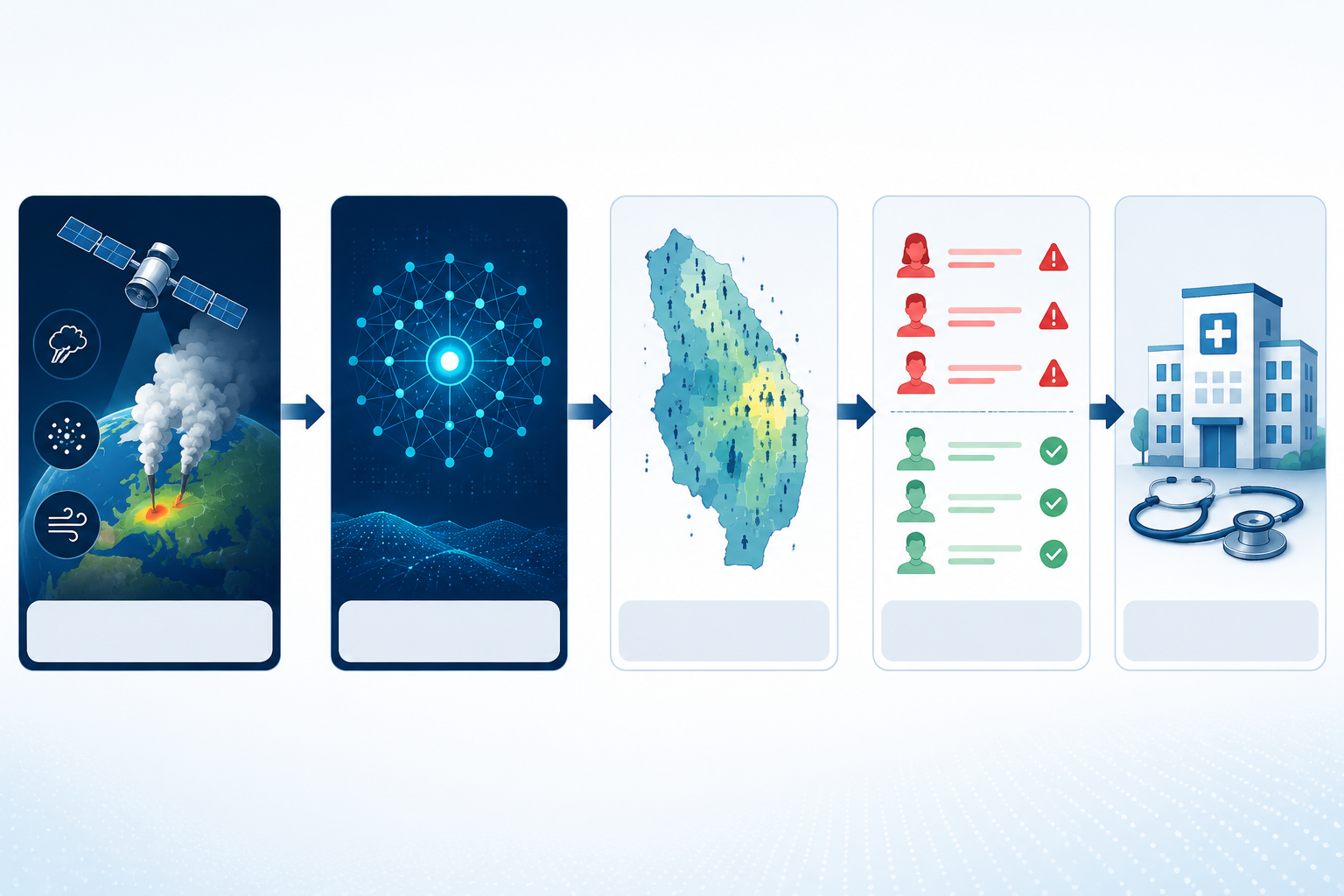
Each handoff introduces a different failure mode. Forecast uncertainty may be poorly communicated. Address data may be stale. Patients may live, work, and receive care in different exposure zones. Race, income, housing quality, occupational exposure, and access to filtration may be incompletely represented or represented in ways that create governance concerns. A model may correctly identify a high-risk group and still fail operationally if no one owns the outreach queue.
| Layer | What AI can contribute | What health systems still have to decide |
|---|---|---|
| Smoke and emissions forecasting | Earlier warning windows and more granular estimates of where smoke may move | Who monitors the forecast and when a preparedness protocol activates |
| Exposure assessment | Daily, geographically specific estimates that can support neighborhood-level risk review | How to handle address quality, patient mobility, and uncertainty |
| Population risk stratification | Identification of groups likely to need outreach or added capacity | Which diagnoses, medications, social factors, and care settings qualify for action |
| Clinical workflow | Prioritized worklists, alerts, messaging triggers, and operational dashboards | Who acts, what they say, how actions are documented, and how outcomes are monitored |
This is where many AI discussions become too abstract. A smoke PM2.5 model may be excellent for epidemiology and still not be ready for an EHR alert. A model that estimates exposure at 10 km resolution may be valuable for service-area planning, but a clinician should not read it as proof that one patient standing in one doorway experienced a specific dose. A risk model that uses prior admissions may help prioritize outreach, but it may also miss patients with poor access who avoid care until late.
The governance questions are clinical, technical, and administrative at the same time. Health systems would need threshold logic for when smoke forecasts trigger action; validation against local utilization, admissions, pharmacy demand, and call volume; monitoring for unequal outreach performance; and a clear distinction between public health messaging and patient-specific medical advice. They would also need a way to retire or revise rules after each smoke season, because a model that cannot be audited will eventually become dashboard theater.
The EHR Is Not the First Place to Start
The temptation is to imagine the final product as a clinician-facing alert. That may be the least useful first deployment. During a smoke event, the earliest value may come from population health and preparedness workflows that can absorb uncertainty: registries of high-risk patients, prewritten outreach campaigns, care-management queues, pharmacy refill checks, home oxygen and durable medical equipment reviews, and scripts for nurse triage lines.
A cardiologist does not need a pop-up every time the air-quality index changes. An ambulatory leader may need to know that patients with recent heart failure admissions, COPD exacerbations, active lung cancer treatment, or limited transportation are concentrated in neighborhoods forecast to have several days of smoke. An ED director may need a smoke-informed view of expected volume layered with staffing and bed status. A public health officer may need confidence that warnings are not only accurate, but timely enough for schools, shelters, and medically fragile residents.
This makes the clinical decision support target broader than a single alert. It may be a preparedness bundle: forecast surveillance, tiered activation criteria, patient list generation, message templates, documentation fields, equity monitoring, and after-action review. The AI component supplies earlier and more granular intelligence. The health system supplies accountability.
Risk Stratification Is Promising, but Still Mostly Potential
The research community is moving toward more predictive wildfire-health work, but the center of gravity remains exposure modeling and observational health-outcome analysis. A GeoHealth systematic review published in February 2026 reviewed 139 studies and called for innovative machine learning approaches to advance wildfire-health research and enhance predictive capacity.[11] That call is valuable partly because it acknowledges the gap: the field needs better prediction, not just better retrospective attribution.
For a health system, a patient-level smoke risk score would have to prove more than statistical association. It would need to show calibration across neighborhoods and clinical subgroups, performance during different smoke patterns, robustness to missing social-risk data, and usefulness compared with simpler rules. It would also need an intervention attached to each risk tier. A list of vulnerable patients is not decision support unless someone can do something useful with it.
The intervention does not always need to be dramatic. For some patients, the action may be confirming access to controller medications, reviewing when to seek care, moving an appointment to telehealth, or directing them to local clean-air resources. For others, it may be adding capacity in a clinic, pre-briefing triage nurses, or coordinating with community partners. The danger is pretending that a model has solved the hard part when it has only produced a ranked list.
Preparedness Frameworks Are Ready for Better Signals
Health systems do not have to invent every workflow from scratch. The Lancet Planetary Health review on seasons of smoke and fire describes health-system preparedness frameworks for wildfire smoke, including the need to plan across phases rather than respond only during acute events.[12] AI can fit into that kind of framework if it is treated as a signal layer, not as a standalone solution.
Before smoke season, models can support scenario planning, identification of exposed communities, registry preparation, and message testing. During the lead-up to an event, forecasts can trigger operational huddles and targeted outreach. During smoke days, exposure estimates can inform triage scripts, ED situational awareness, and public communication. Afterward, health systems can compare predicted exposure with utilization, hospitalization, missed appointments, medication refills, and outreach completion.
The equity implications belong inside those workflows. The Harvard/Mount Sinai finding that disadvantaged neighborhoods saw larger cardiorespiratory hospitalization effects means outreach performance should be monitored by place, language, access channel, and care setting, not just by total messages sent.[4] If the model helps identify exposure but the response mostly reaches patients already well connected to care, the system has improved its data without improving its preparedness.
What Is Ready Now, and What Is Not
The most mature pieces are the upstream intelligence tools: public air-quality mapping, smoke-transport modeling, machine learning exposure estimates, and emerging AI-based emissions forecasts. These are already useful for situational awareness and planning. They can help hospitals stop using ED arrivals as their first operational indicator.
The next layer is plausible but less mature: translating exposure estimates into population health worklists and service-line planning. This is where health systems can begin responsibly, especially if they are explicit about uncertainty and avoid presenting population exposure estimates as individualized dose measurements.
The least mature layer is patient-level, AI-driven wildfire smoke clinical decision support embedded in routine care. The evidence base does not yet show a fully integrated system that forecasts smoke, estimates patient exposure, stratifies individual risk, recommends actions, documents interventions, and demonstrates improved clinical outcomes in a U.S. health-system setting. That absence matters. It should keep procurement language modest and implementation pilots measurable.
A grounded readiness assessment is therefore mixed, but not discouraging. AI is already strengthening the upstream intelligence layer for wildfire smoke health effects. Exposure models are making health-outcome evidence more precise. Sub-seasonal emissions forecasting may give administrators a planning window they have not had before. The clinical integration layer is still early, and it will need the unglamorous work of validation, governance, workflow ownership, equity monitoring, and after-action learning before it deserves the label of clinical decision support.
References
- Climate change worsens wildfire smoke, Climate Central, August 2025
- Artificial intelligence takes wildfire emissions to a new frontier of forecasting, CIRES/NOAA, January 2026
- AirNow, U.S. Environmental Protection Agency
- Cardiorespiratory effects of wildfire smoke particles can persist for months, even after a fire has ended, Harvard T.H. Chan School of Public Health, May 2025
- Where there’s smoke, there’s fire and heart health risks, American Heart Association
- Assessing wildfire health risks, Stanford Report, January 2025
- Wildfire pollution, UC Davis Health, Winter 2026
- Serious health risks posed by wildfire smoke, Reuters, July 16, 2026
- US mortality burden from wildfire smoke under climate change, Nature, September 2025
- Long-term exposure to wildfire smoke PM2.5 and mortality in the contiguous United States, PNAS, 2024
- Wildfire smoke and human health: A systematic review of epidemiological studies, GeoHealth, February 2026
- Seasons of smoke and fire: preparing health systems for improved performance before, during, and after wildfires, The Lancet Planetary Health, 2024
Comments
Join the discussion with an anonymous comment.