
Wildfire smoke is usually measured outside, while most exposure happens inside. That mismatch is not a technical footnote. People spend roughly 90% of their time indoors, yet epidemiologic studies commonly assign exposure from outdoor PM2.5 concentrations because those data are easier to monitor, map, and merge with health records.[1]
For respiratory health, the shortcut matters most when it changes the estimated burden. In a 2025 British Columbia study, machine learning-predicted indoor PM2.5 was associated with a 10.1% increase in salbutamol dispensations per 10 μg/m³ increase in indoor PM2.5. Outdoor PM2.5 metrics, by comparison, were associated with smaller increases of 3.6% to 6.1%, and the indoor-model incidence rate ratios were 1.5 to 2.8 times higher than the outdoor-model estimates.[1]
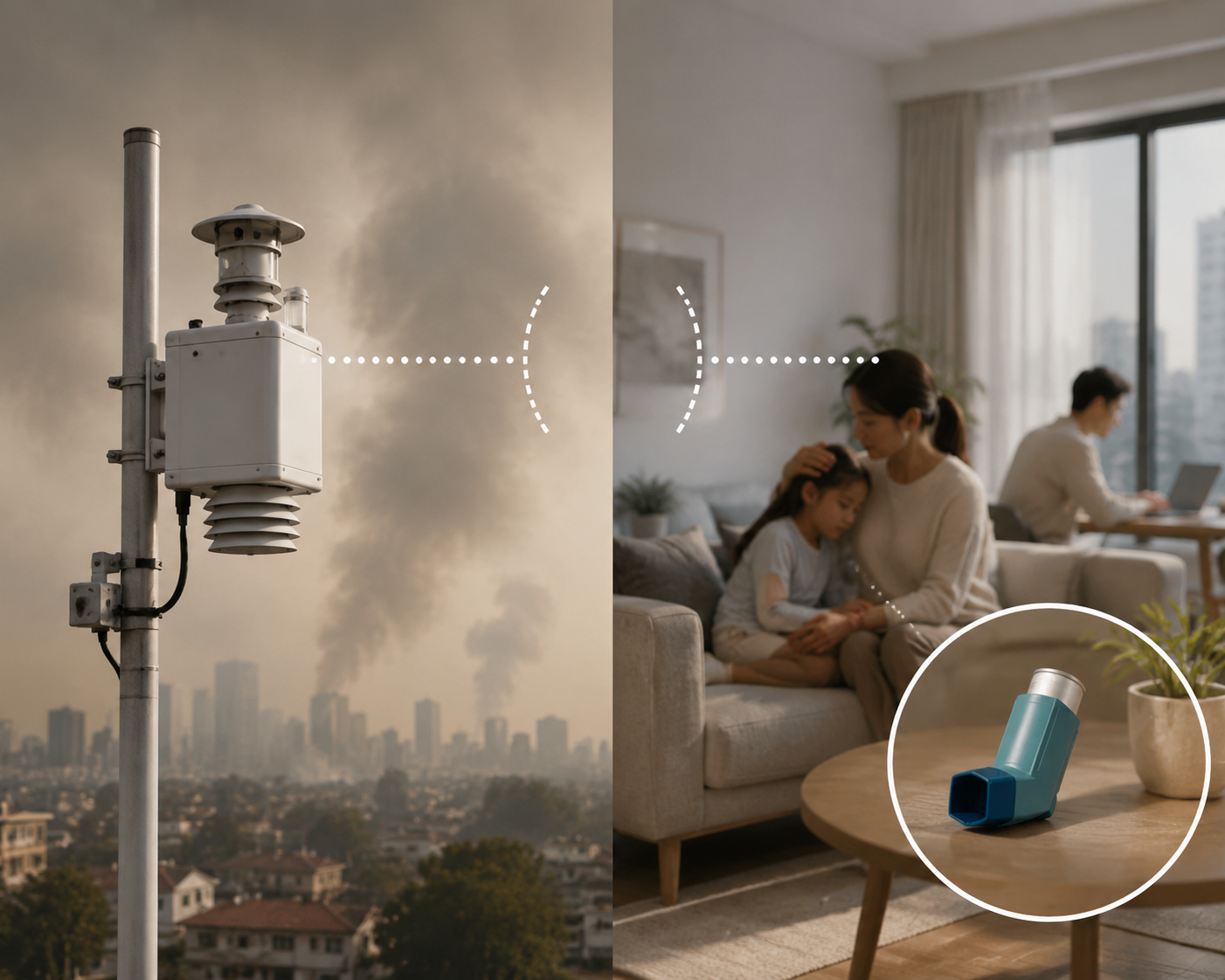
That is the central issue for AI-assisted wildfire smoke monitoring: not whether algorithms can make air pollution surveillance sound more advanced, but whether they can correct a familiar exposure error that has been quietly weakening the clinical signal. If the exposure metric is too distant from where patients actually breathe, the health model can make smoke look less consequential than pharmacy demand suggests.
Outdoor PM2.5 Is Useful, but It Dilutes the Indoor Exposure Signal
Outdoor PM2.5 remains valuable. It captures smoke arrival, regional intensity, and broad population risk. It is also the metric most public health systems can operationalize quickly. The problem begins when outdoor concentration is treated as if it were the exposure itself rather than a proxy for exposure.
During smoke events, two homes in the same outdoor plume can have very different indoor concentrations. Building leakage, filtration, window behavior, cooling systems, occupancy patterns, and the ability to create cleaner indoor air all influence what reaches lungs. When an epidemiologic model assigns the same outdoor PM2.5 exposure to people with different indoor exposures, some high-exposure individuals are misclassified downward and some lower-exposure individuals are misclassified upward.
That kind of measurement error often biases estimates toward the null. In practice, the modeled association between smoke and medication use can look smaller than the association patients and clinicians are managing in real time. A weak-looking outdoor signal does not necessarily mean a weak respiratory effect; it may mean the wrong exposure surface has been placed between the plume and the patient.
| Exposure metric | Association with salbutamol dispensations | Interpretation |
|---|---|---|
| Machine learning-predicted indoor PM2.5 | 10.1% increase per 10 μg/m³ | Stronger medication-use signal, closer to where exposure occurs |
| Outdoor PM2.5 metrics | 3.6% to 6.1% increase per 10 μg/m³ | Smaller signal, consistent with dilution from exposure misclassification |
| Indoor-model IRRs compared with outdoor models | 1.5 to 2.8 times higher | Outdoor-only models likely underestimate respiratory burden |
Salbutamol dispensations are not the same as asthma symptoms, emergency visits, or lung function. They are a medication-use outcome. But they are clinically meaningful during smoke seasons because they reflect demand for reliever medication, and that demand is exactly what clinics, pharmacies, and public health teams must anticipate when smoke persists.
What the British Columbia Study Adds
Coker and colleagues approached the problem as an exposure-assessment problem, not a generic AI demonstration. They trained ensemble machine learning models using paired indoor-outdoor low-cost sensor data from 44 care facilities in British Columbia, primarily childcare and long-term care settings. The models included Random Forest, XGBoost, and Quantile Regression Forest approaches, and the goal was population-scale prediction of indoor PM2.5.[1]
The paired monitoring is important. It gives the model observed indoor-outdoor relationships rather than asking outdoor monitors to stand in for buildings by assumption. The care-facility setting is also a boundary: childcare and long-term care buildings are not the full residential building stock, and the results should not be stretched into household-specific claims.
At the population scale, the model performed well enough to change the interpretation of the health association. Indoor PM2.5 predictions had an RMSE of 3.29 μg/m³, compared with 3.80 μg/m³ for outdoor predictions; R² values were 0.71 for indoor predictions and 0.78 for outdoor predictions. During extreme wildfire seasons, indoor models outperformed outdoor models in validation, with RMSE of 6.65 versus 9.64 μg/m³.[1]
Those performance figures do not turn the model into a clinical instrument for an individual home. They do show that indoor PM2.5 can be estimated at a useful public health scale, including during the severe smoke periods when exposure classification matters most.
The Larger Salbutamol Signal Changes the Burden Estimate
The most consequential finding is not simply that indoor PM2.5 can be predicted. It is that the predicted indoor exposure produced a larger association with asthma reliever medication than the outdoor metrics did. A 10.1% increase in salbutamol dispensations per 10 μg/m³ indoor PM2.5 is not a minor recalibration when the outdoor estimates sit between 3.6% and 6.1%.[1]
For a clinician watching refill pressure during a smoky week, the distinction is practical. Outdoor AQI may describe the regional event, but it can understate the medication demand associated with the exposure people actually experience. For a public health team, the same distinction affects when advisories sound urgent enough, when outreach should begin, and how much respiratory medication demand might accompany prolonged smoke.
This is where exposure misclassification becomes patient-facing. If outdoor-only models dilute the association, the apparent health burden becomes too small. The resulting estimate may look tidy in a regression table but still fail to match the operational reality of patients using more reliever medication and pharmacies absorbing increased demand.
The study does not prove that every indoor environment produces higher risk than outdoor measures imply. It supports a narrower and more useful conclusion: when indoor PM2.5 is estimated at population scale, the association with salbutamol dispensations is substantially stronger than when outdoor PM2.5 alone is used.[1]
Deprivation Indicators Matter Because Indoor Protection Is Uneven
One of the more important modeling details is also one of the most clinically relevant: area-level deprivation indicators significantly improved indoor PM2.5 prediction accuracy.[1] That finding points away from a simplistic view of indoor protection, where everyone can reduce exposure by closing windows, checking an app, or turning on filtration.
Indoor smoke exposure is shaped by resources. Housing quality, access to filtration, ability to cool a home without opening windows, and the option to relocate temporarily are not evenly distributed. The model result does not identify any one household’s conditions, but it does show that socioeconomic context helps explain indoor PM2.5 at a population level.
That matters for outreach. If indoor exposure differs by deprivation, then smoke-season planning cannot rely only on a regional outdoor concentration threshold. The same plume can produce different levels of indoor protection, and therefore different needs for medication access, messaging, and follow-up.
Why This Is No Longer Only a Western Fire-Zone Problem
The measurement issue is becoming more consequential because wildfire smoke is not staying local. Climate Central reported in 2025 that wildfire smoke now affects every county in the contiguous United States, with some counties experiencing 90 to 111 smoke days per year.[2] O’Dell and colleagues estimated that about 75% of smoke-related mortality and asthma morbidity occurs outside western U.S. regions, reflecting the effect of long-range smoke transport.[3]
That geographic spread changes who has to interpret smoke metrics. A clinician in a region without nearby large fires may still see asthma patients exposed to transported smoke. A health department far from a burn scar may still need to plan for advisories, medication access, and communications when PM2.5 rises from distant fires.
Mortality estimates reinforce the scale of the problem, although they answer a different question than the British Columbia salbutamol study. Ma and colleagues estimated that long-term exposure to wildland fire smoke PM2.5 contributes to approximately 11,415 excess nonaccidental deaths per year in the contiguous United States, and that people aged 65 years and older experience 3 to 10 times greater mortality increases.[4] Those estimates use modeled smoke PM2.5 data, including daily local-level estimates developed by Childs and colleagues with R² of 0.67; prescribed fire smoke may be underrepresented.[5]
The mortality literature does not validate the indoor British Columbia model, and the indoor model does not estimate national mortality. Together, they make the same practical problem harder to ignore: if smoke exposure is widespread and the exposure metric is incomplete, burden estimates can be systematically conservative.
What AI Can and Cannot Fix
Machine learning helps here because the relationship between outdoor smoke and indoor PM2.5 is conditional. It depends on building, weather, season, community characteristics, and smoke intensity. Ensemble models are well suited to that kind of exposure problem because they can use many predictors without forcing a single linear indoor-outdoor ratio.
But the model boundary is essential. The Coker et al. predictions were generated at the Local Health Area level, not at the level of a specific patient, apartment, classroom, or bedroom.[1] They support better population-scale exposure assessment and public health interpretation. They do not support telling an individual patient what their personal indoor PM2.5 was during a particular hour.
The training data boundary matters as well. Forty-four care facilities provide paired indoor-outdoor evidence that most outdoor-only studies lack, but childcare and long-term care settings are not a census of housing types. Residential buildings, schools, workplaces, shelters, and multifamily units may have different ventilation and filtration patterns. Extending the approach will require more paired indoor-outdoor monitoring across those settings.
The useful claim is therefore modest and important: AI-driven indoor PM2.5 prediction can reduce a major exposure-assessment blind spot at population scale. It should not be converted into household-specific decision support before the evidence can carry that load.
How This Should Change Smoke-Season Interpretation
Outdoor AQI should be treated as a floor for respiratory burden, not as the full measure of exposure. It remains the fastest public signal that smoke has arrived, but it should not be the only input used to estimate medication demand or chronic respiratory disease burden during wildfire seasons.
For clinical operations, the implication is not an individualized algorithmic alert. It is better calibration. If indoor PM2.5-based models produce stronger associations with salbutamol dispensations, then pharmacy refill planning, asthma outreach, and surge preparation should not be based solely on outdoor-effect estimates that may be biased downward.
For public health agencies, the equity signal is equally important. Because deprivation indicators improved indoor prediction, smoke advisories and resource planning should account for the fact that indoor protection is uneven. Communities with less capacity to control indoor air may need earlier outreach and more realistic estimates of respiratory medication demand.
The study’s most useful contribution is not that it makes wildfire smoke monitoring more technologically impressive. It makes the exposure measure more clinically honest. When the indoor signal is modeled, the respiratory health burden is larger than outdoor-only monitoring suggests, and that difference is large enough to matter for how smoke seasons are interpreted, staffed, and prepared for.
References
- Enhancing Wildfire Smoke Exposure Assessment: A Machine Learning Approach to Predict Indoor PM2.5 in British Columbia, Canada — ACS EST Air, 2025.
- Climate Change Worsens Wildfire Smoke — Climate Central, 2025.
- Estimated mortality and morbidity attributable to smoke plumes in the United States: Not just a western US problem — GeoHealth, 2021.
- Long-term exposure to wildland fire smoke PM2.5 and mortality in the contiguous United States — PNAS, 2024.
- Daily local-level estimates of ambient wildfire smoke PM2.5 for the contiguous US — Environ. Sci. Technol., 2022.
Comments
Join the discussion with an anonymous comment.