
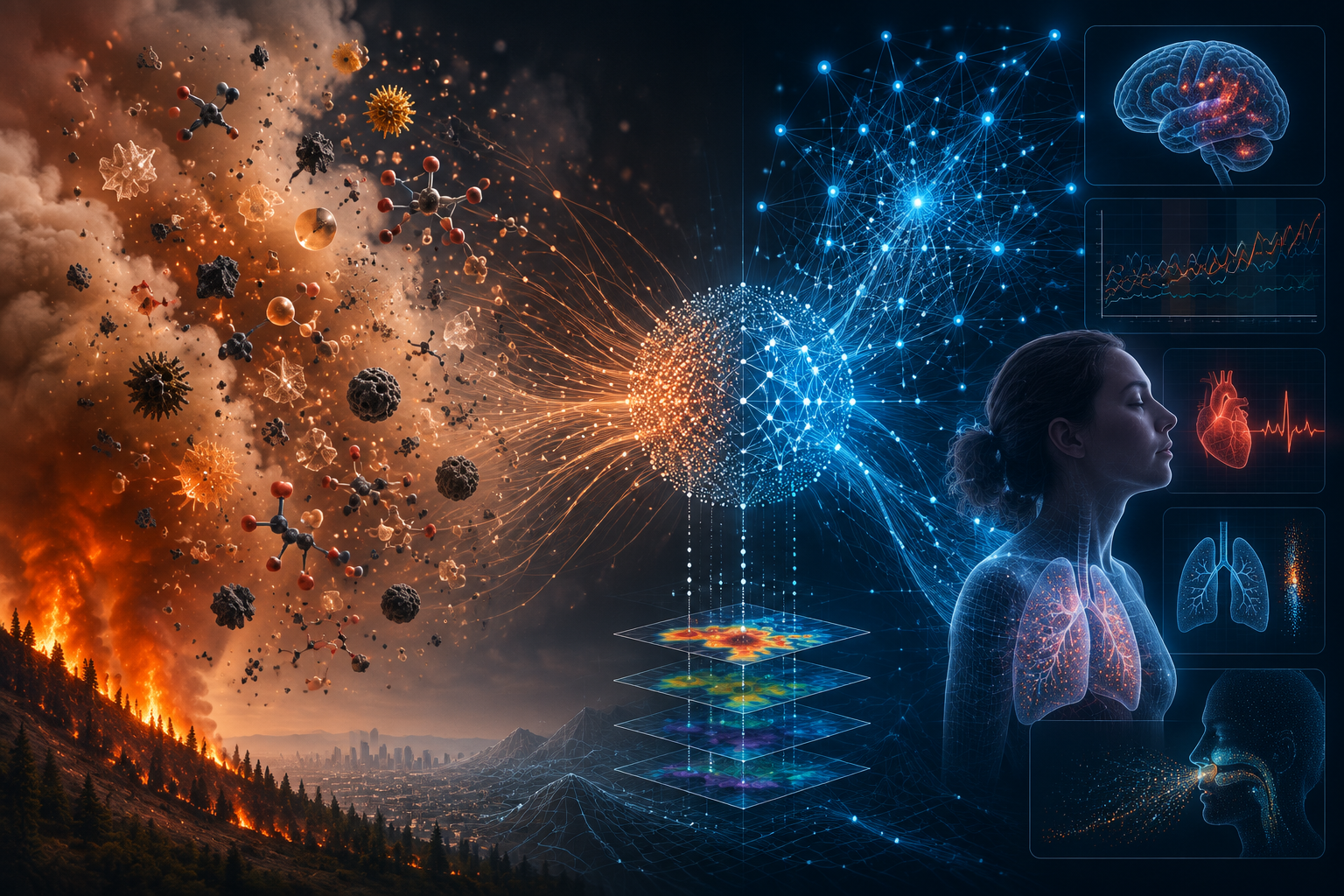
AI in predicting health effects of wildfire smoke begins with a deceptively clinical question: when a model says smoke exposure raises the risk of an emergency visit, admission, cardiovascular event, or death, what did it actually measure? Too often the answer is still PM2.5 mass. That is convenient for modeling and deeply unsatisfying for medicine. Stanford researchers and clinicians warned in 2025 that wildfire smoke may be about 10 times more toxic per unit of PM2.5 than ambient PM2.5 from fossil-fuel sources, because the particles carry a different chemical mixture and injury potential.[1] A separate scoping review of linked wildfire-smoke and health-data studies found that PM2.5 alone was the exposure metric in 70% of studies.[2]
That mismatch matters before anyone argues about Random Forests, neural networks, or forecasting horizons. If the exposure variable flattens chemically different smoke into the same mass concentration, the model may become better at predicting the consequences of an incomplete measurement rather than better at predicting smoke injury.
What AI Models Are Being Asked to Predict
The strongest overview of the current modeling literature is a 2025 systematic review of 36 machine-learning studies predicting hospital visits linked to air pollution and environmental exposures. Random Forest and feed-forward neural networks were the most common model types, and PM2.5, PM10, NO2, and temperature were the most frequently used environmental predictors.[3] The review is not limited to wildfire smoke alone, but it is highly relevant because these are the same modeling families and predictor choices being carried into wildfire-smoke health prediction.
The outcome targets are clinically familiar: asthma and COPD visits, respiratory admissions, cardiovascular mortality, non-accidental mortality, and, in emerging work, longer-term neurologic risk. Large linked studies explain why modelers are interested. Yale investigators used AI-driven exposure modeling to estimate that long-term wildfire-smoke PM2.5 was associated with about 11,415 non-accidental deaths per year in the contiguous United States from 2007 through 2020, including 4,512 cardiovascular deaths.[4] In older adults, a UC Berkeley study of 1.25 million Kaiser Permanente members over age 60 reported a 7% higher mortality risk among those highly exposed over 3 years, with the greatest risk among adults ages 60–75 and Black populations.[5]
Those are population signals, not bedside predictions. They justify surveillance, prevention, and more serious modeling; they do not by themselves make an AI output usable during a clinic visit or an active smoke event.
| Modeling approach | Typical role in wildfire-smoke health prediction | Clinical concern |
|---|---|---|
| Random Forest | Tabular prediction using environmental, temporal, geographic, and health-system variables | Performance can look strong while calibration, missing-data handling, and transportability remain unclear |
| Feed-forward neural network | Nonlinear prediction from structured exposure and health predictors | Often needs careful validation because flexible models can overfit sparse event data |
| LSTM | Time-series prediction when lagged exposure and delayed health effects are central | The lag structure may be biologically plausible but still dependent on the quality and timing of health data |
| CNN-LSTM | Spatiotemporal modeling that combines geographic exposure patterns with temporal sequences | Useful for complex smoke movement, but clinical interpretation can be difficult |
| ML-measurement model fusion | Exposure estimation by combining measurements, modeled fields, and machine learning | Better exposure fields still need health-outcome validation before clinical use |
The Exposure Science Is Improving Faster Than the Clinical Evidence
The most impressive AI work is often upstream of the health model. Machine-learning measurement-model fusion can combine chemical transport models with monitoring and other data streams to estimate exposure more accurately; reported performance exceeds 90% accuracy and improves on standalone chemical transport models by 66% for exposure estimation. That is a meaningful advance, especially when smoke plumes move across counties and monitoring stations miss local gradients.
But exposure estimation and clinical prediction are different claims. A smoke field that is spatially elegant does not automatically tell a clinician which patient is about to decompensate, which hospital should open surge capacity, or whether an alert should change medication, outreach, or triage. That next step requires outcome definitions, validation, calibration, workflow fit, and an honest account of who acts on the signal.
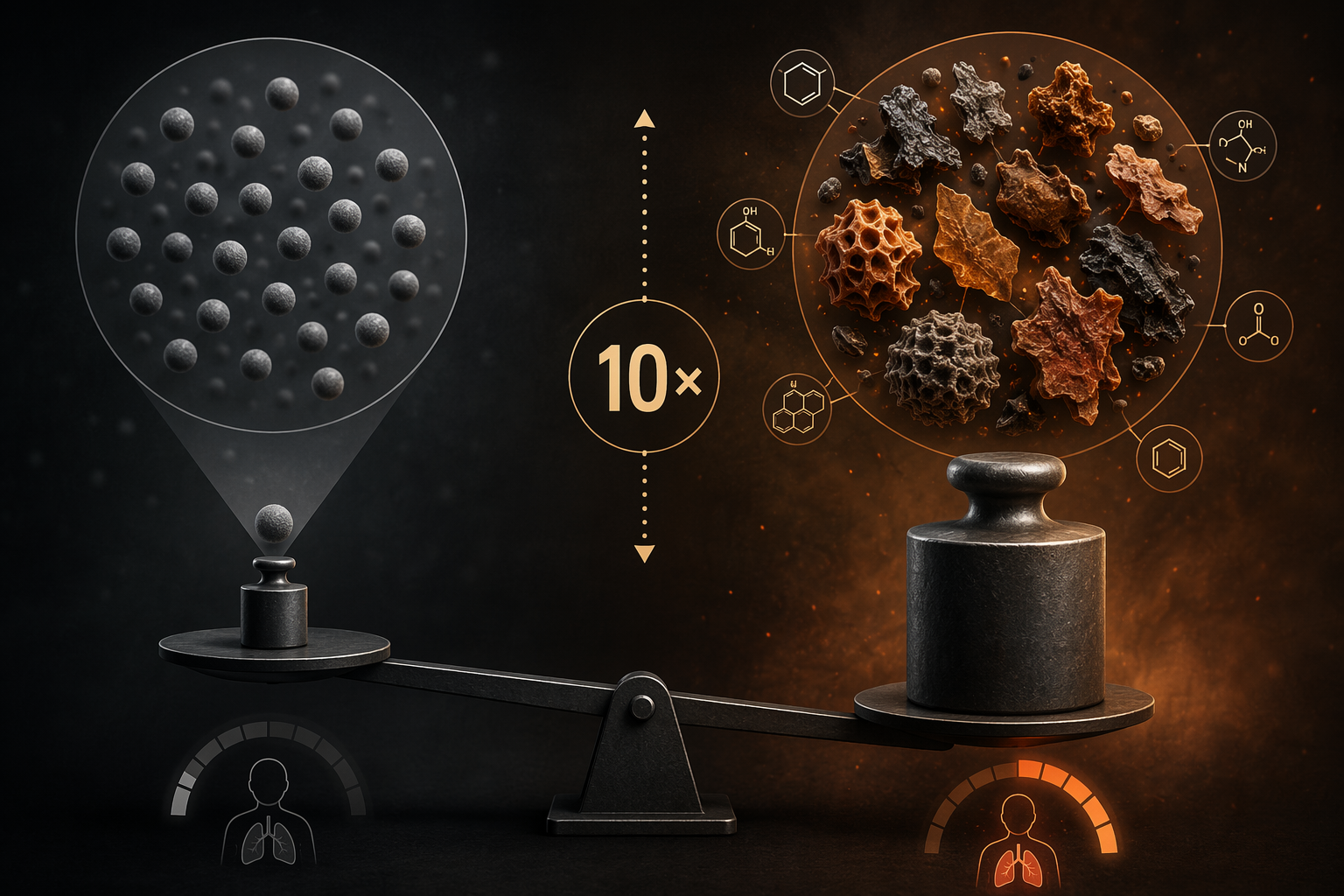
The PM2.5 problem is not a pedantic exposure-science complaint. PM2.5 mass can tell us how much particulate matter is in the air; it does not tell us enough about source, combustion conditions, chemical composition, oxidative potential, or the difference between a regional smoke haze and a local plume loaded with fresh combustion products. When wildfire-smoke particles may be far more toxic per unit mass than fossil-fuel ambient particles, treating the mass as biologically interchangeable is a clinical assumption disguised as a data simplification.[1]
The Systematic Review’s Uncomfortable Finding
The 2025 systematic review is useful precisely because it does not stop at model names or performance metrics. Using PROBAST, the authors found that 22 of 36 studies, or 61%, had high risk of bias. The main problems were inadequate handling of missing data and low events-per-variable ratios.[3] Those are not cosmetic flaws. They are the kinds of weaknesses that make a model look promising in publication and unstable in deployment.
Missing data are especially consequential in smoke-event modeling. The missingness may not be random: monitors fail, populations change behavior, clinics close, people stay indoors, and patients who might otherwise seek emergency care may delay or avoid care. Low events-per-variable ratios create another familiar problem: the model is asked to learn too much from too few outcome events. In that setting, a small improvement in reported discrimination can be less important than whether the model was externally validated, calibrated, and tested in a health system unlike the one that generated the training data.
This is where clinical evidence standards should interrupt data-science enthusiasm. A model can be technically sophisticated and still not answer the clinical question. For wildfire-smoke health prediction, the minimum questions are blunt: Was the outcome clearly defined? Were lag periods prespecified or tuned after the fact? Were missing exposures and missing outcomes handled transparently? Was there external validation? Were there enough events for the number of predictors? Was calibration reported, not just area under the curve? Did the exposure variable represent wildfire smoke specifically, or merely particulate mass on smoky days?
Real-Time Use Is Still the Exception
The infrastructural problem is even harder to ignore. A GeoHealth scoping review of 83 linked-data studies found that administrative health data were the most common health source, used in 36% of articles. Only 2 studies used real-time health data available during active wildfire events, and no studies assessed non-air exposure pathways.[2] That is a poor foundation for claims about operational clinical decision support.
Administrative data can be excellent for retrospective epidemiology, but it often arrives too late for a smoke event that is unfolding now. Claims, discharge records, and billing-coded encounters can help estimate burden after the season; they are much less helpful when a county analyst is deciding whether to push alerts to high-risk patients, when a pulmonary clinic is deciding whether to reschedule vulnerable patients, or when an emergency department is trying to anticipate respiratory demand.
The gap is not merely technical latency. Real-time linkage changes the evidence question. A retrospective model asks whether smoke exposure was associated with outcomes after records were complete. An operational model asks whether the signal is timely, stable, interpretable, and actionable while patients, clinicians, and public health staff still have choices to make.
Observed Visits Can Move in the Wrong Direction
One of the most important findings for model design comes from a Stanford PNAS study of 127 million emergency department visits in California from 2006 through 2017. During extreme smoke days, asthma and COPD visits increased by 30% to 110%, yet total emergency department visits declined by 6% to 9%.[6] That is exactly the kind of nonlinear pattern that punishes naïve outcome modeling.
The decline in total visits does not mean smoke protected the population. It suggests behavior changed. People may have avoided the emergency department unless symptoms were severe, transportation may have been harder, warnings may have kept some people indoors, and non-respiratory visits may have been deferred. A model trained only on observed utilization could therefore learn a distorted version of risk: respiratory morbidity rises, but total measured demand falls.
For health-system planning, that distinction matters. A hospital looking only at total emergency department volume may underestimate respiratory acuity. A public health team looking only at admissions may miss patients managing symptoms at home. A clinical model that treats utilization as a clean proxy for illness may confuse access behavior with disease biology.
Forecasting Smoke Is Not the Same as Predicting Patients
New smoke-emissions forecasting systems are still worth watching. In January 2026, CIRES and NOAA described an AI-driven system that predicts wildfire emissions 35 to 45 days in advance using 7 global fire-emission inventories and meteorological data.[7] A forecast like that could become a valuable upstream input for health departments, hospital preparedness teams, and exposure models.
It should not be mislabeled as a clinical prediction system. Emissions forecasts estimate what fires may put into the atmosphere. Health prediction requires additional layers: plume transport, local exposure, indoor infiltration, individual susceptibility, medication status, baseline disease, access to care, and observed or expected outcomes. Each layer adds uncertainty, and some of the most clinically important variables are not in the smoke model at all.
This distinction is also where regulatory positioning starts to matter. If a tool informs public-health surveillance, the evidence bar is not identical to a tool that recommends patient-specific action inside an EHR. Clinicians and health IT leaders evaluating these systems need the same discipline they would apply to other AI tools: define the intended use, inspect validation, ask whether the output changes a decision, and determine whether the tool crosses into clinical decision support. For readers working through that boundary, the FDA clinical decision support discussion in AI CDS FDA 2026 guidance is the more relevant comparison than a generic AI accuracy benchmark.
What Would Make These Models Clinically More Credible
The field does not need to abandon machine learning. It needs to stop letting model flexibility compensate for weak clinical design. Several improvements would make wildfire-smoke health prediction more credible without pretending the problem is easy.
- Exposure variables should distinguish wildfire-smoke PM2.5 from other PM2.5 sources whenever possible, and should incorporate source, timing, plume characteristics, or chemical indicators when available.
- Validation should move beyond internal splits toward external health-system, geographic, and season-level validation.
- Reports should include missing-data handling, events per variable, calibration, outcome definitions, and lag assumptions, not only discrimination metrics.
- Operational studies should test real-time or near-real-time linkage during active smoke events, because retrospective administrative data cannot answer every deployment question.
- Evaluation should ask whether a prediction changes an action: outreach, staffing, medication review, indoor-air intervention, triage, or public-health messaging.
The same evidence-readiness habits used for other clinical AI tools apply here. A structured framework for clinicians should separate model performance from clinical utility, and retrospective association from deployable decision support. The questions in an AI evaluation framework for clinicians are especially useful when a wildfire-smoke model arrives with impressive maps but limited prospective outcome evidence.
Longer-term outcomes will need even more care. An AAIC 2024 dementia signal in older adults deserves attention, but conference-reported neurologic associations should not be treated as ready-made clinical predictors without stronger publication, exposure characterization, and longitudinal validation. The signal is plausible enough to merit attention; it is not yet a reason to turn smoke exposure into an individual dementia-risk score.
Where the Evidence Stands in Q3 2026
As of Q3 2026, AI and machine learning can help estimate wildfire-smoke exposure, link exposure to respiratory and cardiovascular outcomes, and support research or surveillance. The best systems make invisible risk more visible, especially when public health teams are otherwise working from coarse alerts and delayed utilization data.
They are not ready to be treated as point-of-care clinical decision support. The reasons are specific: exposure measures too often collapse wildfire smoke into PM2.5 mass alone; most reviewed prediction studies have high risk of bias; real-time health-data linkage during active wildfire events is rare; and many systems forecast emissions or exposure rather than validated patient outcomes. The promising direction is clear, but clinical deployment should wait for better exposure characterization, prospective or real-time validation, and a clearer account of what decision the model is supposed to change.
References
- Assessing wildfire health risks, Stanford, January 2025.
- Wildfire Smoke and Health: A Scoping Review of Data Linkage Studies, GeoHealth, 2024.
- Machine learning models for hospital visit prediction using air pollution and meteorological data: a systematic review, Environmental Systems Research, 2025.
- Long-term exposure to wildfire smoke associated with higher risk of death, Yale School of Public Health, 2024.
- Wildfire smoke raises risk of death after the air clears, UC Berkeley School of Public Health, 2025.
- Associations between wildfire smoke exposure and emergency department visits in California, PNAS, 2023.
- Artificial intelligence takes wildfire emissions to new frontier of forecasting, CIRES, January 2026.
Comments
Join the discussion with an anonymous comment.