
For years, the hardest part of estimating the health effects of wildfire smoke was not proving that smoke was dangerous. It was measuring the smoke exposure cleanly enough to separate wildfire PM2.5 from the rest of ambient fine-particle pollution. That distinction matters clinically. If wildfire smoke is treated as a seasonal nuisance folded into all-source PM2.5, its mortality burden remains blurred; if wildfire-specific PM2.5 can be estimated county by county and day by day, the question becomes much sharper: which deaths are plausibly associated with chronic smoke exposure, in which disease categories, and among which populations?
That is where AI-based air quality monitoring for wildfire smoke has changed the evidence base. In Ma et al.’s PNAS analysis of all 3,108 counties in the contiguous United States from 2007 through 2020, long-term exposure to wildland-fire smoke PM2.5 was associated with an estimated 11,415 annual nonaccidental deaths, with a 95% confidence interval of 6,754 to 16,075.[1] A separate Wei et al. analysis, reported in 2025, estimated 24,100 annual US deaths from chronic wildfire PM2.5 exposure.[2] Those two figures should sit side by side, not be averaged into a tidier number. They come from different models, timeframes, and analytical setups.
The point is not to crown one estimate as the final mortality toll. The point is that chronic wildfire-smoke mortality is now measurable at a national scale in a way it was not before. Once wildfire PM2.5 can be isolated from background pollution, the burden no longer looks like a narrow respiratory story. It reaches cardiovascular disease, endocrine and diabetes-related mortality, mental disorders, chronic kidney disease, digestive disease, older adults, and populations already carrying unequal exposure and health risks.
What the newer estimates are actually measuring
The phrase “true mortality toll” can mislead if it suggests a simple count of people killed by flames or even deaths occurring during dramatic smoke days. The newer estimates are about chronic exposure to wildfire-related PM2.5: the long-term burden associated with repeated or sustained inhalation of fine particulate matter from wildland fire smoke. This is a different endpoint from acute emergency-department surges during a smoke event, and it is different again from direct fire fatalities recorded during disasters.
Ma et al. explicitly framed their estimate around long-term exposure and nonaccidental mortality across the contiguous United States. Their 11,415 annual attributable deaths were not a count of people visibly overtaken by fire, nor a tally of short-term respiratory crises. The study estimated deaths associated with chronic wildfire-smoke PM2.5 exposure after linking modeled smoke concentrations to county-level mortality patterns across 2007–2020.[1]
That distinction explains why the modeled mortality burden can exceed the public’s intuitive sense of wildfire lethality. Ma et al. reported that the chronic smoke-related mortality toll was more than 1,000 times NOAA’s recorded direct fire fatalities, and that wildfire-smoke PM2.5 accounted for about 16.8% of all PM2.5-attributable deaths in the United States.[1] The comparison is useful only if it is kept in its lane: direct disaster deaths and chronic pollution-attributable mortality are different measurement objects.
The measurement problem AI helped solve
Wildfire smoke does not arrive in an epidemiologic dataset wearing a label. A county’s PM2.5 concentration may reflect traffic, industry, dust, secondary aerosols, regional transport, and smoke from fires hundreds of miles away. If an exposure model cannot separate wildfire-specific PM2.5 from total PM2.5, then a mortality analysis may capture fine-particle risk in general while missing what is specific to smoke.
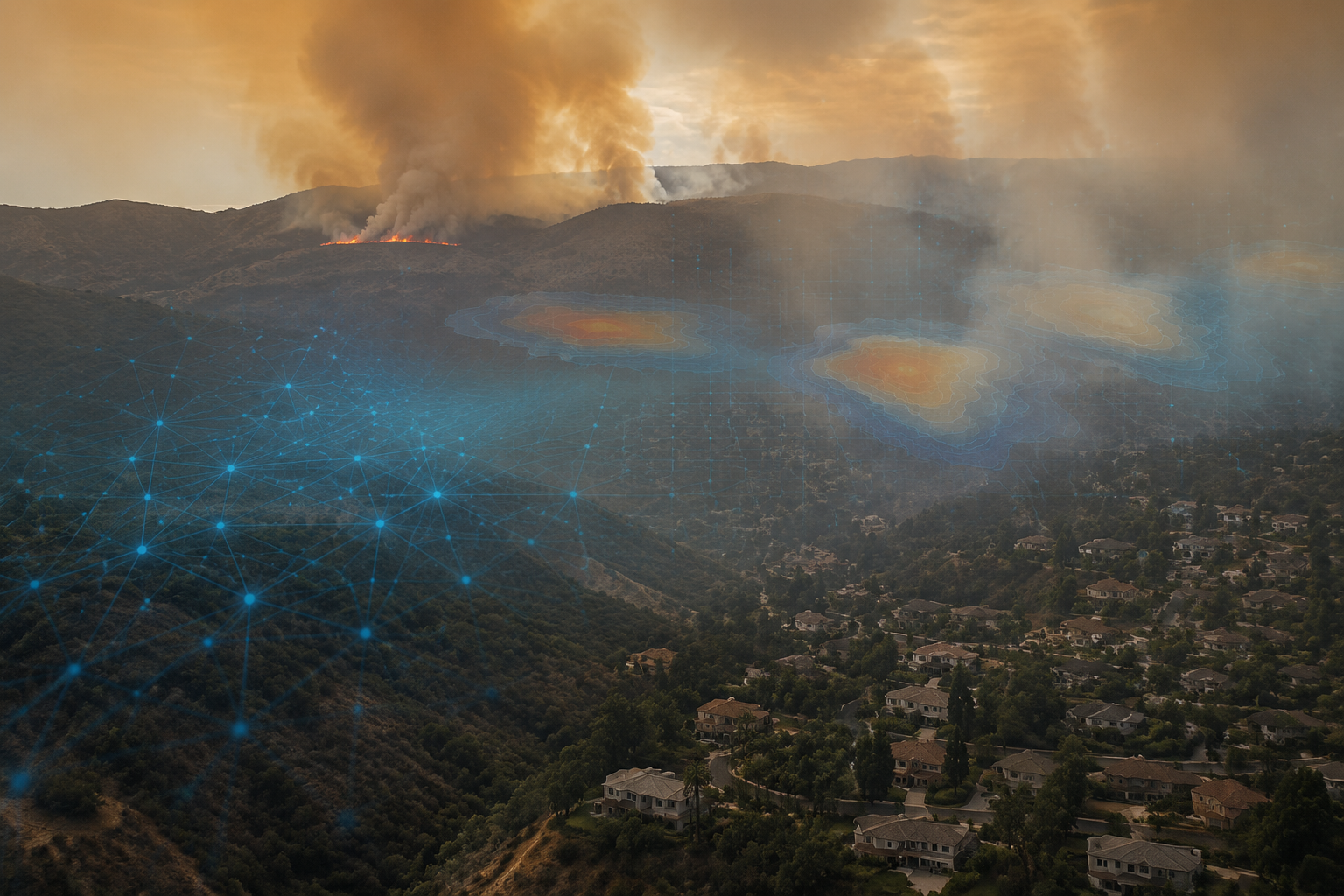
The methodological step that made Ma et al.’s national estimate possible was the use of the Childs et al. machine-learning exposure model, which estimated daily wildfire-specific PM2.5 at a 10 × 10 km resolution across all 3,108 counties.[1] The practical value was not that the model was fashionable or that it could be described as artificial intelligence. Its value was that it converted a hard-to-observe exposure into a daily, spatially resolved estimate that could be linked to mortality data.
That move is easy to understate. A national mortality analysis needs more than satellite images of smoke plumes and more than monitors that measure total PM2.5 at fixed locations. It needs an exposure estimate that can follow smoke across geography, distinguish smoke-related particles from other fine-particle sources, and do so consistently enough over many years to support chronic exposure analysis. The Childs model supplied that exposure layer for the Ma et al. panel fixed-effects study.[1]
This does not make the model a clinical decision tool. No FDA-cleared or CE-marked AI device for predicting wildfire-smoke health effects was identified in the research summarized here. These models are research-stage exposure assessment tools. They can inform how health systems understand population risk; they should not be mistaken for software that predicts an individual patient’s diagnosis, decompensation, or mortality inside an electronic health record.
Ma et al.: from county-level exposure to disease-specific mortality
The Ma et al. study is the more useful anchor for clinical interpretation because it reports not only a national nonaccidental mortality estimate, but also cause-specific categories and disparity findings. The study used a panel fixed-effects design covering all 3,108 counties in the contiguous United States over 2007–2020 and estimated 11,415 annual nonaccidental deaths attributable to long-term wildland-fire smoke PM2.5 exposure.[1]
| Mortality category in Ma et al. | Estimated annual deaths attributable to chronic wildfire-smoke PM2.5 |
|---|---|
| Cardiovascular disease | 4,512 |
| Mental disorders | 2,083 |
| Endocrine and diabetes-related causes | 1,142 |
| Digestive diseases | 537 |
| Chronic kidney disease | 320 |
Cardiovascular disease contributed the largest disease-specific burden in the Ma et al. estimates, with 4,512 annual deaths attributed to chronic wildfire-smoke PM2.5 exposure.[1] That result should not surprise anyone who follows PM2.5 epidemiology, but it should still change the way smoke risk is discussed in clinical settings. If a health system’s smoke-season messaging is organized mainly around asthma and COPD, it is missing the category that contributed the largest share of disease-specific mortality in this analysis.
The mental-disorders estimate is harder to integrate into routine smoke planning because it does not map neatly onto the typical smoke-alert script. Ma et al. estimated 2,083 annual deaths in the mental-disorders category attributable to chronic wildfire-smoke PM2.5 exposure.[1] That does not mean a clinician should infer a simple, patient-level causal pathway from a smoke day to a behavioral-health death. It does mean that population planning that excludes behavioral health from smoke vulnerability is too narrow.
The endocrine and diabetes-related estimate pushes the same point from another direction. Ma et al. attributed 1,142 annual deaths in this category to chronic wildfire-smoke PM2.5 exposure.[1] For primary care and health-system planning, this is the bridge from environmental exposure to the patients already being tracked for cardiometabolic risk: older adults with diabetes, hypertension, chronic kidney disease, and overlapping socioeconomic vulnerability.

The digestive-disease and chronic-kidney-disease estimates were smaller in absolute terms, at 537 and 320 annual deaths, respectively, but they are clinically important because they make the multi-organ nature of the burden harder to ignore.[1] Smoke-related PM2.5 is inhaled, but the mortality signal in this analysis is not confined to the lungs. A seasonal preparedness plan that treats smoke as only an airway irritant is poorly matched to the disease categories now visible in the chronic-exposure literature.
Who bears the excess risk
The most actionable disparity finding is not simply that some regions have more smoke. Ma et al. reported that adults aged 65 and older were consistently at highest risk, and that Black and Hispanic populations showed significantly higher mortality associations at moderate smoke levels of 1–5 μg/m³.[1] Those are the groups for whom smoke exposure should move from a generic environmental advisory into risk stratification.
The moderate-smoke finding is especially important for communication. Many patients and even some institutions treat smoke risk as a problem only when the sky turns visibly orange or air quality alerts become severe. But a mortality association at moderate exposure levels suggests that the burden is not limited to spectacular events. For older adults and populations already facing unequal baseline risk, lower-level recurrent exposure may still matter at the population level.
Ma et al. also observed a positive interaction between smoke exposure and extreme heat days across multiple mortality causes.[1] For clinicians and public health staff, that pairing is more operationally useful than smoke alone. Heat season and smoke season increasingly overlap in the same preparedness calendar: outreach lists, pharmacy access, cooling-center planning, home air filtration messaging, transportation needs, and follow-up capacity all become more urgent when heat and smoke stack on the same patients.
Why the 24,100 estimate should broaden the range, not replace the anchor
Wei et al.’s 2025 estimate is larger: 24,100 annual US deaths from chronic wildfire PM2.5 exposure, with each 0.1 μg/m³ increase linked to approximately 5,594 excess deaths.[2] That number is important because it suggests the Ma et al. estimate is not an isolated signal. It also gives a sense of how sensitive national mortality estimates can be to exposure modeling, study period, and analytic choices.
The larger figure should not be treated as an update that cancels the smaller one. The 11,415 estimate came from Ma et al.’s 2007–2020 panel fixed-effects analysis using the Childs wildfire-specific PM2.5 model.[1] The 24,100 estimate came from a different model and analytical setup.[2] Those differences are not footnotes; they are the reason the estimates should be reported with their methods attached.
Nor should the two figures be averaged. An average would give a false sense of consensus precision while discarding the information that matters most: different research groups, using different exposure models and designs, are estimating a substantial chronic mortality burden from wildfire-smoke PM2.5. For clinical and policy audiences, the safer interpretation is a range of plausible burden, with Ma et al. offering the more detailed disease-specific map in the evidence summarized here.
Clinical interpretation without turning research models into bedside tools
The immediate clinical implication is not a new diagnostic pathway. It is a broader definition of smoke vulnerability. Respiratory disease remains relevant, but the chronic-mortality evidence points toward cardiovascular disease, diabetes and endocrine disease, kidney disease, behavioral health, older age, race and ethnicity, and heat exposure as part of the same preparedness frame.
That shift matters in primary care. A clinician talking with an older patient with diabetes and cardiovascular disease during smoke season should not need to pretend that the only risk is wheeze. A population-health team building outreach lists before a predicted smoke-and-heat episode should not limit its registry logic to asthma and COPD. A health-system planner watching regional smoke forecasts should expect demand to appear through multiple service lines, not only pulmonology or urgent care.
The same evidence also argues for restraint. Ma et al. and Wei et al. estimate population-level mortality associations from chronic exposure. They do not tell a clinician that a specific patient’s death was caused by wildfire smoke, and they do not validate an AI system for individual risk prediction. The correct use is to make seasonal risk assessment less narrow, not to overclaim precision at the bedside.
What health systems can do with this evidence
For health systems, the strongest use of this evidence is preparedness before the worst smoke days arrive. The disease categories in Ma et al. suggest that smoke-season planning should involve primary care, cardiology, endocrinology, nephrology, behavioral health, geriatrics, pharmacy operations, and public health communications. The heat interaction means this planning belongs in summer-readiness work, not in a separate wildfire file that is opened only when the smoke plume is already overhead.
- Risk stratification should include older adults, patients with cardiometabolic disease, chronic kidney disease, and behavioral-health vulnerability, not only patients with asthma or COPD.
- Public messaging should distinguish acute smoke-event advice from the longer-term concern that repeated wildfire PM2.5 exposure contributes to chronic mortality burden.
- Preparedness calendars should treat smoke and extreme heat as interacting seasonal risks when planning outreach, staffing, pharmacy continuity, and community support.
- Equity planning should account for the higher mortality associations reported among Black and Hispanic populations at moderate smoke levels.
- AI exposure estimates should be used as population-health evidence, not as individual-level clinical decision support unless separately validated and regulated for that purpose.
One related problem remains outside the main claim here: indoor versus outdoor exposure. Outdoor wildfire PM2.5 estimates are still imperfect proxies for what a person actually inhales indoors, in a car, at work, or in a shelter. That misclassification matters, but it is a separate layer from the advance discussed here. The first step was isolating wildfire-specific PM2.5 from all-source ambient pollution at national scale; personal exposure refinement is another problem.
AI did not discover that wildfire smoke harms health. It made the exposure specific enough to show that chronic wildfire-smoke PM2.5 carries a substantial, multi-organ, inequitable mortality burden across the United States. The clinical task now is to let that evidence widen smoke-season preparedness without pretending the models are more clinically individualized than they are.
References
- Long-term exposure to wildland fire smoke PM2.5 and mortality in the contiguous United States, PNAS, 2024.
- Wei et al. chronic wildfire PM2.5 mortality estimate, Science Advances, 2025.
Comments
Join the discussion with an anonymous comment.