
Chicago did not need another reminder that wildfire smoke can turn a sports schedule into a public-health decision, but July 2026 supplied one anyway. On July 16, the city's AQI reportedly reached 597, a hazardous level, while professional baseball, soccer, and women's soccer games were disrupted and residents were told to stay indoors.[1] Nearby, reporting on the 2026 World Cup final scheduled for July 19 described unclear contingency planning around wildfire smoke, while also noting that official plans had not been confirmed by FIFA.[2]
That is the uncomfortable part of smoke-related postponement decisions: by the time the air looks obviously unsafe, the operational window has often collapsed. Athletic trainers are trying to protect athletes without appearing alarmist. Team physicians are weighing incomplete local data against respiratory histories they may not fully know. Venue staff, broadcasters, traveling teams, families, and league offices are all waiting for a decision that becomes more expensive by the hour.
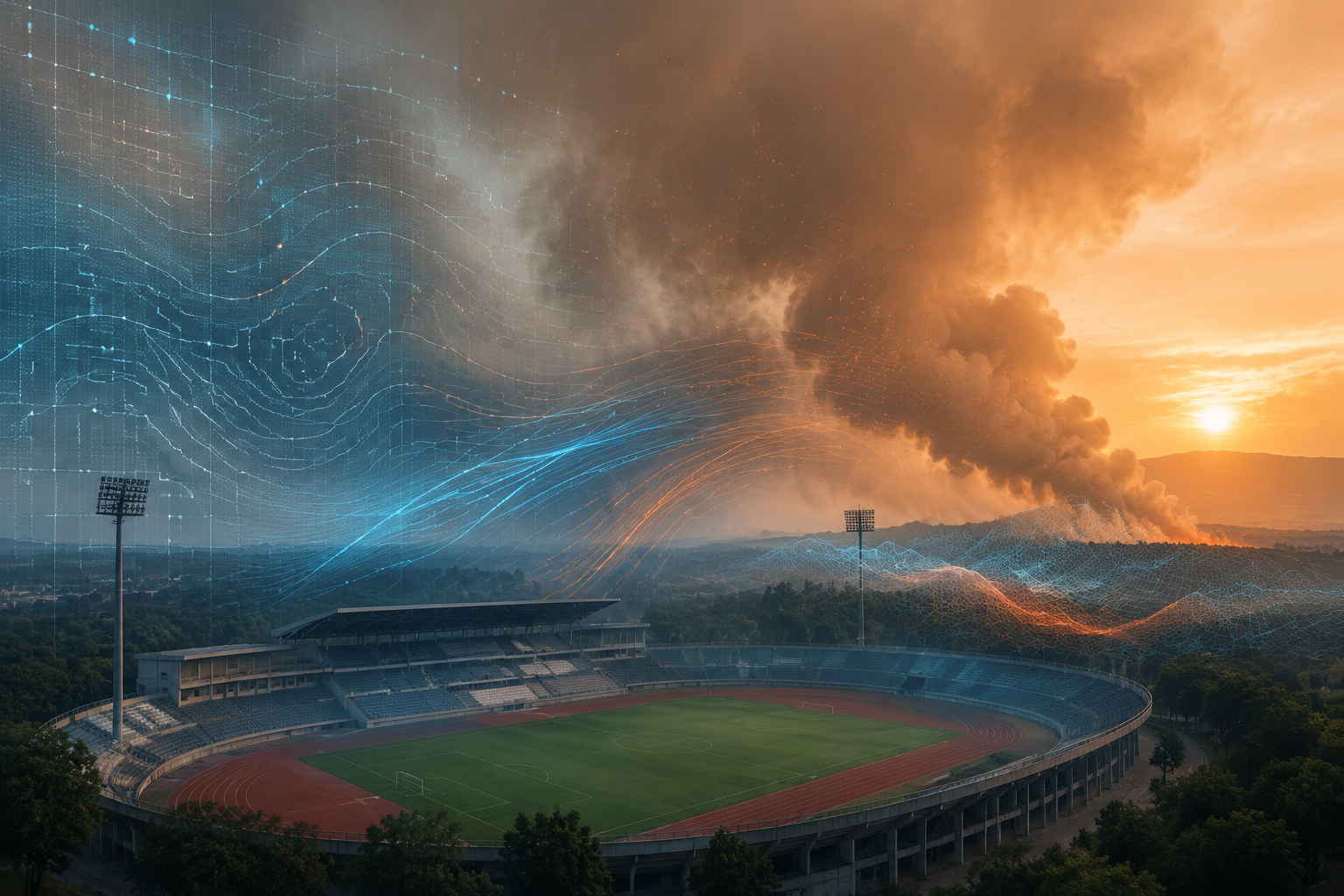
The appeal of AI forecasting is not that it makes postponement easy. It does not. The useful question is narrower and more practical: can a forecast move the decision from the chaotic same-day period into a window where clinicians and operators can still act responsibly?
Smoke Is Not Just Bad Visibility
Sports coverage often treats smoke as if the main issue is whether athletes and spectators can see the field. That misses the clinical problem. Wildfire smoke carries fine particulate matter, including PM2.5, that reaches deep into the respiratory tract. The distinction that matters for sports medicine is that wildfire PM2.5 does not appear to behave like ordinary ambient PM2.5.
A Nature Communications study by Aguilera and colleagues found that wildfire-specific PM2.5 was associated with a 1.3% to 10% increase in respiratory hospitalizations per 10 micrograms per cubic meter increase, compared with 0.67% to 1.3% for non-wildfire PM2.5.[3] The upper end of that comparison is the kind of finding that should make a same-day comfort check feel inadequate. The medical question is not merely whether air pollution is elevated. It is whether the particular pollution mixture in front of the event carries disproportionate respiratory risk.
Research reported by Harvard and published in Epidemiology in 2025 found that cardiorespiratory effects of wildfire smoke PM2.5 can persist for up to 3 months after the fire ends.[4] For an athlete with asthma, a history of bronchospasm, recent viral illness, or heavy training load, the relevant exposure is not just the plume on the radar that morning. It may be part of an accumulated physiological burden.
Performance data point in the same direction. In a Scientific Reports study of 5K performance, Cusick and colleagues found that 21-day PM2.5 exposure was associated with 12.8-second slower 5K times even within the EPA's "good" AQI threshold.[5] A 12.8-second difference is not a catastrophic clinical endpoint, and it should not be oversold as one. But in sport, it is a signal that measurable impairment can occur before the air reaches levels that trigger the most obvious public warnings.
Youth athletes sharpen the issue because the health consequences are less abstract. Heaney and colleagues reported a 10.3% increase in asthma hospitalizations on smoke-event days, with children aged 0 to 5 showing the highest increase at 10.8%.[6] That age group is not the same as a high-school soccer roster or a collegiate cross-country team, so the result should not be transferred carelessly. It does show why youth-sports smoke policies are moving toward hard action thresholds rather than casual observation from the sideline.
Why Same-Day AQI Is a Weak Planning Tool
AQI remains useful because it gives a common language to clinicians, coaches, families, and public agencies. The problem is timing. A same-day AQI threshold can tell a tournament director when to stop; it often cannot tell a league how to preserve the contest by moving it, changing the time, adjusting travel, or screening athletes before they arrive.
Oregon's June 2026 youth-sports policy is important for that reason. The Oregon Health Authority was reported as the first state health authority to issue a hard cancel-or-relocate mandate above AQI 150 for youth sports.[7] That does not solve professional or elite-athlete decision-making. A professional match involves labor agreements, broadcast windows, ticketing, security, travel, and athlete medical care that a youth rule does not cover. Still, a hard threshold changes the culture of the decision. It makes delay less defensible when the measured air is already unsafe.
The missing layer is clinical decision support. A threshold alone cannot answer whether a vulnerable goalkeeper should warm up, whether a youth tournament should be relocated before families drive, whether a visiting team should travel into a projected smoke corridor, or whether a professional match can safely be moved earlier in the day. Those decisions require forecast confidence, medical context, and operational lead time in the same room.
What AI Forecasting Actually Adds
The University of Utah's Trace AQ tool is a useful example because its claimed forecast horizon is close enough to the sports calendar to matter. The system combines physics-based modeling with machine-learning augmentation and predicts wildfire smoke up to 4 days ahead; the university reported a commercial launch in 2025.[8] Four days is not much time for a citywide emergency plan. For a sports event, it can be the difference between a controlled relocation discussion and a public scramble.

A 4-day forecast can support several decisions that a same-day AQI reading cannot. A venue can prepare an indoor backup site if one exists. A league can start relocation talks before travel becomes sunk cost. Medical staff can identify athletes with asthma, recent respiratory infection, sickle cell trait considerations, or other susceptibility factors. Communications staff can warn parents, visiting teams, and ticket holders that a decision point is coming rather than pretending the schedule is stable until it is not.
The CIRES/NOAA system occupies a different planning scale. In January 2026, CIRES reported work on a machine-learning wildfire emissions model aiming to predict emissions 35 to 45 days ahead.[9] That horizon is potentially valuable for seasonal planning, tournament siting, contingency contracting, medical staffing assumptions, and public-health readiness. It is much less suited to a direct clinical recommendation about whether a specific athlete should compete on a specific day.
| Forecast Window | Sports-Medicine Use | Operational Use | Main Caution |
|---|---|---|---|
| Same-day AQI | Immediate exposure decision, symptom checks, removal from play | Delay, cancel, move spectators indoors if possible | Often arrives after travel, staffing, and broadcast commitments are locked |
| Up to 4 days | Pre-event screening, risk stratification, clinician briefing | Relocation talks, schedule changes, travel advisories, staffing adjustments | Requires confidence ranges and local validation before becoming a trigger |
| 35 to 45 days | Seasonal risk awareness, high-level preparedness | Tournament planning, backup venue contracts, public-health coordination | Too uncertain for stand-alone clinical event decisions |
There is also broader evidence that machine learning can perform well in air-quality forecasting. A 2024 systematic review reported Random Forest models achieving up to 98.2% accuracy and found that physics-based models outperform purely data-driven approaches in extreme events.[10] That figure belongs in the conversation, but it should be handled carefully. It is general air-quality forecasting evidence, not proof that every wildfire-smoke forecast is clinically reliable at a specific stadium, on a specific afternoon, for a specific athlete population.
From Forecast to Postponement
The practical workflow should not begin with a physician being asked, 90 minutes before first pitch, whether the game is safe. By then, the medical decision has been forced into a public relations frame. A forecast-informed process has to assign decision points earlier and define who owns each one.
- Four to 5 days before the event: review smoke forecasts, forecast uncertainty, local AQI projections, and backup-site feasibility.
- Two to 3 days before the event: identify susceptible athletes, confirm medication access, prepare travel and communication options, and set a formal decision time.
- Twenty-four hours before the event: compare updated forecasts with local thresholds, exertion intensity, athlete age group, and medical staffing capacity.
- Event day: use real-time AQI, symptoms, and clinical judgment to confirm, delay, relocate, or cancel; do not treat real-time readings as the first meaningful review.
This is where model interpretability matters. A clinician does not need to admire the architecture of a forecasting model. They need to know whether the projected smoke plume is stable across model runs, whether the local terrain or wind pattern is driving uncertainty, whether the forecast has performed adequately in similar events, and what range of AQI or PM2.5 values is plausible during the competition window.
Uncertainty quantification is not an academic footnote here. If a forecast gives a single confident-looking value, administrators may treat it as permission to proceed until the number becomes indefensible. If the same forecast shows a meaningful probability of crossing a health threshold during high-exertion play, the medical conversation changes. The trainer or team physician can point to a documented risk window rather than a personal hunch.
The athlete profile also changes the decision. A professional baseball game, a youth soccer tournament, and an endurance race do not place the same ventilatory demand on participants. Athletes with asthma or recent respiratory symptoms do not carry the same risk as asymptomatic athletes without known respiratory disease. Children and adolescents introduce developmental and supervision issues that are not solved by borrowing professional-sport norms. A credible framework has to combine the forecast with the sport, the age group, the expected exertion, and the actual medical coverage on site.
The Decision Has to Be Defensible Before It Is Popular
No forecast should automatically cancel a game. That is not how clinical governance works, and it is not how event operations work. But a strong forecast should force an accountable review before the field is hazy, the athletes are dressed, and the public explanation has become a contest between safety language and schedule pressure.
A defensible sports postponement framework would make several elements explicit: the forecast source, the level of uncertainty, the relevant AQI or PM2.5 thresholds, the event's exertional demand, the age and susceptibility of athletes, the availability of medical staff, the feasibility of relocation or delay, and the person or committee authorized to make the final call. Without those elements, AI forecasting risks becoming another dashboard that everyone watches while waiting for someone else to accept responsibility.
The July 2026 disruptions make the stakes visible, but the stronger argument comes from the health evidence and the planning window together. Wildfire PM2.5 appears more harmful than non-wildfire PM2.5. Cardiorespiratory effects may persist after the smoke clears. Performance can measurably decline even when AQI remains in a range many people still call acceptable. Youth asthma hospitalization data show that smoke-event days are not merely inconvenient for vulnerable children.
AI-augmented smoke forecasting now gives sports organizations a chance to act before the crisis is visible. The remaining gap is not simply technical. It is the absence of integrated clinical and operational decision support that lets sports medicine professionals, public-health staff, and event authorities make the costly call early enough for it to matter. This Clinical Applications article is not individual medical advice and is not a recommendation for any specific athlete or event.
References
- Wildfire smoke sports games canceled stay inside, Fortune, July 17, 2026.
- 2026 World Cup's contingency plans for wildfire smoke unclear, NBC Los Angeles.
- Wildfire smoke impacts respiratory health more than fine particles from other sources: observational evidence from Southern California, Nature Communications, 2021.
- Cardiorespiratory effects of wildfire smoke particles can persist for months even after a fire has ended, Harvard T.H. Chan School of Public Health, Epidemiology, 2025.
- The effect of air pollution on running performance in road races, Scientific Reports, 2023.
- Heaney et al. study on smoke event days and asthma hospitalizations, 2022.
- Wildfire Smoke Youth Sports 2026: The AQI Decision Tree Every Coach, Camp Director and Athletic Trainer Needs, Tactical Medicine, June 2026.
- U scientists develop AI-powered tool to forecast wildfire smoke, University of Utah, 2025.
- Artificial intelligence takes wildfire emissions to a new frontier in forecasting, CIRES, January 2026.
- Machine learning for air quality prediction: A systematic review, ScienceDirect, 2024.
Comments
Join the discussion with an anonymous comment.