
A resident asks for wine with dinner. The nurse knows the resident takes medications that may interact with alcohol. The family has already complained that the facility is “letting Mom drink.” Activities staff remember a holiday party where alcohol was served without incident. The administrator looks for the rule that settles the matter and finds something less comfortable: there is no single federal rule that simply prohibits alcohol in nursing homes, while federal screening guidance treats alcohol use as a matter to assess, document, and manage rather than erase from view.[1]
That is where alcohol regulations in nursing homes usually become difficult. A blanket ban feels administratively clean until it collides with resident rights. An informal “use common sense” approach feels humane until a staff member has to decide, during a busy shift, whether a second drink is acceptable, whether a contraindication exists, and whether anyone documented the decision.
The better question is not whether the facility is “for” or “against” alcohol. The better question is whether the facility can show how it weighs public health risk, resident autonomy, and law in the same decision. The Nursing Home Reform Act resident-rights framing cited by the National Association of Activity Professionals is direct on the autonomy side: residents have the right to consume reasonable alcoholic beverages at their own expense unless medically contraindicated.[2] That last phrase matters. So does the word “right.”

The false choice: prohibition or permissiveness
Facilities often drift toward one of two weak positions. One is prohibition by culture: nobody writes a ban in those words, but alcohol requests are delayed, discouraged, redirected, or buried under vague “safety” language. The other is permissiveness by omission: alcohol is allowed because no one has objected yet, but admission screening, medication review, care planning, family communication, and staff instructions do not line up.
Both positions fail for the same reason. They make the difficult part invisible. Alcohol use in long-term care is not only a clinical issue, not only a resident-rights issue, and not only a liability issue. Ibrahim and colleagues, writing in JAMDA in 2020, give administrators the more durable frame: alcohol use in long-term care should be analyzed through public health, human rights, and legal frameworks together, because each framework sees something the others can miss.[3]
McKnight’s Long-Term Care News later reported safety experts’ endorsement of the need for decisive alcohol consumption policies in nursing homes and cited a practical warning sign: only 57.7% of facilities collected alcohol information at admission.[4] That number should bother administrators less as a prevalence statistic and more as a governance signal. If a facility does not ask clearly at admission, it is already behind when a resident asks clearly at dinner.
What the three frameworks actually do
The three-framework model is useful because it keeps a policy meeting from collapsing into one dominant voice. The clinician sees fall risk, medication interactions, cognitive change, liver disease, and alcohol use disorder. The rights-focused staff member sees an adult resident whose ordinary preferences did not disappear at admission. The administrator sees survey exposure, family complaints, inconsistent staff practice, and the need for a record that can be reviewed after the fact.
| Framework | Primary question | Policy work it should produce |
|---|---|---|
| Public health | What are the resident-specific risks and benefits of alcohol use? | Screening, clinical review, contraindication assessment, monitoring, and care-plan triggers |
| Human rights | What adult choice, preference, dignity, and quality-of-life interest is at stake? | A process that starts from permission unless a specific, documented reason supports restriction |
| Legal | What do federal resident rights, state requirements, facility duties, and liability concerns require? | Written policy, individualized documentation, staff instructions, and reviewable decision-making |
The table looks tidy. Real practice is not. A resident with diabetes, a history of falls, and a long-standing evening drink is not solved by picking one row. A resident with alcohol use disorder is not solved by invoking autonomy alone. A resident with no contraindication should not lose an ordinary adult pleasure because the facility has no appetite for nuance.
Public health: assess risk without turning screening into punishment
The public health framework asks the facility to know what it is managing. CMS substance use screening guidance for nursing facilities identifies tools including CAGE and AUDIT-C and places alcohol within a broader screening and assessment process.[1] Used well, those tools help staff notice patterns that casual conversation may miss. Used poorly, they become a shortcut for restriction.
Screening should answer practical questions. Does the resident currently drink? How often? In what setting? Is there a history of alcohol use disorder? Are there medications, diagnoses, swallowing concerns, behavioral symptoms, fall patterns, or cognitive changes that make alcohol materially riskier for this resident? Has the physician, pharmacist, or appropriate clinical reviewer identified a contraindication? What does the resident understand about the risk?
The available prevalence data support individualized assessment rather than alarm. Among adults age 65 and older, 43.9% consume alcohol, while estimates of alcohol use disorder prevalence in nursing homes range widely from 1.03% to 29%, depending on facility specialization.[5] That range is too wide to justify a one-size-fits-all assumption about any given resident. It is also too serious to justify a policy that treats alcohol as a harmless hospitality item.
Human rights: dignity of risk is not decorative language
The human rights framework is where many alcohol policies become evasive. They praise resident choice in the opening paragraph, then create a process in which the resident’s preference can be neutralized by delay, discomfort, or staff uncertainty. A policy that honors autonomy has to do more than allow alcohol at a party twice a year. It has to explain how an individual resident may request, obtain, store, pay for, and consume alcohol when no medically contraindicating reason has been documented.
This is not sentimental. Quality of life in a nursing home is built from ordinary adult choices: what time to wake, what to wear, whether to attend activities, whether to eat alone, and sometimes whether to have a beer, wine, or cocktail. Removing those choices quietly can make the facility feel safer to the institution while making life smaller for the resident.
The uncomfortable part is that autonomy may include choices carrying genuine medical risk. Dignity of risk does not mean staff ignore risk. It means the facility does not convert every risk into an automatic veto. The resident’s understanding, the seriousness of the likely harm, the availability of safer conditions, the presence or absence of a contraindication, and the resident’s goals all belong in the same record.
Qualitative findings from Emiliussen and colleagues are useful here because they show how quickly stated rights can separate from daily practice. Their 2021 Danish study documented a gap between formal rights and actual experience, including care workers’ covert control behaviors around alcohol.[6] The setting is not a U.S. regulatory sample, so it should not be treated as proof of how often this happens in American nursing homes. It does, however, name a recognizable operational failure: when policy is vague, staff may manage discomfort indirectly rather than bring the decision into an open, documented process.
Legal: the rule is not only the written policy
The legal framework starts with a modest but important point: CMS guidance does not establish an outright federal prohibition on alcohol in nursing facilities.[1] That does not mean alcohol must always be allowed. It means the facility needs a defensible reason when it restricts alcohol and a defensible process when it permits it.
Federal resident-rights principles set a baseline, state licensing rules may add requirements, and facility policy has to be specific enough for staff to follow. NAAP’s guidance, citing Resident Right #17 of the Nursing Home Reform Act, frames the resident’s right as consumption of reasonable alcoholic beverages at the resident’s own expense unless medically contraindicated.[2] For policy purposes, “medically contraindicated” should not be a vague label. It should point to a resident-specific clinical rationale that can be explained, reviewed, and updated.
Liability concerns belong in the discussion, but they should not be allowed to do all the thinking. A facility can be exposed by allowing alcohol without assessment, supervision where needed, or documentation. It can also be exposed when it restricts a resident’s ordinary choice without a policy basis, individualized review, or connection to a documented contraindication. The legally safer path is not always the most restrictive path. It is the most reviewable one.
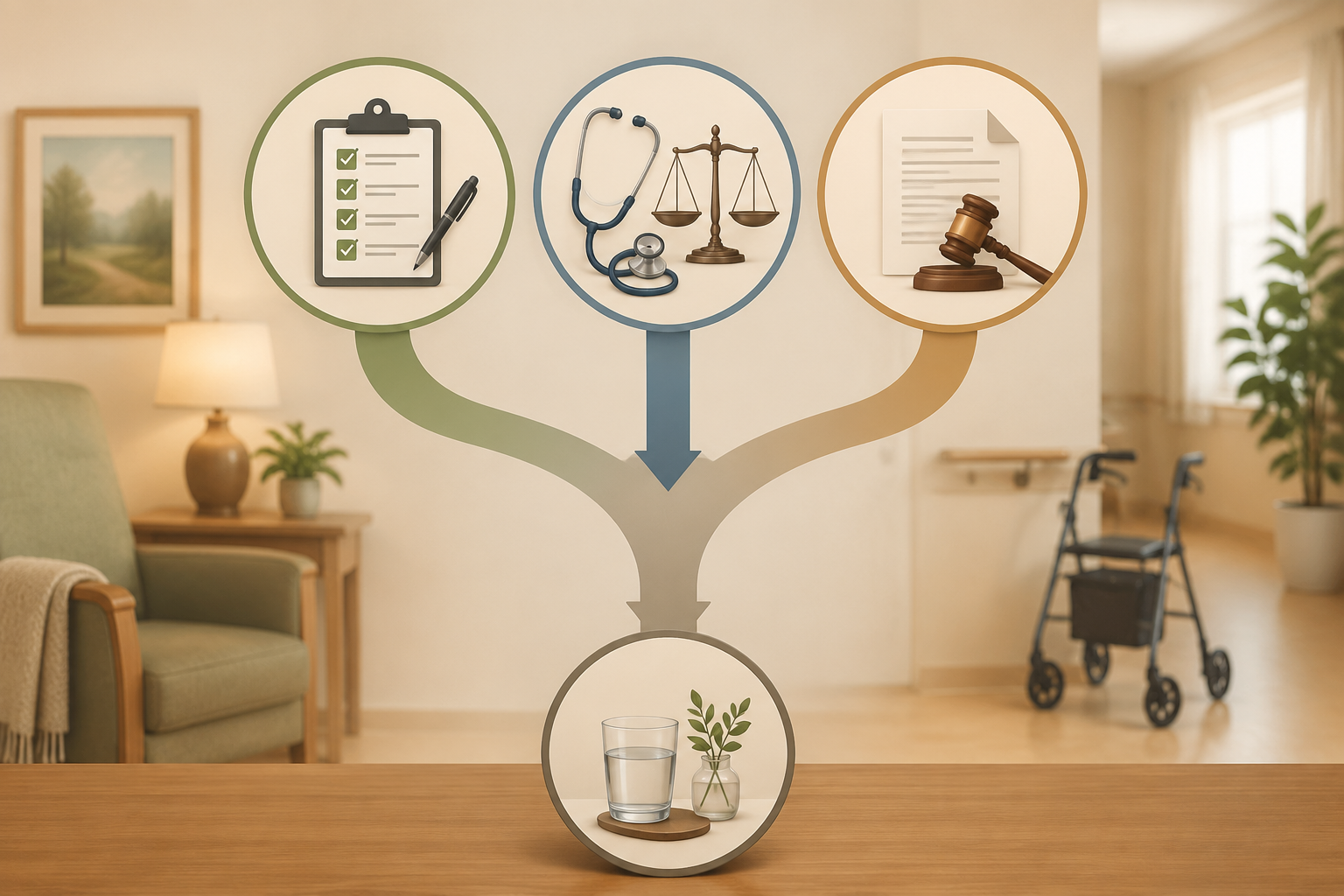
How the frameworks change the policy itself
A facility alcohol policy built on the three frameworks should read less like a ban-and-exception document and more like a decision process. Staff need to know where the decision begins, who reviews it, what gets documented, and what changes the answer over time.
Admission is the first weak point. If alcohol use is not discussed until a resident requests it, the facility is already relying on memory, assumption, or family narrative. The admission process should ask about current alcohol use, past alcohol-related problems, preferred beverages or rituals, and whether the resident expects alcohol to remain part of daily life. The answer should not automatically grant or deny anything. It should trigger the right review.
Care planning is the second weak point. Alcohol decisions do not belong only in an activities note or a nurse’s informal instruction. If alcohol use is permitted, the care plan should state the resident’s preference, any clinically relevant limits, storage or access arrangements, supervision needs if any, and signs that require reassessment. If alcohol is restricted, the care plan should state the specific contraindication or safety rationale, the resident’s response, and the review interval.
Medication and condition review should be real, not ceremonial. A policy can require review by the appropriate clinician or pharmacist when alcohol use may interact with medications or diagnoses. The point is not to make one signature carry the whole ethical burden. The point is to connect the restriction, limit, or permission to facts in the resident’s record.
Staff execution is where vague policy becomes bad practice. Aides, nurses, dining staff, and activities personnel need plain instructions: whether alcohol is allowed, what amount or setting has been approved if limits exist, whether the resident may keep alcohol in the room, what to do if the resident appears impaired, and whom to notify if family objects. The staff member on the floor should not have to invent the facility’s legal and ethical position in the moment.
A workable decision flow
- Ask about alcohol use and preferences at admission, then update the information after significant changes.
- Screen when use history, behavior, diagnosis, or staff observation suggests possible alcohol-related risk.
- Review medications, diagnoses, cognition, falls, swallowing, and history of alcohol use disorder before imposing or removing limits.
- Document the resident’s preference and the facility’s rationale in the care plan, including any contraindication.
- Give staff operational instructions that match the care plan rather than relying on informal judgment.
- Reassess after a change in condition, medication, behavior, resident preference, or regulatory concern.
This flow does not eliminate hard cases. It makes the hard cases visible early enough that the facility can handle them with a record instead of a scramble.
The same resident, three incomplete answers
Consider a hypothetical resident who wants one drink before dinner. The resident has mild cognitive impairment, a recent fall, and a medication list that raises concern. The family wants the facility to prohibit alcohol. The resident says this has been part of life for decades and understands that staff are worried.
A public-health-only answer might restrict the drink because fall risk and medication concerns are present. That may be clinically sensible, but if the facility does not explore the resident’s preference, possible modifications, or the actual severity of the contraindication, it has treated risk as the whole resident.
A human-rights-only answer might permit the drink because the resident remains an adult and the choice has personal meaning. That honors something important, but it can leave staff exposed if no one reviews the medication concern, monitors for impairment, or documents why the facility considered the risk acceptable.
A legal-only answer might look for the fastest liability shield: prohibit if counsel is nervous, permit if no explicit rule forbids it, or defer to family pressure. None of those moves is enough. The record should show the resident’s stated preference, the clinical review, the family concern, the facility’s interpretation of rights and contraindication, the final plan, and the condition changes that would reopen the decision.
Where administrators should be especially careful
The easiest mistake is to write a policy that sounds balanced but leaves the real decision to whoever is on duty. Words like “reasonable,” “safe,” “appropriate,” and “as tolerated” need enough operational support to mean something. Who decides reasonableness? What makes alcohol medically contraindicated? Who updates the care plan? What does dining staff do when a resident asks for alcohol outside a planned event?
The second mistake is to let family objection replace resident assessment. Families may know history the facility needs. They may also be frightened, grieving, angry, or trying to impose values the resident does not share. Their concerns should be heard and documented, especially when they identify prior harm. They should not become the policy unless the resident lacks decision-making capacity and the applicable decision-maker has authority over the issue under governing law and facility policy.
The third mistake is using alcohol use disorder prevalence as a reason to manage all alcohol use as suspected disorder. The wide 1.03% to 29% nursing-home AUD prevalence range reported in the literature varies by facility specialization.[5] A facility serving residents with higher behavioral health or substance use complexity may need more intensive screening, staff training, and monitoring. A general nursing facility still needs a process, but the data do not support treating every request as evidence of disorder.
The fourth mistake is relying too heavily on dated or narrow materials. Older written-policy statistics may be useful historically, but they should not anchor a 2026 policy review. A new state-specific law may matter greatly inside that jurisdiction, but it should not be treated as a national template. Secondary-source claims about alcohol-related health problems may point toward concern, but they should not carry more weight than peer-reviewed or official guidance.
What a defensible policy standard looks like
A defensible nursing home alcohol policy does not promise that every outcome will be risk-free. It promises that resident choice and resident safety will both be taken seriously before the decision is made, while the legal basis for the decision remains reviewable afterward.
That standard should be visible in the policy’s structure. Start from resident rights rather than institutional discomfort. Require admission inquiry and clinically appropriate screening. Define how contraindications are identified and documented. Explain when alcohol may be stored, served, supervised, limited, or declined. Give staff instructions that can be followed on a weekend shift. Reassess when the resident’s condition changes. Keep state law and licensing expectations in view without pretending a general policy can substitute for jurisdiction-specific legal review.
The strongest alcohol regulations in nursing homes are transparent, documented, individualized, rights-aware, clinically informed, and legally reviewable. They do not try to eliminate all discomfort from resident choice. They make the facility responsible for handling that discomfort in the open.
References
- Guide for Substance Use Screening in Nursing Facilities, Centers for Medicare & Medicaid Services.
- Serving Alcohol in Facilities, National Association of Activity Professionals.
- Use of Alcohol in Long Term Care Settings: A Comparative Analysis of Personal Choice, Public Health Advice and the Law, JAMDA, 2020.
- Decisive alcohol consumption policies needed in nursing homes, safety experts contend, McKnight’s Long-Term Care News.
- Prevalence of psychiatric disorders among older adults in long-term care homes: a systematic review, International Psychogeriatrics, 2010.
- Alcohol use in nursing homes: A qualitative investigation of the experiences of nursing home residents, relatives, and care workers, BMC Geriatrics, 2021.
Comments
Join the discussion with an anonymous comment.