
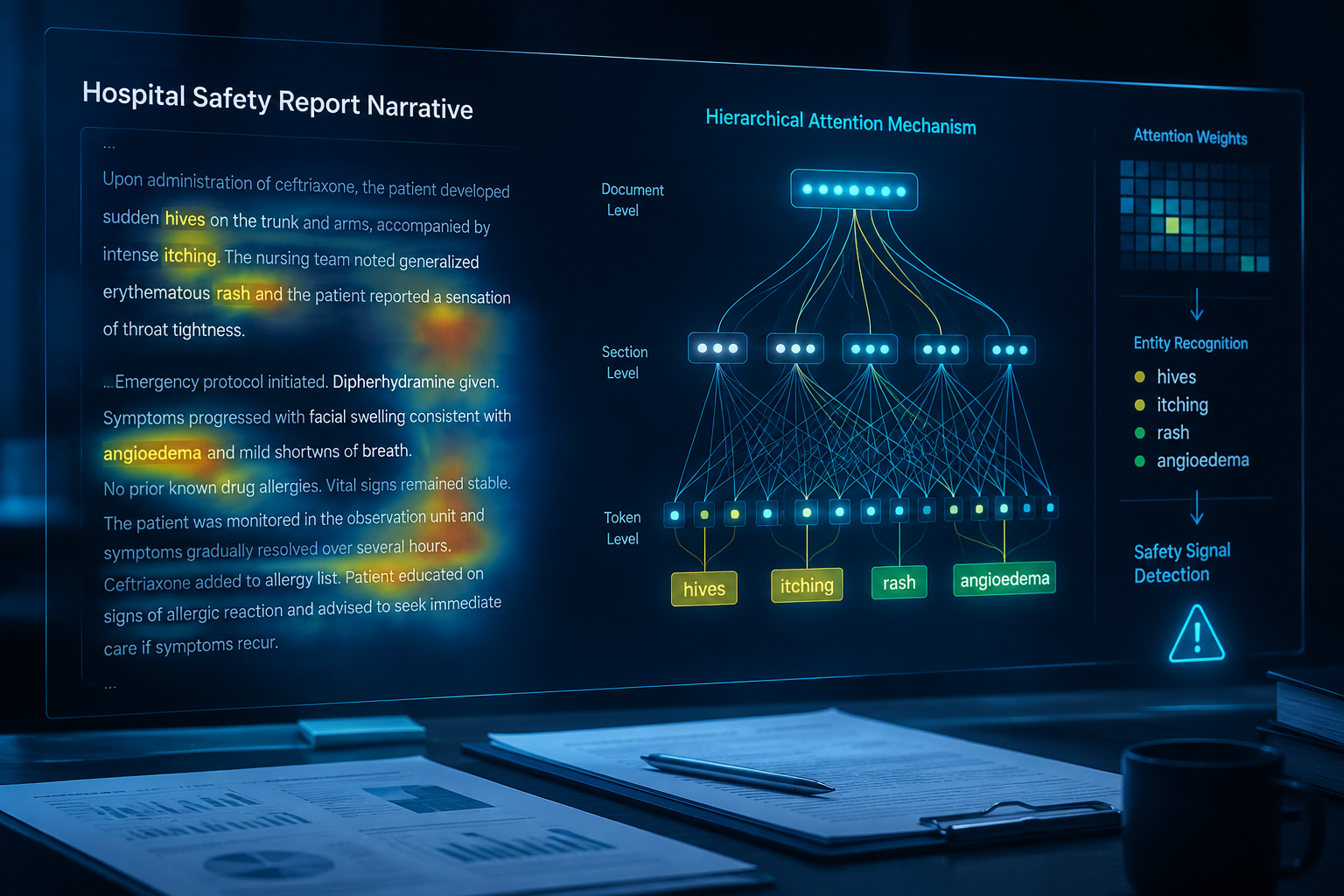
The phrase allergy medication cross-contamination symptoms usually does not arrive as a clean label. In hospital safety reports, the useful clue is often a fragment like hives, itching, rash, or angioedema, and Yang et al. showed that a hierarchical attention model can pull those fragments out of free text at scale rather than relying on a tidy diagnosis code. [1]
What the reports actually say
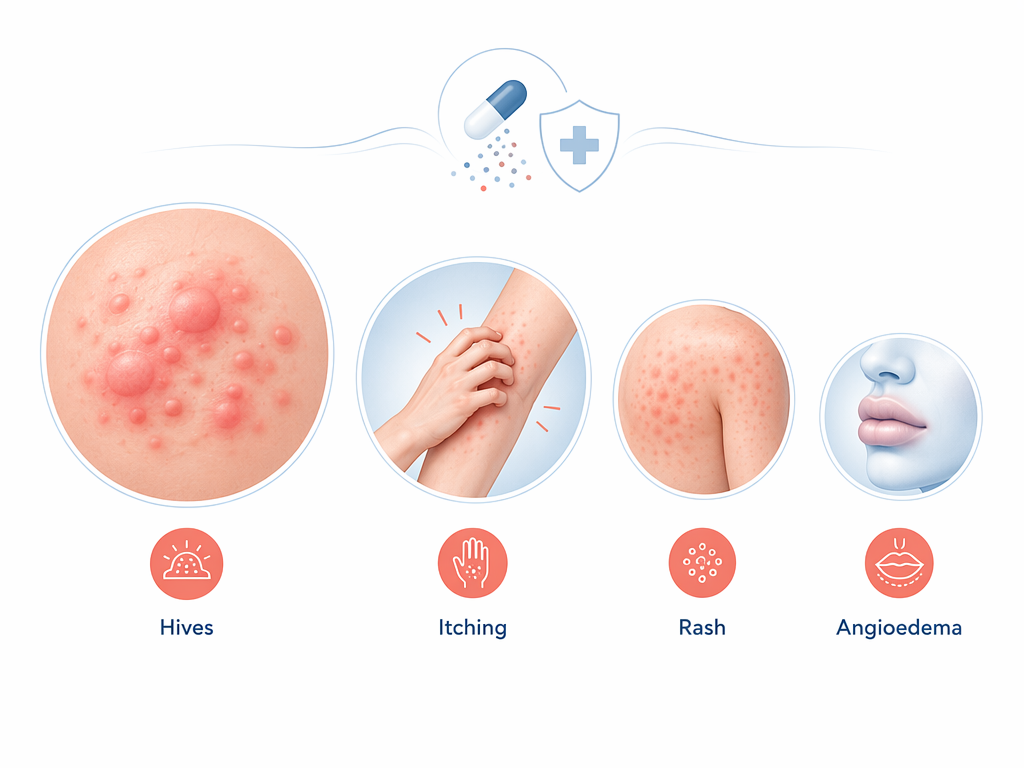
Among validated allergic reactions in the study, the symptom pattern was familiar and clinically messy: hives led the list, followed by itching, rash, and angioedema. That matters because cross-contamination surveillance rarely gets a polished sentence saying what happened; it gets a narrative that may mention only the symptom, not the exposure mechanism. [1]
- hives — 36.1% [1]
- itching — 20.3% [1]
- rash — 15.6% [1]
- angioedema — 5.6% [1]
The severity mix was not trivial either: 75.6% of validated allergic reactions were minor harm, 0.5% were major harm, and fewer than 0.1% ended in death. That is not a reason to overstate the threat, but it is a reason not to dismiss terse symptom language as low-value noise. [1]
How deep learning finds the missed cases
Yang et al. trained the model on 9,107 labeled hospital safety reports and validated it across 299,028 reports from two academic medical centers. Using a CNN plus bidirectional LSTM with hierarchical attention, it reached an AUROC of 0.979, with precision at the top 100 ranging from 0.93 to 0.99 across hospitals and timeframes. Compared with keyword search alone, it found 24.2% more confirmed cases while reducing manual review burden by 63.8%. [1]
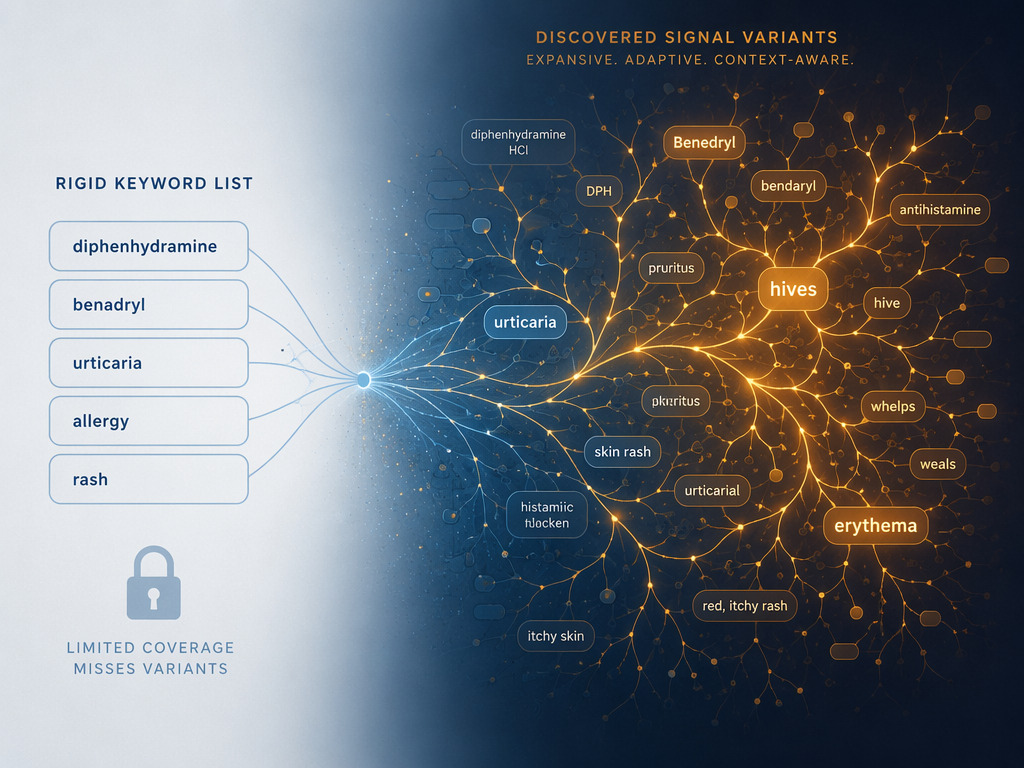
The reason is not just better ranking. The attention mechanism surfaced 99 new keywords beyond the original expert list of 101, including misspellings such as Benedryl and lexical variants such as hive and erythema. That is the practical failure mode of keyword surveillance: the report author writes what they saw, not what the rule set was expecting. [1]
What this can and cannot support
This is strong evidence that AI can detect allergic reactions in free-text safety reports and make cross-contamination surveillance more workable, because the report may record the reaction without explicitly naming the exposure mechanism. But that bridge is still an inference from a broader allergic-reaction detector, not a separate validation of cross-contamination as its own event class. [1]
That limitation matters because the data source is voluntary safety reporting, so the model can only learn from events that made it into the record in the first place. Broader pharmacovigilance reviews make the same practical point in another way: AI tools are promising, but data quality, transparency, and regulatory friction still shape what they can do in real workflows. [2]
The prevention side of the same problem looks different. Han et al. used knowledge-based clinical decision support to detect antibiotic allergy risk across 29 Korean hospitals, finding 15,535 alerts in 4 months, including 42.2% cross-reactivity alerts, 222 anaphylaxis cases, and 61 SCARs. That does not change the central result here, but it shows how detection and prevention sit on the same safety continuum. [3]
The main judgment is narrow and useful: deep learning can surface more confirmed allergic reaction signals from hospital safety reports than keyword search alone, especially when the symptoms are described indirectly, inconsistently, or with misspellings. It is promising for surveillance of medication-related cross-contamination, but it does not yet prove end-to-end cross-contamination detection across settings, and it should not be read that way. [1][2]
References
- Development and Validation of a Deep Learning Model for Detection of Allergic Reactions Using Safety Event Reports Across Hospitals, JAMA Network Open, 2020
- Artificial intelligence in pharmacovigilance: a narrative review and practical experience with an expert-defined Bayesian network tool, PubMed Central, 2025
- The Application of Knowledge-Based Clinical Decision Support Systems to Detect Antibiotic Allergy, Antibiotics, 2024
Comments
Join the discussion with an anonymous comment.