
The practical question behind analog AI patents and their applications in healthcare is not whether a model can recognize a cardiac rhythm in a lab notebook. It is whether the sensing, inference, memory movement, and wake-up logic can live inside the power budget of a coin-cell wearable or an implantable device long enough to matter.
That is why the most interesting analog AI claims are starting to sound less like software demos and more like battery-accounting exercises. Continuous ECG analysis, fall detection, asthma prediction, arrhythmia classification, and closed-loop response all become different engineering problems if inference can stay on instead of waking only after a conventional processor has already spent energy deciding whether anything important happened.
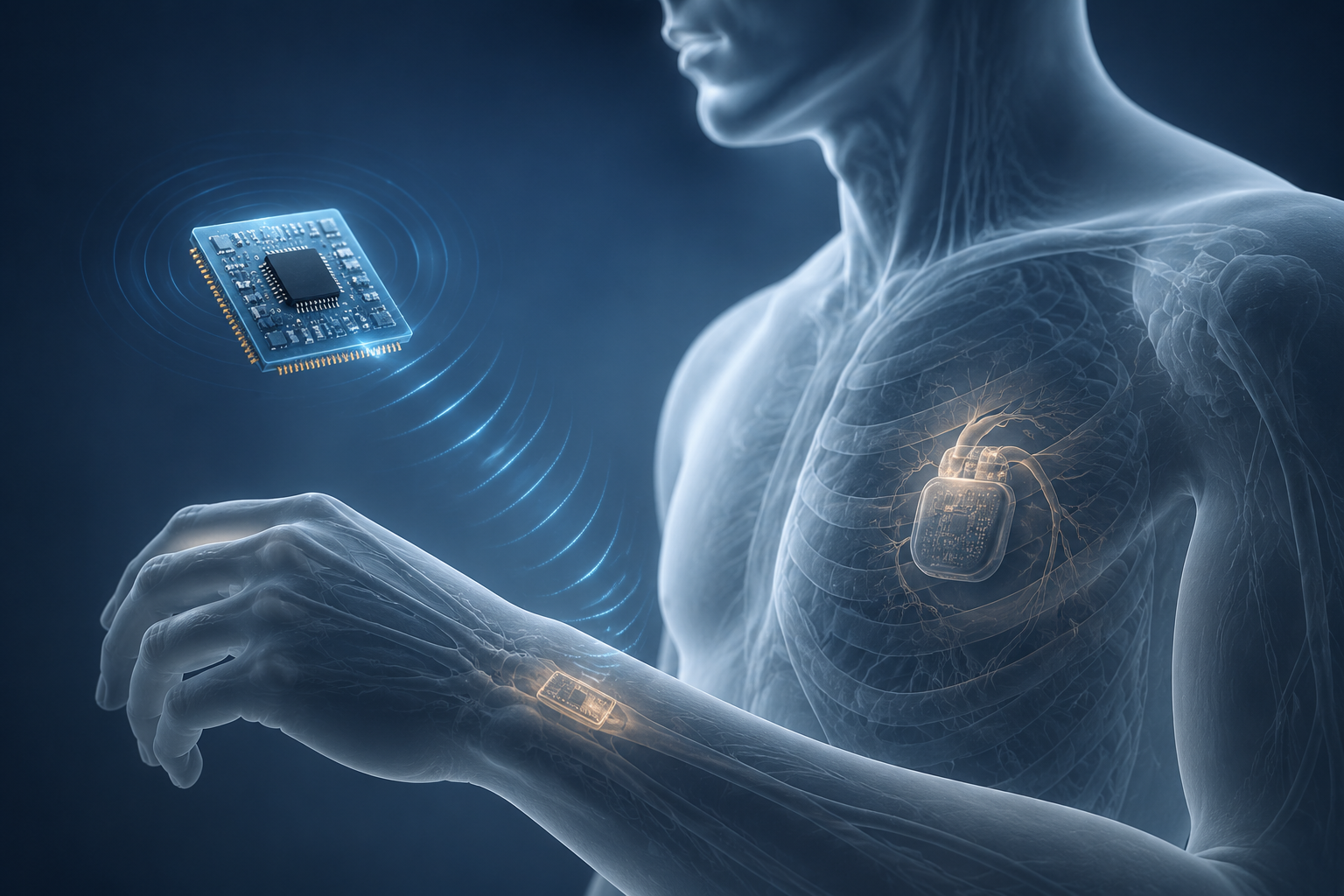
The GPX10 Case Makes the Power Claim Concrete
Ambient Scientific’s GPX10 is useful because it ties analog in-memory computing to named wearable medical functions rather than leaving the discussion at the level of generic edge AI. In a July 2026 Medical Design Briefs article, the company reported that the processor can support continuous ECG analysis, fall detection, and asthma prediction while operating on coin-cell batteries for months.[1]
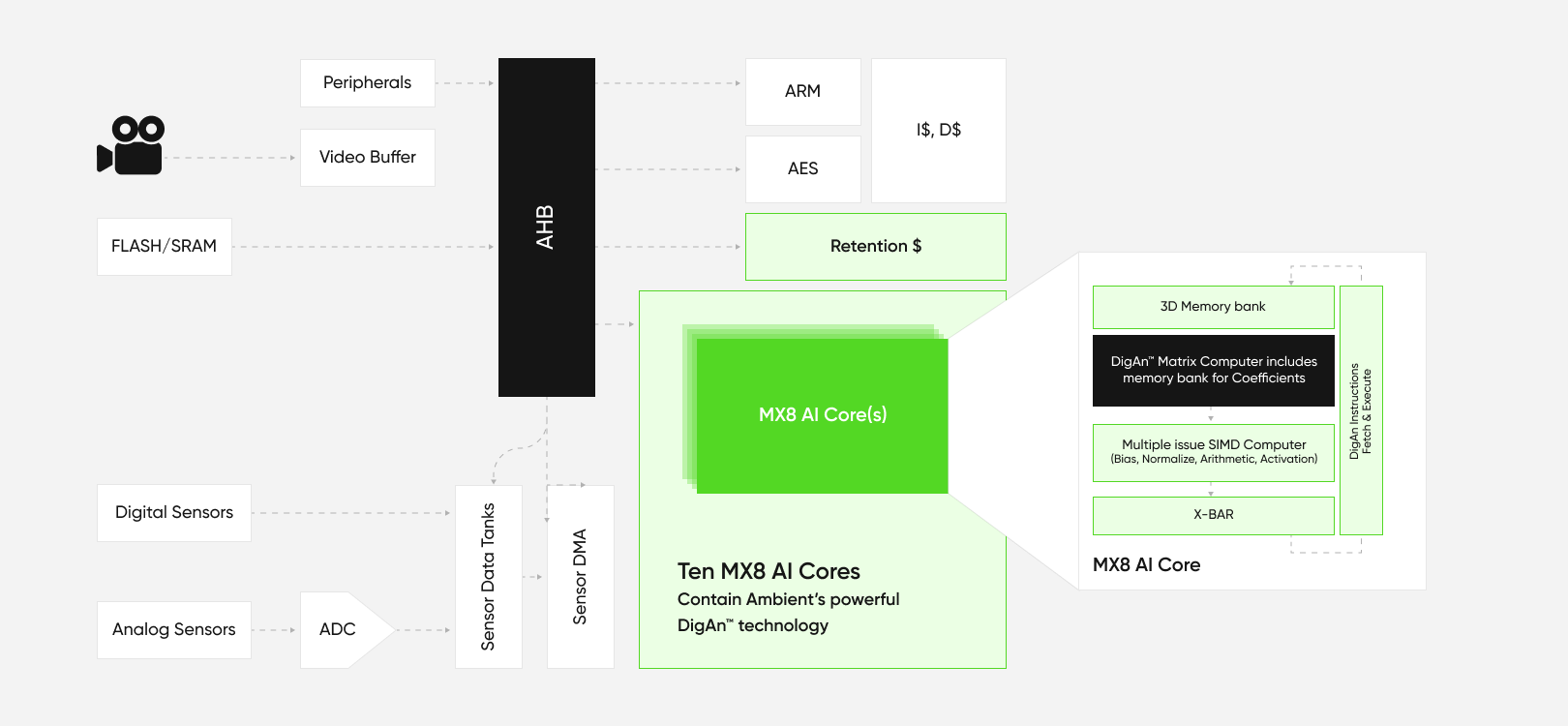
That claim deserves attention, and also restraint. The GPX10 material is manufacturer-reported in a press-oriented publication, not a peer-reviewed clinical validation study. It does not establish diagnostic accuracy in a defined patient population, prove real-world adherence, or show that a regulated device using the chip has crossed a clinical evidence threshold. What it does show is narrower and still important: analog AI has moved far enough toward device-level implementation that wearable medical use cases can be discussed in terms of operating modes and battery life, not only model architecture.
For a wearable device team, that distinction matters. ECG classification running occasionally is one product concept; ECG analysis running continuously without forcing a bulky battery, frequent charging, or aggressive duty cycling is another. Fall detection has the same problem. The sensor may be small, the model may be compact, and the clinical workflow may be plausible, but a device that is asleep at the wrong instant has made an engineering compromise that can become a clinical limitation.
Asthma prediction adds a different lesson. It implies a device that watches patterns over time rather than waiting for a single obvious event. In that kind of monitoring, the power budget is not an afterthought; it shapes what data can be collected, how often features can be computed, whether inference happens locally, and when the system decides to alert a patient or clinician.
The GPX10 therefore functions best as a bridge: not proof that analog AI is clinically ready, but evidence that a chip vendor is explicitly targeting wearable medical workloads where ordinary always-on digital inference would be difficult to justify. That is enough to make the patent question more specific. The valuable claims are unlikely to be broad statements about AI in health monitoring. They are more likely to sit where low-power sensing, analog computation, model constraints, and medical workflow meet.
Implantables Raise the Standard
Wearables can sometimes survive an inelegant power decision by asking the user to recharge. Implantables cannot rely on that escape route. A pacemaker-class power envelope turns every inference cycle into a system-level tradeoff involving battery life, sensing fidelity, circuit noise, firmware behavior, and patient safety.
TTP’s implantable arrhythmia classifier is the more demanding example for that reason. The engineering firm describes an AI classification approach designed for an implantable pacemaker power budget, combining quantisation-aware training, 8-bit constraints, and analog front-end design.[2] The result is not presented as a general approval-ready implantable AI product. It is a device-engineering demonstration of how model design and hardware constraints have to be solved together when the target is inside the body.
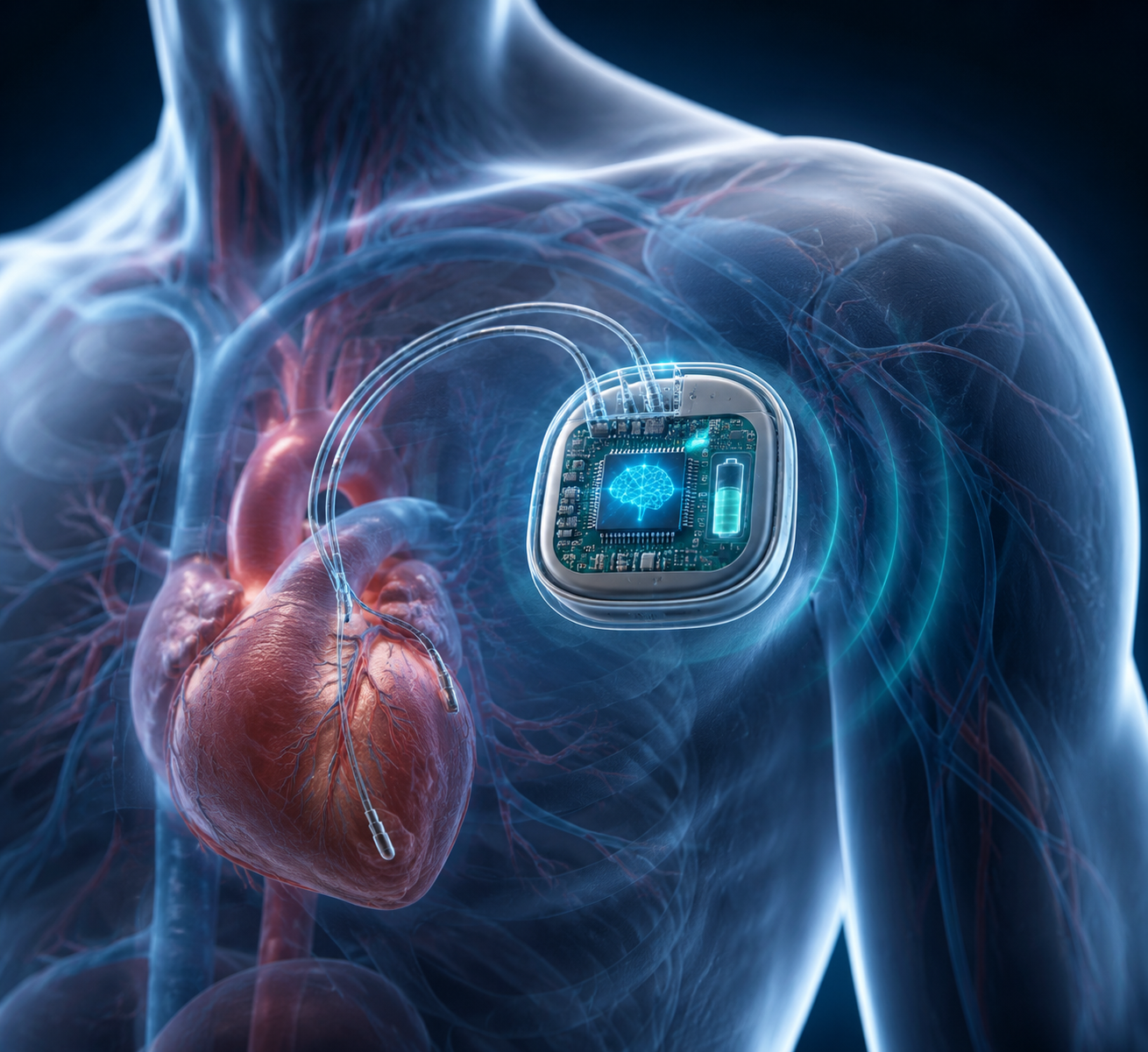
Quantisation-aware training is not just a compression trick in this setting. If the classifier must operate within 8-bit constraints, the model has to learn under the numerical limits it will face in hardware. Otherwise, accuracy estimated during development can degrade when the model is mapped onto the low-power implementation. In an implantable device, that mismatch is not a minor inconvenience; it can change how often the system misclassifies a rhythm, wakes a higher-power block, stores an episode, or triggers a downstream response.
The analog front end is equally important. Arrhythmia classification begins before the classifier sees a feature vector. The electrodes, amplifiers, filters, noise behavior, sampling choices, and signal conditioning all determine what the model receives. When those pieces are co-designed with the inference engine, the patentable invention may not be the classifier alone. It may be the way the sensing path, low-resolution model, analog circuitry, power states, and clinical decision logic are bound together.
That is where implantable analog AI becomes strategically different from general wearable analytics. A closed-loop implantable system may sense, classify, decide, and actuate without waiting for a phone or cloud service. The power constraint is severe, but so is the claim specificity. A filing that describes a concrete arrhythmia workflow, an implantable analog front end, a constrained inference method, and a therapy-control pathway is in a different class from a broad claim to using AI for cardiac monitoring.
Always-On Sensing Is the Pattern to Watch
Aspinity’s analog machine-learning work illustrates the always-on sensing pattern from another angle. In an Embedded.com discussion of analog computing for edge AI, Aspinity is cited for event detection at 20 µA and reported system power reductions of 92× to 105×.[3] Those are not clinical outcome figures. They are power-system figures, and that is exactly why they matter for continuous monitoring.
The value of an always-on event detector is that it can keep the expensive parts of the system asleep until the signal justifies waking them. In a medical wearable, that might mean fewer unnecessary radio transmissions or fewer high-rate processing windows. In an implantable, it could mean preserving battery life while still watching for clinically meaningful events. The patentable layer is often the event gate: what it listens for, how it rejects noise, what it wakes, and how it handles uncertain events without draining the system.
Why Analog AI Saves Energy
The short version is that analog computing can let the circuit physics do work that digital processors usually perform through many clocked operations and memory transfers. In analog in-memory approaches, matrix operations can be mapped onto conductance values and currents, using Ohm’s Law and Kirchhoff’s Current Law to accumulate multiply-accumulate behavior in the circuit itself.[3][4][5]
That is the elegant part, but it should not be overgeneralized. The often-cited energy advantage of analog or mixed-signal AI is best treated as an order-of-magnitude opportunity, not a guaranteed specification. Actual savings depend on workload, required resolution, signal quality, memory movement, process node, calibration needs, and the rest of the system around the accelerator.
Medical devices add another layer of caution. Lower power does not automatically mean clinical readiness. A device still has to handle drift, noise, patient variability, manufacturing tolerances, fault states, cybersecurity, verification, validation, and regulatory evidence. Analog AI can reduce one of the hardest constraints, but it does not remove the rest of the medical-device problem.
The Patent Landscape Is Moving, but the Healthcare Map Is Uneven
Once the power constraint is visible, the patent activity looks less like abstract semiconductor competition and more like early positioning around future device architectures. Patsnap reported 596 neuromorphic chip patents through early 2026, including a 401% filing surge in 2025 with 239 filings. The leading assignees identified in that analysis include IBM with 161 patents, Samsung with 141, Intel with 47, Syntiant with 21, and Polyn Technology with 19.[6]
Those numbers show competitive formation, not clinical inevitability. Many filings in a neuromorphic or analog AI chip landscape will concern device physics, memory arrays, signal processing, accelerator architecture, training methods, packaging, or general edge-AI use. They do not by themselves show that medical wearables or implantables are already crowded with mature, application-specific patent coverage.
The healthcare opening is more directional than numerical. Patsnap and ipCG both identify medical-device neuromorphic patents as undercovered or strategically open, but the available materials do not provide precise healthcare subcategory counts.[6][7] That limitation matters. It supports a watch-this-space judgment, not a claim that a quantified white space has been fully measured.
| Patent Layer | What the Claim Often Covers | Healthcare Relevance |
|---|---|---|
| Broad chip architecture | Analog arrays, neuromorphic cores, memory-compute structures, data movement, mixed-signal circuits | Important foundation, but not necessarily specific to a medical workflow |
| Low-power sensing and wake-up | Event detection, signal thresholds, sensor-front-end interaction, power-state control | Highly relevant for continuous monitoring where the device cannot process everything at full power |
| Application-specific medical inference | Constrained models, physiological signal processing, device-local classification | More defensible when tied to a defined signal and use condition |
| Closed-loop implantable function | Sensing, classification, therapy decision, actuation, safety limits, battery management | Potentially strongest when the technical pieces are inseparable from the medical function |
For IP strategy, that means the interesting work is not merely counting neuromorphic patents. It is separating enabling semiconductor claims from claims that solve a medical-device problem under medical-device constraints. A broad analog accelerator patent may be powerful, but it may not prevent a competitor from building a specific cardiac, neurological, respiratory, or closed-loop therapy workflow on a different architecture. Conversely, a narrow medical filing can become valuable if it captures the way a physiological signal, low-power inference engine, and device response have to cooperate.
Where Application-Specific Claims Look Stronger
A vague claim to “analog AI for healthcare” is unlikely to age well. The stronger opportunity is usually a well-specified combination: the sensor modality, the analog or mixed-signal inference path, the model constraints, the power-management behavior, and the medical action that follows.
- Continuous cardiac monitoring: ECG acquisition, analog front-end conditioning, low-bit arrhythmia classification, episode storage, and escalation logic.
- Implantable rhythm management: pacemaker-budget sensing, local classification, therapy gating, safety fallback behavior, and battery-aware operating modes.
- Fall and motion event detection: always-on inertial sensing, analog event gating, false-trigger reduction, and selective wake-up of higher-power processing.
- Respiratory monitoring: longitudinal pattern detection, local inference, patient alerting, and power management across quiet and high-risk periods.
- Closed-loop neuromodulation: neural or physiological sensing, ultra-low-power inference, stimulation control, and safety-bounded adaptation.
The common thread is not that every medical AI function needs analog hardware. Many do not. The stronger claim is that certain functions become technically plausible only when continuous sensing and inference fit inside a very small energy budget. In those workflows, power management is not a supporting detail; it is part of the invention.
The same logic should guide diligence. A medtech team evaluating an analog AI vendor should ask what has been demonstrated at the system level, not only what the accelerator can do in isolation. The relevant evidence includes total current draw, sensor duty cycle, radio behavior, memory access, calibration needs, performance after quantisation, temperature behavior, and how the device handles ambiguous signals. A clinical researcher will then ask a different but connected question: whether those engineering choices preserve the signal quality and decision reliability needed for the intended use.
What Can Be Said Now
Analog AI appears to be removing one of the hardest engineering barriers for continuous wearable and implantable inference: the cost of keeping intelligence awake. GPX10 gives the wearable discussion a concrete, manufacturer-reported device example. TTP’s arrhythmia work shows how implantable AI has to be co-designed around model precision, analog front ends, and pacemaker-class power. Aspinity’s event-detection figures show why always-on analog sensing is strategically different from periodically waking a digital processor.
The patent field is expanding quickly, but the healthcare-specific map is still uneven. The best opportunities are unlikely to come from claiming analog AI broadly. They are more likely to come from medical workflows where ultra-low-power sensing, continuous inference, and closed-loop response are technically inseparable.
References
- Ultra-Low-Power Processor Brings Real-Time AI to Wearable Medical Devices, Medical Design Briefs, July 2026.
- Ultra-low power machine learning for implantable medical devices, TTP.
- How analog computing can boost edge-AI power efficiency, Embedded.com.
- The Dream of Edge AI, Analog Devices.
- Mythic.
- Neuromorphic Computing Chip Patents Surge 401% in 2025, Patsnap.
- Neuromorphic Computing Patent Race, ipCG.
Comments
Join the discussion with an anonymous comment.