The phrase “apple ai partnerships in healthcare” sounds cleaner than the portfolio actually is. Apple is not running one healthcare AI program with one kind of partner and one standard of proof. It is operating across four partnership layers that should not be collapsed into each other: large virtual research studies, hospital technology deployments, frontier-model access arrangements, and a still-unreleased consumer health coaching product.
That distinction matters because the evidence behind each layer is very different. A peer-reviewed atrial fibrillation study with hundreds of thousands of participants is not the same thing as a reported model-licensing negotiation. A hospital deployment that changes medication administration and documentation workflows is not the same thing as a wellness coach that has not yet launched. Apple’s healthcare AI strategy looks most coherent when it is mapped by function, not by brand halo.
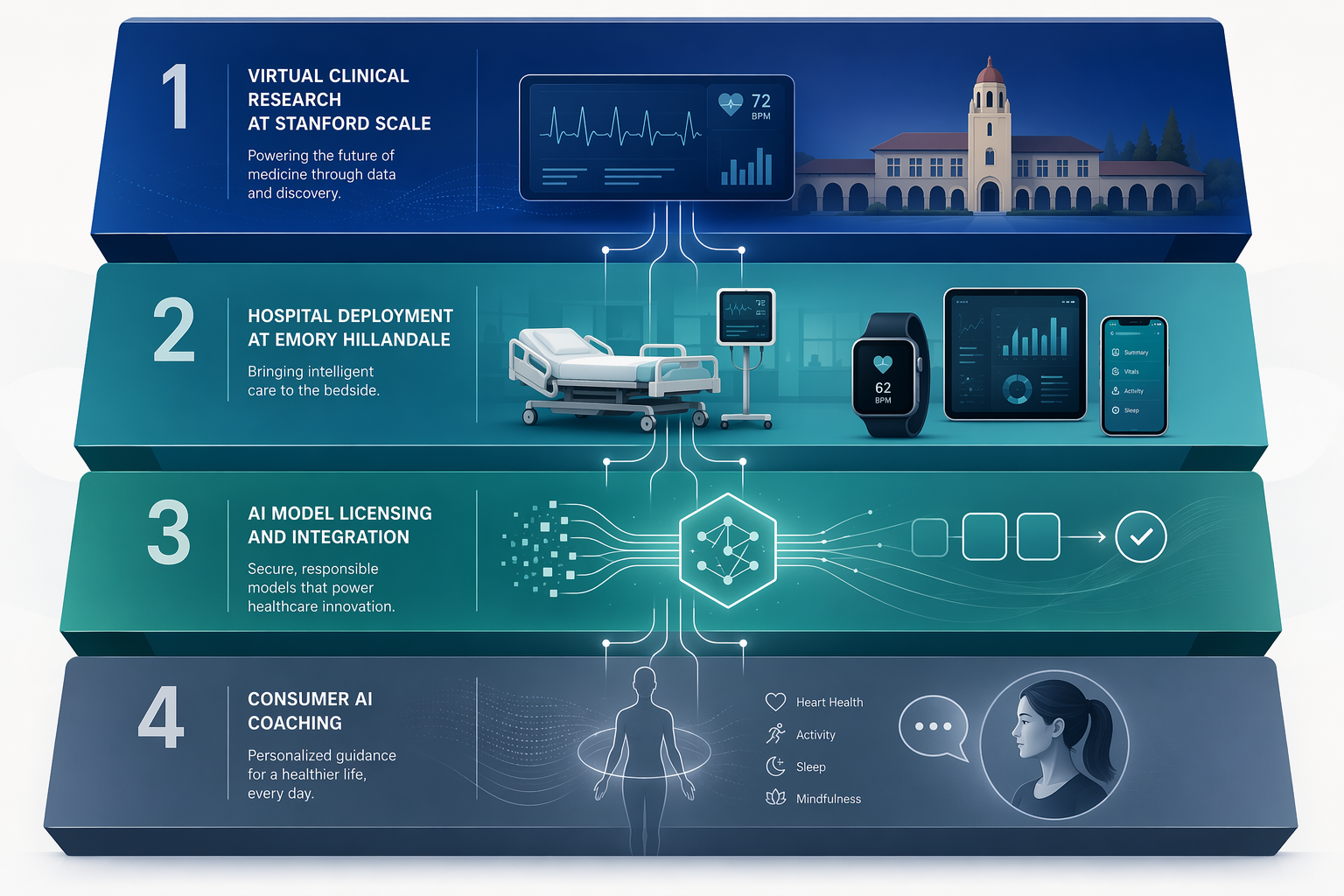
| Partnership layer | Strategic objective | Strongest supporting evidence | Main caveat |
|---|---|---|---|
| Large-scale virtual clinical research | Use Apple devices and opt-in study infrastructure to generate longitudinal health evidence | Apple Heart Study enrolled more than 400,000 participants in 8 months and reported an 84% positive predictive value for atrial fibrillation among notified participants who later had ECG patch confirmation [1] | Observational, opt-in, Apple-device user population; participation may not represent the broader patient population |
| Full-stack hospital deployment | Embed Apple hardware and software into bedside, EHR, medication, alerting, and documentation workflows | Emory Hillandale was described in 2025 as the first U.S. hospital powered by Apple products, using Apple devices with Epic workflows and Abridge documentation [2] | Reported documentation savings are preliminary and tied to a narrow single-physician study |
| AI model access and market access | Use external frontier models and regional partners while preserving Apple’s product and privacy positioning | Industry reporting describes OpenAI integration in iOS 18, a reported Google Gemini arrangement, Anthropic use for internal coding, and Alibaba/Baidu-related China arrangements [3] | Healthcare impact is indirect unless and until these models are tied to regulated or clinically consequential health functions |
| Consumer AI health coaching | Turn device signals, physician-informed content, and AI interfaces into personalized wellness guidance | Project Mulberry / Health+ has been reported as an AI health coach trained with Apple-employed physicians and external specialists [4] | As of July 2026, launch details and safety controls remain unconfirmed by Apple, and no FDA clearance has been publicly sought |
The research layer: Apple’s most credible healthcare asset
Apple’s strongest healthcare partnership evidence still comes from research, not generative AI. The Stanford Apple Heart Study is the anchor because it produced a clear clinical question, a large virtual enrollment pipeline, and peer-reviewed results. More than 400,000 participants enrolled over 8 months. Only 0.5% received an irregular pulse notification. Among participants who received a notification and then had simultaneous irregular pulse detection and ECG patch monitoring, the positive predictive value for atrial fibrillation was 84% [1].
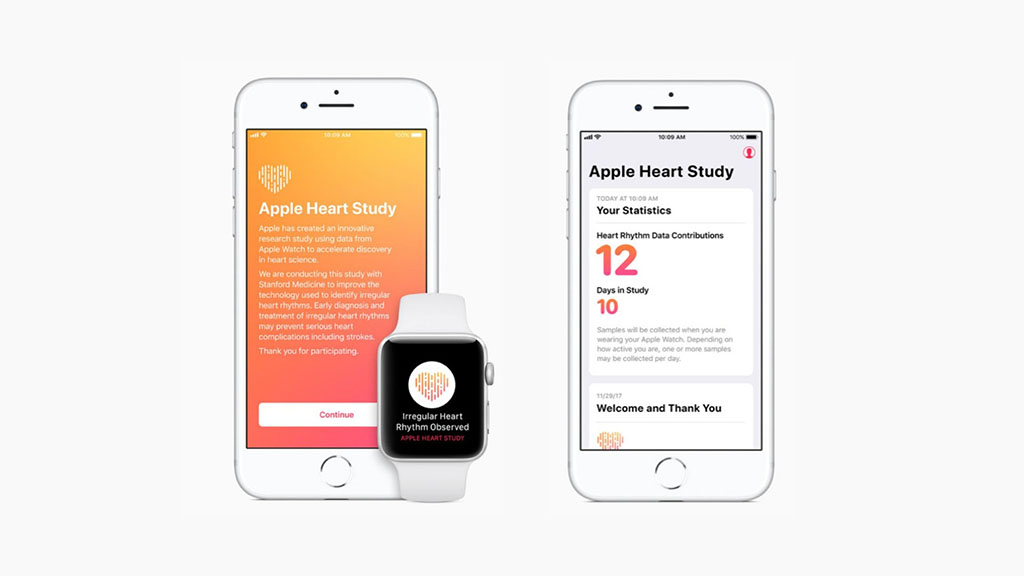
The number that tends to get quoted is the enrollment count, and for good reason. Recruiting more than 400,000 participants into a digital study in 8 months is not routine clinical research logistics dressed up in consumer packaging. It required a device base, an app-based consent pathway, remote monitoring, notification routing, and follow-up patch workflows that most conventional research operations teams would recognize as a hard operational problem, not just a marketing milestone [1].
The Apple Heart Study also sets the boundary for what Apple could claim. It did not prove that Apple Watch screening reduces stroke, improves mortality, or should be treated as a population-wide diagnostic pathway. It assessed whether a smartwatch-based irregular pulse notification could identify atrial fibrillation in a large, opt-in population and how often notifications corresponded to later ECG patch findings. That is meaningful evidence, but it is narrower than the way consumer device findings are sometimes discussed outside clinical circles.
The study’s design also foreshadowed the recurring limitations of Apple’s research model. Participants had to own or use compatible Apple technology, choose to enroll, and remain engaged enough for study follow-up. Those are not trivial filters. They create a population that may be healthier, more affluent, more digitally comfortable, and more motivated than the patients who most strain real-world clinical workflows.
From single-condition detection to longitudinal signal mapping
The Brigham and Women’s Apple Health Study, launched in February 2025, moves the research layer into a broader longitudinal design. Apple described it as a holistic study in the Research app intended to examine relationships across more than 15 health areas, including activity, aging, cardiovascular health, circulatory health, cognition, hearing, menstrual health, mental health, metabolic health, mobility, neurologic health, respiratory health, sleep, and others [5].
That shift is strategically important. The Apple Heart Study asked whether one device-mediated signal could help identify one condition. The Apple Health Study is closer to the data architecture Apple would need for AI-assisted health interpretation: repeated measurements, cross-domain correlations, and long observation windows. It does not by itself validate an AI coach or a clinical decision support tool, but it helps explain why Apple keeps investing in research partnerships rather than relying only on consumer engagement metrics.
Other collaborations sit in the same research layer. Apple has been associated with studies on cognitive decline with Biogen, behavioral health signals with UCLA, menstrual health through the Apple Women’s Health Study with Harvard and the NIH, and hearing exposure through the Apple Hearing Study with the University of Michigan. CB Insights estimates cumulative enrollment across Apple health studies at more than 750,000 participants, although that figure should be treated carefully because participants may overlap across studies [6].
This is where Apple has a real advantage. It can recruit at consumer scale while partnering with academic institutions that understand protocol design, consent, study governance, and publication standards. The clinical value is still study-specific. The strategic value is broader: Apple is building the habit, infrastructure, and partner network for device-mediated health research before asking AI systems to interpret increasingly complex personal health signals.
The hospital deployment layer: less glamorous, more operationally revealing
Emory Hillandale is a different kind of partnership altogether. It is not mainly a study enrollment story. It is a hospital implementation story, and that makes it more exposed to the ordinary friction of care delivery: logins, medication workflows, device availability, alert routing, EHR context, staff adoption, support, and the question of who gets interrupted when something breaks.
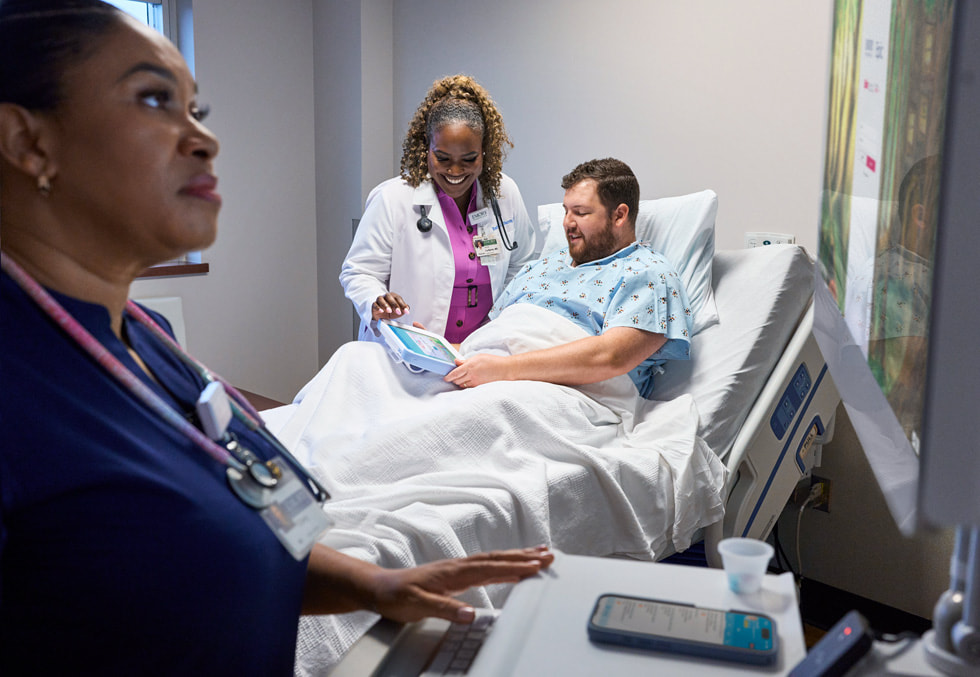
In May 2025, Apple and Emory described Emory Hillandale in Lithonia, Georgia, as a 100-bed hospital where Apple products were deployed across clinical workflows. The deployment included iMac, Mac mini, MacBook Air, iPhone 16, iPad, and Apple Watch hardware, with Epic workflows such as Rover for mobile medication administration and Limerick on Apple Watch for critical lab notifications [2]. Emory’s own announcement similarly framed the site as the nation’s first hospital powered by Apple products [7].
The interesting part is not that a hospital bought attractive devices. The interesting part is that the deployment touches multiple failure-prone handoffs. A nurse administering medication on an iPhone with Epic Rover is working in a different operational zone than a physician receiving a critical lab alert on Apple Watch. An iPad outside or inside a patient room changes who can access context and where. A Mac-based workstation changes the daily computing environment for clinicians who are usually forced to tolerate fragmented hardware, aging carts, and inconsistent peripheral setups.
The Abridge piece adds the AI layer. Apple reported that Emory physicians using Abridge ambient documentation saved about 2 hours per day on documentation [2]. That finding deserves attention, but it also needs to be kept in its lane. Available reporting ties the figure to Dr. Narayan’s single-physician study combining Apple, Epic, and Abridge. It should not be generalized as a hospital-wide productivity effect, a guaranteed ambient AI result, or proof that Apple hardware caused the savings by itself.
For hospital leaders, the more useful question is what had to be true for that saving to appear at all. Ambient documentation has to capture the visit well enough. The physician has to trust the draft enough to edit rather than rewrite it. The EHR integration has to reduce clicks rather than move them. The device environment has to be reliable enough that clinicians do not revert to parallel workarounds. The deployment is therefore best read as an early full-stack example: Apple hardware, Epic workflow, Abridge AI, and Emory implementation capacity operating together.
Apple also reported improvements in nurse satisfaction and retention at Emory Hillandale [2]. Those outcomes matter, especially in settings where technology burden contributes to staff frustration. But satisfaction and retention claims require the same discipline as documentation claims: baseline, comparison period, response methods, confounders, and whether improvements persist after the novelty of a deployment fades. A smoother device environment can help a hospital. It does not suspend the normal rules of implementation evidence.
What Emory proves — and what it does not
| Known from the Emory materials | Still uncertain |
|---|---|
| Apple products were deployed across a 100-bed hospital, including clinician workstations, iPhones, iPads, and Apple Watches [2][7] | Whether the same configuration would work in larger, more complex, or less resourced hospitals |
| Epic workflows were part of the deployment, including mobile medication administration and Apple Watch-based critical lab notifications [2] | How alert burden, escalation policies, downtime workflows, and support staffing were handled over time |
| Abridge ambient documentation was associated with about 2 hours per day of physician documentation savings in a narrow preliminary finding [2] | Whether savings generalize across specialties, clinicians, note types, and patient volumes |
| Apple and Emory reported nurse satisfaction and retention improvements [2] | How much of the change is attributable to Apple hardware versus broader operational changes |
This layer is strategically important because it places Apple closer to clinical work than a consumer watch notification does. It also makes Apple dependent on the least forgiving part of healthcare technology: local implementation. The partner is not just lending credibility. The partner is making the system work on Tuesday morning.
The model-access layer: strategically important, clinically indirect
Apple’s generative AI posture is more hybrid than vertically pure. Industry reporting summarized by EnkiAI describes several model and market-access arrangements: ChatGPT integration in iOS 18, a reported Google Gemini deal valued at about $1 billion per year, Anthropic models for internal code generation, and Alibaba and Baidu relationships tied to China regulatory and market requirements [3].
The reported Gemini figure should be handled as reporting, not as a confirmed Apple contract term. It may not reflect final terms, scope, in-kind considerations, or how model access would be allocated across consumer and developer features. The same caution applies to reading any of these arrangements as healthcare partnerships in the strict sense. They are AI infrastructure and market-access arrangements that could support healthcare features, not clinical validation events.
Still, the layer matters. If Apple wants sophisticated health coaching, summarization, conversational interfaces, or multimodal interpretation, it needs frontier-model capacity somewhere in the stack. The company’s product story emphasizes privacy and on-device processing where possible, but current frontier-model performance often requires external infrastructure. Apple’s practical answer appears to be selective model access while retaining control over the user interface, permissioning, and product boundary.
For healthcare, the key distinction is whether a model is being used to make a regulated clinical claim, assist documentation, summarize consumer wellness information, or power a general assistant. Those uses carry different safety, validation, monitoring, and regulatory expectations. A model partnership alone does not answer any of those questions.
Health+ is where the layers may converge, but the evidence is thinnest
Project Mulberry, also reported as Health+, is the most speculative layer in Apple’s healthcare AI portfolio. Healthcare Digital describes it as an AI-powered health coach trained with input from Apple-employed physicians and external specialists across areas such as sleep, nutrition, physical therapy, mental health, and cardiology [4]. Reporting has pointed to a U.S.-first launch tied to iOS 19.4 in 2026, but as of July 2026, Apple has not officially confirmed final launch scope, pricing, detailed safety controls, or clinical boundaries.
This is the layer where Apple’s research infrastructure, consumer devices, physician-informed content, and external AI capacity could meet. A consumer might bring years of Watch, iPhone, sleep, activity, hearing, or menstrual-cycle data into an AI interface that offers coaching rather than diagnosis. That is a plausible strategic direction. It is not the same as evidence that the product improves outcomes, avoids harm, or performs safely across age, literacy, language, comorbidity, and access differences.
The wellness positioning is not a minor detail. Apple has not publicly sought FDA clearance for Health+ as of July 2026, and the product has been described as wellness coaching rather than a medical device. That boundary can reduce regulatory burden, but it does not eliminate safety questions. A physician-trained AI system that gives health guidance may still influence care-seeking, medication conversations, anxiety, diet, exercise, sleep behavior, or decisions about symptoms.
The timing is also sensitive because AI error is no longer a theoretical concern for healthcare technology governance. ECRI listed AI-related errors among its top health technology hazards for 2025, a reminder that health systems are already being asked to manage incorrect, misleading, or poorly contextualized AI outputs in clinical environments. A consumer coaching tool lives outside the hospital, but patients do not leave the consequences of bad advice outside the clinic door.
How strong is the evidence behind Apple’s healthcare AI posture?
By Q3 2026, Apple can credibly claim that it has built one of the most scaled consumer-device research pipelines in health technology. It can also claim that it has moved beyond wearables into a deeper hospital deployment model, at least in one closely watched Emory setting. It can say less, with confidence, about generative AI’s clinical value under the Apple brand.
| Layer | Evidence strength by Q3 2026 | What Apple can credibly claim | What would overstate the evidence |
|---|---|---|---|
| Virtual clinical research | Strongest | Apple can recruit and operate very large opt-in digital studies with academic partners, and the Apple Heart Study produced peer-reviewed evidence for irregular pulse notification performance in a defined context [1] | Claiming broad outcome improvement or population-wide diagnostic replacement |
| Hospital deployment | Promising but early | Apple devices can be integrated into hospital workflows with Epic and ambient documentation partners in at least one 100-bed hospital deployment [2][7] | Treating preliminary documentation savings as generalizable across hospitals |
| Model access | Strategically relevant but clinically unproven | Apple is using external model and regional partnerships to support AI capability and market access [3] | Calling these arrangements clinical AI partnerships without a healthcare use case |
| Consumer coaching | Unproven before confirmed launch and evaluation | Apple appears to be preparing a wellness-oriented AI health coach informed by physician and specialist input [4] | Implying clinical efficacy, FDA-cleared status, or established safety performance |
There is also a capital and ecosystem backdrop. Apple announced a $500 billion U.S. investment commitment in February 2025, and Forbes argued that healthcare AI would likely benefit from the broader ecosystem investment [8]. That may be directionally reasonable, but investment capacity should not be confused with healthcare evidence. Money can accelerate infrastructure, hiring, silicon, cloud arrangements, and product development. It does not validate a health intervention.
The cleanest reading of Apple’s portfolio is pragmatic rather than revolutionary. In research, Apple partners with academic medical centers because clinical credibility requires more than device telemetry. In hospitals, it partners with health systems, Epic, and documentation vendors because workflow value is created inside messy operational dependencies. In generative AI, it uses external model partners because frontier capability is expensive and fast-moving. In consumer coaching, it appears to be assembling the ingredients for a health guidance product while keeping the initial posture outside regulated medicine.
That layered strategy is sensible. It is also uneven. The research layer has scale and peer-reviewed support. The hospital layer has a concrete deployment but still needs broader evidence. The model layer gives Apple capability without proving healthcare benefit. The coaching layer may become the most visible consumer expression of Apple’s healthcare AI ambitions, but its clinical significance remains unproven until launch details, guardrails, performance monitoring, and regulatory boundaries are clearer.
References
- Large-Scale Assessment of a Smartwatch to Identify Atrial Fibrillation — NEJM
- Apple products transform care at Emory Healthcare — Apple Newsroom, May 2025
- Apple AI Partnerships 2025: Inside the Ecosystem Strategy — EnkiAI
- Project Mulberry: Apple's secret AI-powered health coach — Healthcare Digital
- New holistic Apple Health Study launches today in the Research app — Apple Newsroom, Feb 2025
- Apple's AI Strategy In Healthcare: How The Tech Giant Is Tackling Heart Health, Cognitive Health, Elder Care & More — CB Insights
- Emory Healthcare launches nation's first hospital powered by Apple products — Emory Newsroom, May 2025
- Apple Announces $500 Billion Investment; Its Healthcare AI Ecosystem Will Surely Benefit — Forbes, Feb 2025
Comments
Join the discussion with an anonymous comment.