
The first human experience with antisense therapy for KCNT1 epilepsy contains both the result families had been hoping to see and the safety problem future programs cannot work around. In two infants with KCNT1 p.R474H epilepsy of infancy with migrating focal seizures, intrathecal valeriasen, also known as KT777, was followed by reduced seizure burden. Both infants then developed communicating hydrocephalus with elevated cerebrospinal fluid pressure, including a CSF opening pressure of 55 cm H2O in the first treated child and greater than 20 cm H2O in the second.[1]
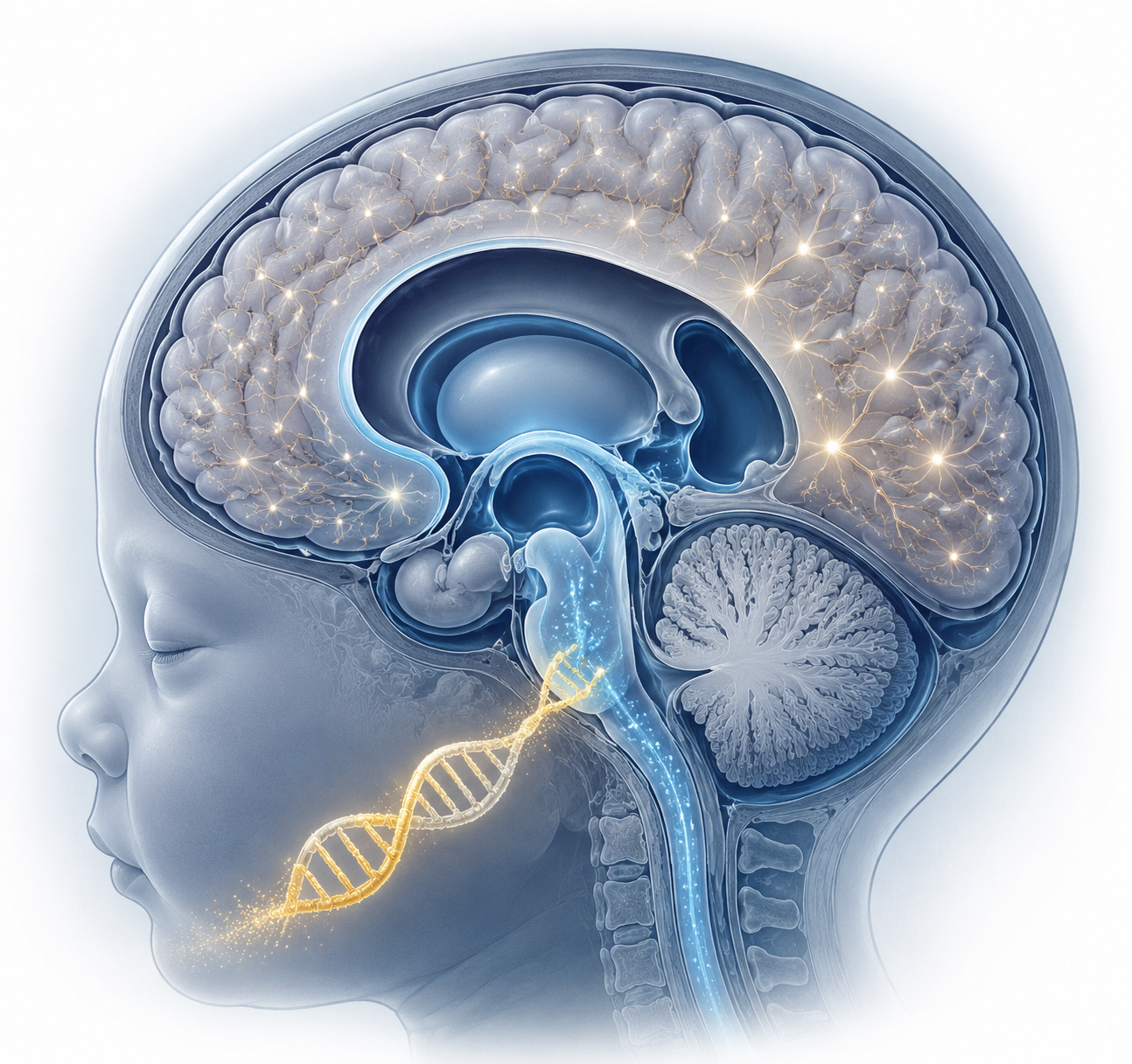
That is the central clinical tension. KCNT1 knockdown has now shown human activity in a catastrophic developmental and epileptic encephalopathy. It has not yet shown that the therapeutic window is settled. The meaningful observation is not simply that an N-of-2 trial produced a signal; it is that the seizure signal, the dose history, the need for shunting, and the decision to resume treatment under a revised protocol now define the next trial-design problem.
The Clinical Signal Arrived Early, But Not Cleanly
KCNT1 developmental and epileptic encephalopathy is an ultra-rare genetic epilepsy, with an estimated 3,000 affected children in the United States.[1] The infants in the valeriasen report had one of the severe early presentations: epilepsy of infancy with migrating focal seizures. This is not a setting where clinicians can wait comfortably for conventional trial architecture. Seizures may begin within hours or days of birth, development is under immediate threat, and standard antiseizure medications often leave families counting events that continue despite treatment.
Valeriasen was designed as an RNase H-activating antisense oligonucleotide to reduce KCNT1 mRNA. The biological idea is direct: if a pathogenic KCNT1 gain-of-function variant contributes to neuronal hyperexcitability, lowering the amount of KCNT1 transcript could reduce disease-driving channel activity. The clinical question is more demanding: can that knockdown be achieved in the central nervous system of an infant at a dose that changes seizures without creating a new intracranial pressure problem?
| Clinical feature | Patient 1 | Patient 2 |
|---|---|---|
| Seizure onset | Day 4 of life | 5 hours of life |
| Initial treatment course | Dose escalated to 60 mg intrathecal valeriasen | Treatment interrupted after hydrocephalus, then resumed at a lower dose |
| Efficacy signal | Seizure reduction reported before later deterioration | Approximately 66% seizure reduction after lower-dose resumption |
| Hydrocephalus finding | Communicating hydrocephalus with CSF opening pressure of 55 cm H2O | Communicating hydrocephalus with CSF opening pressure greater than 20 cm H2O |
| Afterward | Family withdrew to palliative care | VP shunt placement followed by lower-dose, MRI-monitored treatment resumption |
The table can make the courses look orderly. They were not interchangeable. Patient 1’s seizures began on day 4 of life, and treatment was escalated to 60 mg intrathecal valeriasen. A seizure reduction was reported, but the child later developed dystonia and communicating hydrocephalus. The measured CSF opening pressure was 55 cm H2O, a value that moves the event out of the realm of vague imaging concern and into a clinically serious intracranial pressure complication. The family ultimately withdrew to palliative care.[1]
Patient 2’s course is the reason the report is more than a warning. This infant’s seizures began 5 hours after birth. After hydrocephalus was identified and a ventriculoperitoneal shunt was placed, treatment resumed at a lower dose under a redesigned monitoring plan that included MRI surveillance. On that resumed lower-dose regimen, seizure frequency fell by approximately 66%.[1] In a disease where the daily arithmetic of seizures can dominate an infant’s life, that is a clinical signal worth taking seriously.
It is also a signal with important measurement limits. The trial had no control arm. Seizure frequency was captured through caregiver diaries and interval EEGs, not continuous seizure monitoring.[1] That does not make the observation meaningless; many severe infant epilepsy studies necessarily rely on imperfect measures. It does mean the efficacy claim should stay close to what was observed: a substantial seizure reduction in one infant after lower-dose resumption, and reported seizure improvement in another infant before a severe hydrocephalus complication and treatment withdrawal.
Why This Was Scientifically Reasonable To Try
The clinical attempt did not come from a single sequence chosen on faith. The preclinical program screened 263 candidate ASO sequences through iterative rounds before moving toward a therapeutic candidate.[2] That kind of narrowing is one of the quieter places where modern RNA therapeutics overlap with the data-intensive world more familiar to healthcare AI readers: the therapeutic object is small, but the selection process is computationally guided, experimentally filtered, and unforgiving of weak candidates.
The mouse data also gave the program a reason to proceed. In a homozygous Kcnt1 P905L mouse model, median survival extended from 44 days to 233.5 days after ASO treatment.[2] That is a large preclinical effect, and in a disorder with few realistic disease-modifying options, it matters. Still, the model carries a translation caveat: the mouse phenotype required two mutant alleles, while human KCNT1 disease is heterozygous. A survival extension in that model supports biological plausibility; it does not define the infant dose-response curve or predict CSF dynamics in the human ventricular system.
The rat GLP toxicology package also failed to predict the hydrocephalus signal seen in the two treated infants.[1] That failure is not a small footnote. For CNS ASO programs, especially those delivered intrathecally to infants and children, the negative predictive value of current toxicology models becomes part of the risk assessment. If the relevant toxicity emerges through CSF flow, choroid plexus biology, meningeal handling of phosphorothioate gapmers, or another route-dependent mechanism, then ordinary preclinical reassurance may be too thin.
Hydrocephalus Is The Safety Signal Future KCNT1 Programs Inherit
The hydrocephalus question cannot be answered by the KCNT1 trial alone. Two infants are enough to demand attention, not enough to settle mechanism. The Nature Medicine report discusses both an on-target hypothesis, because KCNT1 is expressed in choroid plexus epithelium, and off-target explanations, including TLR9/CpG immunostimulation and high-dose phosphorothioate gapmer effects.[1] The distinction matters because the next step differs depending on the answer. A target-specific choroid plexus effect would follow KCNT1 knockdown itself. A chemistry-and-route effect would follow a broader class of intrathecal gapmer ASOs, especially at higher exposure.
The strongest comparator is tominersen, the intrathecal huntingtin-lowering ASO studied in Huntington’s disease. In the Phase III GENERATION HD1 program, ventricular volume increases were dose dependent: 11.4% in the placebo group, 17.4% with every-16-week dosing, and 24.3% with every-8-week dosing.[3] That gradient does not prove the same mechanism in KCNT1 infants, but it makes a purely target-specific explanation less satisfying. It points toward a broader relationship among intrathecal exposure, ASO chemistry, and CSF compartment response.
Nusinersen adds a more cautious piece of evidence. Five post-market hydrocephalus reports have been described in spinal muscular atrophy, but interpretation is confounded by baseline disease risk and the treated population.[1] Those cases should not carry the same weight as the tominersen ventricular-volume gradient. They are still relevant because they keep hydrocephalus on the surveillance list for intrathecal oligonucleotide programs, particularly in children with complex neurologic disease.
Tofersen is the useful counterweight. No hydrocephalus signal has been reported for tofersen in ALS.[1] That prevents the easy but inaccurate conclusion that all CNS ASOs inevitably produce hydrocephalus. The more defensible interpretation is narrower: hydrocephalus and ventricular enlargement have appeared across more than one intrathecal ASO program, the pattern may be dose related in at least some settings, and the mechanism remains unresolved.
Patient 2 Shows The Path Forward, Not The Answer
The most consequential part of the valeriasen experience may be what happened after the complication, not before it. Patient 2 did not simply continue unchanged. A VP shunt was placed, dosing was lowered, and treatment resumed with MRI monitoring.[1] That sequence suggests the risk may be modifiable and monitorable. It does not show that the risk is eliminated.
For future antisense therapy for KCNT1 epilepsy, that difference is critical. A lower-dose strategy is not just a conservative instinct; it is anchored in the observation that the clearer sustained seizure reduction occurred after lower-dose resumption in patient 2. MRI monitoring is not simply documentation; it becomes part of the safety intervention, because ventricular changes may precede or accompany clinical deterioration. CSF opening pressure is not an ancillary measurement; in patient 1, it was the fact that defined the seriousness of the complication.
The next protocols therefore need to separate three questions that are easy to blur in a rare-disease emergency. First, what is the minimum KCNT1 knockdown needed for seizure benefit? Second, which imaging or pressure changes should trigger dose delay, dose reduction, shunting evaluation, or discontinuation? Third, can preclinical systems be made sensitive enough to detect hydrocephalus risk before an infant is exposed?
That last question may be the hardest. Existing animal toxicology did not forecast the human complication, and the mouse efficacy model does not perfectly mirror heterozygous human disease.[1][2] Better models may need to account for age, CSF flow, choroid plexus expression, ASO chemistry, cumulative exposure, and inflammatory signaling. None of those variables can be assumed away because the target biology is compelling.
What The First Trial Changes For The Field
The valeriasen report changes the evidentiary baseline. Before it, KCNT1 ASO therapy rested on preclinical plausibility and the broader success of CNS oligonucleotide delivery. After it, there is human evidence of seizure reduction after KCNT1 knockdown, including an approximately 66% reduction in patient 2 on a resumed lower-dose regimen.[1] That is proof of clinical activity, not proof that the therapy is established.
It also changes what regulators, investigators, and families should expect from future studies. A KCNT1 ASO protocol that does not explicitly address ventricular monitoring, CSF pressure assessment, hydrocephalus management, dose de-escalation, and stopping rules would now look incomplete. The field has already moved beyond a purely hypothetical next step: Servier announced in June 2026 that the first patient had been enrolled in a Phase Ib/II study of S230815 for a rare pediatric epilepsy syndrome, and the registered study is listed as NCT07227857.[4][5]
Those later programs should not be judged by whether they recreate the drama of the first N-of-2 experience. They should be judged by whether they learn from its sequence. The seizure endpoint needs to be measured as rigorously as feasible in infants whose events may be frequent, subtle, and caregiver-reported. Dose selection should assume that higher exposure may carry ventricular risk until shown otherwise. Safety monitoring should be built into the therapeutic logic, not appended after enrollment.
The careful conclusion is also the most useful one: KCNT1 knockdown has now produced meaningful human seizure reduction, but the first human ASO therapy for KCNT1 epilepsy also revealed the safety problem the next generation of trials must solve. In this disease, that is progress. It is not permission to look away from hydrocephalus.
References
- Antisense oligonucleotide-mediated knockdown therapy in two infants with severe KCNT1 epileptic encephalopathy, Nature Medicine, April 2026.
- Preclinical mouse proof-of-concept for KCNT1 ASO therapy, JCI Insight, 2022.
- Hydrocephalus Complicating Intrathecal Antisense Oligonucleotide Therapy for Huntington's Disease, PMC, 2021.
- Servier announces first patient enrolled in Phase Ib/II study for the treatment of a rare pediatric epilepsy syndrome in the US, Servier Press Release, June 2026.
- NCT07227857, ClinicalTrials.gov.
Comments
Join the discussion with an anonymous comment.