
Public attention often comes to cause-of-death data through individual names. That is why understanding causes of death in public figures can feel like a question of disclosure, certainty, or forensic finality. Mortality surveillance works in a less tidy place. A cause of death is first written as clinical text, often under time pressure, then interpreted through certificate structure, spelling, diagnostic vocabulary, and coding rules before it becomes a count in a national dataset.
The public health problem is not only whether the final code is correct. It is also whether the coded data arrive while they can still guide action. In Portugal, the AUTOCOD system was evaluated as a way to classify causes of death from death certificates in near real time, shifting mortality surveillance away from a retrospective process that had been completed by March of the following year toward much faster operational use.[1]

The delay AUTOCOD is trying to compress
Mortality data are among the most consequential public health signals because they describe the endpoint other indicators only approximate. Hospitalizations, syndromic complaints, laboratory reports, and excess death counts can all warn that something is wrong. Cause-specific mortality tells agencies what kind of wrong they are dealing with: cancer, circulatory disease, respiratory disease, infection, injury, or something less common.
Traditional cause-of-death coding is slow because it asks humans and coding systems to turn free-text medical certification into standardized ICD-10 categories. That work is necessary, but the calendar matters. If the usable cause-specific mortality picture appears only after an outbreak wave, heat event, or respiratory season has passed, the data become more useful for annual reporting than for response.
AUTOCOD’s importance is therefore not that it makes death certification effortless. It does not. Its importance is that it tests whether a national mortality system can produce an earlier cause-specific signal from the text already being collected.
What the Portugal evaluation actually tested
Ferreira and colleagues evaluated AUTOCOD on 330,098 death certificates from Portugal’s national mortality database, an important scale because it moves the discussion beyond a small model demonstration and into the workload of a mortality surveillance system.[1]
The system used natural language processing and a deep neural network to classify free-text death certificate content into ICD-10 outputs at two levels: broad chapters and more specific blocks.[1] That distinction matters. A chapter-level result can tell a surveillance team that deaths are being classified under respiratory diseases; a block-level result narrows the signal further, while still remaining within a standardized coding structure.
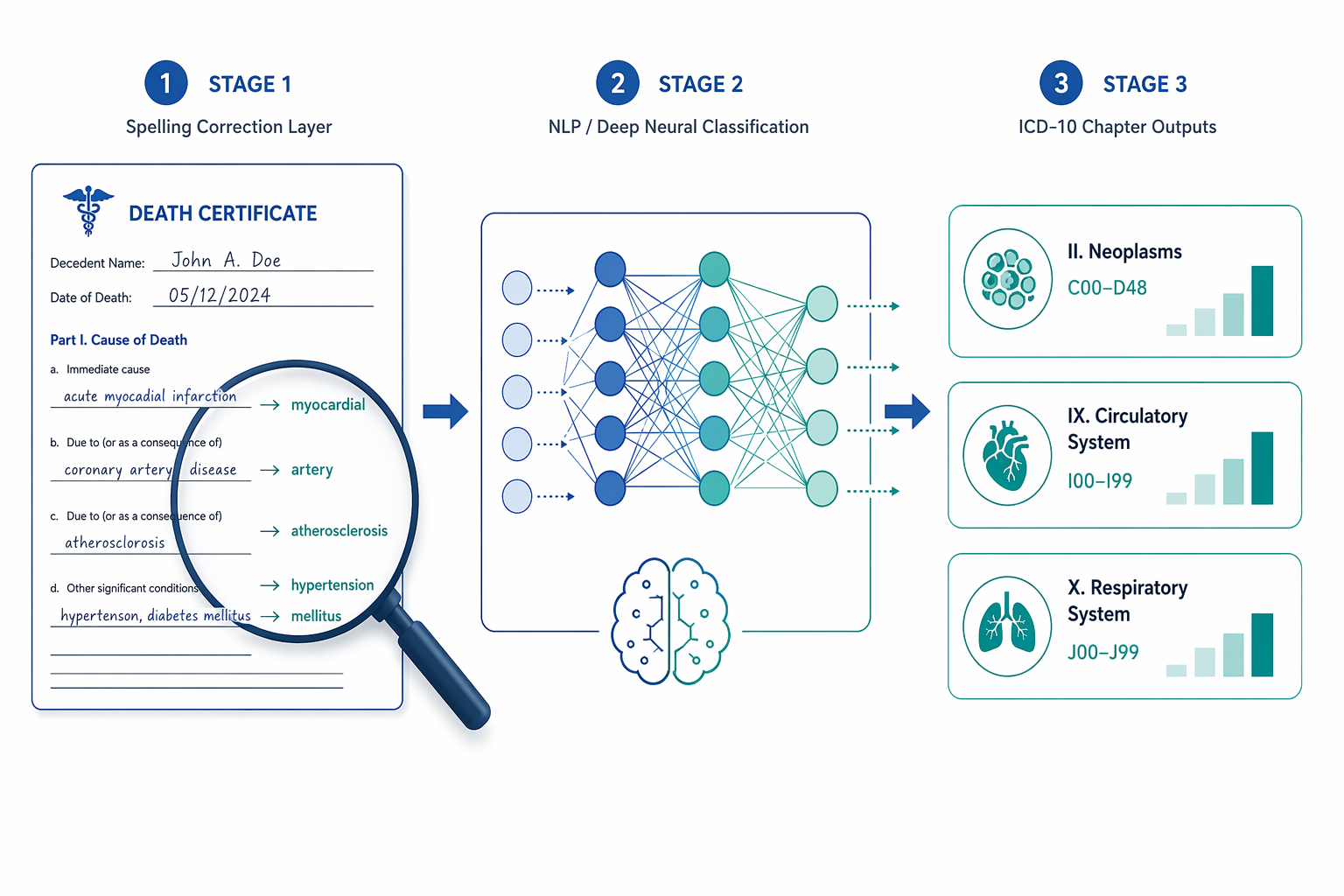
One of the more revealing parts of the design is not the neural network label. It is the spelling-error processing layer. The system recognized more than 25 variant spellings of “Alzheimer” alone, a small detail that says a great deal about real certificate data.[1] Mortality text is not a pristine diagnostic vocabulary. It is written by people, and people abbreviate, misspell, translate clinical uncertainty into phrases, and omit context.
| AUTOCOD component | Why it matters for surveillance |
|---|---|
| Free-text certificate input | Works with the wording clinicians actually enter, rather than waiting for fully coded records |
| Spelling-error processing | Reduces preventable classification failures from misspelled diagnostic terms |
| NLP and deep neural classification | Maps certificate text to standardized ICD-10 categories |
| ICD-10 chapter and block outputs | Supports both broad monitoring and more specific cause-group tracking |
This is also why performance should be read as classification performance under a particular documentary regime, not as pure medical truth extracted from death. The model can only classify what the certificate text gives it, and death certificate text is itself a product of clinical judgment, form design, and local certification practice.
Where the sensitivity is strongest
In the JMIR AI evaluation, AUTOCOD reached a weighted average sensitivity of 0.88 at the ICD-10 chapter level and 0.94 at the block level.[1] Sensitivity here is the share of causes in the comparator coding that the system correctly identified. It is not the same as public adoption, clinical usefulness in every case, or legal certainty for an individual death.
The strongest practical finding sits in the common causes. AUTOCOD achieved sensitivity of 0.95 for neoplasms, 0.91 for circulatory diseases, and 0.90 for respiratory diseases.[1] Those three ICD-10 chapters together accounted for 67.69% of all causes in the dataset.[1] For a surveillance unit, that is the difference between a model that performs well on isolated categories and one that performs well across most of the daily mortality burden.
| ICD-10 grouping | Reported sensitivity |
|---|---|
| Neoplasms | 0.95 |
| Circulatory diseases | 0.91 |
| Respiratory diseases | 0.90 |
| Weighted average at ICD-10 chapter level | 0.88 |
| Weighted average at ICD-10 block level | 0.94 |
That finding should not be stretched into a claim that rare causes are equally well covered. Weighted performance can look reassuring because frequent categories carry more of the total. A rare diagnosis may matter enormously for outbreak detection, occupational health, toxic exposure, or family counseling, while contributing little to an overall average. The Portugal results support confidence for high-volume surveillance categories more strongly than for uncommon causes.
The human comparator also deserves a little humility. The study notes that human coder reliability for cause-of-death coding is approximately 70% to 89%.[1] That does not excuse errors by an automated system. It does mean the “gold standard” is not a flawless oracle. A model can disagree with human coding because the model is wrong, because the human-coded reference is imperfect, or because the certificate text supports more than one plausible interpretation under coding rules.
The stress test during excess mortality
Mortality systems do not fail only during ordinary weeks. They are most needed when deaths rise, clinicians are overloaded, administrative routines are strained, and the mix of causes may shift. For that reason, the AUTOCOD evaluation’s excess-mortality analysis is more than a secondary result.
The study examined performance across normal, excess, severe excess, and extreme excess mortality periods. AUTOCOD remained stable across those conditions, with sensitivity decreasing by only 0.04 during extreme excess mortality, defined as more than 6 standard deviations above baseline.[1]
That stability is the part that makes the system relevant for emergency preparedness. A classifier that looks good only when certificate volume and disease patterns are routine is less useful when a surveillance team is trying to understand a surge. Portugal’s results suggest AUTOCOD did not collapse under the very conditions that make timeliness valuable.
The claim still needs careful boundaries. Stable sensitivity during excess mortality in Portugal is not proof that the same model would perform identically in another country, language, certificate format, or coding workflow. It is evidence that this system, in this national setting, handled both routine mortality and periods of elevated mortality without a large performance drop.
From coded deaths to population signal
Near-real-time cause classification changes the use case. Instead of waiting for completed annual coding, a health agency can monitor whether respiratory mortality is moving unusually, whether circulatory deaths are rising during a heat event, or whether a known outbreak is accompanied by a cause-specific mortality pattern. The benefit is not perfect individual adjudication. It is earlier population signal detection.
That places AUTOCOD in the same broad family as other AI-assisted population health surveillance tools, including systems that look for earlier warning signs outside mortality data. For example, AI-supported syndromic surveillance for enteric outbreaks faces a related problem: noisy early signals can be useful before definitive confirmation, but only if decision-makers understand what the signal can and cannot prove. The comparison is useful, but mortality coding has its own stakes because a death certificate becomes both a public health record and, in many settings, part of an administrative and legal trail. See AI-powered Cyclospora surveillance for a parallel surveillance problem in outbreak monitoring.
In practice, an automated mortality classifier is most defensible when it is used to prioritize review, accelerate aggregate reporting, and flag trends. It is less defensible if its output is treated as a final individual determination without human review, especially for rare causes, ambiguous certificates, or deaths likely to carry legal, occupational, or public controversy.
What still depends on people and local validation
AUTOCOD’s results are strongest when read as evidence for a practical surveillance accelerant. They do not remove the need for good death certification. If the certifying text is incomplete, clinically vague, or internally inconsistent, the model inherits that uncertainty. A spelling layer can catch many variants of a disease name; it cannot supply a missing causal chain.
They also do not remove the need for human coders. Human review remains important for unusual causes, changing coding rules, new disease entities, and categories where misclassification has consequences beyond aggregate trend monitoring. The more unusual the cause, the less comfort one should take from strong weighted averages dominated by common chapters.
Country-specific validation is not a formality. Portugal’s death certificates, language, coding workflow, disease distribution, and historical data shaped the system evaluated by Ferreira and colleagues.[1] A U.S. deployment, or deployment in any other health system, would need local testing against its own certificate wording, coding practices, and surveillance priorities before similar operational confidence would be justified.
The distinction that should survive deployment
Real-time cause-of-death classification is valuable because public health decisions are made before perfect data arrive. AUTOCOD shows that, at national scale in Portugal, a deep neural system can classify the most common mortality categories with high sensitivity and remain stable during periods when mortality rises sharply.[1]
The line to keep clear is simple: faster classification can improve population surveillance, but it does not turn every certificate into a definitive individual cause-of-death determination. For agencies watching mortality trends, that distinction is not a caveat at the edge of the story. It is the condition that makes the tool usable.
References
- Real-Time Classification of Causes of Death Using AI: Sensitivity Analysis. JMIR AI, 2023. https://pmc.ncbi.nlm.nih.gov/articles/PMC11041420/
Comments
Join the discussion with an anonymous comment.