
For healthcare AI cloud infrastructure, AWS, Azure, and Google Cloud are all defensible HIPAA-eligible choices. The better procurement question is which provider reduces friction for the organization you already are: AWS for breadth and relative platform independence, Azure for Microsoft- and Epic-embedded health systems, and GCP for analytics-heavy teams with real data-engineering depth. The 2026 HIPAA Security Rule encryption mandate makes that choice less theoretical because AES-256 encryption at rest and TLS 1.2+ in transit become mandatory by January 1, 2027, not merely addressable controls.[1]
| Organizational profile | Best-fit provider | Why it usually wins | Procurement caution |
|---|---|---|---|
| Large or diversified health system that wants the broadest HIPAA-eligible service catalog | AWS | 166+ HIPAA-eligible services and a mature set of healthcare-specific services including HealthLake, Comprehend Medical, Omics, and Medical Imaging.[2] | Service eligibility changes over time; validate the current BAA and eligible-services list before architecture sign-off. |
| Health system already standardized on Microsoft identity, Microsoft 365, Teams, Power BI, and Epic-adjacent workflows | Azure | Less organizational disruption because identity, collaboration, analytics, and enterprise licensing often already sit in the Microsoft estate. | Do not assume existing Microsoft contracts automatically cover every PHI workflow; BAA scope still has to be checked service by service. |
| Academic medical center, research organization, payer analytics group, or AI product team building custom ML pipelines | GCP | Vertex AI, BigQuery-FHIR integration, and the Healthcare API are strong fits for analytics-first and data-science-led workloads.[2] | The advantage is easier to waste if the organization lacks engineers who can operate modern data and ML pipelines. |
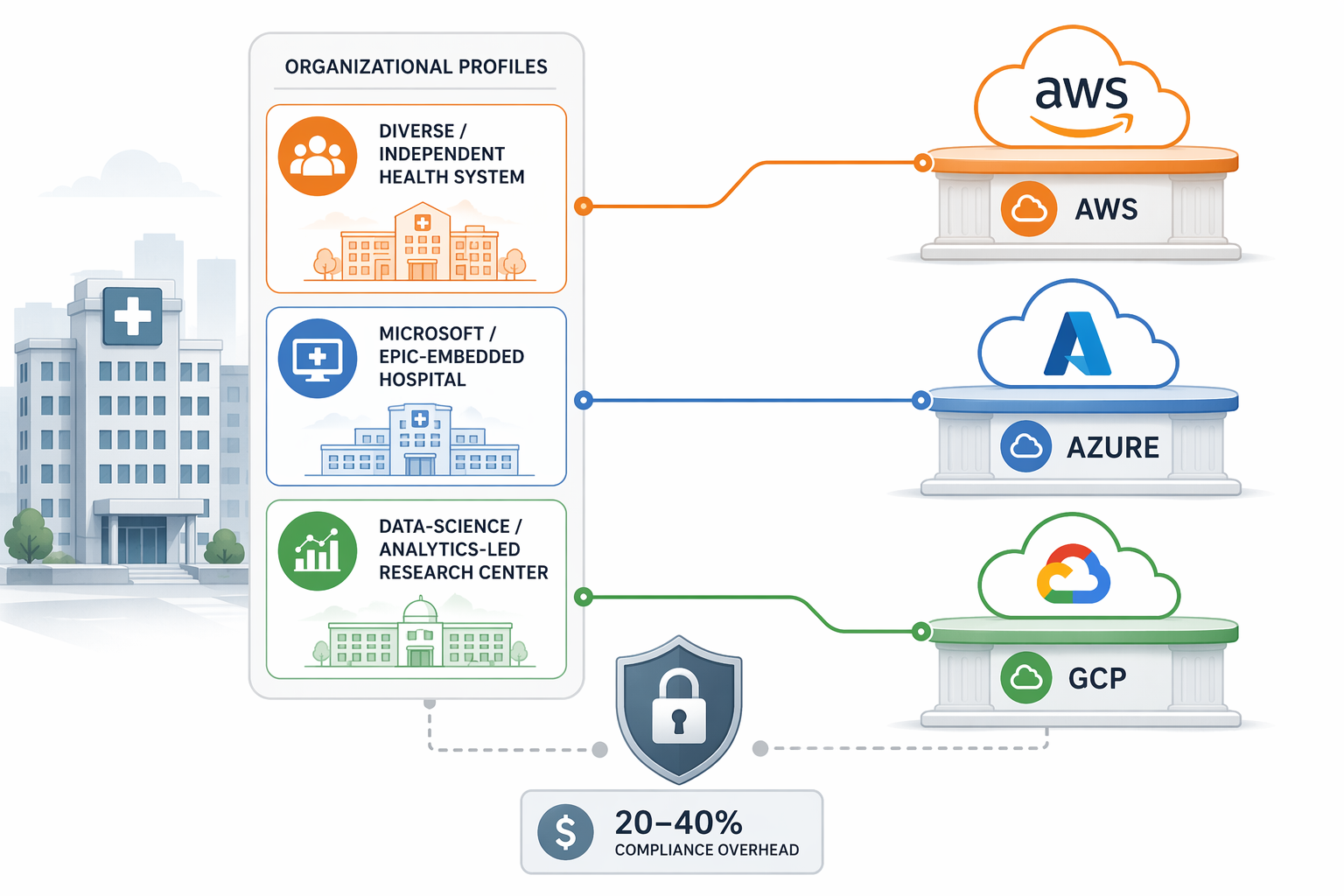
That table is the useful starting point because cloud selection in healthcare is rarely decided by a single benchmark or keynote feature. It is decided later, in the room where security asks who owns the keys, legal asks whether the BAA covers the service, finance asks why the estimate grew, and clinical leadership asks whether the workflow will survive a real go-live.
The market context is large enough to matter but not precise enough to settle anything. Fortune Business Insights estimates the healthcare cloud computing market at $74.57 billion in 2026, though market-sizing figures vary by methodology.[3] That growth explains why every provider is investing in healthcare AI, but procurement teams still have to make a narrower decision: which platform can support PHI-bearing AI workloads without creating a permanent exception-management program.
The Compliance Baseline Is Shared, Not Differentiating
AWS, Azure, and GCP all provide HIPAA-eligible services and business associate agreement pathways. None of that makes a deployed AI workload compliant by itself. The customer still has to keep PHI inside covered services, configure access controls, manage encryption keys, retain logs, document risk decisions, and make sure downstream tooling is not quietly outside the BAA.
The 2026 encryption rule raises the floor. Encryption at rest using AES-256 and encryption in transit using TLS 1.2 or higher must be in place by January 1, 2027.[1] For infrastructure teams, that deadline turns several design choices into audit-facing obligations: key ownership, rotation, logging, retention, segmentation, and evidence production all need to be deliberate rather than inherited from a default template.
The cost effect is not trivial. HIPAA-compliant cloud operations typically run 20–40% above baseline because of encryption, KMS key management, CloudTrail or equivalent audit logging, longer retention, and dedicated PHI environments.[1][2] That overhead belongs in the first financial model, not in the variance explanation six months after the platform team has already signed the enterprise agreement.
For generative AI and model-serving architectures, the practical pattern is to keep PHI boundaries explicit: controlled ingestion, policy-bound transformation, monitored retrieval, logged inference, and human review where clinical or operational risk requires it. A separate PHI-safe generative AI workflow is useful when the architecture discussion starts moving from platform choice into implementation design.
Where AWS Usually Has the Strongest Case
AWS is the strongest default candidate when a healthcare organization wants maximum service breadth, wants to avoid being pinned too tightly to an existing enterprise productivity stack, or expects several AI workload types to emerge over time. The reported 166+ HIPAA-eligible services give architects room to build without constantly asking whether the next managed service is allowed for PHI.[2]
That breadth matters in unglamorous ways. A mature HIPAA-eligible catalog can prevent teams from building brittle substitutes for managed queues, eventing, data movement, analytics, storage, identity, monitoring, and ML operations. In healthcare, every workaround eventually needs an owner, a log trail, a patching plan, and an explanation during risk review.
AWS also has a relatively deep healthcare-specific portfolio. HealthLake, Comprehend Medical, Omics, and Medical Imaging give healthcare teams more vertical building blocks than a generic compute-and-storage menu.[2] The relevance of those services depends on workload fit: clinical text extraction, longitudinal patient data, imaging workflows, and omics pipelines are different operational problems, even when they all sit under the AI budget line. For a closer product-level view, the AWS health AI portfolio profile is the more specific read.
The caution is that service-count arguments age quickly. A number current in April 2026 is useful evidence, not a permanent entitlement.[2] Before committing an AI platform design, the team should validate the current HIPAA-eligible services list, the BAA terms, regional availability, logging support, key-management options, and whether every downstream service that touches PHI is actually in scope.
AWS is also a good fit when different departments are likely to move at different speeds. A radiology AI pilot, an NLP project, a research data lake, and an operational forecasting model may not share the same tooling preferences. AWS gives a central infrastructure group enough service variety to support that spread while still enforcing common controls around accounts, keys, logs, network boundaries, and PHI environments.
Where Azure Becomes the Practical Choice
Azure often wins when the health system already runs on Microsoft. Native alignment with Active Directory, Microsoft 365, Teams, Power BI, and enterprise identity workflows can remove a surprising amount of implementation drag. That does not make Azure automatically better for every AI workload, but it can make the first secure deployment less disruptive.
Identity is the center of that argument. A cloud AI platform that fits the existing directory, role model, conditional-access policies, and administrator workflows is easier to defend than one that requires a parallel identity universe. Healthcare organizations already struggle with employee turnover, affiliate access, contractors, researchers, service accounts, and emergency exceptions. If those controls are already operationalized through Microsoft identity, Azure starts with a real advantage.
The same is true for collaboration and reporting. Teams and Power BI are not niche tools in many health systems; they are where operational work already happens. If an AI program produces utilization forecasts, quality dashboards, call-center predictions, patient-access models, or operational summaries, Azure can reduce the number of handoffs between cloud engineering, analytics, and the business users who consume the output.
Epic adjacency belongs in the same procurement conversation. The important point is not that Azure magically solves EHR integration. It is that many Microsoft-heavy health systems already have governance, identity, reporting, and vendor-management habits that make Azure easier to insert into existing clinical and administrative workflows. That can matter more than a marginal feature comparison when the deployment has to pass through change control, security review, and clinical operations.
Azure’s weakness in this comparison is not immaturity. It is that its strongest case is contextual. A Microsoft-embedded system may get lower organizational friction, while a less Microsoft-dependent organization should compare Azure against AWS and GCP on workload specifics rather than brand familiarity. The BAA scope still has to be reviewed service by service, and PHI-bearing AI workflows still need dedicated controls for keys, logs, retention, and access.
Where GCP Deserves a Serious Look
GCP is the most compelling of the three when the center of gravity is data science rather than enterprise application hosting. Vertex AI, native BigQuery-FHIR integration, and the Healthcare API make Google Cloud attractive for teams building custom AI/ML pipelines, cohort discovery, analytics workflows, and research-grade data products.[2]
The Healthcare API is especially relevant because it unifies FHIR, DICOM, and HL7v2 in a single managed service.[2] That design is useful when a team is trying to normalize clinical, imaging, and message-based data into an analytics environment without stitching together a large number of custom ingestion services. For healthcare AI, fewer custom seams can mean fewer places where PHI handling, logging, and schema drift become operational debt.
BigQuery-FHIR integration is the part that should get the attention of analytics leaders. Many health systems can collect data; fewer can make it consistently usable for model development, validation, monitoring, and population-level analysis. If the workload depends on large-scale querying, feature generation, and iteration by data scientists, GCP’s architecture can feel more direct than a platform assembled mainly for general enterprise hosting.
The tradeoff is operational readiness. GCP’s AI/ML advantages are easier to capture when the organization has engineers who understand data pipelines, model operations, access boundaries, and cost controls. A team without that depth may buy into a superior developer experience and still end up with fragile workflows, unclear ownership, and a backlog of compliance exceptions.
GCP can also be economically attractive for analytics-first workloads because the Healthcare API uses pay-per-usage pricing that can undercut competitors in that pattern.[2] That claim should be tested against actual data volumes, query patterns, retention rules, regional needs, and audit requirements. Healthcare AI cost models fail when they price only training or inference and ignore the surrounding data estate.
The 20–40% Compliance Overhead Changes the Math
Compliance overhead attaches to all three clouds. It shows up in managed keys, customer-managed keys, key rotation, private networking, audit logging, log retention, backup retention, incident evidence, environment separation, vulnerability management, access reviews, and the labor required to prove that those controls are working. The 20–40% premium over baseline cloud operations is not a vendor-specific tax; it is the cost of running PHI-bearing infrastructure with auditability.[1][2]
The painful part is that many of those costs scale with seriousness rather than traffic. A lightly used AI pilot may still need a dedicated PHI environment, key-management design, monitoring, logging, and review process. That makes small experiments look expensive, but the alternative is worse: a pilot that cannot graduate because it was built outside the controls required for production.
BAA scope is where procurement language becomes architecture. A provider’s willingness to sign a BAA does not mean every service in the console is available for PHI. The team has to map each workload component to covered services: data ingestion, storage, embedding generation, model training, inference, orchestration, monitoring, observability, ticketing integrations, and any third-party tooling that touches logs or payloads.
Audit logging deserves more attention than it usually gets during vendor comparison. Logging is often treated as a checkbox until someone asks for a reconstruction of who accessed what, which model ran, which dataset was used, where the output went, and whether PHI left the approved boundary. The cloud provider can supply the mechanisms; the health system still owns the retention policy, review cadence, escalation path, and evidence package.
Governance should be paired with infrastructure selection early enough to affect design. A clinical AI governance committee charter is not a substitute for cloud controls, but it clarifies who approves use cases, who reviews risk, who accepts residual exposure, and who decides when a model is ready to move from R&D into clinical or operational use.
Cost and Capacity Are Not Just Unit Prices
For healthcare AI, cloud cost comparison is easy to flatten into storage, compute, GPU, and managed-service rates. That misses the real procurement exposure. A platform that looks cheaper for inference may become expensive once PHI environment separation, audit retention, data movement, observability, and staff specialization are included. A platform with higher list prices may be cheaper to run if it fits the existing identity model and reduces custom control work.
GPU and accelerator availability also vary by region, instance type, and time. This comparison is about service capabilities and compliance posture, not benchmark performance. A serious procurement process still needs workload-specific testing for training throughput, inference latency, failover behavior, quota availability, and regional constraints.
Capacity risk is no longer an abstract facilities issue. Data center constraints, power availability, and regional infrastructure politics can affect availability and cost for AI workloads. For broader context, see how AI data center moratoriums reshape healthcare AI deployment and eminent domain for AI data centers squeezes healthcare AI. These issues do not determine whether AWS, Azure, or GCP is the better platform, but they do make regional planning and reserved-capacity strategy harder to treat as afterthoughts.
The procurement team should also distinguish R&D economics from clinical inference economics. Research workloads may tolerate batch windows, preemptible capacity, data-science tooling variability, and higher iteration costs. Clinical or operational inference needs predictable latency, supportability, monitoring, rollback, and incident response. A provider can be excellent for one pattern and merely adequate for the other.
Multi-Cloud Is a Specialty Decision
Multi-cloud sounds attractive when no single provider wins every column. In practice, it adds identity federation, network routing, data duplication, egress planning, logging normalization, incident-response complexity, and more BAA boundary management. It may be justified for large organizations with specialized teams, regulatory separation needs, or distinct research and production environments. It should not be used as a way to avoid making a primary-platform decision.
A cleaner pattern for many health systems is primary-cloud plus controlled exceptions. That lets the infrastructure team standardize identity, keys, logging, network controls, and operating procedures while still allowing a research group or analytics team to use a second platform where the workload genuinely requires it. The exception then has to carry its own cost, compliance evidence, and support model.
Large government and defense AI computing contracts are also reshaping the broader infrastructure market. They do not translate directly into hospital cloud strategy, but they matter as a signal of how much AI capacity planning is becoming a procurement discipline rather than a simple IT sourcing exercise. The adjacent infrastructure context is covered in defense AI computing contracts and healthcare AI infrastructure.
How to Defend the Choice
A defensible cloud recommendation for healthcare AI should read less like a vendor ranking and more like an operating model. The committee needs to see why the selected provider fits the organization’s current estate, which AI workloads are in scope, how PHI will stay inside covered services, what the compliance premium is expected to be, and who owns the controls after implementation.
- Choose AWS when service breadth, healthcare-specific managed services, and platform flexibility matter more than tight alignment with an existing Microsoft-heavy operating model.
- Choose Azure when Microsoft identity, Teams, Power BI, enterprise licensing, and Epic-adjacent workflows are already central to how the health system operates.
- Choose GCP when analytics, FHIR-centered data engineering, Vertex AI, BigQuery, and custom ML pipelines are the primary drivers.
- Treat the 20–40% compliance overhead as recurring operating cost, not a temporary implementation premium.
- Require current BAA and HIPAA-eligible service validation before final architecture approval, especially when using newer AI, analytics, observability, or orchestration services.
There is no single best cloud for healthcare AI. There is a best-fit cloud for a particular organization, workload portfolio, compliance maturity level, and operating budget. AWS, Azure, and GCP can all support HIPAA-eligible AI infrastructure; the wrong choice is the one that ignores the environment the health system already has to secure, staff, govern, and explain.
References
- HIPAA cloud compliance guide, Medcurity, 2026.
- AWS vs Azure vs GCP for HIPAA-Compliant Healthcare AI Infrastructure, Of Ash and Fire, March 2026.
- Healthcare Cloud Computing Market Size, Share & Industry Analysis, Fortune Business Insights, 2026.
Comments
Join the discussion with an anonymous comment.