
The useful story about AI humanoid robots in military applications does not begin with a human-shaped machine walking into a trauma bay. In battlefield medicine, the more serious work is being done by probes, portable scanners, sensor networks, triage algorithms, wheeled ground vehicles, and small autonomous systems designed for the moments when the normal chain of care has broken.
That distinction matters for civilian emergency medicine. A humanoid form factor may make a demonstration easier to understand, but trauma care is usually lost at narrower points: bleeding that cannot be reached, imaging that is not available, transport that takes too long, a medic who has too many casualties and too little information, or a rural team waiting for transfer while physiology deteriorates. Military-funded AI and robotics programs are credible when they attack those bottlenecks directly.
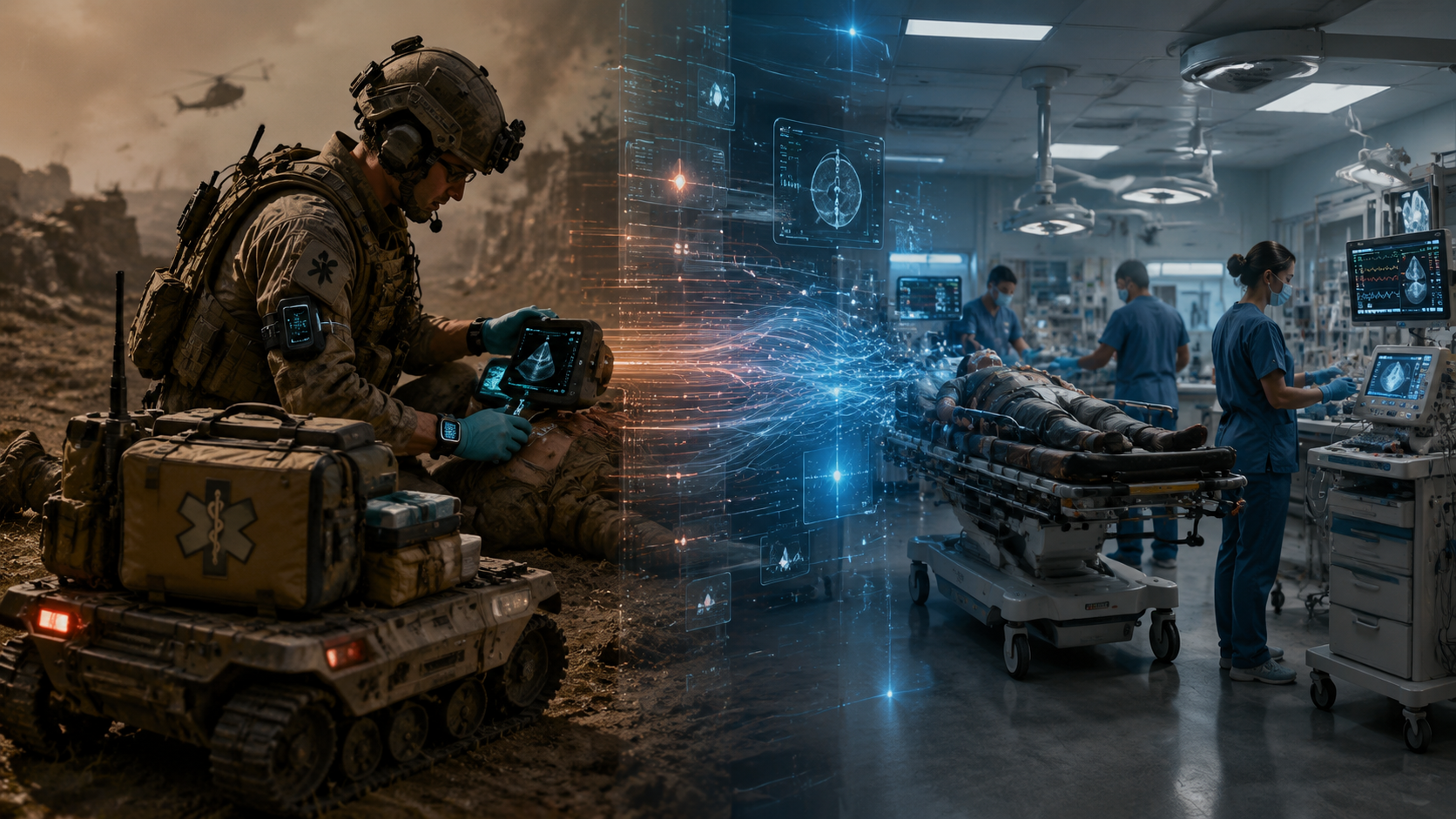
The civilian question is therefore practical rather than futuristic: which battlefield systems could plausibly help rural trauma, disaster response, mass-casualty triage, tactical EMS, or hazardous-scene rescue, and what has to be proven before an emergency department or trauma system should trust them?
The strongest dual-use case is buying time before surgery
DARPA’s MASH program is the clearest example because it is not trying to make a robot look familiar. It is trying to stabilize internal hemorrhage when evacuation or definitive surgery is not available. DARPA described the effort in September 2025 as a plan for sensor-guided robotic systems that could find internal bleeding, navigate inside the body with something like “GPS for inside the body,” and stabilize casualties for more than 48 hours in austere combat conditions.[1]
That is a battlefield objective, but the clinical need is not exotic. Rural trauma teams already know the problem: a patient is bleeding somewhere that cannot be compressed, the surgeon or interventional radiology team is somewhere else, and the clock is moving faster than the transfer system. Disaster teams know a version of it too, when collapsed infrastructure, weather, fire, or a hazardous scene delays transport. If a robotic system could temporarily control internal bleeding without requiring a full operating room, it would be aimed at one of trauma care’s most stubborn handoff failures.
The historical military case for time-sensitive evacuation is strong, but it has to be used carefully. A 2016 JAMA Surgery analysis associated the 2009 Department of Defense “golden hour” evacuation policy with a reduction in combat fatality rate from 13.7% to 7.6% during the 2009–2014 period.[2] That does not prove that a MASH-like device would reproduce the same survival effect. It does show why battlefield medicine keeps returning to the same question: what can be done before the casualty reaches definitive care?
The old answer was faster evacuation. In drone-saturated battlefields, that assumption is less stable. Movement itself can become lethal, evacuation routes can close, and the medic may be asked to hold a patient far longer than the doctrine expected. Civilian systems face a quieter version of the same failure when distance, weather, staffing, or disaster damage stretches the interval between injury and specialist care. A stabilization device does not replace the surgeon; it tries to keep the patient alive long enough for the surgeon to matter.
| Battlefield function | Civilian setting where it could matter | Main translation test |
|---|---|---|
| Autonomous hemorrhage stabilization | Rural trauma, prolonged transport, disaster medicine | Can it safely intervene inside the body under FDA-regulated clinical use? |
| AI triage and casualty prioritization | Mass-casualty incidents, EMS dispatch, trauma transfer coordination | Can it improve decisions without hiding uncertainty from clinicians? |
| Portable AI imaging | Critical access hospitals, field hospitals, austere response sites | Can image quality and workflow support actionable diagnosis? |
| Wearable biometric monitoring | Large incidents, tactical EMS, remote observation before transport | Can it detect deterioration without overwhelming teams with noise? |
| Ground evacuation robots | Hazardous rescue, CBRN scenes, wildfire zones, wilderness extraction | Can they move patients reliably where crews cannot safely enter? |
MASH also exposes the hardest translation problem. An autonomous system that diagnoses a bleeding source, navigates tissue, and performs a stabilizing intervention does not fit neatly into the regulatory habits built around passive software, surgeon-controlled instruments, or single-function devices. The program’s promise is exactly what makes it difficult: it moves from decision support toward treatment.
Civilian trauma systems would not be able to adopt such a system simply because the indication is compelling. They would need evidence about failure modes, training requirements, handoff to surgeons, imaging dependence, anticoagulated patients, pediatric and geriatric physiology, maintenance in small hospitals, and who is responsible when the machine stabilizes the wrong target or cannot complete the task. Those are not objections to the idea. They are the conditions under which the idea becomes medicine rather than a program slide.
Triage is already moving both ways
The usual dual-use story runs from military research to civilian care. TRACIR complicates that. The Trauma Care in a Rucksack system was trained on more than 7,000 civilian prehospital trauma records from UPMC Stat MedEvac and then adapted for military use.[3] That matters because it is not a simple export of battlefield technology. It is a loop: civilian EMS data informed a military triage system, and the resulting approach could later return to civilian mass-casualty care.
This is where AI triage has a real use case, provided the claims stay narrow. The point is not that an algorithm knows more than the paramedic standing over the patient. The point is that, in a multi-casualty scene, a system that continuously combines mechanism, vital signs, injury pattern, and transport constraints might notice a deteriorating patient earlier or preserve a decision trail when crews are overloaded.
For civilian emergency systems, the attractive part is not automation for its own sake. It is coordination. A trauma center deciding whether to accept a transfer, an EMS supervisor assigning limited ambulances, and an emergency physician preparing scarce blood products are all making linked decisions from incomplete information. A TRACIR-like system is useful only if it improves that shared picture without turning uncertainty into false precision.
There is also an uncomfortable data lesson here. Civilian trauma datasets are often more relevant to civilian deployment than battlefield records, but military systems and civilian health systems do not share data easily. Privacy rules, classification, operational security, incompatible records, and institutional incentives all work against the kind of feedback loop that would make these tools safer.
Portable imaging matters because the scanner is often the missing specialist
The least cinematic military medical robot may be the portable imaging system. It is also one of the more transferable ideas. Hyperfine’s portable MRI platform, discussed in a bioengineering review of military medical applications, has FDA-cleared AI reconstruction software reported to reduce acquisition time by 1.5 to 4.5 times, and the platform has been deployed in military hospital settings with minimal staff requirements.[4]
For a major academic trauma center, that may sound modest. For a rural hospital, forward surgical team, disaster field site, or critical access facility, the ability to acquire usable imaging without a conventional imaging suite changes who has to be moved first: the patient, the specialist, or the information. AI reconstruction does not make a portable scanner equivalent to every hospital-based modality, but it can shorten the distance between injury and diagnosis.
This is the kind of translation that tends to be underrated because it is not autonomous in the dramatic sense. It still depends on acquisition protocols, clinician interpretation, connectivity, and escalation pathways. But in austere care, a better scan in the wrong place may be more valuable than a perfect scan the patient cannot reach.
Monitoring is useful only if it changes the waiting period
Wearable sensors and biometric analytics sit in the same category: useful if they help clinicians act during the long middle interval, not if they merely create more numbers. The Army’s MedCOP concept brings together real-time biometric sensor data and AI analytics for predictive health monitoring, including early detection concerns such as shock, tension pneumothorax, and hemorrhage.[5]
Civilian mass-casualty response has an obvious analogue. After an explosion, shooting, building collapse, or chemical exposure, the first triage decision is rarely the last useful decision. Patients drift. A person tagged as delayed can become immediate; a compensated patient can stop compensating. If remote monitoring can identify that shift while crews are moving among many patients, it could protect the exact group that is easiest to lose: the patient who looked stable ten minutes ago.
The danger is alarm burden and misplaced confidence. A battlefield medic and a civilian incident commander both need signals that survive sweat, motion, blood loss, cold, radio problems, and chaotic documentation. Predictive analytics in this setting have to be judged by what they change operationally: who gets reassessed, who gets blood, who moves first, and who gets watched when no one has enough hands.
Evacuation robots are less polished, and harder to dismiss
Ukraine has made casualty evacuation robotics concrete in a way that laboratory demonstrations rarely do. Field reporting from ASPI described unmanned ground vehicles being used for supply and evacuation, with one account stating that 47% of UGV missions were supply or evacuation, one brigade’s ground robots had traveled 70,000 kilometers, and individual systems cost roughly $5,000 to $20,000.[6] CNN separately reported a case in which a ground robot helped evacuate three Ukrainian soldiers after they had been stranded for 33 days.[7]
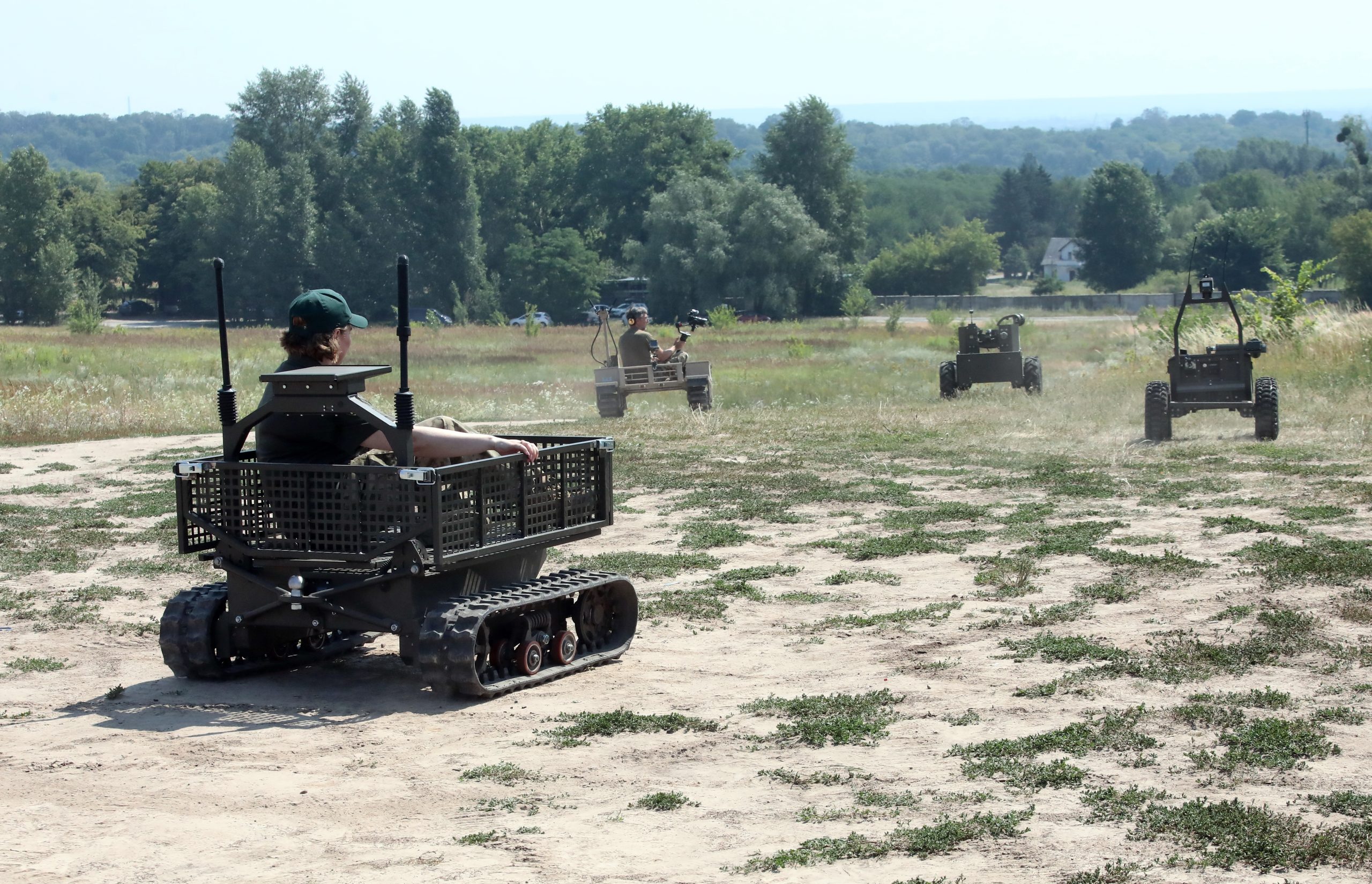
Those reports are not peer-reviewed evacuation trials. Operational security limits detail, and commander interviews are not the same as controlled outcome data. Still, the use case is brutally clear: if a human rescuer is likely to be killed crossing open ground, a cheap ground robot that can haul supplies or a casualty is not a gimmick. It is a way to move some risk from a person to a machine.
Civilian medicine has its own places where responders cannot safely go. Chemical, biological, radiological, or nuclear incidents; active fire zones; unstable rubble; wildfire perimeters; floodwater; and remote terrain all create versions of the same problem. Tactical EMS and rescue teams do not need a humanoid nurse in those moments. They need a platform that can carry equipment in, bring a patient out, relay video, and keep human crews from becoming additional casualties.
The low cost reported for some Ukraine systems also changes the access conversation. A robot priced like a vehicle accessory has a different adoption path than a capital surgical robot. It can be bought, broken, repaired, modified, and fielded by units that could never justify a high-end hospital robotics platform. That does not solve medical validation, but it makes experimentation possible outside elite centers.
Swarm medical robots show how early the regulatory problem has become
DARPA’s Medical Swarm Robotics for Extraction and Life-Saving Interventions STTR solicitation, which closed in June 2026, is notable less because award outcomes are public than because of what the solicitation asks the field to confront. The program description called for autonomous battlefield medical robots and explicitly required attention to an FDA regulatory pathway; it also described dual-use Phase III possibilities including collapsed buildings, fires, and hazardous chemical incidents.[8]
That is the right order of concern. If a robot is only carrying supplies, the regulatory burden is one thing. If a robot is extracting a casualty from a dangerous area, it enters another set of safety questions. If it is making or assisting a life-saving intervention, the medical-device problem becomes central. The technology cannot be evaluated only as robotics, and it cannot be evaluated only as software. It lives at the seam.
Civilian responders will recognize the dual-use settings immediately. A collapsed building is not a battlefield, but it is an environment where access is dangerous, visibility is poor, communication is degraded, and medical decisions happen before full hospital resources arrive. The hard part is proving that a swarm system can operate safely in that mess without requiring an expert team that defeats the point of deployment.
Cost can open the door or close it
Robotics translation is partly a clinical question and partly a purchasing question. The Raven surgical robot, originally developed with DARPA funding as an open-source platform, has been cited at about $250,000, compared with approximately $1.75 million to $1.8 million for the da Vinci system.[9] The comparison should not be stretched into an equivalence between platforms. It is an access signal.
Civilian trauma systems do not adopt technology in the abstract. A major academic center, a county EMS agency, a critical access hospital, and a disaster-response cache all face different budget realities. A device that requires specialized maintenance, rare staff skills, and expensive disposables may stay trapped in well-funded centers even if the original military use case was austere care. A lower-cost platform has a better chance of being tested where the need is most visible.
That does not make low cost sufficient. Cheap evacuation robots still need reliability, infection-control procedures, patient securing methods, communications plans, liability coverage, and training. Cheap intervention robots would need far more. But price determines whether the next question is “how do we validate this?” or “who could ever buy it?”
The datasets are smaller than the rhetoric
Modern AI language has trained people to expect enormous datasets. Battlefield medicine rarely has them. The research comparison is stark: the Department of Defense Trauma Registry has been characterized as roughly 0.017 GB, while ChatGPT-3’s training corpus was about 45 TB. That difference is not just a trivia point. It changes what should be expected from battlefield medical AI.
Small, high-stakes datasets make generalization fragile. A model trained on one evacuation system, one conflict, one documentation culture, or one injury pattern may not travel cleanly to a civilian pileup, rural farm injury, school shooting, hurricane shelter, or industrial explosion. Even when military and civilian injuries overlap, the surrounding system differs: transport times, blood availability, imaging access, documentation, staffing, legal duties, and patient demographics.
The answer is not to dismiss the models. It is to be precise about what they can claim. A triage system may be useful as a prioritization aid before it is safe as an autonomous decision-maker. A monitoring system may be valuable for trend detection before it can predict a named diagnosis. A robotic stabilizer may need tightly bounded indications before anyone should imagine broad trauma autonomy.
What civilian ERs can realistically inherit
The battlefield-to-ER pipeline is real, but it is uneven. Portable imaging and monitoring analytics have clearer near-term civilian pathways because they can often enter care as tools that inform clinicians. Triage systems have plausible mass-casualty value, especially when they preserve clinician oversight and make uncertainty visible. Evacuation robots are credible for hazardous environments where the alternative is exposing rescuers to unacceptable risk.
Autonomous hemorrhage control is the most important and the hardest. It aims at the right clinical failure: the patient who needs an intervention before the system can deliver one. It also asks regulators, trauma surgeons, emergency physicians, medics, manufacturers, and hospitals to trust a machine at the point where trust is most expensive. That trust will have to be earned through evidence, workflow testing, and narrow deployment before it can be broadened.
Military medicine has often advanced by necessity. Civilian emergency care should not pretend that necessity is enough. A rural trauma center cannot buy a battlefield device into safety. A disaster agency cannot convert a field report into a protocol. An ED cannot treat a regulatory gap as a rounding error because the device was designed for war.
The credible future is narrower and more useful than the humanoid image suggests: machines that carry casualties, acquire scans, integrate vital signs, support triage, and perhaps one day stabilize internal bleeding when no surgeon can arrive in time. Civilian medicine may inherit those capabilities, especially in austere trauma, mass-casualty, rural, and hazardous-response settings. It will not inherit them automatically.
References
- Sensor-Guided Robots Could Boost Lifesaving Combat Casualty Care, DARPA, September 2025
- Association of Prehospital Transport Time and In-Hospital Mortality in Combat Casualties, JAMA Surgery, 2016
- UPMC, Pitt Developing Artificial Intelligence System to Help Medics Treat Trauma Patients, UPMC/Pitt, May 22, 2019
- Bioengineering for military medicine: from trauma care to telemedicine, PMC
- Artificial Intelligence and Army Medicine, Military Review, Army University Press, May-June 2024
- Ground robots are transforming battle casualty evacuation in Ukraine, ASPI Strategist
- Ukraine land drone medical evacuations, CNN, December 21, 2025
- Medical Swarm Robotics for Extraction and Life-Saving Interventions, DARPA
- Glimpses of Future Battlefield Medicine: The Proliferation of Robotic Surgeons and Unmanned Vehicles and Technologies, Journal of Military and Veterans’ Health
Comments
Join the discussion with an anonymous comment.