
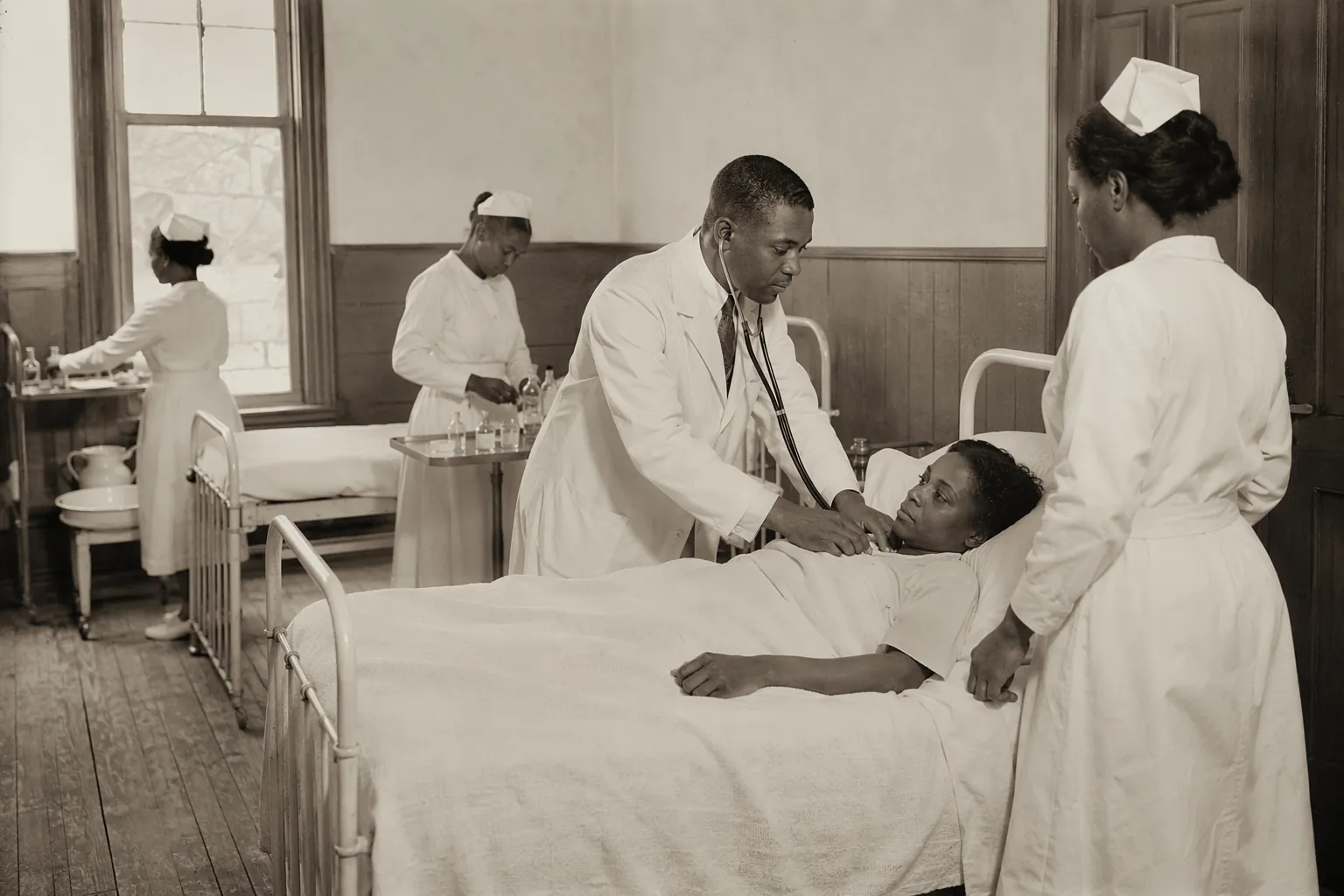
The history of Black physicians under US segregated healthcare begins with a basic operating fact: access to a hospital bed, an admitting privilege, a training appointment, or a professional society membership was not governed only by illness or skill. In much of the segregated South, Black patients could be refused outright or admitted only under inferior conditions, while Black physicians were commonly barred from the hospitals where their own patients needed surgery, laboratory services, and inpatient care. One archival summary puts the scale plainly: only 6% of Southern hospitals offered unrestricted services to Black patients, while 31% denied admission altogether.[1]
That exclusion did not merely inconvenience individual doctors. It determined where patients could safely give birth, where nurses could be trained, where surgeons could operate, where records could be kept, and where young physicians could learn hospital medicine. Segregation created a system that denied responsibility for Black health and then treated the institutions built to fill that void as secondary.
What Exclusion Required Black Physicians to Build
The response Black physicians and Black communities built was not a loose collection of charitable exceptions. It was a parallel medical infrastructure: hospitals that admitted Black patients and employed Black staff; medical schools that trained Black physicians when white institutions would not; and professional organizations that provided recognition, advocacy, and standards when the dominant organizations excluded them.
Provident Hospital in Chicago, founded in 1891, is often remembered as the first Black-owned and operated hospital in the United States. Freedmen's Hospital in Washington, DC, began in 1862 and later became Howard University Hospital. Lincoln Hospital in Durham opened in 1901 with funding from the Duke family. Taborian Hospital in Mound Bayou, Mississippi, opened in 1942, built by the Knights and Daughters of Tabor, a Black fraternal organization.[2] These institutions differed in origin, governance, and local politics, but they shared a practical purpose: to make care possible where the formal hospital system either excluded Black people or admitted them on unequal terms.
Their work was institutional before it was symbolic. A hospital meant beds, operating rooms, payrolls, night coverage, nursing instruction, purchasing, fundraising, board governance, and relationships with local physicians. It also meant a place where Black physicians could practice the medicine they had been trained to provide. Without admitting privileges in white hospitals, a physician's education could be made useless at precisely the point when a patient needed more than an office visit.
A Hospital Movement at Its Peak, and at Its Limits
By 1944, the Black hospital movement had reached a documented peak of 124 Black hospitals. Yet only 23 were fully approved by the American College of Surgeons, according to a Duke archival guide citing Eugene H. Bradley's 1945 Modern Hospital article.[1] The gap is important, but it needs careful handling. Accreditation counted, especially in a profession increasingly organized around standardized hospital practice. But those approval numbers reflected the standards of one professional body operating inside a racially unequal funding system. They should not be read as a simple measure of whether Black hospitals mattered or whether Black physicians were competent.
The more revealing question is what those hospitals were being asked to do with the capital available to them. White hospitals could draw on better access to philanthropy, municipal support, specialist networks, and professional legitimacy. Black hospitals often depended on churches, fraternal organizations, local donors, Black physicians' own labor, and community fundraising. Taborian Hospital's creation by a fraternal order in Mound Bayou was not an eccentric footnote. It showed how health infrastructure had to be assembled from the institutions Black communities actually controlled.[2]
Provident, Freedmen's, Lincoln, and Taborian therefore sit in the same history even though they do not tell the same story. Provident made ownership and hospital practice possible in a northern city. Freedmen's tied care to medical education and the federal legacy of emancipation. Lincoln showed how segregated philanthropy could produce a Black hospital while leaving the larger racial order intact. Taborian showed what community self-financing could accomplish in a place where exclusion was not incidental but organizing policy.[2]
The hospitals also made visible a burden that statistics alone can flatten. When a Black patient was denied admission to a white hospital, someone still had to deliver the baby, set the fracture, treat the infection, manage the postoperative fever, or explain to a family why transfer was impossible. The parallel system did not arise because separation was culturally preferred. It arose because illness does not wait for institutional permission.
Professional Medicine Had Its Own Color Line
Hospitals were only one part of the structure. Professional recognition mattered because medical authority was increasingly organized through associations, journals, meetings, credentialing norms, and specialty networks. In 1895, Black physicians founded the National Medical Association after exclusion from the American Medical Association. The AMA has acknowledged that Black physicians were excluded from many state and local medical societies and that the AMA remained exclusionary until 1968.[3][4]
The NMA's founding was therefore not simply the creation of another professional club. It was a claim that Black physicians required an institutional home for scientific exchange, public health advocacy, and professional standing when the main channels of organized medicine denied them entry. Today, the NMA describes itself as representing more than 30,000 Black physicians and their patients.[3] Its endurance is one of the clearest continuities from the segregated medical order into the present.
That continuity should not obscure the cost of the original exclusion. Professional societies shape careers by deciding who is seen, who is heard, whose hospital is legitimate, whose research circulates, and whose trainees can attach themselves to a recognized network. When Black physicians were forced to build outside those structures, they were not merely denied prestige. They were denied the ordinary machinery through which a profession reproduces itself.
The Pipeline Was Narrowed Before It Could Mature
The hospital system depended on schools, and the schools were hit hard. Seven Black medical schools were established between 1868 and 1904, but after the 1910 Flexner Report, only Howard and Meharry survived.[5] The closures are sometimes folded into a general story of educational reform, as though weak schools simply disappeared under neutral standards. That account misses the infrastructure problem. Standards requiring laboratories, clinical affiliations, and financial reserves landed in a world where Black institutions had been systematically denied the capital and hospital access needed to meet them.
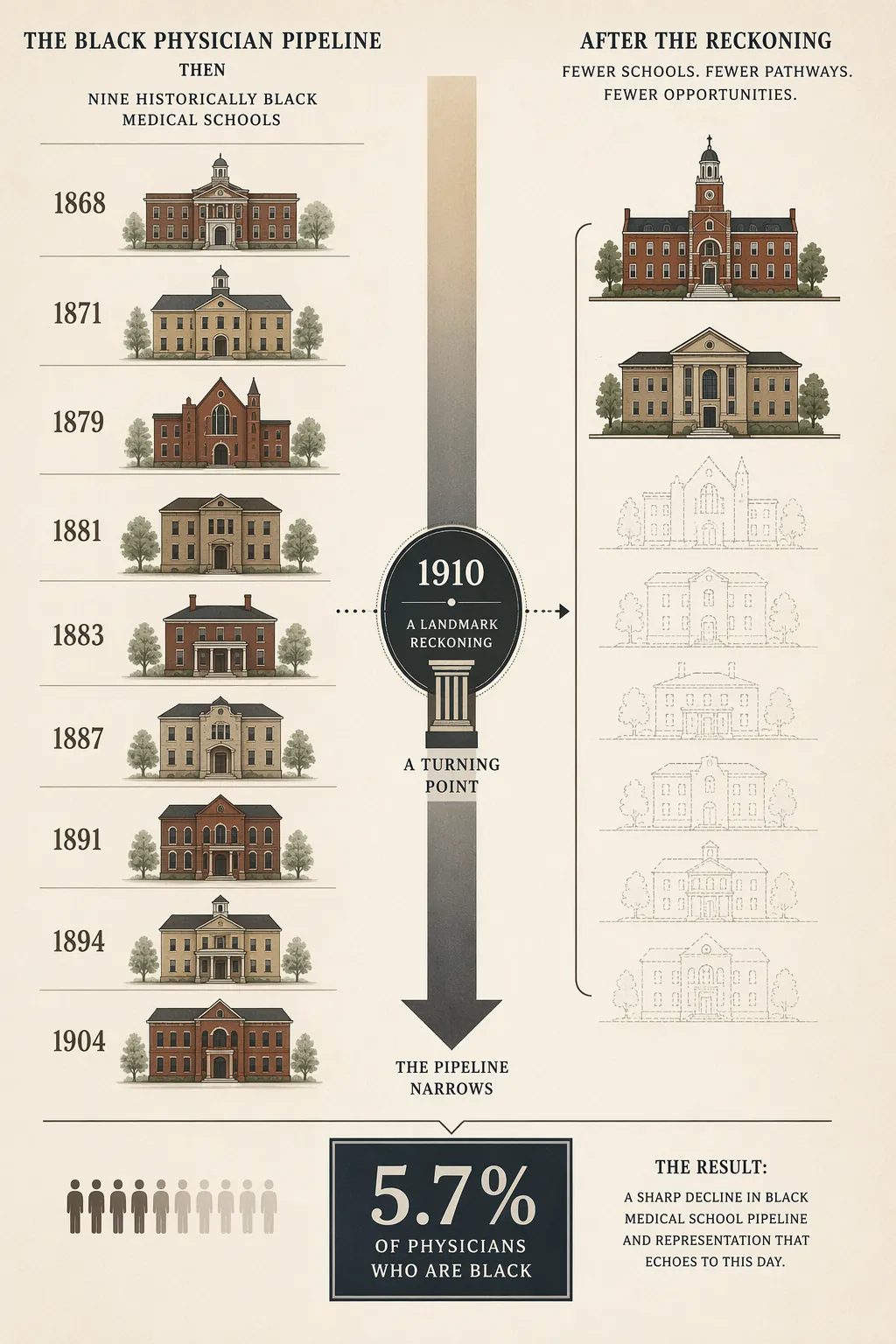
The result was not only the loss of campuses. It was the loss of admissions seats, faculty appointments, alumni networks, clinical training routes, and local expectations that Black students could become physicians. A closed medical school is a workforce event that unfolds for generations. Each missing class means fewer doctors for hospitals, fewer mentors for students, fewer candidates for specialty training, and fewer institution builders in the communities most dependent on them.
Howard and Meharry survived, but survival carried its own burden. They were left to do the work of schools that had disappeared, while the segregated hospital order still limited where graduates could train and practice. The narrower pipeline and the restricted hospital market reinforced each other: fewer schools meant fewer Black physicians, and fewer hospital opportunities made it harder to expand training.
Integration Changed Access, Then Undercut the Institutions Built Under Exclusion
The Civil Rights Act of 1964 and Medicare's arrival in 1965 changed the legal and financial terms of hospital segregation. Federal pressure tied hospital participation in Medicare to desegregation, making access to previously white hospitals possible in ways Black patients and physicians had long demanded.[6] That was a civil rights victory. It also exposed the unstable position of Black hospitals that had been forced to carry the burden of segregated care without equal resources.
Once white hospitals opened, Black hospitals lost some of the patient base that segregation had assigned to them. At the same time, they faced reimbursement changes, capital needs, facility standards, and competition from larger institutions. NPR and KFF Health News describe a broad post-integration collapse in which most Black hospitals vanished, with only about eight remaining by the early 1990s.[2] The exact count varies across accounts and regions, and desegregation was not the only force involved. Financial pressures and Medicare-era hospital economics mattered. But the sequence is still stark: a system made necessary by exclusion was not given an equivalent replacement when exclusion formally ended.
This is the central contradiction in the history. Integration expanded the right to enter hospitals that had once refused Black patients. But the Black hospitals that had trained staff, employed physicians, and anchored community care often did not survive the new order. A patient might gain access to a larger hospital across town while the neighborhood institution that had admitted her family for decades lost its reason for being, its revenue, or both. A Black physician might gain a pathway into a previously closed medical staff while losing a hospital where Black leadership had not been exceptional but ordinary.
What Remained
The parallel hospital system largely disappeared. The NMA endured. The educational burden narrowed onto a small number of institutions whose importance is out of proportion to their share of the medical education system. The four remaining historically Black medical schools produce 18% of Black medical graduates while representing only 3% of US medical schools.[7]
That figure belongs beside another: only 5.7% of US physicians are Black.[7] The number is often presented as a contemporary diversity problem, which it is. But it is also a historical accounting statement. It reflects schools closed before their pipelines could mature, hospitals built under unequal financing, professional societies formed because membership was denied elsewhere, and post-integration institutional losses that were not matched by comparable investment in Black physician production.
The point is not that the old parallel system should be restored. It existed because segregation made ordinary access impossible. The more precise lesson is that today's workforce gap is not a mystery of interest, aspiration, or talent. It is the afterlife of institutions that Black physicians and communities had to build under exclusion, and that the country allowed to weaken or vanish once the doors of the formal system began to open.
References
- Hospitals — Black History Month: A Medical Perspective, Duke University Medical Center Library.
- Black hospitals vanished in the U.S. decades ago, NPR/KFF Health News, August 2024.
- NMA History, National Medical Association.
- The history of African Americans and organized medicine, American Medical Association.
- The forgotten history of defunct black medical schools, Journal of the National Medical Association.
- Health Policy in Action — A Brief History of Hospital Desegregation, Association for Academic Surgery.
- Only 5.7% of US doctors are Black, CNN, February 2023.
Comments
Join the discussion with an anonymous comment.