
For Salmonella outbreak prevention, AI is already useful enough to take seriously, but not reliable enough to take over. The best evidence does not show a model replacing specimen collection, laboratory confirmation, epidemiologic interviews, food sampling, or genomic surveillance. It shows something narrower and more operational: machine learning can help estimate where Salmonella risk is likely to appear, which food sources deserve attention, and which signals may warrant earlier review when the underlying surveillance data are strong.
That distinction matters. An early warning system that misses too many outbreak signals can create a dangerous kind of quiet. A source attribution model with high accuracy can still be answering a different question from “Will this municipality see an outbreak soon?” The practical question is not whether a model sounds intelligent. It is whether its output lands at the right time, at the right geographic or source level, with error patterns that public health teams can live with.
The Italy Study Gets Closest to the Operational Question
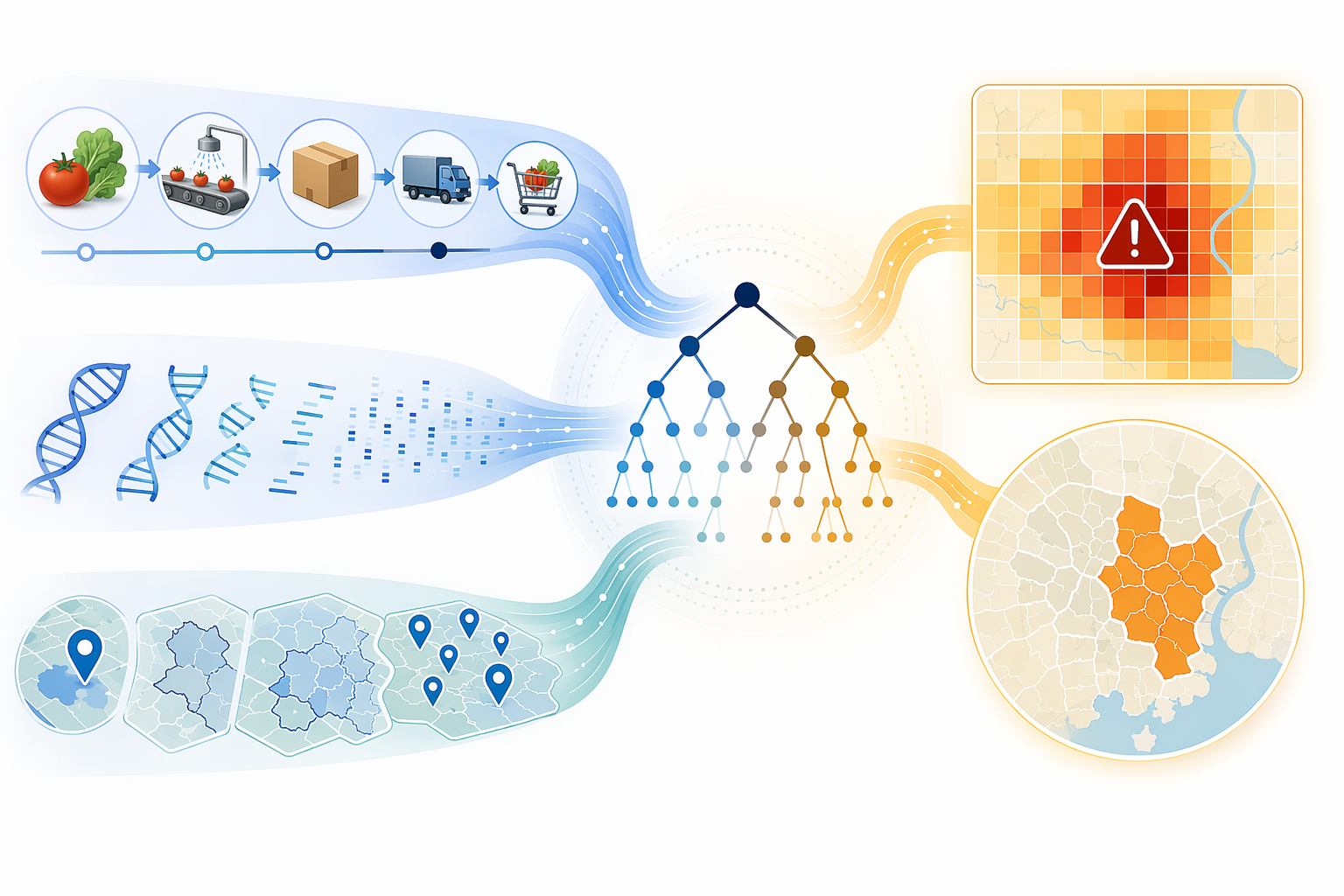
The most direct evidence comes from a 2024 study in northwestern Italy that trained random forest and gradient boosting models on food surveillance data to predict human salmonellosis incidence and outbreak locations. The models were not merely classifying isolates after the fact. They were attempting the harder surveillance task: using food data to anticipate human disease patterns in space.
For incidence prediction, the study reported R²=0.55 and MAPE=7.5%. The random forest model predicted salmonellosis incidence of 8.08 per 10,000 people, compared with an observed incidence of 7.03 per 10,000 people.[1] Those numbers are not a crystal ball, but they are not trivial either. In an operational setting, a model that can produce a geographically meaningful incidence estimate with that level of average error could help analysts decide where to look harder, where to sample more intensively, or where to compare food-chain signals against clinical reports.
The municipality-level outbreak prediction result is more uncomfortable. The study reported 78.5% specificity, meaning the model was fairly good at identifying places without outbreak signals.[1] That is valuable for workload management. Public health units do not have unlimited investigators, lab capacity, or environmental health staff, so false alarms carry real costs.
But the same study reported sensitivity of only 46.5%.[1] In plain surveillance terms, that means the model missed roughly half of the outbreak signals it was supposed to flag. That single number changes the deployment conversation. A system with that sensitivity may still be useful as a supplementary prioritization tool, but it should not be described casually as an early warning system unless the users understand how often the warning may never arrive.
This is where headline accuracy becomes less helpful than decision mapping. If an administrator wants to know whether to add an AI layer to a dashboard, specificity helps answer “Will this swamp the team with false positives?” Sensitivity answers “What happens when the dashboard stays quiet?” For outbreak surveillance, the second question is often the one that decides whether the tool can be trusted.
What These Models Are Actually Learning
A second useful study, published in 2025, helps clarify what “prediction” means in this setting. An XGBoost model analyzed 41,945 food samples collected over 11 years and produced spatially coherent Salmonella risk estimates, with median absolute error of approximately 0.02.[2] The scale and duration of that food-sampling record matter because the model was not learning from a handful of dramatic outbreaks. It was learning from routine surveillance material, the kind of data stream that makes or breaks operational food safety analytics.
The most influential predictors were food matrix composition, especially swine and poultry proportions, along with production stage and spatial factors. Climatic variables were not the main drivers in the model.[2] That finding is useful because it pulls the discussion away from a vague idea of AI detecting environmental risk in the air. The signal was embedded in what foods were being sampled, where they were in the production chain, and how those patterns varied across space.
| Model input | Operational meaning |
|---|---|
| Food matrix composition | Which food categories dominate the sampled material and may carry different Salmonella risk profiles |
| Production stage | Whether contamination risk is being assessed closer to primary production, processing, distribution, or later food-chain points |
| Spatial factors | Where risk clusters or gradients appear across the surveillance area |
| Climatic variables | Included in the analysis but not the leading predictors in this study |
That is a more grounded version of AI than the usual promotional language suggests. The model is not “seeing” an outbreak before anyone else in some free-floating way. It is combining structured observations from food surveillance and identifying patterns that may be too distributed for manual review. A food safety analyst can work with that, provided the sampling frame, coding of production stages, and geographic identifiers remain consistent enough for the model’s learned relationships to mean something.
It also explains why tree-based models keep appearing in the strongest evidence. Random forest, gradient boosting, and XGBoost are well suited to mixed surveillance data: categorical food matrices, production-stage variables, spatial features, and nonlinear interactions that do not behave like a simple exposure-response line. Their usefulness here is practical rather than glamorous. They can sort through messy, structured public health data without requiring every relationship to be specified in advance.
Source Attribution Is Powerful, but It Is Not the Same as Forecasting
The strongest U.S.-based evidence in the brief comes from a CDC, FDA, and USDA source attribution model published in 2025. The multi-agency team used a random forest model trained on 18,661 whole-genome sequenced Salmonella isolates and 7,360 genetic loci. The model achieved 91% overall accuracy and 97% accuracy for chicken isolates, and it linked 34% of human cases to chicken and 30% to vegetables.[3]
Those are impressive results, especially because genomic source attribution is directly relevant to outbreak investigation. When human isolates resemble source-associated isolates at informative loci, investigators gain a stronger basis for prioritizing food sources. That can shorten the list of plausible vehicles, focus traceback work, and help agencies decide where additional sampling is most likely to pay off.
Still, source attribution should not be confused with pre-outbreak prediction. The CDC/FDA/USDA model helps answer a question like “Which sources are these human cases most likely linked to?” It does not, by itself, answer “Which community will experience a Salmonella outbreak before cases appear?” That does not make it less important. It places it in the correct part of the surveillance workflow.
Public reporting around the same line of work emphasized that machine learning could link up to 64% of Salmonella cases to chicken and vegetables at varying confidence thresholds.[4] That framing is useful for communicating the public health stakes, but the confidence-threshold language is doing real work. Changing thresholds changes how many cases can be assigned and how much uncertainty agencies accept.
Genomic models also have a maintenance problem that should not be treated as a footnote. A 2025 mBio study found that machine learning revealed dynamic importance of accessory genome sequences for Salmonella outbreak clustering, showing that genetic features important for accurate outbreak identification can vary over time.[5] A model trained on yesterday’s most informative features may need active updating as populations, sampling, and outbreak strains change.
The Hard Part Is Not the Algorithm
The hardest deployment questions are ordinary surveillance questions with a model attached. Were food samples collected consistently? Were production stages coded in comparable ways? Are negative samples recorded with the same care as positives? Are genomic isolates sequenced quickly enough and with sufficient quality? Are municipality-level identifiers stable and usable? A model trained on a clean historical system can fail quietly when the operational data stream becomes patchy.
Class imbalance is one reason this field is difficult. Most food samples are not positive for Salmonella, and most places are not experiencing a recognized outbreak at a given moment. That imbalance can make a model look reassuring if it is good at identifying negatives while still missing too many true signals. The Italy study’s pairing of relatively strong specificity with low sensitivity is exactly the kind of pattern that should make administrators and implementers slow down.
Geographic transferability is another constraint. Several early warning studies come from European surveillance systems, including Italy and the Netherlands, while U.S. operational deployment evidence is more limited outside genomic attribution work. A model that performs well under one sampling design, regulatory context, laboratory network, and reporting culture cannot be assumed to perform the same way elsewhere. The food chain may be global, but surveillance systems are not interchangeable.
This is why validation has to be framed around the decision being supported. A model used to prioritize additional food sampling can tolerate different error patterns than a model used to trigger a public health investigation. A model used for retrospective source attribution can be valuable even if it does not forecast outbreak onset. A dashboard alert sent to an epidemiologist at 8 a.m. on Monday carries a different burden than a research model evaluated after the fact.
Where AI Fits in Salmonella Prevention
The evidence supports a practical role for AI in food safety for Salmonella outbreak prevention, but the role is adjunctive. These systems can help rank municipalities for review, estimate spatial risk, identify food matrices and production stages that deserve attention, and attribute human cases to likely sources using genomic data. They are best understood as tools that sharpen surveillance, not as systems that remove the need for surveillance.
- Use food-sample models to prioritize inspection, sampling, or analytic review where risk estimates are elevated.
- Use genomic attribution models to focus source hypotheses once human cases or isolates are available.
- Track sensitivity, specificity, and false-negative consequences separately instead of relying on a single accuracy number.
- Treat model performance as conditional on stable specimen collection, food sampling, sequencing, and reporting pipelines.
The credible near-term use case is not an autonomous Salmonella outbreak oracle. It is a monitored analytic layer that helps public health and food safety teams notice patterns earlier, allocate attention more defensibly, and compare food-chain signals with human disease data. When the model is wrong, the conventional system still has to catch what it missed.
References
- Prediction of human salmonellosis incidence from food surveillance data using machine learning — Veterinary Research / BMC, 2024.
- Machine Learning-Based Prediction of Salmonella Contamination in Food Matrices — Microorganisms, 2025.
- Source Attribution of Salmonella enterica Serotype Enteritidis Infections by Using Machine Learning — Emerging Infectious Diseases, 2025.
- Machine learning links up to 64 percent of Salmonella cases to chicken and vegetables — Food Safety News, March 2025.
- Machine learning reveals dynamic importance of accessory genome sequences for Salmonella outbreak clustering — mBio, 2025.
Comments
Join the discussion with an anonymous comment.