
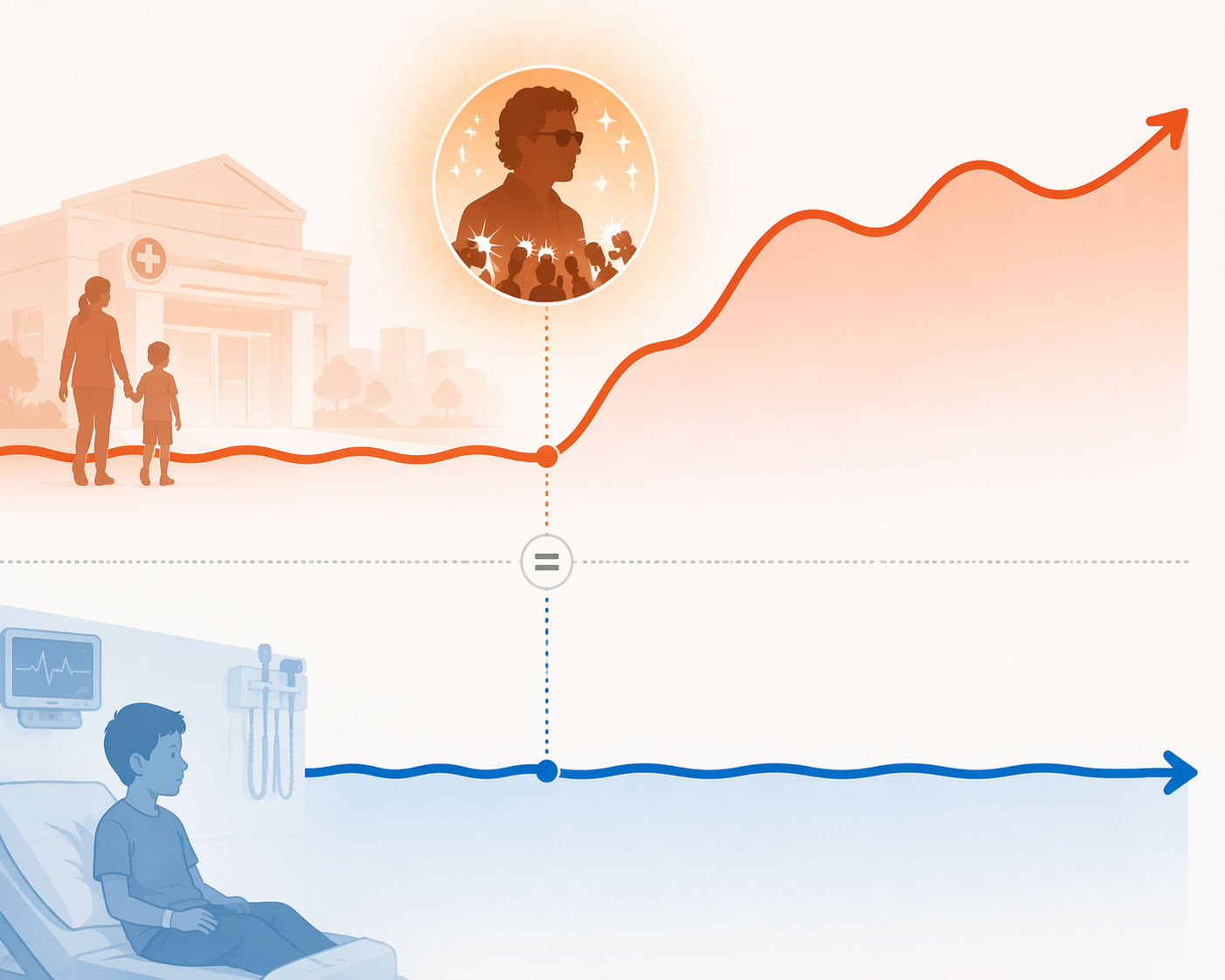
The sharpest evidence on the impact of celebrity hospital visits on pediatric care does not come from a celebrity walking into a children’s hospital. It comes from what happened after a celebrity death elsewhere. In the 10 weeks after Natasha Richardson died from a skiing-related head injury, Montreal Children’s Hospital saw a 60% increase in injury-related pediatric emergency department visits, a surge that was statistically significant at p<0.001.[1]
That finding matters because the hospital did not simply become busier in a vague, seasonal way. The increase was concentrated in the kind of injury parents had just watched play out in the news. Nearly half of the additional visits were for head injuries. Yet the proportion of severe cases did not rise.[1] For anyone who has watched a triage desk absorb a run of worried families after a frightening public story, that distinction is the whole point: the clinical denominator did not necessarily change, but the threshold for seeking care did.
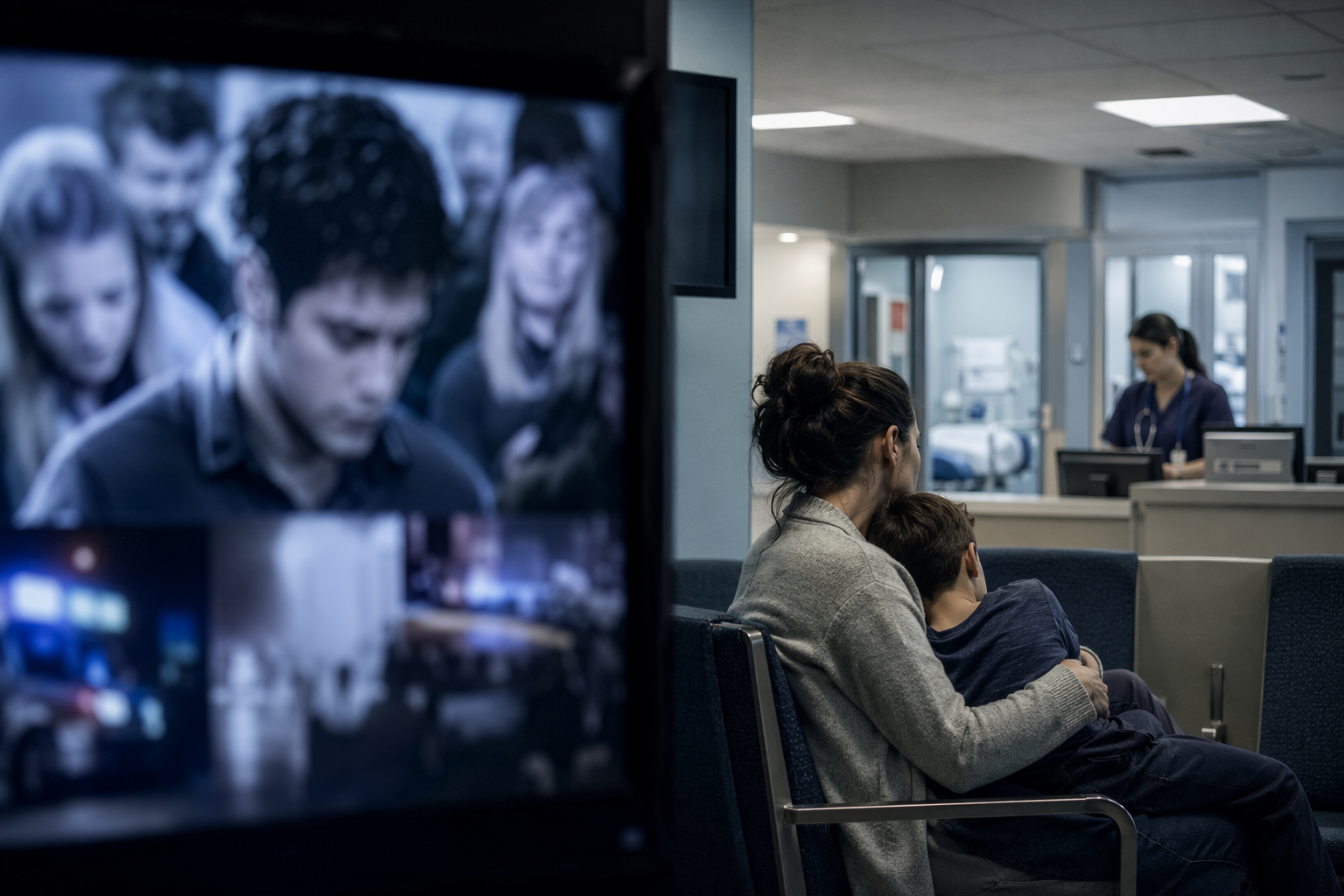
A Measurable Surge After A Public Injury Death
Keays and Pless treated Richardson’s death as a natural experiment. The study examined injury-related emergency visits at Montreal Children’s Hospital during the 10 weeks after the event, then compared that period with 16 years of weekly historical data. Against that long baseline, the post-event increase was 66% above the weekly average.[1]
The 16-year comparison is doing important work. Pediatric ED volume moves for many reasons: weather, school calendars, sports seasons, respiratory epidemics, local access patterns, and plain randomness. A short before-and-after snapshot would have been easier to dismiss. A 16-year weekly control does not remove every possible confounder, but it makes the signal harder to explain away as ordinary fluctuation.[1]
The study’s strongest operational detail is the mismatch between visit volume and severity. If more children had truly been injured, or if a concurrent environmental factor had increased serious injuries, the severity mix should have shifted. Instead, head injury visits rose while the proportion of severe cases stayed stable.[1] That is the pattern one would expect when parents lower their threshold for evaluation after a frightening, highly available story.
It would be too blunt to call those visits unnecessary. A child with a head injury may look well at home and still frighten a parent for reasons that are not irrational. The Richardson story was exactly the kind of story that parents replay: an initially survivable-seeming mechanism, a delayed recognition problem, and a catastrophic ending. The study does not show that every extra visit was clinically indicated. It does show that public fear became visible as ED demand.
Why The Media Link Is Hard To Ignore
The Montreal finding would be weaker if it stopped at one hospital’s time trend. It does not. Keays and Pless compared Montreal Children’s Hospital with hospitals in Quebec, Ontario, and western provinces, using differences in media exposure as part of the interpretation. The effect was stronger in Quebec, where English-language coverage of Richardson’s death was more intense, and weaker in western provinces.[1]
That geographic gradient helps separate a media-linked care-seeking response from a broader injury incidence explanation. If Canadian children had suddenly sustained more head injuries for an unrelated reason, the signal should not have tracked so neatly with the news environment. The gradient does not turn a retrospective natural experiment into a randomized trial, but it gives the behavioral interpretation much firmer footing.
| Study Signal | Operational Meaning |
|---|---|
| 60% increase in injury-related pediatric ED visits after the celebrity death | A high-profile injury story can create short-term demand that front desks, triage nurses, and physicians actually feel. |
| 66% increase over a 16-year weekly average | The surge was large relative to a long historical baseline, not just a casual impression from a busy week. |
| Nearly half of surge visits involved head injuries | The visit mix tracked the mechanism that dominated public attention. |
| No increase in severity proportion | The rise looked more like anxiety-weighted care seeking than a rise in serious pediatric injury burden. |
| Stronger effect in Quebec and weaker effect in western provinces | The pattern aligned with media exposure rather than simply with national injury trends. |
The design still has boundaries. It was a retrospective natural experiment at one Canadian pediatric hospital, built around one celebrity death and one injury mechanism.[1] The evidence is credible for that event. It does not automatically prove that every celebrity injury, diagnosis, or hospitalization produces the same pediatric ED effect.
Celebrity Health Events Do Move Behavior, But Not All In The Same Way
The Richardson study sits inside a broader literature on celebrity influence and health behavior, though the parallels should be kept in their lane. Public reports around Angelina Jolie, Katie Couric, and Kylie Minogue have been associated with increased attention to genetic testing, colonoscopy, and breast screening, respectively.[2] Those are adult preventive or screening behaviors, not pediatric emergency visits.
The Minogue example is the closest functional comparison because it includes a concrete utilization jump: after Kylie Minogue’s breast cancer diagnosis, mammography bookings reportedly increased by 40% across four Australian states.[2] That does not tell a pediatric ED director how many extra children will arrive after an injury death. It does show that a celebrity health story can move people from concern to appointment-making.
Hoffman and Tan’s framework is useful here because it keeps the explanation from becoming mystical. In a review spanning 104 studies across five disciplines, they identified 14 biological, psychological, and social mechanisms through which celebrities may influence health-related behavior.[3] Identification, fear, salience, and perceived trust are enough to explain much of what likely happened in Montreal: a story became emotionally vivid, easy to recall, and behaviorally actionable.
The parent-facing side of celebrity influence is not imaginary, either. A 2009 survey cited in this literature found that 24% of parents placed “some trust” in celebrity-provided vaccine safety information.[3] That statistic is about vaccine information, not injury visits, and it measures trust rather than behavior. Still, it is a useful warning against assuming parents simply wall off celebrity narratives from medical decisions.
What Pediatric EDs Should See In The Signal
For pediatric emergency operations, the practical lesson is not that celebrity news should dictate staffing. Most stories will not create a measurable surge, and the Keays and Pless paper does not provide a universal forecast model. The lesson is narrower and more useful: after a highly publicized, frightening, child-relevant injury mechanism, a hospital may see demand that behaves like clinical volume even when severity does not rise.
That distinction matters at triage. A flat severity mix does not mean no one needs evaluation. It means the front end of the department may carry more reassurance work, more head-injury histories, more return-precaution conversations, and more decisions about whether imaging is warranted. The resident debating a head CT is not solving a media problem; they are evaluating a child in front of them. The media problem has already arrived as volume.
The clearest operational response is situational awareness. If a high-profile injury death dominates local media, especially one involving delayed deterioration after an initially ordinary-seeming mechanism, pediatric ED leaders can watch for a short-term change in chief complaints and arrival patterns. This does not require labeling families as inappropriate users. It requires separating a rise in injury incidence from a rise in injury concern.
- Track whether the increase is concentrated in the celebrity event’s injury mechanism, such as head trauma rather than all injuries.
- Compare severity, admission, imaging, and observation patterns with the usual baseline before assuming true injury burden has changed.
- Prepare triage scripts and discharge instructions for the anxiety points parents are likely to bring in from the news story.
- Use local media exposure as part of surge interpretation instead of treating all regions or catchment areas as equally exposed.
The communication task is delicate. Parents who arrive after a story like Richardson’s are often not asking the ED to validate a news cycle. They are asking whether their child is the exception everyone missed. A calm explanation of warning signs, observation windows, and why imaging is or is not appropriate may be the intervention that absorbs the surge without converting anxiety into unnecessary testing.
Where AI Analytics Might Help, And Where The Evidence Stops
The Keays and Pless study did not test artificial intelligence, anomaly detection, natural language processing, or automated triage support.[1] Any AI implication is downstream operational reasoning, not a study finding. That boundary is important because it is easy to smuggle a proven utilization signal into an unproven technology claim.
Still, the pattern the study describes is exactly the kind of pattern modern ED analytics teams would want to detect early: a transient rise in a specific complaint category, temporally linked to a public event, with no matching rise in severity. An anomaly model trained on historical arrival patterns could flag the volume change. NLP on chief complaints and triage notes could help distinguish “head injury after fall” from broader injury noise. A dashboard could then show whether acuity, imaging rates, observation time, or admissions are moving with the complaint surge.
The value would not be in replacing triage judgment. It would be in making the denominator visible while the department is busy. If the queue lengthens because mild head-injury concerns are rising, that calls for different operational choices than a queue lengthening because higher-acuity trauma has increased. The first may need communication support, fast-track adjustment, discharge-instruction consistency, and real-time monitoring. The second may need a very different escalation.
Even then, AI should not overclaim causation. A model may detect that head-injury complaints rose after a celebrity death. It may show that severity stayed flat. It cannot, by itself, prove that a parent came because of the story unless that information is collected. The Montreal paper’s geographic comparison and 16-year baseline are part of why its inference is persuasive; an operations dashboard would need comparable discipline before calling a surge media-driven.
A Narrow Finding With Real Operational Weight
The Richardson study supports a disciplined conclusion: a high-profile celebrity death from injury produced a real, transient, media-linked increase in pediatric injury-related ED visits at Montreal Children’s Hospital, with head injuries driving much of the surge and no corresponding increase in severity.[1] That is not a general law of celebrity medicine. It is stronger than an anecdote and narrower than a universal prediction.
For pediatric care, that is enough to take seriously. A public story outside the hospital changed who appeared at the front desk. The children still had to be assessed one by one. The operational burden was real even if the clinical severity mix did not rise.
References
- Impact of a Celebrity Death on Children's Injury-related Emergency Room Visits — PubMed, 2010
- What Is The Celebrity Effect? How A Star's Diagnosis Saves Public Lives — Acibadem International
- Biological, psychological and social processes that explain celebrities' influence on patients' health-related behaviors — PMC, 2015
Comments
Join the discussion with an anonymous comment.