
The practical question behind celebrity perspectives on artificial intelligence in healthcare is not whether famous people should influence medicine. That door has been open for a long time. The better question is narrower and more useful: when a recognizable public figure talks about AI-supported diagnosis, triage, mental health tools, imaging, or clinical decision support, does that help people interpret a complicated technology more responsibly, or does it give a premature emotional shortcut to something that still needs evidence, safeguards, and explanation?
That question matters because public trust in AI healthcare has not kept pace neatly with technical momentum. In 2023, Pew Research Center found that 60% of Americans said they would feel uncomfortable if their own healthcare provider relied on artificial intelligence in their care, and 57% said AI use in healthcare would make the patient-provider relationship worse.[1] Those are not small hesitations at the edge of the market. They describe an emotional permission problem: many people may accept that AI is technically powerful while still feeling uneasy about being personally cared for through it.
By 2026, Pew’s update suggested a more positive shift: 44% of Americans said AI would have a positive impact on medical care.[2] That is meaningful, but it is not a victory lap. Expectations can improve before people understand what a tool does, who supervises it, what happens when it is wrong, or how much agency a patient keeps. Health systems that mistake rising optimism for earned trust are likely to discover the difference later, in exam rooms, consent conversations, and complaint lines.

AI Healthcare Trust Is Already Being Interpreted Through Messengers
People rarely meet a medical technology as a pure technical object. They encounter it through a clinician’s tone, a hospital’s consent form, a regulator’s decision, a news segment, a patient story, a family member’s fear, or a familiar face on a platform they already use. The messenger does not replace the evidence, but the messenger affects how evidence is noticed, remembered, and translated into personal risk.
That is why dismissing celebrity health communication as mere publicity misses something important. A celebrity does not need to understand model validation, bias audits, or clinical workflow integration to change whether an anxious patient asks a clinician about an AI-supported screening tool. At the same time, a celebrity who speaks beyond the evidence can leave clinicians with the repair work: correcting expectations, reintroducing uncertainty, and explaining why a tool appropriate for one setting may be unsafe or unproven in another.
The most defensible role for celebrity voices, then, is not to “sell” AI medicine. It is to help people attend to expert-grounded messages that already have institutional credibility: what the tool is for, who oversees it, what it cannot do, how privacy is handled, when a human clinician remains responsible, and what questions patients should ask before relying on it.
The Messenger Effect Is Not One Thing
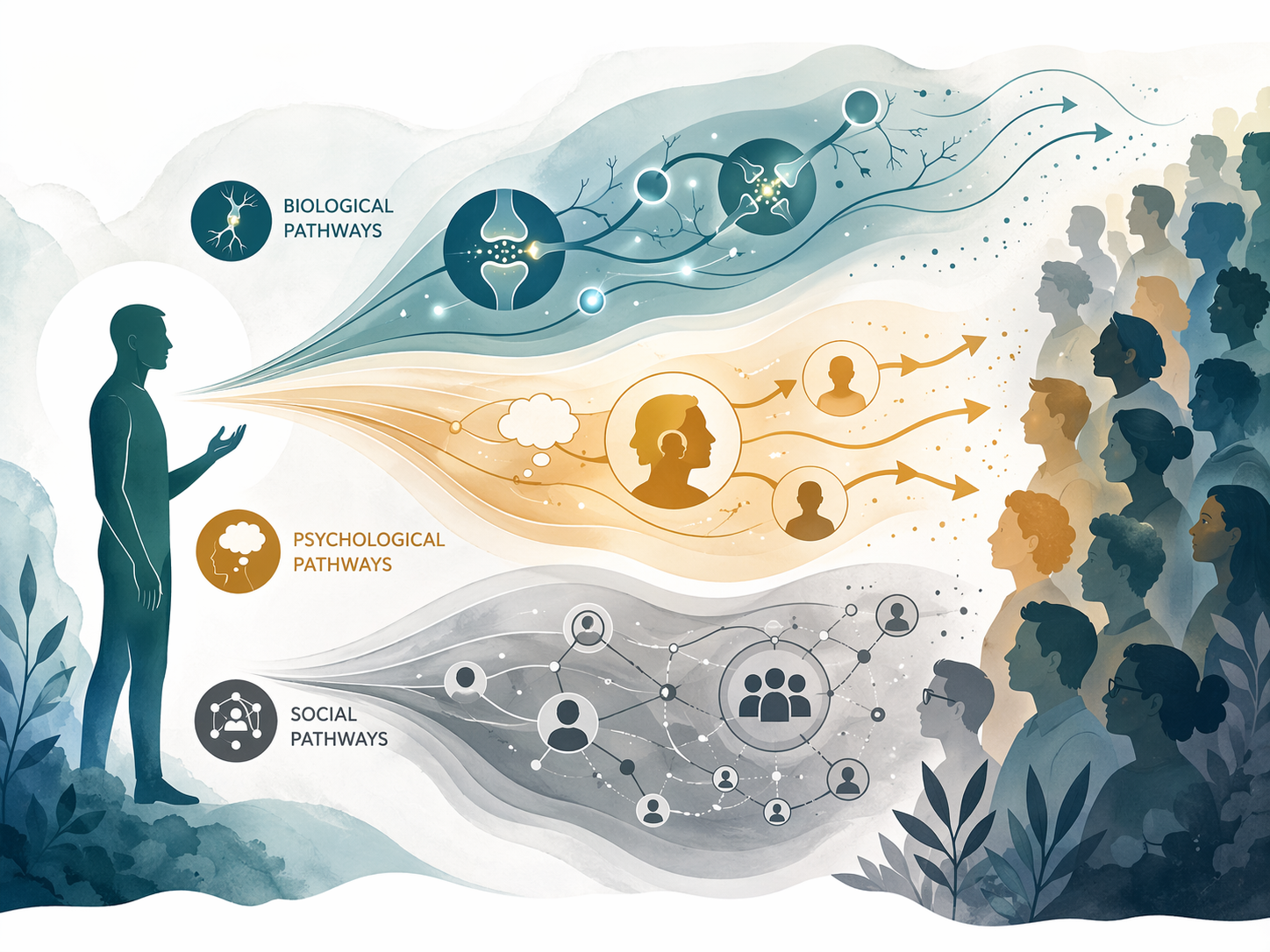
A useful corrective comes from Hoffman and colleagues’ 2017 systematic review, which identified 14 biological, psychological, and social mechanisms through which celebrities can influence health-related attitudes and behaviors.[3] The value of that framework is not that it produces a simple coefficient for celebrity power. It does something more basic and often more needed: it gives structure to a phenomenon that is too often described as charisma, fandom, or noise.
Some mechanisms are about attention and memory. A famous person can make a health topic more emotionally available. A post, interview, or public appearance can turn an abstract risk into something people can picture. In AI healthcare, this might mean a patient first learns that AI is being used in radiology, symptom checking, or administrative triage because someone they follow describes a personal encounter with it. That first moment of attention is not adoption, but it can open the path to later questions.
Other mechanisms involve identification. People may be more receptive when the messenger seems to share something with them: age, illness experience, family role, cultural background, vulnerability, or a recognizable fear. A celebrity who has navigated a serious diagnosis may make a technology feel less alien if the message is anchored in what patients actually face: uncertainty, waiting, second opinions, cost, access, and the desire not to be reduced to a data point.
Credibility is a separate mechanism, and it is more fragile. Fame alone is not medical credibility. In health communication, perceived credibility can come from lived experience, transparency about limits, alignment with trusted clinicians, or a visible connection to a reputable institution. For AI healthcare, this distinction is decisive. A celebrity who says, in effect, “Ask your clinician how this tool is used and what safeguards are in place” is doing a different thing from a celebrity who implies that an app, chatbot, or screening product is trustworthy because they personally like it.
Social modeling also matters. When a public figure is seen getting vaccinated, calling a hotline, undergoing screening, or discussing treatment openly, the action itself becomes easier to imagine. The person watching does not need to copy the celebrity exactly. The important shift may be smaller: a taboo subject becomes speakable, a preventive step becomes socially normal, or a conversation with a clinician becomes less intimidating.
Parasocial attachment adds another layer. People can feel a durable, one-sided familiarity with public figures they have followed for years. That attachment can make a health message feel less like an announcement and more like news from someone known. Used carefully, that emotional access can lower defensiveness. Used carelessly, it can blur the line between a personal story and general medical advice.
The Hoffman framework is especially helpful because it does not require one grand theory of celebrity influence. It allows several channels to operate at once: salience, trust, imitation, identity, norms, emotional arousal, perceived similarity, and social diffusion. Its limitation is just as important. The review’s mechanism-based account is stronger than the available precision about effect sizes across settings, so it supports serious attention to celebrity messengers without supporting confident claims that any given celebrity intervention will produce a predictable adoption rate.[3]
Older Health Campaigns Show Power, Not a Template
The history of celebrity health influence is strong enough to take seriously and uneven enough to resist imitation. Elvis Presley’s 1956 polio vaccination photo has been cited as helping boost teen vaccination rates.[4] The mechanism was unusually clean: a visible act, a clear preventive behavior, a public campaign context, and a vaccine already embedded in medical and public health authority. The celebrity did not have to explain immunology. He made participation visible.
Magic Johnson’s 1991 HIV disclosure worked differently. His announcement helped move HIV into mainstream public conversation and generated more than 28,000 calls to the CDC hotline.[5] The observed action there was not immediate treatment adoption; it was information-seeking at scale. That distinction matters for AI healthcare. A celebrity message may be most valuable not when it pushes people to use a tool, but when it sends them toward qualified sources before they decide.
Angelina Jolie’s 2013 announcement about her BRCA-related double mastectomy is another calibration point. It was associated with increased BRCA1 testing rates.[6] The public signal was powerful because it joined personal vulnerability with a specific genetic risk context. But even that case illustrates the danger of flattening. BRCA testing is not generally useful because a famous person had it; it is useful for people whose family history, ancestry, or clinical profile makes testing medically relevant.
Michael J. Fox’s Parkinson’s advocacy shows a funding and agenda-setting pathway rather than a simple patient behavior pathway. His foundation has raised more than $1.75 billion for Parkinson’s research.[7] That is celebrity influence operating through institutional persistence: money, visibility, partnerships, and sustained attention to a disease area. AI healthcare may see similar advocacy around access, disability, rare disease diagnosis, or clinician burden, but funding influence should not be confused with proof that a specific AI system works.
| Case | What the celebrity attention appeared to move | Why the AI healthcare analogy has limits |
|---|---|---|
| Elvis Presley’s polio vaccination photo | Visibility of a concrete preventive action | AI tools are often less visible, less standardized, and harder for the public to evaluate |
| Magic Johnson’s HIV disclosure | Public discussion and hotline information-seeking | AI adoption should often begin with questions, not immediate use |
| Angelina Jolie’s BRCA-related announcement | Testing interest tied to a specific risk context | AI tools also need careful matching to patient, setting, and indication |
| Michael J. Fox’s Parkinson’s advocacy | Research funding and agenda attention | Funding and awareness do not validate a specific clinical product |
AI Makes the Messenger Problem Harder
AI healthcare is not one behavior. It can mean a hospital using an algorithm to flag sepsis risk, a radiology system prioritizing scans, a chatbot offering mental health support, a primary care practice using automated documentation, or a patient-facing app suggesting next steps. A celebrity can model getting a vaccine or calling a hotline. It is harder to model an appropriate relationship to an AI system that sits partly inside clinical workflow and partly behind institutional procurement, privacy policy, model governance, and clinician judgment.
That complexity changes what responsible influence looks like. The best celebrity message about AI healthcare may be less dramatic than older campaign moments. It may sound like: this tool helped my care team review information, my physician explained its limits, I asked how my data would be used, and I still had a human clinician responsible for my care. That kind of message is not as easily clipped into a slogan, but it preserves the chain of accountability.
The 2023 Pew findings make this especially important. If many people worry that AI will worsen the patient-provider relationship, then a celebrity endorsement that seems to celebrate replacing clinicians may aggravate the very fear communicators need to address.[1] By contrast, a celebrity perspective that shows AI as clinician-guided, bounded, and explainable may help people place the technology within care rather than imagine it as care’s substitute.
The 2026 improvement in expectations gives communicators an opening, not a license. More positive public sentiment can make people more willing to listen, but it can also make exaggerated claims travel faster.[2] In that environment, celebrity attention can help good explanations reach people who would never read a hospital AI governance statement. It can also give a weak product the borrowed warmth of a trusted face.
Platform-Native Health Influence Is More Personal and Less Contained
Recent celebrity health communication has moved far beyond the press conference or public service advertisement. Ryan Reynolds’ 2022 colonoscopy video turned a preventive screening experience into shareable entertainment while still pointing toward a real medical action.[8] Selena Gomez’s Wondermind platform sits in a different category: ongoing mental health conversation, content, and community rather than a single disclosure event.[9]
Neither example proves anything specific about AI healthcare adoption. They are useful because they show the current media environment into which AI messages will land. Health influence is now continuous, intimate, algorithmically distributed, and often framed as personal vulnerability. That can make a message more humane. It can also make sponsorship, product interest, and evidence quality harder for audiences to separate.
Mental health AI is a particularly sensitive example. If a well-known person encourages people to seek help, reduce shame, or ask a clinician about available tools, the messenger effect may support access. If the same person presents an AI companion, chatbot, or self-guided tool as an adequate substitute for professional care without careful boundaries, the influence can become clinically dangerous. The deciding factor is whether the message keeps expertise, escalation, and patient safety in view.
Authenticity Helps Only When the Message Has Somewhere Reliable to Point
Authenticity is often treated as the cure for public skepticism. It is not. An authentic story can still be medically misleading if it generalizes from one person’s experience to a population, from one tool to a category, or from one supervised clinical use to consumer use. In AI healthcare, authenticity should be considered a condition for attention, not a substitute for evidence.
The strongest celebrity perspectives on artificial intelligence in healthcare will likely share several features. They will be specific about the setting without pretending the setting applies everywhere. They will identify clinicians, researchers, or institutions as the proper interpreters of the technology. They will name uncertainty without making uncertainty sound like failure. They will encourage questions rather than obedience. They will avoid implying that comfort with AI is a personality trait of modern, enlightened patients.
The weakest messages will do the opposite: collapse all AI tools into one promise, treat personal experience as proof, use emotional recovery stories to imply product effectiveness, or frame reluctance as ignorance. Those messages may still move behavior. That is precisely why they deserve scrutiny. Influence is not made safe by being effective.
What Celebrity Voices Can and Cannot Do for AI Adoption
Celebrity voices can make AI healthcare discussable. They can reduce social distance from an unfamiliar technology. They can prompt people to ask clinicians whether an AI tool is being used in their care. They can normalize questions about privacy, bias, human oversight, and error. They can also draw attention to patient groups that might benefit from better diagnostics, faster review, or more accessible support.
They cannot, by themselves, make AI healthcare trustworthy. Trustworthiness comes from validation, transparency, regulation, workflow design, clinician accountability, equity testing, privacy protections, and patient-centered implementation. A famous person can amplify those signals when they exist. When they do not exist, celebrity attention does not fill the gap; it hides it for a while.
The evidence supports a disciplined middle position. Celebrity influence in health is real enough to matter, and the mechanisms are more varied than simple persuasion.[3] Public trust in AI healthcare is unsettled enough that messengers will shape interpretation whether institutions plan for it or not.[1][2] But older celebrity health successes cannot be imported into AI as plug-and-play proof. The conditions are different, the technologies are more opaque, and the consequences of misunderstanding may fall on patients and clinicians who were not in the room when the campaign was approved.
Celebrity perspectives can move trust, but they do not create trustworthy AI healthcare. They amplify what evidence, expert context, and patient-centered implementation have already made available.
References
- 60% of Americans Would Be Uncomfortable With Provider Relying on AI in Their Own Health Care, Pew Research Center, February 22, 2023.
- Americans’ views of artificial intelligence in health and medicine, Pew Research Center, March 12, 2026.
- How do celebrities influence public health decisions? A systematic review, PMC, 2017.
- How Elvis helped America win the fight against polio, Gavi/The Conversation.
- Magic Johnson’s HIV disclosure and public health response, LinkedIn analysis.
- Angelina Jolie’s BRCA announcement and genetic testing behavior, LinkedIn analysis.
- Michael J. Fox Foundation Parkinson’s research fundraising analysis, LinkedIn analysis.
- Ryan Reynolds’ 2022 colonoscopy video, LinkedIn analysis, 2022.
- Wondermind mental health platform, LinkedIn analysis.
Comments
Join the discussion with an anonymous comment.