
In healthcare, ChatGPT is no longer one thing. In 2026, the same family of tools may be asked to draft a discharge instruction, summarize a long chart, suggest a differential diagnosis, answer a patient’s symptom question, or help a clinician write a prior authorization appeal. Those tasks sit at very different distances from clinical harm.
That distinction matters more than the brand name. A tool that saves time on a reviewed note is doing a different job from a tool that reassures a patient with chest pain. The strongest safety signal in the current evidence is not that ChatGPT sometimes gets medical facts wrong; it is that, in an independent patient-facing evaluation reported in February 2026, the model undertriaged emergency cases 52% of the time.[1]
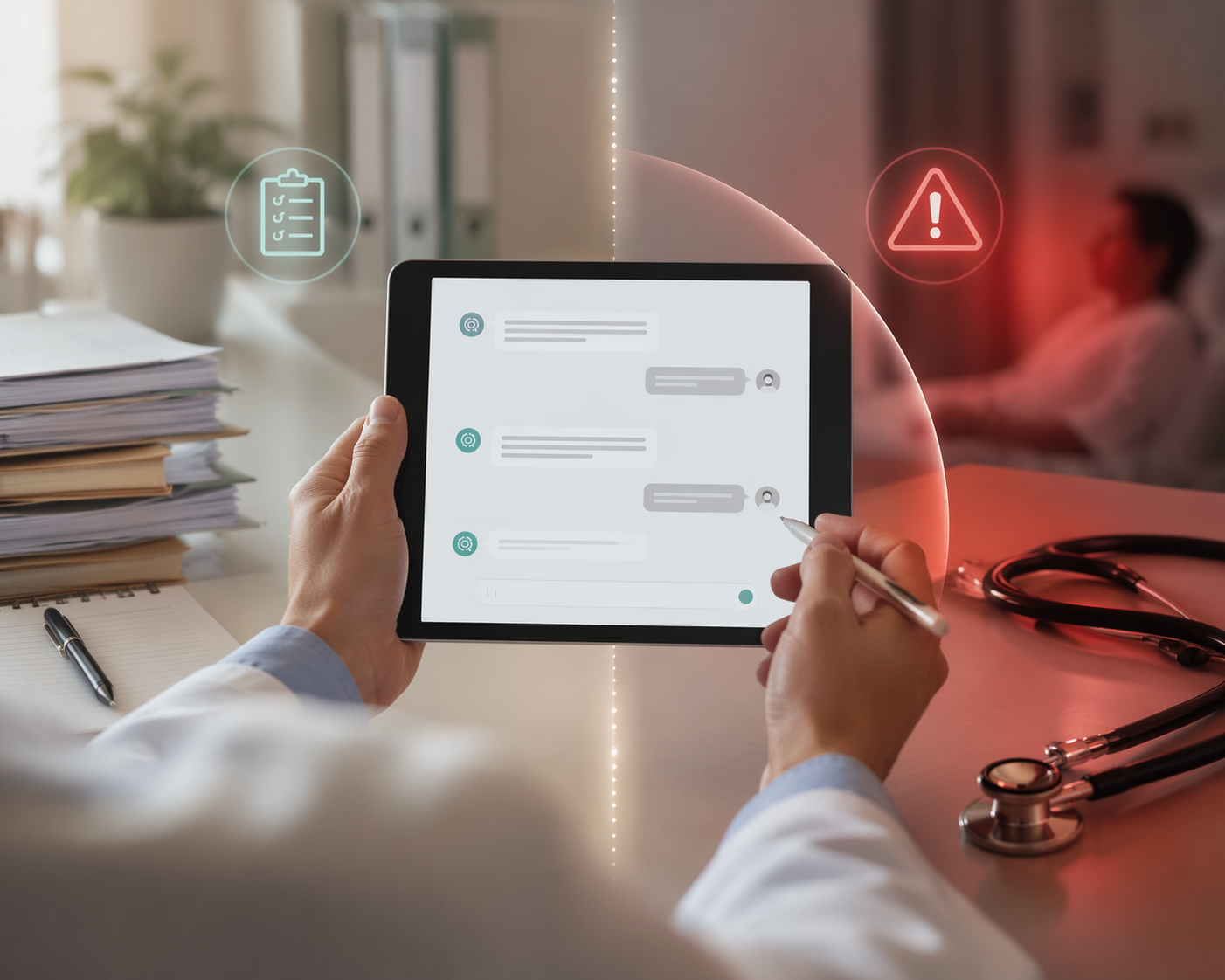
That result should not erase the useful work these systems can do. Clinicians are already using them, often for ordinary friction: documentation drafts, patient education language, coding support, inbox summaries, literature explanations, and first-pass note cleanup. In Elsevier’s 2025 Clinician of the Future survey of 2,206 clinicians across 109 countries, 48% reported using AI, and among those AI-using clinicians, 97% relied on generalist tools such as ChatGPT rather than purpose-built clinical products.[2]
So the practical question for ChatGPT in healthcare is not whether the tool can produce medical-sounding text. It can. The question is which task it is performing, whether that task is bounded enough to review, and who remains accountable when the answer is incomplete, overconfident, or wrong.
Product Availability Is Not Clinical Evidence
OpenAI’s 2026 healthcare product stack makes adoption easier to imagine. Between January and April 2026, the company launched or described three healthcare-oriented tiers: ChatGPT Health for consumers, ChatGPT for Healthcare for enterprise organizations, and ChatGPT for Clinicians for individual clinical users.[3]
Those tiers matter as market context. They tell health systems that generalist AI is being packaged for consumer health questions, enterprise workflows, and individual clinician use. They do not, by themselves, prove that the tool is safe for triage, diagnosis, medication advice, or autonomous patient communication.
This is a familiar trap in health IT. A product can be available, polished, integrated, and heavily used before anyone has shown that it improves the outcome people quietly assume it improves. For a deeper review of the broader evidence base, see How AI in Medicine and Healthcare Performs in 2026 and Generative AI and Health: What the Clinical Evidence Actually Shows in 2026.
Where ChatGPT Looks Most Useful
The best case for ChatGPT in healthcare is still the least glamorous one: reduce clerical work while keeping a human reviewer in the loop. Documentation, summarization, and education drafts are attractive because the output can be checked against the chart, the source material is often available, and the clinician can edit before anything becomes part of care.
| Task setting | What the evidence suggests | Why the risk changes |
|---|---|---|
| Administrative and educational work | Strongest current fit; reported efficiency gains are commonly described in the 40-70% range | The task is usually reviewable before it affects care |
| Medical knowledge and exam-style tasks | Performance commonly falls in the 60-78% range on medical exams | Correctness depends on question format and does not equal bedside reliability |
| Clinical decision support | Accuracy varies widely, with reported results in the 71-93% range depending on task | The clinician must interpret, verify, and decide what applies to the patient |
| Direct patient-facing triage | Independent evaluation found 52% emergency undertriage | The patient may act on the answer before a clinician sees the risk |
The documentation use case is also where the saved time has the clearest path back to clinical work. If a physician spends less time turning a visit into a note, there is at least a plausible opportunity to recover time for chart review, counseling, message response, or simply leaving the clinic closer to on time. That only holds if the AI output does not create a second job: hunting for fabricated details, correcting subtle distortions, or reconciling a note that sounds fluent but misstates the encounter.
That is why ambient scribing and summarization need to be judged by more than speed. A system that drafts quickly but inserts an unsupported symptom, omits a contraindication, or changes the temporal sequence of a history can move risk downstream into coding, handoffs, prior authorizations, or future visits. For a focused discussion of this problem, see How Ambient AI Scribes Reduce Workload and Where Accuracy Fails.
Clinical Reasoning: Impressive Results, Narrower Meaning
The most interesting diagnostic evidence is not a simple story of human versus machine. In a randomized clinical trial by investigators from UVA, Stanford, and Beth Israel, ChatGPT alone reached 92% diagnostic accuracy on clinical vignettes, while physicians using ChatGPT reached 76.3%.[4]
That result is striking, but the unit of evidence is important. The trial used vignettes, not live patients with incomplete histories, ambiguous exams, competing priorities, family dynamics, time pressure, local resource constraints, and evolving data. A vignette is a legitimate way to test reasoning behavior. It is not the same as demonstrating safe autonomous diagnosis in a clinic, emergency department, or inpatient service.
The physician-with-ChatGPT result may be the more useful finding for implementation. It suggests that giving clinicians access to a strong model does not automatically improve diagnostic performance. The clinician has to know when to ask, how to frame the question, how to weigh the answer, and when to ignore it. If the AI produces a plausible differential but the user anchors on the wrong item, the interface has not solved the reasoning problem; it has changed its shape.
This is where “accuracy” becomes too blunt a word. Accuracy on a board-style question, a diagnostic vignette, a differential diagnosis list, and a real-time clinical decision are not interchangeable. A model can do well when all relevant facts are present and still perform unevenly when the chart is noisy or the patient’s story does not fit the expected pattern.
Clinical decision support may still be a reasonable place for ChatGPT-like systems, especially when the output is treated as a second set of suggestions rather than a decision. The safer version looks like this: a clinician asks for alternative diagnoses, missing history questions, patient-friendly explanations, or a summary of guideline considerations, then verifies the answer against the patient and the record. The unsafe version is quieter: the answer is pasted forward, accepted because it sounds authoritative, or used to reassure someone before the risk has been checked.
Patient-Facing Use Is Where the Margin Shrinks
Patient-facing use changes the safety calculation because the reviewer may disappear. A clinician reading a generated summary can catch an error. A patient reading a chatbot’s reassurance may decide not to seek care.
The 52% emergency undertriage finding is therefore more clinically important than many broader adoption numbers.[1] Undertriage is not an abstract model weakness. It is a failure mode in which a patient with an emergency-level presentation is directed toward a lower level of urgency. The consequence is not merely an incorrect answer; it is delayed care.
This does not mean every patient-facing use is equally unsafe. A reviewed draft of post-visit instructions, written at an appropriate reading level and checked by the care team, is very different from a consumer-facing symptom chatbot making urgency judgments. The boundary is not whether the language is addressed to a patient. The boundary is whether the output can alter patient behavior before a qualified human has reviewed the risk.
The concern is not that patients are incapable of using AI tools. Many patients already search online, compare answers, and bring generated text to visits. The concern is that fluent conversational systems can make uncertainty feel settled. In triage, that is dangerous because the safest answer is sometimes inconvenient: call emergency services, go to the emergency department, speak to an on-call clinician now.
Hallucination Is Small Per Sentence and Large at the Point of Care
Clinical summarization studies show why small error rates can still matter. In a 2025 npj Digital Medicine study of 12,999 annotated sentences, Asgari and colleagues reported a 1.47% hallucination rate per sentence in clinical summarization, and 44% of those hallucinations were classified as clinically significant.[5]
The number can be read two ways. A 1.47% per-sentence hallucination rate sounds low if the task is drafting rough text. It sounds different when a long summary contains many sentences, when the error is hard to notice, or when the hallucinated statement concerns a medication, diagnosis, allergy, symptom, or follow-up plan.
The study also has limits that should stay attached to the finding. It evaluated a single large language model using Tortus AI’s proprietary prompt framework, and the authors were employed by Tortus AI.[5] That does not make the result unusable. It does mean the result should not be stretched into a general hallucination rate for all clinical LLM deployments.
For implementation, the lesson is simpler than the statistics: the review step cannot be ceremonial. If clinicians are expected to sign AI-assisted notes, the workflow must give them enough time, source visibility, and interface support to find errors. A fast draft that no one can realistically audit is not the same thing as a safe draft.
Why Performance Shifts So Sharply by Task
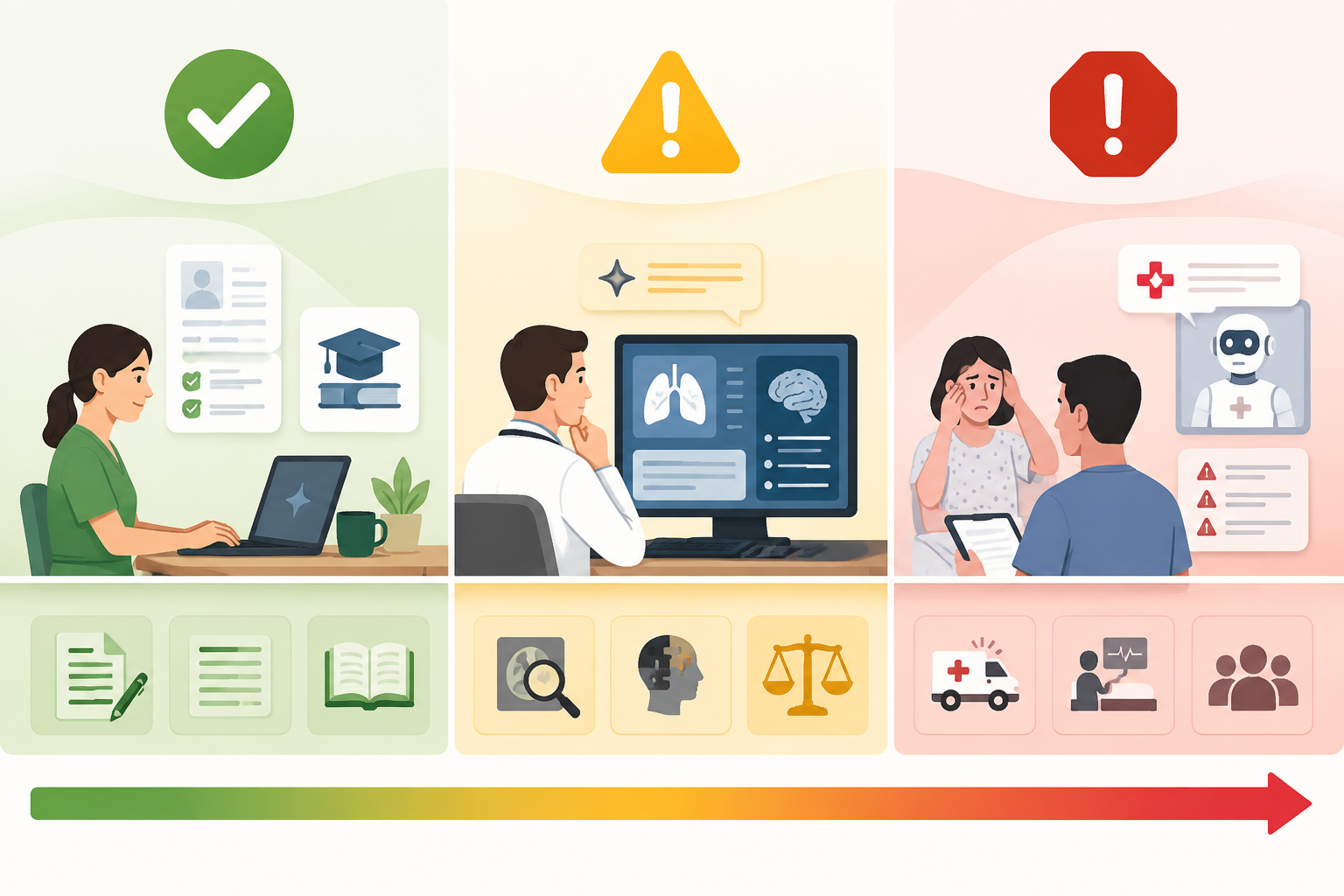
ChatGPT performs best when the task has three features: the input is reasonably complete, the expected output is textual, and a knowledgeable person can review the result before it affects care. Documentation drafts, education rewrites, and administrative letters often meet those conditions.
The risk rises when any of those features disappears. Clinical reasoning may begin with incomplete information. Triage requires conservative urgency judgments under uncertainty. Patient-facing advice may be acted on immediately. In those settings, the same fluent style that makes ChatGPT useful for drafting can hide the difference between supported inference and confident guesswork.
- Structured, supervised tasks: note drafting, visit summaries, coding support, prior authorization language, patient education drafts.
- Clinician-facing reasoning support: differential diagnosis suggestions, missing-history prompts, guideline reminders, handoff summaries.
- High-risk patient-facing tasks: symptom triage, urgency decisions, reassurance about potentially serious symptoms, medication changes without clinician review.
Specialty also matters. A dermatology image workflow, an oncology note summary, a psychiatry intake draft, and an emergency department triage exchange do not share the same failure modes. For a specialty-by-specialty view, see AI in Healthcare by Specialty — What the Evidence Supports.
The Human-in-the-Loop Problem Is Not Solved by Naming It
“Human oversight” is often treated as if it were a safety control by itself. In practice, it is only a control if the human has the expertise, time, authority, and information needed to change the output.
A resident asked to verify an AI-generated discharge summary while covering admissions has a different oversight capacity than an attending reviewing a short patient education draft after the visit. A nurse triage team receiving AI-preprocessed patient messages needs clear escalation rules. A primary care physician signing an AI-assisted inbox response needs to know what the model saw, what it did not see, and what it may have inferred.
The adoption data suggest clinicians will keep using generalist tools whether or not every health system has finished building governance around them.[2] That reality argues for more precise local rules, not performative bans or uncritical enthusiasm. If a tool is being used to make a note clearer, the guardrails can be relatively lightweight. If it is being used to answer a patient’s symptom question, the guardrails need to account for urgency, escalation, auditability, and liability.
Regulation Remains Unsettled
The regulatory status of consumer-facing health AI is still unsettled. In May 2026, Harvard’s Petrie-Flom Center published an analysis arguing that ChatGPT Health may meet the FDA’s medical device definition.[6]
That is a scholarly legal argument, not an FDA determination and not a court-tested conclusion. It still captures the pressure point: once a conversational product starts influencing health decisions, especially diagnosis or treatment decisions, it becomes harder to treat it as ordinary information software.
For health systems, the regulatory ambiguity does not remove the operational obligation. Someone still has to decide which uses are allowed, which are prohibited, which require documentation, and which need monitoring after deployment. For more on the policy landscape around generative AI, see Generative AI in Healthcare: State of the Evidence and Policy Landscape in 2026.
A Deployment Judgment
The evidence through mid-2026 supports a bounded role for ChatGPT in healthcare. It is most defensible in structured administrative and educational work where a clinician or care team reviews the output before use. It may be useful in clinical decision support when it is explicitly treated as assistive, not authoritative. It is hardest to justify as a direct patient-care or triage substitute, especially when urgent symptoms are involved.
The safest deployments will not be organized around the question, “Can ChatGPT answer medical questions?” That question is too broad to be clinically useful. The better question is: which exact task is it performing, who checks it, and what happens if it is wrong?
References
- Independent evaluation of emergency undertriage in patient-facing AI health responses, Nature Medicine, reported via iatroX, February 2026.
- Clinician of the Future 2025, Elsevier, 2025.
- OpenAI 2026 healthcare product stack announcements, OpenAI, January-April 2026.
- Parsons et al., randomized clinical trial of ChatGPT and physician diagnostic reasoning on clinical vignettes, JAMA Network Open, November 2024.
- Clinical hallucinations in large language models for clinical summarization, npj Digital Medicine, May 2025.
- Analysis arguing ChatGPT Health may meet the FDA medical device definition, Harvard Petrie-Flom Center, May 2026.
Comments
Join the discussion with an anonymous comment.