
The weakest clinical AI governance programs do not usually fail because nobody formed a committee. They fail because the committee cannot answer the questions that matter when an AI-enabled tool creates a patient-safety concern: who can stop it, who must be notified, what record is created, and whether the event triggers reporting outside the organization.
That distinction has become harder to avoid in 2026. One industry FAQ reports that 59% of healthcare organizations deploy AI without a documented committee approval gateway, while Censinet has reported that only 22% can produce a 30-day AI audit trail and that 84% have formed AI committees but only 12% have implemented a formal framework.[1][2] Those percentages should be treated as limited market signals, not as independently verified proof of every hospital’s maturity. Still, they describe a governance gap that compliance officers and CMOs will recognize: broad adoption, thin documentation, and too much reliance on informal escalation.
A clinical AI governance committee (CAGC) charter is the document that closes that gap. It does not merely announce that the organization values safe AI. It assigns authority, creates a record, defines quorum, names the clinical roles that must be present, and tells staff what happens when an AI output may have contributed to harm.
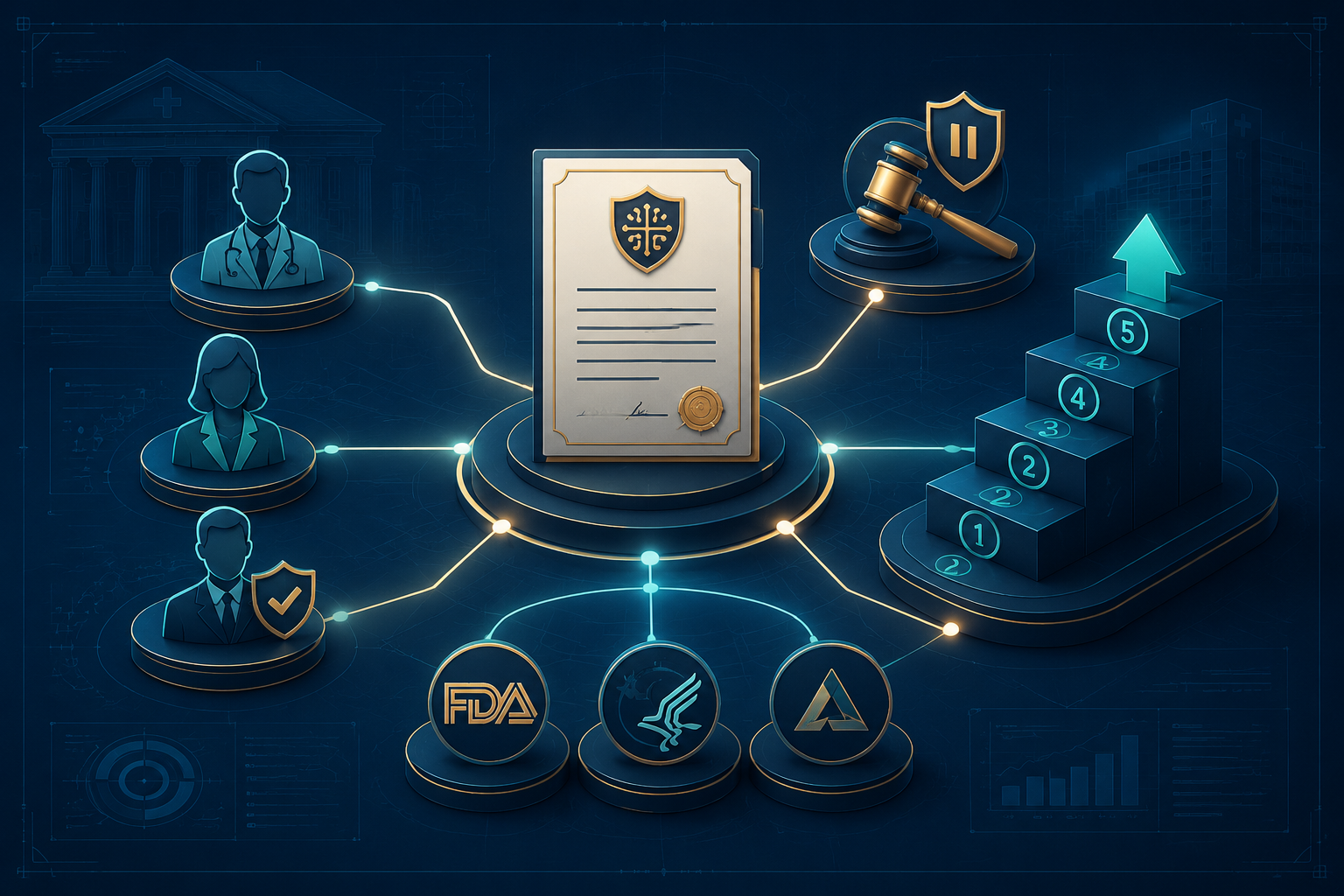
The Charter Has To Do More Than Name A Committee
The first mistake is treating a clinical AI governance committee as a softer version of an enterprise AI committee. Enterprise AI governance may be adequate for productivity tools, contracting standards, or general data-use rules. Clinical AI is different because the failure mode can be delayed diagnosis, inappropriate triage, biased risk scoring, unsafe automation, or misplaced reliance by a licensed clinician.
The second mistake is treating a steering committee as governance. A steering committee can recommend, coordinate, and educate. A clinical AI governance committee must be able to approve, condition, suspend, retire, investigate, and refer. If its decisions are advisory only, the charter should say so plainly; but then leadership should not pretend it is governing clinical AI.
The James A. Haley Veterans’ Hospital AI Committee is useful here because it shows that structured clinical AI governance is not theoretical. Its charter, approved on July 22, 2021, organized work through seven subcommittees and used a six-principle product evaluation framework.[3] A health system does not need to copy that architecture. It does need the same seriousness about documented scope, defined review, and repeatable evaluation.
Minimum Anatomy Of A Clinical AI Governance Committee Charter
A defensible clinical AI governance committee charter should read like an operating instrument. The clauses below belong together because each one depends on the others. Membership without quorum is symbolic. Quorum without decision rights is procedural theater. Decision rights without incident escalation leave the bedside clinician carrying risk that belongs at the enterprise level.
| Charter clause | What it must specify | Why it matters operationally |
|---|---|---|
| Scope | Clinical AI systems covered, including vendor tools, internally developed models, embedded EHR tools, AI-enabled devices, and clinical content generation | Prevents departments from treating embedded or pilot tools as outside governance |
| Membership | Required voting and advisory roles by title, not generic stakeholder groups | Makes clear whose judgment is necessary before approval, suspension, or retirement |
| Quorum | Minimum attendance and mandatory roles for any binding decision | Prevents major safety decisions from being made without clinical, compliance, security, and patient-safety representation |
| Decision rights | Approval, conditional approval, denial, suspension, retirement, monitoring changes, and escalation authority | Turns the committee from a discussion forum into an accountable control point |
| Incident escalation | A staged pathway from frontline recognition to external reporting review | Gives clinicians and safety officers a route that does not depend on informal relationships |
| Meeting cadence | Routine meeting schedule plus emergency convening rules and review cadence by risk | Allows rapid action without waiting for a quarterly agenda |
| Regulatory mapping | FDA, ONC HTI-1, CHAI/TJC, state-law, privacy, security, and patient-safety reporting obligations | Creates an audit-ready explanation of why the committee acted and what duties were considered |
| Records | Required minutes, decision memos, model inventory updates, monitoring logs, incident files, and ratification records | Preserves the evidence leadership will need after harm, complaint, survey, litigation, or regulator inquiry |
Membership By Role, Not By Invitation List
The charter should name required roles, not merely say that “clinical, operational, and technical stakeholders” will participate. The minimum membership commonly identified for a clinical AI governance committee includes the CMO, CMIO, compliance officer, CISO, service-line clinical representatives, patient safety officer, frontline clinician, and AI ethics officer.[4][5]
- CMO: owns clinical authority, patient-safety judgment, emergency suspension power, and escalation to executive leadership.
- CMIO: evaluates workflow integration, EHR embedding, clinical usability, alerting behavior, and monitoring feasibility.
- Compliance officer or legal representative: maps approval, monitoring, documentation, disclosure, and reporting duties.
- CISO or security leader: reviews access controls, vendor risk, cybersecurity exposure, data flows, and incident coordination.
- Patient safety officer: determines how AI-related events enter the organization’s safety reporting and root-cause review systems.
- Service-line clinicians: test whether the tool’s clinical assumptions match actual practice in the affected specialty.
- Frontline clinician: supplies the bedside or clinic view that senior committees often miss, especially workarounds and alert fatigue.
- AI ethics officer or equivalent ethics oversight role: reviews fairness, transparency, explainability, and bias monitoring obligations.
The ethics role is not ornamental. One IHS source reports that 75% of current committees lack an ethics officer role.[1] That figure is not enough to prove the prevalence of ethics oversight across the whole market, but it is a useful warning. Bias monitoring, patient communication, and use in vulnerable populations cannot be left to whoever happens to raise a concern late in deployment. For organizations still building terminology and mitigation processes, a standing reference point such as an algorithmic bias framework can help keep that review from becoming an abstract fairness discussion.
Quorum Should Protect The Decision, Not Just The Calendar
A useful quorum clause does not simply require a majority of members. It requires the right mix of authority. For binding approval, suspension ratification, or return-to-service decisions, quorum should include at least the CMO or designee, CMIO or designee, compliance or legal, patient safety, information security, and one clinician from the affected service line. If the AI system materially affects a specific population, the ethics representative should be mandatory as well.
The charter should also distinguish routine quorum from emergency quorum. Routine approval can wait for full representation. A safety pause cannot. Emergency quorum should allow immediate action by a small set of required leaders, followed by formal ratification and recordkeeping.
Decision Rights Are The Hinge Of The Charter
The charter’s most important sentence should be the one that answers this question: who can stop the tool?
For clinical AI, immediate suspension authority should sit with the CMO or an identified physician executive designee, with mandatory full-committee ratification within 48 hours. That structure appears in AI governance maturity and policy-template materials as a way to avoid advisory-only review while still requiring committee accountability after emergency action.[4][6]
This is not a bureaucratic preference. At 6 p.m. on a Friday, the organization may not know whether the problem is model drift, a vendor update, an EHR integration error, a local workflow mismatch, or clinician misuse. The CMO still needs authority to pause use if continued operation could expose patients to harm. The committee can then determine whether the pause becomes a formal suspension, whether the tool returns with restrictions, or whether the event requires deeper investigation.
The decision-rights section should enumerate, at minimum, the committee’s authority to:
- Approve, deny, or conditionally approve clinical AI deployment before use in patient care.
- Require clinical validation, local performance testing, usability review, cybersecurity review, or bias assessment before approval.
- Set monitoring metrics, thresholds, ownership, and review frequency for each approved system.
- Suspend or restrict use when safety, compliance, security, or performance concerns arise.
- Approve return to service after remediation and document the evidence supporting that decision.
- Retire tools that no longer perform adequately, no longer match clinical workflow, or no longer satisfy regulatory or contractual requirements.
- Refer events to enterprise risk, patient safety, privacy, security, legal, FDA reporting review, state reporting review, or Joint Commission readiness review.
The charter should also prevent silent change. Vendor model updates, changes in intended use, new patient populations, EHR workflow changes, altered thresholds, and material changes to training or validation information should return to the committee under a defined change-control pathway. The committee cannot govern a system it no longer recognizes.
A 5-Stage Incident Escalation Path
Incident escalation is where a clinical AI governance committee charter stops being a committee document and becomes part of clinical workflow. The escalation path described in AI governance controls and health law guidance moves from frontline identification to clinical leadership review, formal committee investigation, enterprise risk integration, and external reporting analysis.[4][7]

Stage 1: Frontline Staff Identify A Possible AI-Related Event
The charter should require a low-friction reporting route for clinicians, pharmacists, nurses, technologists, and other staff who suspect that an AI output contributed to a near miss, delay, wrong recommendation, missed alert, inappropriate triage, documentation error, or other safety concern. The reporter should not have to prove causation. At this stage, the operational standard is suspicion plus enough detail to preserve the facts.
The required record should capture the tool name, patient-care context, date and time, user role, AI output or recommendation if available, clinician action, patient outcome if known, and whether the system remains active. If the concern involves an embedded EHR model, the report should identify the clinical workflow and screen location. If it involves an AI-enabled device, the report should preserve device identifiers and version information where available.
Stage 2: Clinical Leadership Performs Immediate Review
The affected service-line leader, patient safety officer, and CMO or designee should review the concern promptly enough to decide whether continued use is acceptable while the facts are gathered. The charter should authorize temporary safeguards at this stage: narrowing use, adding human review requirements, disabling a workflow integration, notifying users, or pausing the tool.
This is also where the charter should separate clinical disagreement from possible system failure. A clinician may disagree with an AI recommendation for good clinical reasons; that alone may not be an incident. A pattern of unsafe recommendations, an output outside intended use, an undisclosed model change, a biased performance concern, or a workflow design that encourages overreliance should move forward.
Stage 3: The CAGC Convenes A Formal Investigation
The committee should convene under emergency rules when patient harm, repeated near misses, regulatory exposure, security concerns, or loss of performance signal is plausible. Its investigation should assign an owner, preserve relevant logs, review monitoring dashboards, compare the event with approved intended use, and determine whether vendor notice is required.
The record should not be limited to meeting minutes. A useful incident file includes the original report, immediate safeguards, committee attendance, conflicts of interest, data reviewed, decision made, rationale, dissent if any, notification plan, and follow-up date. The Epic Sepsis Model governance case study remains a useful caution for health systems because it shows why pre-approval review, post-deployment monitoring, and escalation cannot be assumed after deployment; those controls must be charter-defined before clinical reliance grows around a model.
Stage 4: Enterprise Risk Management Integrates The Event
Once the committee determines that the concern may implicate patient harm, legal exposure, privacy, security, vendor performance, credentialing, malpractice risk, or disclosure obligations, the event should enter enterprise risk channels. That does not mean the clinical AI governance committee loses responsibility. It means the event is now coordinated with the functions that own claims, disclosures, insurance, regulatory communications, contracting, and board reporting.
The charter should state who makes that handoff, what documentation accompanies it, and whether the committee remains responsible for technical and clinical remediation. Without that clause, clinical leaders may assume risk management is handling the AI problem, while risk management assumes the committee is handling the clinical tool.
Stage 5: External Reporting Duties Are Reviewed
The final stage is not automatic reporting; it is documented reporting analysis. The charter should require review of FDA medical device reporting obligations under 21 CFR Part 803 where an AI-enabled device may be involved, state patient-safety or disclosure requirements where applicable, and Joint Commission-related reporting or survey-readiness implications.[7]
That analysis should be time-stamped, assigned, and preserved. If the organization decides that an event is not reportable, the file should explain why. If it is reportable, the file should identify who submitted the report, when it was submitted, and what corrective actions were taken or planned.
Meeting Cadence Should Follow Risk, Not Convenience
A charter that sets only a monthly or quarterly meeting schedule is incomplete. Routine cadence matters, but clinical AI governance also needs event-triggered review and risk-based monitoring. The review schedule should be tied to FDA Software as a Medical Device classification where applicable, intended use, degree of automation, patient acuity, deployment scale, and the organization’s local performance history.
| AI system category | Minimum committee posture | Cadence expectation |
|---|---|---|
| AI-enabled device or SaMD used in diagnosis, treatment, triage, or monitoring | Formal pre-use approval, regulatory mapping, post-market monitoring, incident pathway, and version-change control | Review frequency tied to SaMD risk and performance signals, with emergency review available |
| Clinical decision support embedded in the EHR | Approval of intended use, user-facing explanation, monitoring metrics, escalation triggers, and change-control review | Regular monitoring, with heightened review after workflow, threshold, or population changes |
| Operational AI with direct patient-care consequences | Clinical review if outputs affect access, prioritization, staffing, scheduling, or escalation of care | Periodic review based on patient impact and complaint or safety signals |
| Administrative AI with no direct clinical consequence | Enterprise AI governance may lead, with CAGC consultation if patient-care effects emerge | Review under enterprise cadence unless clinical use expands |
The committee should also maintain a complete inventory of approved clinical AI systems. For each system, the inventory should identify owner, vendor, intended use, covered population, deployment locations, approval date, version, monitoring metrics, review date, known limitations, regulatory classification if applicable, and incident history. That inventory is the beginning of the audit trail, not an administrative afterthought.
Regulatory Mapping Belongs Inside The Charter
The regulatory section should not be a generic list of laws. It should map obligations to committee actions: what must be reviewed before approval, what must be monitored after deployment, what changes require re-review, and what events trigger reporting analysis.
FDA SaMD, PCCP, And Post-Market Surveillance
FDA’s AI-enabled device environment is no longer small. Censinet describes more than 1,400 FDA-authorized AI-enabled devices as of March 2026, alongside growing attention to predetermined change control plans and post-market surveillance.[2] A clinical AI governance committee charter should therefore require the committee to identify whether a tool is an FDA-regulated device or SaMD, whether a vendor has an authorized PCCP, and whether local use remains within the cleared or authorized intended use.
PCCP tracking is especially easy to under-document. If the vendor can modify the model under an authorized change plan, the health system still needs to know what changed, when it changed locally, what users were told, and whether monitoring thresholds still make sense. A more detailed treatment of that governance problem belongs in the health system’s FDA PCCP guidance process, but the CAGC charter should make the committee accountable for recognizing and recording those changes.
ONC HTI-1 Transparency And Documentation
The ONC HTI-1 rule pushes health systems and health IT actors toward more structured transparency around predictive decision support, including source attributes, training data demographics, and bias-related disclosures in the materials summarized by Censinet and Regology.[2][8] The CAGC charter should translate those expectations into review requirements: the committee should not approve clinical AI unless required source and performance information is collected, stored, and available to the clinicians and governance personnel who need it.
The practical issue is not whether a vendor has a polished transparency statement. The issue is whether the organization can produce the version-specific documentation that explains what the committee reviewed, what limitations were known, and what monitoring was required.
CHAI, TJC, And Responsible AI Expectations
CHAI and The Joint Commission issued responsible use of AI in healthcare guidance in September 2025 and governance playbooks in May 2026, as summarized in the regulatory materials in the research record.[2][8] These materials do not replace legal obligations, but they matter because accreditation and responsible AI expectations are converging around the same operational questions: governance structure, accountability, transparency, risk management, monitoring, and response to harm.
A charter should therefore identify which committee records are maintained for accreditation readiness: minutes, approvals, exception decisions, monitoring results, incident files, corrective action plans, and education records for affected users.
State AI Laws And Clinical Review Duties
State law is now part of the clinical AI governance file. The regulatory materials identify Colorado SB 24-205, with algorithmic impact assessment duties effective June 30, 2026; Texas SB 1188, requiring licensed practitioner review of AI-generated clinical content; and California AB 316, addressing liability removal in AI-related healthcare contexts.[8] The point for a charter is not to reproduce every state requirement. It is to assign responsibility for identifying which state rules apply to a given tool, patient population, and use case.
For multi-state systems, that clause should be explicit. A tool approved for one state or service line should not silently become a systemwide standard if the legal review, patient disclosure analysis, or licensed-practitioner review requirements differ across jurisdictions.
Standalone Committee Or Nested Subcommittee
Not every organization needs the same chart. An academic medical center with a mature digital health governance body may place clinical AI under a specialized subcommittee. A community hospital may need a standalone clinical AI governance committee because no existing body has the right mix of clinical, safety, compliance, and technical authority. A VA facility, integrated delivery network, or children’s hospital may make a different design choice again.
The structure is less important than the authority. Whether standalone or nested, the charter must give the body clinical decision rights, incident escalation responsibility, access to the model inventory, and the ability to create records that survive audit, survey, complaint, and litigation review. If the parent committee can override clinical safety decisions without a documented process, the charter should say who owns that risk.
A Practical Charter Skeleton
A draft brought to executive leadership or a board quality committee should be short enough to approve and specific enough to operate. The following skeleton is the minimum structure worth putting in front of leadership.
- Purpose and authority: establish the committee as the governing body for clinical AI approval, monitoring, suspension, incident review, and regulatory mapping.
- Scope: define covered systems, including AI-enabled devices, SaMD, EHR-embedded decision support, internally developed models, vendor tools, and AI-generated clinical content.
- Membership: require CMO, CMIO, compliance or legal, CISO, patient safety, service-line clinicians, frontline clinician, ethics oversight, and other roles as needed.
- Quorum: require mandatory clinical, compliance, security, patient-safety, and affected-service representation for binding decisions, with separate emergency quorum rules.
- Decision rights: enumerate approval, conditional approval, denial, monitoring requirements, change-control review, suspension, return to service, retirement, and external referral.
- Immediate suspension: authorize the CMO or physician executive designee to pause a tool immediately for patient-safety concerns, subject to full-committee ratification within 48 hours.
- Incident escalation: adopt the five-stage pathway from frontline recognition to clinical leadership review, CAGC investigation, enterprise risk integration, and external reporting analysis.
- Meeting cadence: set routine meetings, emergency convening rules, and review frequency tied to SaMD risk, clinical impact, monitoring results, and incident history.
- Regulatory mapping: require documented review of FDA, ONC HTI-1, CHAI/TJC, state-law, privacy, security, patient-safety, and contractual obligations.
- Records and audit trail: require inventory updates, approval memos, minutes, monitoring logs, incident files, ratification records, change-control records, and reporting analyses.
In 2026, the defensible clinical AI governance committee charter is the document that converts concern into accountable action. The committee may be standalone or nested under a broader digital health body. It may meet monthly, more often, or on an emergency basis. But if it lacks clinical authority, a defined suspension pathway, a five-stage incident process, risk-based review cadence, and audit-ready documentation, it is not governing clinical AI in any meaningful sense.
References
- IHS AI Governance Healthcare FAQ, IHS, https://integralhs.com/ai-governance-healthcare-faq
- 2026: The Defining Year for AI Governance in Healthcare, Censinet, https://censinet.com/perspectives/2026-defining-year-ai-governance-healthcare
- Developing a Hospital Artificial Intelligence Committee and Patient Safety and Quality Plan, Federal Practitioner, 2022, https://pmc.ncbi.nlm.nih.gov/articles/PMC9652023/
- Clinical AI Governance Committee Charter, AI Governance Institute, https://aigovernance.com/controls/clinical-ai-governance-committee-charter
- Key Elements of an AI Governance Program in Healthcare, Sheppard, https://sheppard.com/insights/blogs/key-elements-of-an-ai-governance-program-in-healthcare
- Policy Template, Physician AI Handbook, https://physicianaihandbook.com/appendices/policy-template.html
- AI Governance in Health Care: What In-House Counsel and Compliance Teams Need to Know Now, Baker Donelson, https://www.bakerdonelson.com/ai-governance-in-health-care-what-in-house-counsel-and-compliance-teams-need-to-know-now
- Operationalizing AI Governance in Healthcare, Regology, https://regology.com/blog/operationalizing-ai-governance-in-healthcare
Comments
Join the discussion with an anonymous comment.