
A medical benchmark score in the mid-90s used to be a headline. In 2026, it is more often the start of the evaluation problem. A public LM Council aggregator lists GPT-5.2 at 95.84% on MedQA, a result that is impressive enough to rule out easy dismissals and high enough to make the old exam-passing story feel crowded. The harder question is what that number permits a health system to do next.
It does not, by itself, clear a model for triage, patient messaging, prior-authorization support, documentation cleanup, specialty extraction, or clinician-facing reasoning. MedQA, MedMCQA, and PubMedQA remain useful low-resolution screens: they test whether a model can parse biomedical language, retrieve conventional facts, and select from constrained options. The Open Medical-LLM Leaderboard helped make that comparison culture visible across common medical question-answering datasets.[1] But the closer a benchmark gets to saturation, the less it can distinguish the failures that matter after procurement.

That is the useful tension in clinical LLM evaluation benchmarks now. The older tests are not worthless; they are being asked to certify too much. The newer evidence does not say that high-scoring models are fake progress. It says that exam accuracy, safety behavior, probabilistic judgment, workflow fit, and robustness are different measurement targets.
What a Benchmark Is Actually Measuring
The most useful first cut is not “old versus new.” It is the clinical property being measured. A benchmark can test answer selection without testing whether a model recognizes risk. It can test chain-of-thought-style reasoning without testing whether the model knows when to defer. It can test a real clinical NLP task without proving the same model will behave safely in patient-facing conversation.
| Benchmark family | What it mainly measures | What it does not settle |
|---|---|---|
| Exam-style medical QA, including MedQA, MedMCQA, and PubMedQA | Biomedical knowledge retrieval, test-taking skill, and answer selection under constrained formats | Clinical workflow readiness, safety under high-risk ambiguity, calibration, local documentation burden |
| Safety-weighted clinical benchmarks, including CSEDB | Whether the model’s answer remains safe as well as effective across clinical scenarios | Generalizability across languages, institutions, and unfamiliar data distributions |
| Reasoning-focused benchmarks, including SCT | Probabilistic judgment, uncertainty handling, and alignment with clinician reasoning patterns | Stability under different prompting strategies or direct deployment value in a specific workflow |
| Real-world task suites, including MedHELM and DRAGON | Performance across broader clinical tasks and datasets closer to operational use | Full reproducibility where datasets are PHI-constrained, and post-deployment behavior |
This distinction matters because benchmark choice becomes a proxy for risk appetite. If the use case is an internal literature assistant, a strong exam-style screen may be a reasonable starting point. If the model will draft discharge instructions, surface differential diagnoses, or help classify patient messages, an answer-key benchmark is only the first gate. For broader context on why high model accuracy often fails to imply clinical readiness, the same pattern appears in the evidence gap in machine-learning diagnostics.
CSEDB Makes the Safety Gap Harder to Hide
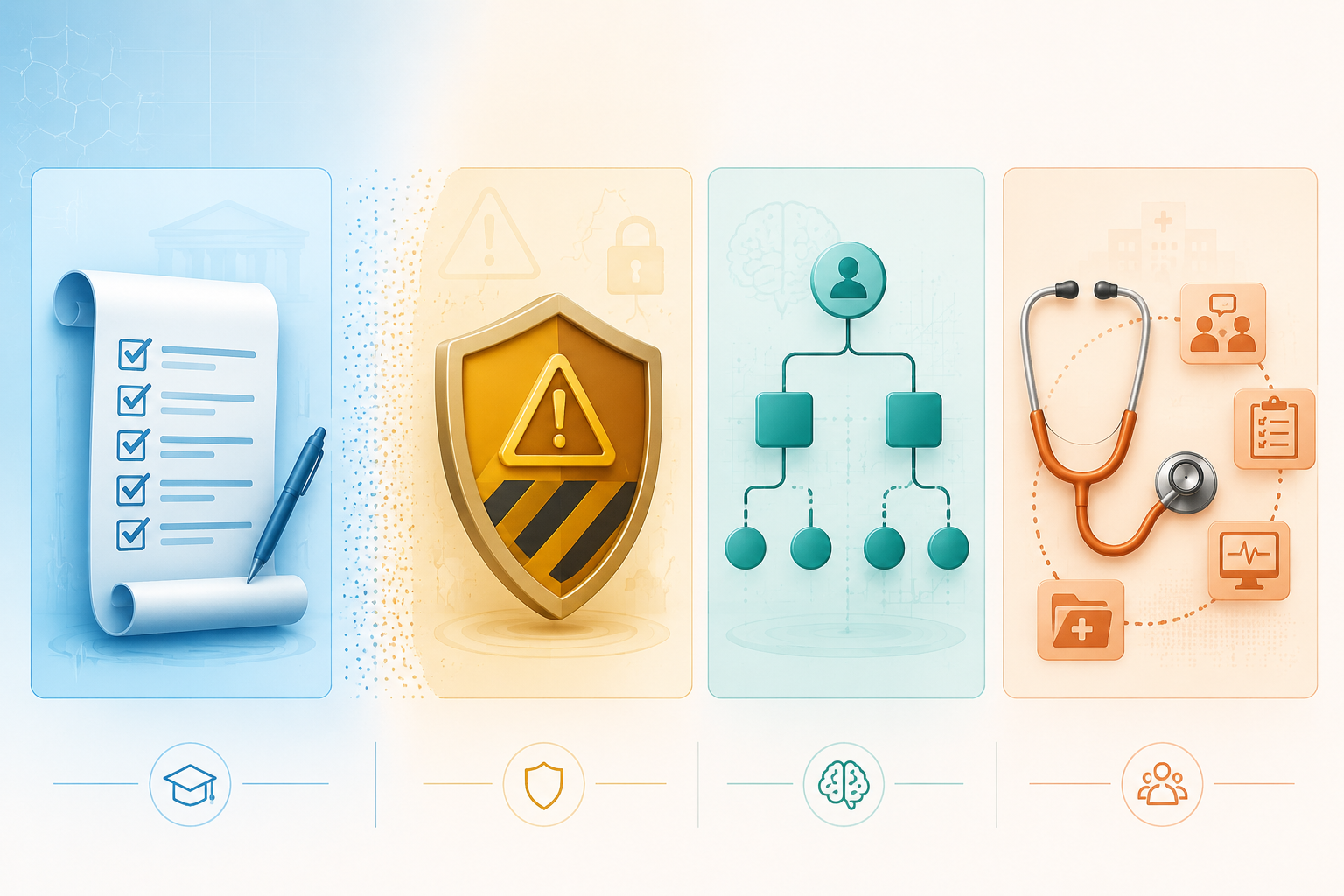
CSEDB is valuable because it separates two quantities that are often blurred in model demos: effectiveness and safety. In the npj Digital Medicine benchmark, six LLMs averaged 62.3% on effectiveness but only 54.7% on safety. In high-risk scenarios, performance dropped by 13.3%.[2] That is the kind of gap a multiple-choice medical exam can easily miss, because the exam usually rewards selecting the expected answer rather than managing the consequence of being wrong.
The benchmark also complicates the assumption that the largest general-purpose model should always be preferred. In CSEDB, the domain-specific MedGPT outperformed general-purpose models by 15.3% overall and by 19.8% on safety.[2] That finding is procurement-relevant, but it should not be inflated into a universal rule. A domain-specific model may benefit from training and evaluation distributions that look familiar to it. The responsible reading is narrower: when safety-weighted clinical questions are close to a model’s domain, specialization can matter, and evaluators should test for it rather than assume scale will compensate.
CSEDB’s language context also belongs close to the claim. The benchmark primarily uses Chinese clinical questions authored by native physicians. Back-translation validation showed about 5% performance variance while preserving model ranking consistency.[2] That supports some cross-language stability, but not unrestricted generalization to English-only hospital workflows, multilingual safety-net settings, or health systems outside the benchmark’s clinical assumptions.
The practical lesson is not that CSEDB is the safety benchmark. It is that separating safety from effectiveness changes what evaluators see. A model can answer more questions while still producing a risk profile that should trigger tighter supervision, narrower deployment, or additional local testing.
SCT Tests a Different Clinical Skill
The Script Concordance Test benchmark in NEJM AI points at another blind spot: clinical reasoning is not only recall. In the SCT study, o3 was the top-performing model at 67.8% compared with attending physicians, while Gemini 2.5 ranked lowest at 52.1% despite strong performance on exam-style tasks.[3] The ranking divergence is the important part. A model that looks excellent on medical QA may not rank the same when the task shifts toward probabilistic judgment under uncertainty.
SCT-style tasks ask whether new information makes a diagnosis or management option more or less likely. That is closer to the texture of clinical reasoning than “choose the one best answer,” especially when the case is incomplete. It also exposes calibration problems. The NEJM AI assessment reported systematic overconfidence in reasoning-tuned models.[3] For a clinician-facing assistant, overconfidence is not a cosmetic defect. It changes how a user reads the output, how quickly they challenge it, and how much cleanup work lands downstream.
The limitation is real: SCT results are prompt-sensitive, and the authors acknowledged that optimized prompting strategies could shift scores.[3] That should not be used to wave away the benchmark. Prompt sensitivity is itself part of deployment evidence. If a model’s clinical reasoning score moves materially when an instruction template changes, then the prompt becomes part of the evaluated intervention, not a wrapper that can be ignored.
This is where the progression from exam-style evaluation to reasoning-focused testing becomes most consequential. A model used as a clinical reasoning aid should be judged on uncertainty behavior, rank ordering, and sensitivity to presentation. For a closer look at that movement in one vendor ecosystem, see the discussion of the Google clinical reasoning AI pipeline.
Broader Task Suites Move Closer to Deployment, but Not All the Way
MedHELM and DRAGON are useful because they stop pretending that clinical AI evaluation is one task. Stanford’s MedHELM covers 121 real-world clinical tasks across 31 datasets and 5 categories, with preliminary results reported on 6 models.[4] DRAGON covers 28 clinical NLP tasks in npj Digital Medicine.[5] These suites better reflect the variety of work health systems actually assign to language models: extraction, summarization, classification, question answering, and other forms of clinical text processing.
Breadth has a cost. MedHELM’s early results are preliminary, and some datasets remain constrained by protected health information, which limits reproducibility for outside groups.[4] That does not make the suite weak; it makes it honest about the tradeoff. The closer a benchmark gets to real clinical data, the more it may inherit access restrictions, institutional documentation habits, and dataset-specific artifacts. A public leaderboard built entirely from easy-to-share data is easier to reproduce, but may be farther from the work a hospital actually needs done.
The JAMA systematic review adds caution from another angle. Bedi and colleagues found that only about 5% of published evaluations of health care LLM applications used real patient data.[6] The caveat is important: the review is based on pre-2024 literature, so it may understate recent progress in clinical evaluation. Even so, it captures a structural problem that has not disappeared. Many model claims are still built on synthetic, public, or exam-like materials because real clinical data are expensive, regulated, messy, and hard to share.
For evaluators, the lesson is to treat broad task suites as landscape builders, not deployment clearance. They can show whether a model is brittle across task types. They can identify which families of work deserve local pilots. They cannot answer whether a specific hospital’s note templates, specialty mix, escalation rules, and liability boundaries will produce the same result.
Prompting and Rubrics Are Part of the Evaluation, Not Afterthoughts
Clinical LLM evaluation often treats the model as the object and the prompt as a detail. That is too neat for deployment. Google Research reported that Adaptive Precise Boolean rubrics reduced evaluation time by 50% while improving inter-rater reliability compared with Likert scales.[7] That finding is less glamorous than a new model score, but it matters because evaluation throughput and reviewer agreement determine whether a health system can run repeated validations rather than one ceremonial test.
Prompt structure can also change safety results. In the CSEDB work, structured prompting significantly improved DeepSeek-R1’s safety scores with p<0.01 and effectiveness scores with p<0.05.[2] The safe interpretation is not that prompting solves safety. It is that the evaluated unit is often model plus prompt plus rubric plus workflow constraint. A benchmark score without those details is difficult to reproduce and easy to overread.
Reliability under repeated sampling is another underused stress test. Google Research reported that under a Worst@k reliability framing, at k=10 most general-purpose models dropped to about 0.4 or below on a 0-to-1 scale, with Claude 3.7 Sonnet below 0.1.[8] That is a different question from average accuracy. It asks what happens when a user, prompt variant, or stochastic generation path exposes the model’s worst plausible behavior.
This is why evaluation protocols should record prompt templates, sampling settings, refusal instructions, rubric criteria, reviewer backgrounds, adjudication rules, and failure categories. Without those details, two organizations can say they tested the same model on the same benchmark and still have measured meaningfully different interventions.
Choosing Benchmarks by Deployment Context
A clean benchmark taxonomy is less useful than a deployment map. The same model can be low-risk in one workflow and unacceptable in another. The selection question is not “Which clinical LLM evaluation benchmark is best?” It is “Which failure would matter here, and which benchmark has a chance of surfacing it before patients or clinicians do?”
| Deployment context | Benchmark emphasis | What to inspect beyond the score |
|---|---|---|
| General biomedical assistant or research support | Exam-style QA plus broad medical knowledge benchmarks | Citation behavior, retrieval grounding, refusal boundaries, hallucinated references |
| Patient-facing education or message drafting | Safety-weighted benchmarks, communication evaluation, and local review of high-risk prompts | Triage leakage, inappropriate reassurance, health-literacy mismatch, escalation instructions |
| Clinician-facing diagnostic or management support | Reasoning-focused benchmarks such as SCT plus safety-weighted scenario testing | Calibration, uncertainty language, overconfidence, ranking changes under prompt variants |
| Clinical documentation and summarization | Real-world task suites, local note datasets, and workflow-adjacent human review | Omissions, invented findings, copy-forward risk, reviewer time saved or added |
| Specialty NLP extraction or cohort identification | Task-specific benchmarks such as DRAGON-style NLP coverage plus local labeled samples | False negatives, ambiguous labels, distribution shift, downstream reporting consequences |
Triage and patient communication deserve safety-weighted evaluation early because the model’s mistake can change when care is sought. Documentation tools need a different emphasis: the central risk may be omitted evidence, invented detail, or extra clinician review time. A reasoning assistant should face SCT-like uncertainty tests, not just medical fact recall. A cohort-identification tool should be judged on task-specific clinical NLP performance and local labels, because an elegant answer to a board-style question says little about extraction from the institution’s notes.
Language and site context should be explicit selection criteria. Most current benchmarks are English or English-and-Chinese dominant. CSEDB’s Chinese-language design is a strength for one set of questions and a limitation for another.[2] MedHELM’s PHI-constrained datasets move closer to real care while making independent replication harder.[4] If a deployment will serve multilingual patients, community clinics, or a specialty service with unusual documentation patterns, benchmark evidence should be treated as prior information, not direct validation.
Classic multiple-choice benchmarks still have a role in this map. They are fast, familiar, and useful for excluding models that lack basic medical competence. They also help track broad progress, as seen in the exam-score trajectory of systems such as Med-PaLM and related clinical AI models discussed in Google clinical AI model evaluations. The mistake is to treat that screen as if it has measured clinical readiness.
A Practical Evaluation Rule
A defensible evaluation portfolio starts with the intended use and works backward. The first layer can be an exam-style competence screen. The second should add the failure mode most relevant to the workflow: safety-weighted scenarios for patient-facing or high-risk use, reasoning and calibration tests for clinician-facing advice, real-world task suites for documentation and NLP operations, and domain-specific benchmarks when the deployment is narrow enough for specialization to matter.
The third layer is local validation. That means testing the model-plus-prompt system on representative local cases, with reviewers who understand the workflow, and with rubrics that separate harmless wording issues from clinically meaningful failures. It also means measuring what the benchmark usually omits: who reviews the output, how often edits are required, whether escalations are missed, whether clinicians become over-reliant, and what monitoring will catch after launch.
The decision rule is deliberately unromantic: use MedQA, MedMCQA, PubMedQA, and similar benchmarks as low-resolution competence screens; add safety-weighted, reasoning-focused, domain-specific, and real-world-task evaluations according to the deployment context; and treat any single benchmark claim as incomplete until it is paired with prompt documentation, workflow analysis, local validation, and post-deployment monitoring.
References
- Open Medical-LLM Leaderboard — Hugging Face.
- A novel evaluation benchmark for medical LLMs illuminating safety and effectiveness in clinical domains — npj Digital Medicine, Dec 2025.
- Assessment of Large Language Models in Clinical Reasoning — NEJM AI, 2025.
- Holistic Evaluation of Large Language Models for Medical Applications — Stanford HAI, 2025.
- DRAGON benchmark — npj Digital Medicine.
- Testing and Evaluation of Health Care Applications of LLMs — JAMA, 2025.
- A scalable framework for evaluating health language models — Google Research.
- Benchmarking LLMs for global health — Google Research.
Comments
Join the discussion with an anonymous comment.