
Searches for HIPAA-compliant AI chatbots in healthcare usually send buyers toward vendor pages: encryption, access controls, business associate agreements, retention settings, audit logs. Those questions matter. They are also the comfortable questions, because they assume the tool under review is the tool being used.
The less comfortable possibility is already sitting in a clinician's browser tab or phone app. A resident wants discharge instructions in plainer language. A billing manager wants help making an appeal letter sound less adversarial. A nurse educator wants to clean up patient-facing material after hours. No one opens a procurement ticket. No one asks legal for a BAA. A consumer chatbot account is close enough, fast enough, and familiar enough.

That is where the largest compliance exposure may be forming: not inside the chatbot contract compliance teams are reviewing, but outside every sanctioned workflow, in personal accounts used for work.
The risk begins before procurement sees the tool
Procurement narratives have a way of making AI risk look orderly. A vendor is identified. Security reviews the questionnaire. Privacy asks whether the vendor will sign a BAA. Legal negotiates data-use terms. IT decides how the tool will be provisioned. Training follows.
Shadow AI does not wait for that sequence. Staff members under pressure can reach a consumer AI chatbot directly, often with no malicious intent and no sense that they have changed the legal posture of the data. The task feels administrative, educational, or clerical. The data may still be protected health information.
A 2026 Paubox article, citing Netskope analysis, reported that 71% of healthcare workers use personal AI accounts for work, that 81% of healthcare data policy violations involved regulated data such as PHI, and that 96% of healthcare organizations rely on AI tools that may train on user data.[1] Those figures should not be treated as settled industry law without seeing the original Netskope methodology, sample, and time window. They are still useful as alarm signals because they describe exactly the pattern privacy teams are least likely to see through contract review alone.
The adoption pressure is real. One 2026 healthcare AI statistics roundup reported that 66% of physicians used health AI in 2024, up from 38% in 2023.[2] That number does not prove that physicians are pasting PHI into consumer chatbots, and it should not be used that way. It does show why a policy posture built around abstinence is brittle. Staff are experimenting because the work is there, the tools are available, and the sanctioned alternatives often arrive later than the need.
What changes when PHI enters a consumer chatbot
HIPAA risk is not created by the word "chatbot." It is created by the relationship among the data, the person disclosing it, the organization responsible for it, and the entity receiving it.
A covered entity can use a vendor to perform functions involving PHI when the vendor is acting as a business associate and the required agreement and safeguards are in place. That structure is familiar. It is imperfect, but it gives the organization contractual duties, permitted-use limits, breach obligations, and some basis for oversight.
Consumer AI use can break that structure. A legal analysis on AI chatbots and HIPAA compliance explains that when patients directly share PHI with consumer AI chatbots, the chatbot developer is neither a covered entity nor a business associate; the information may therefore sit outside HIPAA's regulatory framework rather than inside a business-associate relationship.[3] The same structural concern applies when workforce members place organizational PHI into a consumer tool that the organization has not approved, contracted with, or configured for healthcare use.
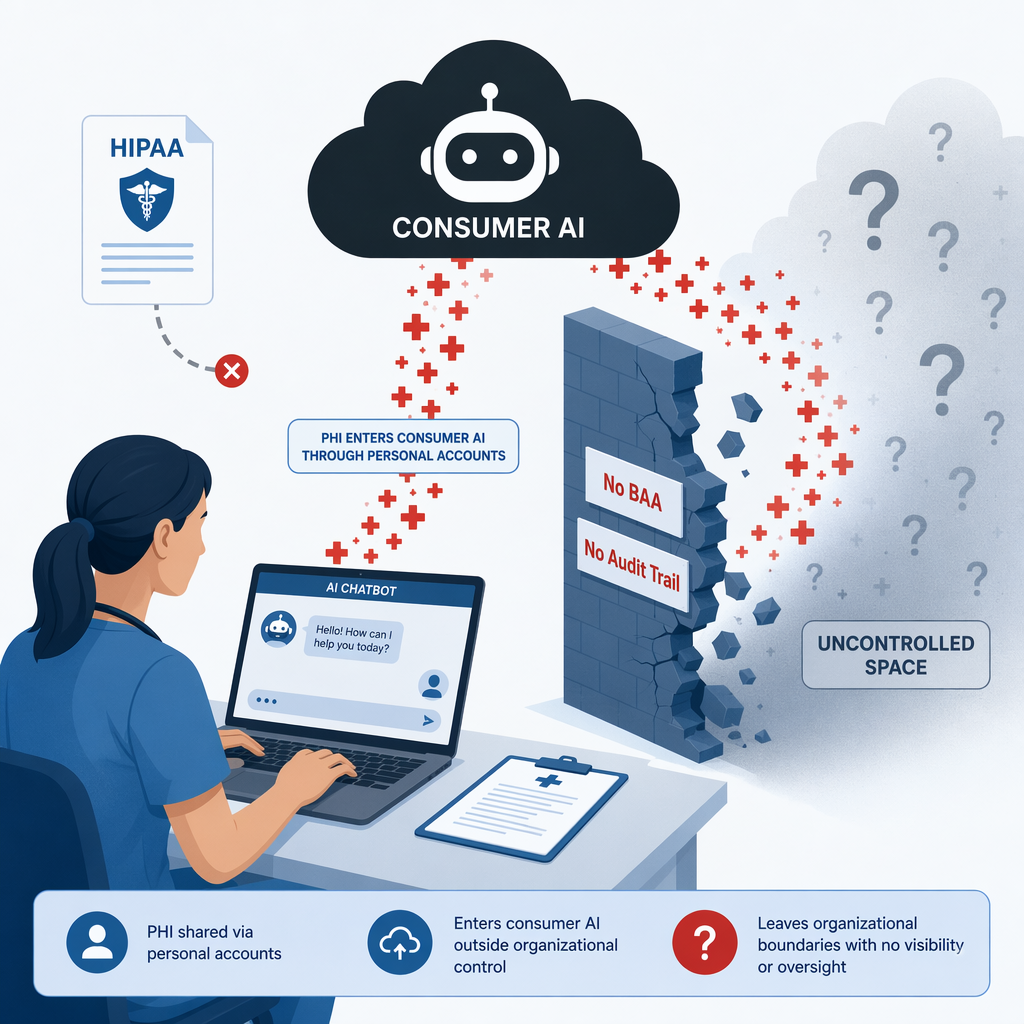
The practical problem is plain. Once PHI is entered into a personal consumer account, the organization may not know what was entered, whose record it came from, where it was stored, whether it was retained, whether it was used for model improvement, who can access it, or how to retrieve and account for it later. A vendor's public security page is not a substitute for a signed BAA, account-level controls, auditable access, retention terms, and a deployment path the organization can actually govern.
| Governed chatbot deployment | Consumer-account shadow AI use |
|---|---|
| Vendor is reviewed before use | Use may begin before privacy, legal, security, or IT know it exists |
| BAA and permitted uses can be negotiated | No BAA may exist between the organization and the AI developer |
| Access can be provisioned and removed | Access may sit in personal accounts outside workforce identity controls |
| Logs and retention can be required | Prompts and outputs may be unavailable to the organization |
| Training can be attached to a defined workflow | Staff may improvise across clinical, billing, education, and administrative tasks |
This is why the phrase "HIPAA-compliant chatbot" can mislead when it becomes the whole conversation. A compliant vendor deployment may reduce risk for one approved workflow while leaving the larger behavior unmeasured. The exposure is not solved because one door has a lock if staff are carrying data through another entrance entirely.
Ordinary workarounds are enough to create exposure
The riskiest prompts will not always look dramatic. Staff do not need to upload a full chart for a disclosure problem to exist. A paragraph can contain a diagnosis, date of service, age, medication, procedure, facility name, clinician name, insurance dispute, or rare fact pattern that identifies a patient when combined with context.
A hypothetical example is enough to show the pattern: a staff member asks a consumer chatbot to "make this discharge note easier for an anxious patient to understand" and pastes language that includes the patient's condition, treatment date, and medication instructions. The staff member may believe the task is low risk because the goal is patient education. The organization still has to ask where that text went, whether the AI provider was authorized to receive it, and whether the organization can produce any record of the disclosure.
Billing, coding, quality, and education teams can create the same problem without touching bedside care. An appeal letter, denial summary, incident review, training scenario, or patient complaint may carry identifiers or enough clinical detail to become PHI. De-identification is not a feeling; it is a standard that has to survive context.
This is where leadership language matters. Calling these workarounds "grassroots innovation" may be emotionally satisfying, but it can also launder unmanaged risk into a success story. Staff are often trying to keep up with work the organization has not made manageable. That deserves sympathy. It does not make the disclosure governable.
FTC cases are a warning about health-data misuse, not chatbot precedent
The strongest enforcement lesson available today does not come from a neat line of consumer chatbot HIPAA cases. The better lesson is broader: regulators have shown interest in health-data disclosures that organizations framed too casually or failed to control.
The legal analysis on AI chatbots and HIPAA compliance discusses FTC actions involving Flo Health, GoodRx, BetterHelp, and 1Health.io. The cited matters involved health apps and digital health services, not AI chatbots specifically. Flo Health involved alleged unauthorized sharing of health data with Facebook and Google and affected more than 100 million users; GoodRx involved prescription data used for advertising and a $1.5 million penalty; BetterHelp involved mental health data shared for advertising and a $7.8 million refund; and 1Health.io involved genetic data sharing without consent.[3]
Those cases should not be stretched into claims that the FTC has already created a chatbot-specific enforcement playbook. They do show that health-data handling outside traditional care settings can attract scrutiny, especially when disclosures, advertising uses, or consent practices do not match what users reasonably understood. For a hospital or health system, the relevant lesson is simpler: do not assume that data loses sensitivity because the receiving technology is new or because the use case feels operational.
The first governance job is discovery
The immediate response is not to convene another vendor beauty contest. The first response is to find out whether workforce members are already using consumer AI tools for work and where that use intersects with PHI.
Discovery has to be designed so staff will tell the truth. A punitive survey that reads like a trap will produce clean answers and dirty behavior. Ask what tasks people are trying to complete, which tools they have tried, whether they use personal or organizational accounts, and what kinds of information they paste or upload. Separate curiosity from misconduct where possible. The goal is not to bless unsafe use; it is to make hidden use visible enough to govern.
- Survey high-pressure departments first: clinical documentation, billing, coding, prior authorization, patient education, quality, compliance, and call centers.
- Ask about tasks before asking about brands; staff may remember what they did more clearly than which AI product handled it.
- Distinguish personal accounts from approved enterprise accounts, even when the tool name is the same.
- Look for uploads as well as pasted text, including spreadsheets, denial letters, draft notes, transcripts, images, and training materials.
- Document where staff believe de-identification is happening and test whether that belief is accurate.
IT signals can help, but they will not tell the whole story. Network logs may show visits to consumer AI domains from managed devices. Data loss prevention tools may flag some regulated-data movement. Browser controls may identify extensions or unsanctioned SaaS use. Mobile devices, home networks, personal laptops, and copied text can still evade easy measurement. Treat technical visibility as one layer, not the inventory itself.
Policy language must name the behavior, not just the technology
Many healthcare AI policies are written at the wrong altitude. They say the organization supports responsible AI or prohibits unauthorized disclosure of PHI. Both statements may be true and still fail the employee standing in front of a chatbot window with a paragraph of patient text copied to the clipboard.
Useful language is concrete. It tells workforce members that PHI, patient images, clinical notes, billing records, appeals, messages, transcripts, and identifiable case descriptions may not be entered into consumer AI tools or personal AI accounts unless the organization has approved that specific use, account type, and contractual arrangement. It explains that changing the patient's name is not automatically de-identification. It tells managers they may not ask staff to use personal AI accounts to complete work.
The policy should also make room for safe use. If staff can use an approved tool to draft generic patient education material from non-PHI source text, say so. If they can use an enterprise AI assistant with protected settings for certain administrative tasks, define the tasks. A policy that only says no will push the behavior back into private channels.
Blocking alone will not solve the problem, but doing nothing is not neutral
Healthcare organizations need a tiered access response. Some consumer AI destinations may need to be blocked on managed devices or networks, especially where the organization cannot control retention, training, logging, or account ownership. Other channels may be monitored or allowed only under enterprise configurations. The point is to align technical controls with the organization's actual risk decisions, not to pretend every AI URL carries the same profile.
Blocking has limits. Staff can switch to phones. They can use home devices. They can summarize instead of paste, which may reduce or may merely disguise the PHI problem. But technical controls still matter because they slow the easiest unsafe path, create teachable moments, and produce evidence about attempted use.
The more durable control is substitution. If leadership wants staff to stop using personal chatbots for work, it has to give them approved ways to complete the same work. That may mean an enterprise AI tool with disabled training on customer data, contractual privacy protections, administrative controls, logging, retention settings, role-based access, and clear use-case limits. It may also mean fixing the workflow that made the chatbot attractive in the first place.
Training should use the prompts people actually write
Annual privacy training rarely prepares staff for generative AI because the risky moment is small and ordinary. The user is not "selling data." The user is trying to make a sentence clearer, a denial appeal stronger, a message kinder, or a checklist faster.
Training should show concrete prompt examples and ask whether they contain PHI. It should include close calls: a rare condition with no name, a date of service with no medical record number, a patient quote, a photo with the face cropped out but a wristband visible, a payer appeal with claim details, a staff education scenario based on a recent incident. The objective is not to make every employee a HIPAA lawyer. It is to give them enough pattern recognition to stop before pasting.
Managers need separate instruction. They should not praise turnaround time if the work was completed through an unapproved consumer account. They should not forward patient-specific material to staff with a casual "run this through AI." They should know where to send a legitimate automation need so the organization can evaluate it without forcing staff into workarounds.
Approved AI still needs account-level controls
Buying an enterprise product is not the finish line. The same brand can have consumer, team, enterprise, API, and healthcare-specific configurations with different data-use terms and administrative controls. A workforce member using a personal paid account is not equivalent to a workforce member using an organization-provisioned account governed by contract and policy.
For any approved AI chatbot workflow that may involve PHI, privacy and security teams should be able to answer basic operational questions: Who owns the account? Who can create users? Can access be removed when employment ends? Are prompts and outputs logged? Who can review those logs? How long are they retained? Are customer prompts used for training or product improvement? Does the vendor sign a BAA for this exact service tier and use case? What happens to data after termination?
If the answer depends on an employee remembering to toggle a setting in a personal account, the control is too fragile for PHI.
Use governance frameworks without hiding behind them
Formal governance resources can help structure the work. Foley & Lardner's 2025 privacy-officer guidance points readers to the AMA's 8-step AI governance toolkit as a resource for healthcare AI governance.[4] A toolkit can help assign ownership, evaluate risks, document decisions, and bring clinical, legal, privacy, security, operational, and patient-safety voices into the same process.
The caution is that governance artifacts can become theater if they only cover approved projects. Shadow AI needs a standing intake path, a reporting channel that does not start with discipline, and a fast review process for common requests. If the review process takes months for a task that staff face every afternoon, personal accounts will keep winning.
A workable triage model starts with visibility, then separates use cases into categories the organization can act on: prohibited because PHI would leave control without a BAA; allowed only through an approved enterprise tool; allowed with non-PHI inputs; or escalated for formal review because the workflow is clinically or operationally significant. That is enough to begin. Perfect taxonomy can wait.
What to do in Q3 2026
A privacy officer does not need to resolve every AI governance question before reducing the immediate exposure. The near-term work is practical and specific.
- Run a focused shadow-AI discovery effort across high-pressure departments and ask about tasks, inputs, account types, and tools.
- Update policy language to prohibit PHI in consumer AI tools and personal AI accounts unless a specific approved workflow allows it.
- Create concrete training examples showing how discharge text, appeals, complaints, images, transcripts, and case summaries can contain PHI.
- Use technical controls to block, warn, or monitor high-risk consumer AI channels on managed devices and networks where appropriate.
- Offer approved alternatives for the tasks staff are already trying to complete, with account ownership, logging, retention, and vendor terms reviewed.
- Require that any AI workflow involving PHI have a documented owner, approved account type, BAA where required, access controls, auditability, and exit plan.
The hard part is cultural as much as technical. Staff need to believe that reporting an AI workaround will produce help, not only punishment. Leaders need to stop treating unapproved tool use as evidence of innovation when it is really evidence that the official workflow failed to meet the work.
In Q3 2026, a healthcare organization that has reviewed chatbot vendors but has not measured or governed staff use of consumer AI chatbots has likely secured the front door while leaving the side entrance unmonitored.
References
- 5 HIPAA violations caused by improper AI use, Paubox, 2026.
- AI in Healthcare Statistics 2026, Uvik.
- AI Chatbots and Challenges of HIPAA Compliance, Rezaeikhonakdar, 2023.
- HIPAA Compliance for AI in Digital Health: What Privacy Officers Need to Know, Foley & Lardner LLP, 2025.
Comments
Join the discussion with an anonymous comment.