
The 2025-2026 evidence on conversational AI for healthcare is no longer just a collection of demos. It includes multi-visit diagnostic-reasoning experiments, a prospective real-patient feasibility study, multicenter ambient documentation data, large deployment experience, and an umbrella review that asks a more uncomfortable question: across clinical domains, where do outcomes consistently improve?
The short answer is narrower than the adoption narrative. Ambient documentation and structured diagnostic reasoning now have credible early clinical evidence. Addiction support has the clearest uniformly positive review-level signal. Broad claims that general-purpose conversational agents improve healthcare outcomes remain ahead of the evidence.
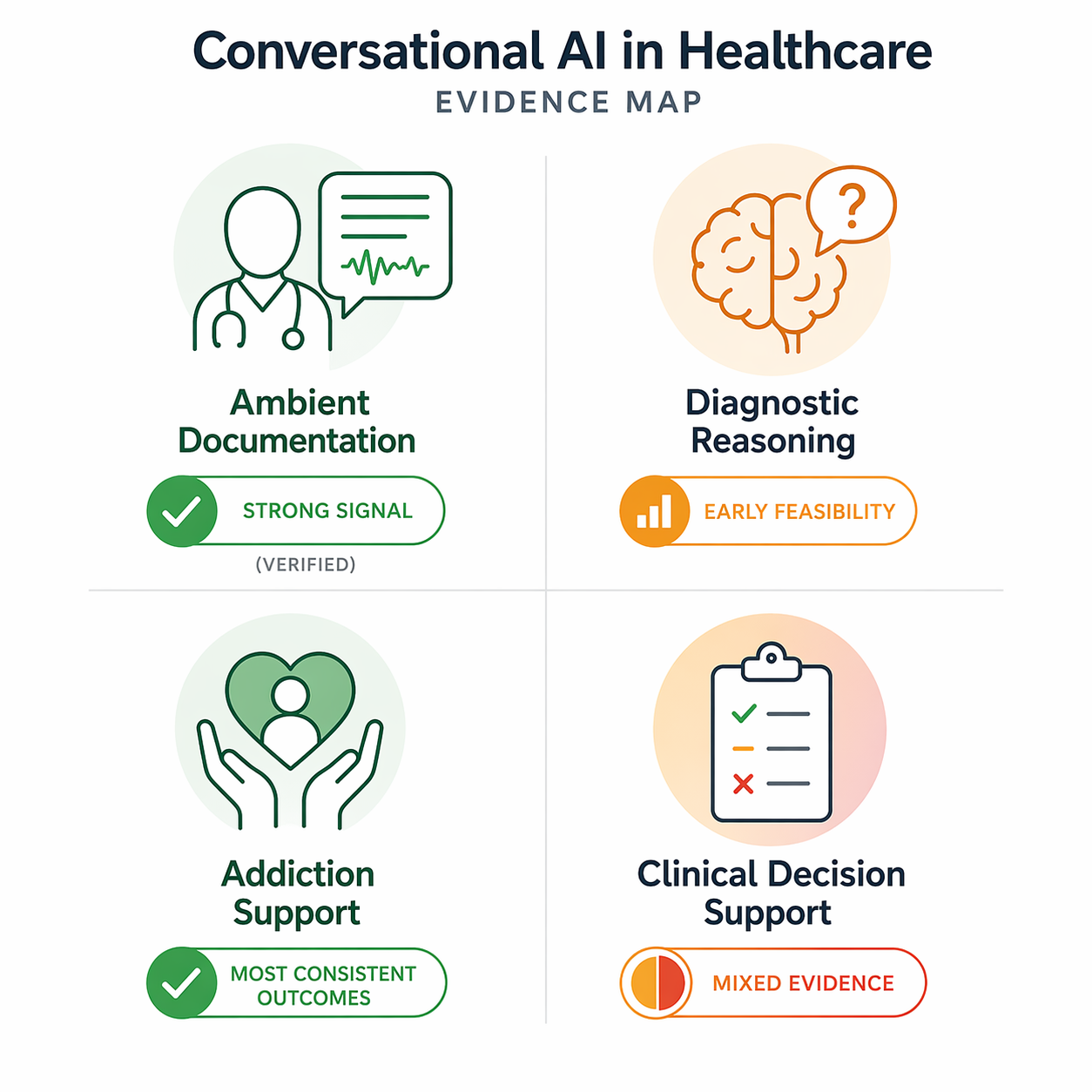
The Evidence Map Has Become More Specific
A useful reading of the field starts with study design and setting, not with the model interface. A chatbot that performs well in a controlled examination is not in the same evidentiary category as a tool used during a live clinic encounter. A reduction in after-hours charting is not the same endpoint as better diagnosis, safer prescribing, or improved patient outcomes.
| Use case | Best 2025-2026 signal | What the evidence supports | What it does not yet prove |
|---|---|---|---|
| Structured diagnostic reasoning | AMIE: 100 multi-visit OSCE cases with 21 primary care physicians; non-inferior management reasoning and superior guideline alignment [1] | A conversational diagnostic agent can perform structured management reasoning in a demanding simulated clinical format. | Autonomous diagnosis, real-world comparative effectiveness, or replacement of clinician judgment. |
| Real-patient diagnostic assistance | BIDMC prospective feasibility study: 100 real patients, zero safety stops, and final diagnoses included in the AI differential in 90% of cases [2] | Supervised use in a real clinical workflow can be feasible without triggering predefined safety stops in this study. | Generalizable safety, improved outcomes, or superiority over usual diagnostic work. |
| Ambient documentation | Yale multicenter study: 263 physicians across 6 health systems, 74% lower burnout odds after 30 days, with burnout falling from 51.9% to 38.8% [3] | Ambient AI scribes can plausibly reduce documentation burden and clinician burnout measures over short follow-up. | That saved time automatically becomes better patient care or durable workload relief. |
| Large-scale ambient deployment | Cleveland Clinic: more than 4,000 providers, 1 million encounters, and about 2 minutes saved per appointment, or 14 minutes per physician per day [4] | Ambient documentation can operate at large health-system scale and produce measurable workflow savings. | Independent proof of patient-outcome improvement or net benefit after review, correction, and signing work. |
| Cross-domain conversational AI | Umbrella review of 44 reviews: clinical decision support and mental health were most studied; only addiction support showed uniformly positive outcomes [5] | The strongest review-level consistency is domain-specific, not general. | A blanket conclusion that conversational AI improves healthcare across specialties and tasks. |
That table is the practical inflection point. The question is no longer whether conversational AI can produce clinically plausible language. It can. The question is whether a given system has evidence for a defined task, in a defined setting, with a clear person responsible for checking and acting on the output.
AMIE Shows Strong Simulated Reasoning, With the Simulation Still Attached
The AMIE result deserves attention because it tests more than a one-turn medical question. In the Nature study published in June 2026, AMIE was evaluated across 100 multi-visit objective structured clinical examination scenarios and compared with 21 primary care physicians. The system showed non-inferior management reasoning and superior guideline alignment in that setting [1].
That is a meaningful step beyond many earlier chatbot evaluations. Multi-visit OSCEs require continuity of reasoning: what to ask next, how to revise a plan, when to escalate, and how to align management with guidelines. Those are closer to outpatient cognitive work than a single-board-style answer. A clinician reading the study should not have to pretend that this is trivial.
But the boundary matters just as much as the signal. An OSCE is not a clinic session with an overbooked schedule, an incomplete medication list, a worried family member, a prior authorization problem, and a lab result arriving after the visit. The study supports structured reasoning capability under controlled conditions. It does not establish autonomous use in primary care, and it does not show that clinicians can safely hand off diagnostic responsibility to the model.
The sponsor context should also travel with the result. AMIE comes from Google DeepMind and Google Research. That does not invalidate the work, and it should not be used as a substitute for reading the methods. It does mean the result belongs in the category of serious, sponsor-connected evidence that still needs independent replication, workflow testing, and outcome evaluation.
The BIDMC Study Moves the Question Into Real Encounters
The Beth Israel Deaconess Medical Center feasibility study is interesting for a different reason: it involved real patients. In a prospective study of 100 patients, the AI system had zero safety stops, and the final chart-review diagnosis appeared in the AI differential diagnosis in 90% of cases [2].
A safety stop is not a patient outcome, and absence of safety stops is not proof of safety in the broader sense. Still, in outpatient implementation work, it is an important operational signal. It suggests that the tool could participate in a bounded workflow without immediately forcing repeated clinician interruption for unsafe behavior, at least in this study population and setting.
The 90% figure also needs careful wording. The finding was not that the AI definitively diagnosed 90% of patients in a way that should be treated as final. It was that the final diagnosis was included in the AI-generated differential. That is closer to diagnostic support than diagnostic resolution. For a clinician, the useful question is whether the differential catches possibilities worth considering, not whether it can sign the assessment and plan.
Because the study was single-center feasibility work rather than a controlled comparative effectiveness trial, it cannot answer whether the AI improved diagnostic accuracy, reduced time to diagnosis, changed testing behavior, or prevented harm. It does, however, move the evidence from polished simulated interaction toward the messier threshold that matters: a real clinical encounter in which the AI output has to survive supervision.
Ambient Documentation Has the Clearest Workflow Case
Ambient documentation is where conversational AI has its most adoption-ready clinical workflow evidence. The task boundary is narrower than diagnosis: listen to the encounter, draft documentation, and leave a clinician responsible for review, correction, and signature. That supervision chain is one reason the use case has moved faster than broader conversational agents.
In the Yale multicenter study, 263 physicians across 6 health systems used an ambient AI scribe. After 30 days, the study reported 74% lower odds of burnout, with burnout decreasing from 51.9% to 38.8% [3]. Those are not small signals, especially in clinics where pajama-time documentation has become a predictable extension of the workday.
The Cleveland Clinic deployment adds scale. Across more than 4,000 providers and 1 million encounters, the health system reported about 2 minutes saved per appointment and 14 minutes saved per physician per day [4]. For a full clinic schedule, those minutes can determine whether a note is finished before the next patient or after dinner.
The temptation is to translate saved minutes directly into better care. That is too fast. A draft note can save time and still require careful correction. A physician can feel less burned out and still carry responsibility for a misleading phrase, an omitted negative, or a billing-relevant error. The evidence supports operational plausibility and short-term burden reduction; it does not yet settle downstream effects on diagnostic quality, patient understanding, coding accuracy, or medicolegal risk.
That distinction should not be read as pessimism. Ambient documentation has a coherent clinical role because it leaves the clinician in the loop at a natural review point. The implementation question is not whether the AI can write a note. It is whether the generated note reduces total work after the physician checks it, whether errors are visible enough to catch, and whether the system behaves consistently across visit types, accents, interruptions, sensitive histories, and specialty workflows.
The Umbrella Review Keeps the Field Honest
Individual studies can make the field look more mature than it is. The systematic umbrella review of 44 reviews is useful because it looks across bodies of evidence rather than celebrating a single result. It found that clinical decision support and mental health were the most studied areas, but only addiction support showed uniformly positive outcomes across reviews [5].
That finding should reset the confidence level for broad claims. It does not mean conversational AI fails in other domains. It means the review-level evidence is not uniformly positive outside addiction support. Mental health and clinical decision support may contain promising studies, but promise is not the same as consistent outcome evidence across reviews.
Addiction support is also a reminder that conversational AI is not one intervention. A tool that supports cravings, check-ins, adherence, or coaching between visits is different from a diagnostic assistant, an ambient scribe, or a medication-management agent. The interface may look similar, but the clinical risk, endpoint, and accountability chain differ.
What the Evidence Does Not License
The 2025-2026 evidence supports cautious movement in defined use cases. It does not support treating conversational AI as a general clinical actor. The distinction is practical, not semantic. In a clinic, someone has to decide whether to trust the answer, correct the note, explain the recommendation, and bear the consequences if the output is wrong.
- Feasibility is not effectiveness: a tool can fit into a workflow without improving patient outcomes.
- Diagnostic inclusion is not diagnostic authority: placing the final diagnosis in a differential does not establish that the model should decide the diagnosis.
- Reduced documentation burden is not automatically better care: the endpoint may be clinician time, not patient safety or disease control.
- Positive evidence in one domain does not transfer cleanly to another: addiction support, primary care reasoning, and note generation have different risk profiles.
- Sponsor-connected studies can be important and still need independent replication.
Some gaps remain especially hard to generalize across. The available evidence does not support confident claims about lifestyle promotion, pediatrics, or most specialty-specific applications. Those areas may eventually produce strong evidence, but they should not borrow certainty from AMIE, BIDMC, Yale, Cleveland Clinic, or addiction-support reviews.
Regulation Is Still Narrow
The regulatory picture matches the clinical evidence more closely than the marketing language does. As of this evidence window, the FDA had cleared one LLM-enabled conversational AI agent, UpDoc, in December 2025, and only for insulin management in type 2 diabetes [6]. That is a narrow indication, not a regulatory endorsement of general clinical autonomy.
For health systems, that narrowness matters. A cleared agent for a specific medication-management task cannot be treated as permission to deploy a general-purpose assistant across triage, diagnosis, counseling, documentation, and prescribing. Each task changes the risk surface. Each task needs its own evidence and oversight plan.
Adoption Decisions Should Follow the Task Boundary
For clinicians and health IT teams, the strongest adoption case is not for conversational AI in the abstract. It is for specific tools in specific roles where the evidence, supervision model, and failure mode are visible.
| If the proposed use is... | The adoption posture should be... |
|---|---|
| Ambient documentation | Reasonable for cautious, monitored pilots if note review burden, error types, clinician time, patient consent, and specialty fit are measured. |
| Structured diagnostic reasoning support | Reasonable for research or tightly supervised pilots, especially where outputs are treated as differentials or reasoning prompts rather than decisions. |
| Addiction support | The most evidence-consistent patient-facing domain, though individual products still need evaluation against their own endpoints and populations. |
| General-purpose clinical chatbot | Not justified as a broad clinical solution without task-specific evidence, transparent oversight, escalation rules, and accountability for output review. |
| Autonomous clinical management | Not supported by the cited 2025-2026 evidence except within narrow cleared indications and defined clinical constraints. |
The inflection point is real. Conversational AI has crossed from plausible demonstration into early clinical evidence in documentation and structured reasoning, and addiction support has the most consistent review-level outcome signal. The same evidence also draws the line: broad clinical benefit remains uneven, and the responsible unit of adoption is still the bounded task, not the conversational interface.
References
- AMIE's Nature June 2026 OSCE study, Nature, June 2026, link
- BIDMC prospective feasibility study, Google Research Blog, link
- Yale ambient AI scribe study, Yale Medicine news, link
- Cleveland Clinic ambient AI deployment, Cleveland Clinic Consult QD, link
- Systematic umbrella review of 44 reviews, International Journal of Medical Informatics, link
- FDA clearance of UpDoc for insulin management in type 2 diabetes, FDA, December 2025, link
Comments
Join the discussion with an anonymous comment.