
CoreWeave is a serious candidate for healthcare AI cloud infrastructure workloads when the work is GPU-hungry, research-led, and owned by a team that can run close to the metal. It is less comfortable as the default answer for regulated clinical production, where the deciding evidence is often not benchmark performance but the paperwork and operating model behind HIPAA, residency, support, and incident response.
That distinction matters because healthcare AI demand is no longer theoretical. NVIDIA’s 2026 healthcare survey reported that 70% of healthcare and life sciences respondents were actively using AI, 69% were using generative AI, and 85% reported revenue increases associated with AI initiatives.[1] Once AI programs move from pilots into repeated training runs, evaluation jobs, synthetic data workflows, and inference services, GPU capacity becomes a procurement question rather than an engineering preference.

The practical answer is not “CoreWeave or hyperscaler.” It is workload first. CoreWeave is plausible for research training, model development, and batch GPU jobs where scarce NVIDIA hardware, cluster density, and price structure dominate the decision. AWS, Azure, and GCP remain safer defaults when the deployment has to satisfy mature HIPAA documentation expectations, broad geographic residency choices, integrated managed AI services, and established enterprise procurement routes. For a wider comparison of those hyperscaler paths, see AWS, Azure, and GCP for Healthcare AI Infrastructure Compared.
Where CoreWeave Is Genuinely Hard To Ignore
CoreWeave’s strongest argument is infrastructure specialization. The company says its AI data center platform spans 49 data centers, a fleet of more than 250,000 GPUs, and a $30.1 billion backlog.[2] For healthcare AI teams waiting on H100, H200, or Blackwell capacity, those are not vanity metrics. They speak directly to queue time, cluster availability, and the ability to plan large training or fine-tuning runs without treating every reservation as a one-off emergency.
The architecture is also aimed at teams that care about multi-node training, not just access to a single accelerator. CoreWeave describes Blackwell-scale infrastructure with up to 110,000 Blackwell GPUs per cluster connected through NVIDIA Quantum-2 InfiniBand.[2] For foundation-model work, medical imaging model development, clinical note model training, or retrieval-heavy experimentation, the network fabric matters because GPU count alone does not guarantee useful throughput.
Cost comparisons are less clean than marketing tables suggest, but the cited spread is meaningful enough to examine. Neysa’s 2026 comparison lists CoreWeave HGX H100 8-GPU node pricing at $6.16 per GPU-hour versus AWS at $6.88 per GPU-hour for the compared configuration.[3] It also distinguishes CoreWeave’s reserved model from the on-demand and spot patterns common on hyperscalers.[3] That difference changes the buying question: a lower per-GPU rate helps most when the team can keep the hardware busy and can tolerate commitment terms.
| Decision variable | CoreWeave signal | Procurement implication |
|---|---|---|
| GPU capacity | 49 data centers and 250K+ GPU fleet reported by CoreWeave | Attractive when internal teams are blocked by scarce accelerator supply |
| Cluster architecture | Large Blackwell clusters using NVIDIA Quantum-2 InfiniBand | Relevant for distributed training and heavy experimentation, not just small inference jobs |
| H100 pricing example | $6.16/hr per GPU in Neysa’s compared HGX H100 configuration versus $6.88/hr for AWS | Worth modeling against utilization, commitment length, data movement, and support costs |
| Operating model | Kubernetes-native specialist cloud | Strong fit for platform teams with K8s depth; friction for teams expecting managed AI abstractions |
The pricing point should not be stretched into a universal claim that CoreWeave is always cheaper. The research materials note that H100 rates vary by configuration, including lower figures for H100 PCIe single-card scenarios and higher rates for HGX H100 8-GPU nodes. Enterprise discounts, reserved capacity, spot interruptions, storage, egress, observability, support, and idle time can erase a simple hourly advantage. Still, if a healthcare AI research group knows it will run sustained training jobs and already has the engineering discipline to schedule GPUs efficiently, CoreWeave’s model deserves a real slot in the evaluation.
This is where a specialist cloud can beat a hyperscaler in practice. A hyperscaler may offer a broader platform, a larger compliance library, and better enterprise familiarity, while still making a research team wait for the exact GPU shape it needs. CoreWeave’s value is concentrated where the bottleneck is raw accelerator access and high-performance cluster design.
The Kubernetes-Native Model Helps Some Teams And Filters Out Others
CoreWeave’s Kubernetes-native posture is not a minor implementation detail. It determines who can use the platform well. A team that already runs model training through containers, Helm charts, job queues, GPU scheduling policies, and infrastructure-as-code can treat CoreWeave as a high-performance substrate. A team that depends on SageMaker, Bedrock, Vertex AI, Azure AI Studio, or similar managed workflows may see the same feature as operational drag.
That distinction often maps to where the workload sits in the healthcare AI lifecycle. Research groups, computational pathology teams, and AI labs frequently want flexible clusters more than prepackaged ML services. Enterprise clinical IT groups often want identity integration, audit trails, managed deployment patterns, security documentation, model monitoring, and vendor support pathways that their procurement and compliance teams already recognize.
OneSource Cloud’s enterprise evaluation points to the same divide: CoreWeave can be compelling for committed GPU workloads, but its support models, reserved contract terms, and geographic constraints require closer enterprise review than a simple hourly price comparison captures.[4] In healthcare, that review usually lands on the desk of someone who needs to know not only whether the model trains, but who is accountable when data handling, incident response, or service obligations are questioned.
Research Training And Production Inference Are Different Purchases
A training environment can often be isolated, time-bounded, and restricted to de-identified or tightly governed datasets. The controls still matter, but the operational consequences differ from a production inference service embedded in clinical documentation, triage, revenue cycle workflows, or care delivery. Production brings uptime expectations, change control, model rollback, auditability, clinical workflow dependencies, regional routing, and a much larger surface area for compliance review.
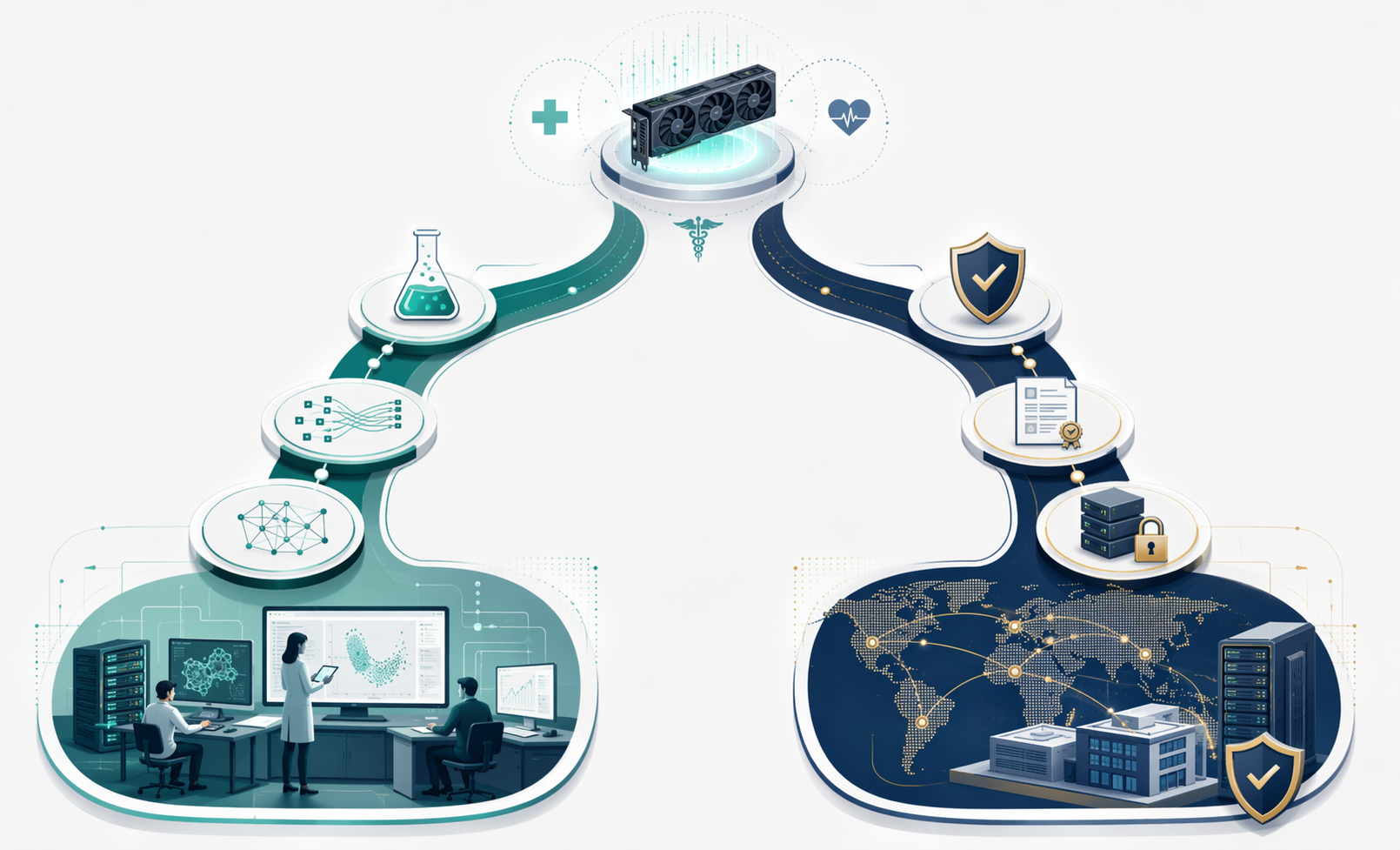
For research-heavy training, the CoreWeave case is straightforward: secure scarce NVIDIA capacity, run large jobs efficiently, and avoid paying hyperscaler premiums when the organization does not need the full managed-service stack. For regulated inference, the comparison flips. The GPU may be only one line item in a design dominated by identity, logging, PHI handling, data residency, incident management, vendor attestations, and the business associate agreement process.
| Workload | CoreWeave fit | Why the answer changes |
|---|---|---|
| Foundation-model training or fine-tuning in a research environment | Strong candidate | GPU availability, cluster density, and sustained utilization can dominate the decision |
| Batch experimentation with governed or de-identified data | Often plausible | Compliance diligence still applies, but operational blast radius may be narrower |
| Clinical inference involving PHI across multiple regions | Requires deeper proof | HIPAA documentation, residency, auditability, and support obligations become central |
| Enterprise AI platform standardization | Usually harder | Hyperscalers offer broader managed services and familiar procurement paths |
This is not a theoretical distinction. It is how healthcare cloud reviews actually proceed. The infrastructure team may arrive with a compelling GPU utilization model. The security and compliance reviewers will ask for a BAA path, encryption controls, isolation details, audit evidence, breach notification process, subprocessors, data location guarantees, and support commitments. If those answers are not documented in a form the organization can approve, a faster cluster does not close the procurement file.
Compliance Evidence Is The Harder Part Of The CoreWeave Case
CoreWeave’s public security materials include important controls. The company describes SOC 2 and ISO 27001, single-tenant node isolation, encryption at rest and in transit, and other platform security practices.[5] Those are meaningful signals. They show that CoreWeave is not approaching enterprise AI infrastructure as an unmanaged GPU rental business.
They do not, by themselves, answer the healthcare procurement question. HIPAA review is not satisfied by a general security page. A covered entity or business associate needs to understand whether the vendor will sign a BAA, which services are in scope, what shared-responsibility assumptions apply, how audit evidence is provided, where PHI may be processed, and how incidents are handled. Corvex AI’s HIPAA-focused GPU cloud analysis treats CoreWeave’s SOC 2 and ISO 27001 posture as HIPAA-relevant, but also notes the lack of public BAA detail.[6]
That is the narrow conclusion the public record supports: CoreWeave has enterprise security evidence that may support a HIPAA diligence process, but it does not publicly provide the same kind of HIPAA-specific documentation trail that many healthcare buyers are accustomed to seeing from hyperscalers. The absence of public documentation does not prove CoreWeave cannot support a compliant arrangement. It means a healthcare buyer cannot responsibly infer production HIPAA readiness from SOC 2, ISO 27001, or customer logos alone.
This is the point at which many vendor comparisons become too tidy. A GPU cloud can have strong isolation and encryption controls while still requiring a difficult contract and architecture review for PHI workloads. Conversely, a hyperscaler can be more expensive or less convenient for a specific GPU shape while still being easier to approve because the compliance documentation, service scopes, and enterprise legal pathways are already familiar.
Geography And Residency Narrow The Deployment Map
CoreWeave’s footprint is substantial, but it is not the same kind of global cloud map offered by AWS, Azure, or GCP. The research materials describe CoreWeave as operating in the United States and Europe, with 49 facilities concentrated regionally.[2][4] For a US-based research workload or a Europe-compatible training environment, that may be enough. For a multinational provider, pharma company, payer, or digital health vendor with strict local residency requirements, it may not be.
Residency is not just a checkbox for where the VM is launched. Healthcare deployments may need to account for backups, logs, support access, telemetry, disaster recovery, key management, and subcontractor access. Hyperscalers have spent years packaging these questions into region catalogs, compliance programs, and enterprise controls. CoreWeave may be able to answer many of them in direct diligence, but the public materials do not make the answer as self-service as a conservative procurement team would prefer.
Healthcare Traction Is Real, But The Public Signals Are Limited
CoreWeave does have healthcare and life sciences signals worth taking seriously. On its Q2 2025 earnings call, CEO Michael Intrator cited “significant growth from healthcare and life science verticals” and named Hippocratic AI as a healthcare partner.[7] That matters because it indicates demand from healthcare-adjacent AI companies, not only generic frontier-model labs.
Abridge is another useful signal, but it should be handled carefully. CoreWeave’s trust page lists Abridge among customers, and Abridge separately announced work with NVIDIA to train clinical conversation foundation models on Blackwell infrastructure using NVIDIA NIM microservices.[5][8] Those public materials support healthcare AI adjacency and infrastructure relevance. They do not disclose the full contract architecture, whether PHI was processed on CoreWeave, what compliance terms applied, or whether the deployment represented regulated production rather than model development.
That caveat is not nitpicking. In healthcare infrastructure selection, named customers can show market acceptance, but they do not substitute for a buyer’s own BAA, data-flow diagram, threat model, residency review, and support agreement. For ambient documentation and clinical conversation AI specifically, the business case and workflow pressure are real; the infrastructure approval still depends on the exact data path. For more context on that use case, see Conversational AI in Healthcare: The ROI Evidence Executives Need to See.
How To Make The Vendor Choice
A healthcare organization should start the CoreWeave evaluation by classifying the workload, not by asking for a generic GPU cloud recommendation. If the job is model training, fine-tuning, simulation, or batch experimentation, CoreWeave’s accelerator supply, Blackwell access, InfiniBand-oriented cluster design, and price structure may outweigh the extra diligence. If the job is production inference with PHI, clinical workflow dependency, or multi-region residency requirements, the burden shifts toward documentation and operational assurances.
| Choose CoreWeave when | Favor AWS, Azure, or GCP when |
|---|---|
| The workload is GPU-intensive training or early model development | The workload is regulated production inference involving PHI |
| The team can operate Kubernetes-native infrastructure confidently | The team relies on managed AI services and integrated MLOps platforms |
| US or Europe deployment locations satisfy the data strategy | Global or country-specific residency options are mandatory |
| Reserved GPU capacity and high utilization are realistic | Demand is bursty, uncertain, or better suited to established on-demand cloud patterns |
| The organization can run direct HIPAA and contract diligence without relying on public documentation | Procurement requires mature public HIPAA documentation, standard BAA pathways, and familiar enterprise controls |
The procurement questions should be concrete. Which GPU type and node configuration is being priced? Is the quoted rate tied to a reserved commitment? What utilization level is assumed? Which datasets will enter the environment, and are they PHI, de-identified, synthetic, or public? Will CoreWeave sign the required BAA for the specific services in scope? Where will compute, storage, logs, backups, and support access occur? Who operates Kubernetes, patches dependencies, monitors jobs, and responds to incidents?
If those questions are answered cleanly, CoreWeave can be a strong infrastructure choice for GPU-intensive, research-oriented, US/Europe-compatible, Kubernetes-friendly workloads before the regulated production boundary. Crossing that boundary may still be possible, but if the answers depend on assumptions, customer-logo inference, or general security attestations being treated as HIPAA proof, the safer default is usually AWS, Azure, or GCP. That is not because hyperscalers are always technically better. It is because regulated healthcare production rewards documented operating maturity as much as raw compute.
References
- State of AI in Healthcare 2026, NVIDIA Blog
- AI Data Centers, CoreWeave
- AWS vs CoreWeave: AI Cloud Comparison (2026), Neysa
- CoreWeave Enterprise Evaluation, OneSource Cloud
- Security, CoreWeave
- Top HIPAA-Compliant Cloud GPUs for Secure AI Training, Corvex AI
- CoreWeave Q2 2025 Earnings Call, CoreWeave Investor Relations
- Abridge Collaborates with NVIDIA to Advance Clinical Conversation AI, Abridge
Comments
Join the discussion with an anonymous comment.