
In July 2026, a patient with watery diarrhea that has lasted beyond the usual viral window should not move through the standard “stomach bug” pathway without a pause. CDC’s July 14 Health Alert Network notice reported 1,645 laboratory-confirmed domestic cyclosporiasis cases across 34 states, 141 hospitalizations, a median age of 44 years, and an age range from 2 to 95 years; more than 5,100 additional cases were under investigation at the time.[1] That is the clinical problem now: the outbreak is large, but the default stool-testing route can still miss the diagnosis.
The useful move is not to make Cyclospora sound rare or exotic. It is to recognize when the patient in front of you has moved out of the ordinary viral gastroenteritis lane and into a testing-and-treatment pathway that has to name Cyclospora specifically.

When the symptom pattern should change the order set
Cyclospora cayetanensis typically causes watery diarrhea, and the incubation period is usually about a week; CDC lists a median incubation period of 7 days, with a range of 1 to 14 days.[2] The pattern that should alter management is acute or prolonged watery diarrhea lasting at least 5 to 7 days, especially when symptoms remit and then relapse during the May-through-August season.
Other symptoms can help, but they should not distract from the stool pattern. CDC’s symptom list includes loss of appetite, weight loss, stomach cramps or pain, bloating, increased gas, nausea, fatigue, and low-grade fever.[3] Vomiting may occur, but it is not the feature that usually makes the diagnosis. The patient who keeps returning because diarrhea improves and then comes back is the one who gets missed when the first stool study is treated as definitive.
| Clinical clue | How it should affect management |
|---|---|
| Watery diarrhea lasting 5–7 days or longer | Add Cyclospora to the differential rather than stopping at viral gastroenteritis. |
| Remitting-relapsing course | Do not let a temporary improvement reassure you if diarrhea returns. |
| May–August onset | Seasonality strengthens suspicion during the current outbreak. |
| Incubation around 1 week after possible exposure | Ask about produce and prepared fresh-food exposures without waiting for a known traceback. |
| Negative routine stool testing | Check whether Cyclospora-specific testing was actually ordered. |
Exposure history still matters, but it should not become the spine of the workup. CDC and public reporting identified Taylor Farms de Mexico shredded lettuce and vegetable mixes supplied to Taco Bell as linked to one cluster announced in mid-July 2026, but that finding does not explain every case in a multi-cluster outbreak.[1] A compatible exposure can raise suspicion; the absence of a known exposure should not end it.
The workflow: suspect it, order the right test, repeat when needed, treat when the picture is strong
A practical cyclosporiasis workflow during this outbreak is short enough to use in clinic and specific enough to prevent the common miss.
- Suspect Cyclospora in watery diarrhea lasting 5–7 days or longer, especially with relapse, summer onset, or compatible fresh-produce exposure.
- Order Cyclospora-specific testing rather than relying on a routine ova-and-parasite exam.
- Use modified acid-fast staining, UV autofluorescence, or PCR-based testing when available.
- Collect additional stool specimens if the first test is negative and clinical suspicion remains.
- Start empiric TMP-SMX in adults when suspicion is strong, without waiting for confirmation if the patient is clinically compatible.
That sequence matters because the failure is often baked into the order set. A patient can have the right syndrome and still receive the wrong diagnostic workup.
Routine O&P is the wrong reassurance
Cyclospora oocysts are not reliably detected by routine ova-and-parasite examination. Mathison and Pritt’s review describes the need for specific diagnostic approaches, including modified acid-fast staining, UV fluorescence, and molecular methods; they also note that oocyst shedding can be intermittent, so multiple specimens may be required.[4] A negative routine O&P result is therefore not the same as a negative Cyclospora evaluation.
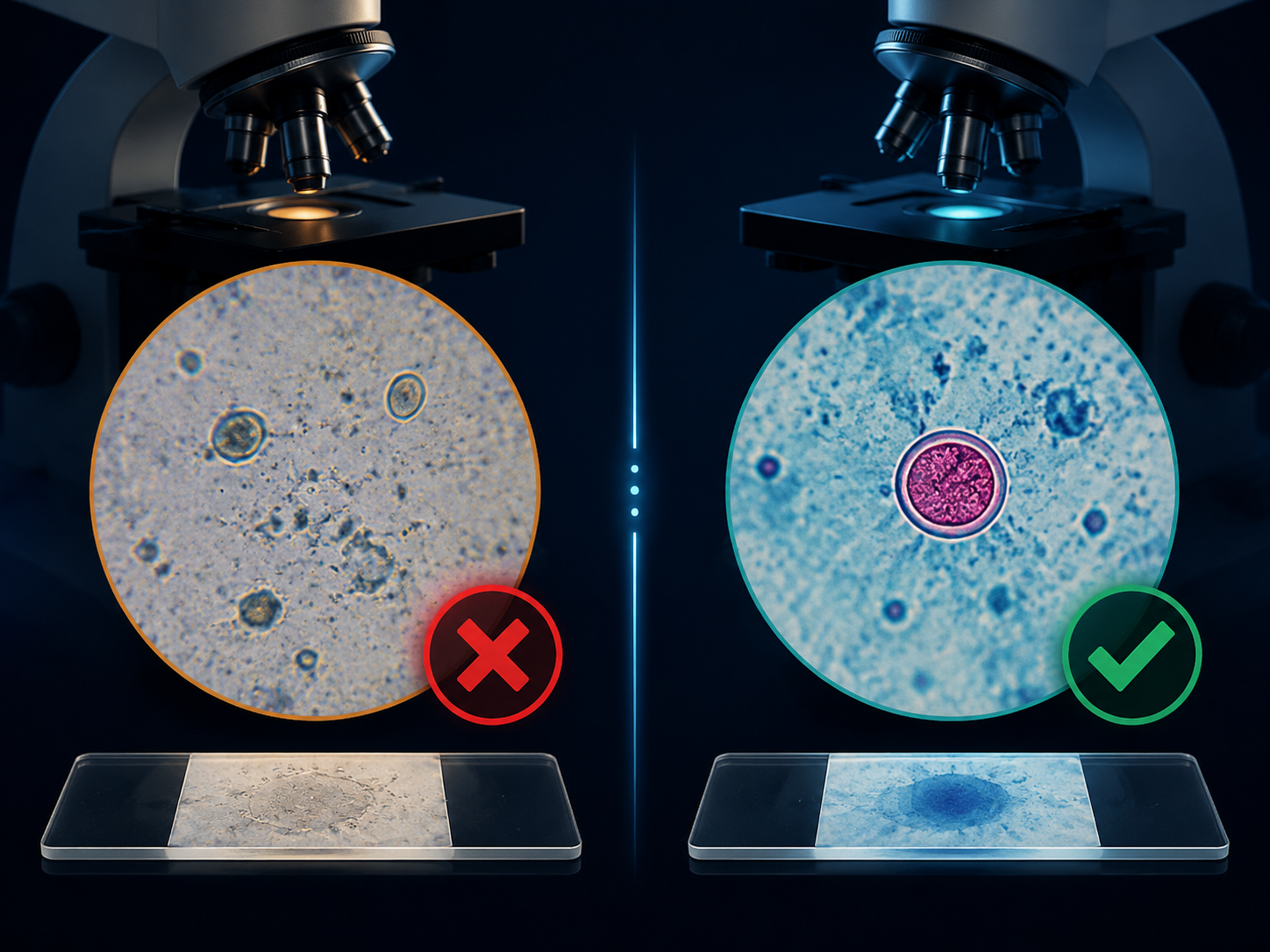
The stool order has to say what you mean. If the local laboratory requires a separate request for Cyclospora, write it. If the electronic order set hides Cyclospora behind a parasite panel, verify that the ordered test includes it. If the patient already had “O&P negative” in the chart, read the lab method before closing the case.
| Testing option | Clinical use during the outbreak |
|---|---|
| Modified acid-fast staining | Appropriate when specifically requested and performed by a laboratory familiar with Cyclospora detection. |
| UV autofluorescence | Useful because Cyclospora oocysts autofluoresce under ultraviolet microscopy. |
| PCR-based testing | Appropriate where available; confirm the panel includes Cyclospora. |
| BioFire FilmArray GI Panel | FDA-cleared multiplex NAAT option for Cyclospora detection. |
| Routine O&P alone | Insufficient reassurance unless Cyclospora-specific methods were included. |
The repeat-specimen point is not academic. If shedding is intermittent, a single negative specimen can become a false stopping point. For a patient with a convincing syndrome, especially during a record-scale outbreak, the better next step is to repeat stool testing with Cyclospora-specific methods rather than sending the patient home with another nonspecific explanation.
When to treat before confirmation
CDC clinical care guidance identifies trimethoprim-sulfamethoxazole as the treatment of choice for cyclosporiasis. For adults, CDC lists one double-strength tablet, containing TMP 160 mg plus SMX 800 mg, taken orally twice daily for 7 to 10 days.[5] During this outbreak, when the presentation and season fit, empiric treatment is reasonable before confirmation rather than waiting for a delayed or incorrectly configured test to catch up.
The evidence base is not outbreak-specific, and it should not be sold as if it were. The landmark placebo-controlled Nepal trial from 1995 found a cure-rate signal greater than 90% for TMP-SMX in cyclosporiasis, and later reviews continue to treat TMP-SMX as the best-supported therapy.[4] That supports prompt treatment when the clinical picture is strong, while still leaving room for confirmatory testing, public health reporting, and reconsideration if symptoms fail to respond.
| Patient situation | Treatment implication |
|---|---|
| Immunocompetent adult with compatible illness | TMP-SMX DS 160/800 mg orally twice daily for 7–10 days per CDC guidance. |
| Strong suspicion with testing pending | Do not delay empiric TMP-SMX solely because confirmation has not returned. |
| Persistent symptoms after treatment | Reassess adherence, diagnosis, immune status, and whether repeat or alternative testing is needed. |
| Need for public health confirmation | Send appropriate testing even if empiric treatment has already started. |
Without treatment, symptoms can last from days to more than a month and may relapse.[2] In a working adult, that can mean repeated visits, missed work, dehydration risk, and a chart that accumulates negative nonspecific studies. In an older adult, infant, or immunocompromised patient, the threshold for taking persistent watery diarrhea seriously should be lower, not higher.
Sulfa allergy and patients at higher risk
Sulfa allergy is where the tidy pathway becomes less tidy. CDC notes that no highly effective alternative antibiotic regimen has been identified for patients unable to take TMP-SMX; ciprofloxacin has been studied but is less effective and is not considered a reliable substitute.[5] For a patient with a true severe sulfonamide reaction, this is a situation for careful risk assessment, supportive care, and infectious disease input rather than a casual swap.
Immunocompromised patients may need closer monitoring and, in some cases, longer or repeated treatment courses; CDC’s clinical care page distinguishes management considerations for people with HIV and other immunocompromising conditions.[5] Infants, elderly patients, and anyone with severe dehydration, inability to maintain oral intake, or concerning comorbid illness should not be managed as if this were only a nuisance diarrheal illness.
Why confirmed counts lag what clinicians are seeing
The CDC-confirmed national number is the baseline to cite, but it is not the same as the true burden. CIDRAP’s analysis of the 2026 outbreak emphasized uncertainty around confirmed versus probable counts, including discrepancies in Michigan counts and the reality that many cases remain under investigation.[6] That uncertainty should make clinicians more attentive to the syndrome, not more passive while waiting for a perfect traceback.
Traceback information can narrow exposure questions, and it matters for public health. At the bedside, though, the patient does not need to match a named restaurant cluster to deserve the right stool test. Multiple clusters were under investigation, and some food sources had not been identified.[1]
The chart review that prevents the miss
For a patient returning with persistent watery diarrhea in this outbreak window, the fastest useful chart review is not long. Look for illness duration, relapse pattern, season, dehydration risk, immune status, and whether the stool test actually included Cyclospora. If the record only says “stool studies negative,” that is not enough.
- If symptoms are under 48 hours and improving, routine supportive care may still fit.
- If watery diarrhea has lasted 5–7 days or more, add Cyclospora-specific testing.
- If the course is remitting and relapsing, do not accept one nonspecific negative test as closure.
- If suspicion is strong, start TMP-SMX while appropriate testing and reporting proceed.
- If the patient cannot take TMP-SMX or is immunocompromised, escalate sooner.
The preventable delay in this outbreak is a workflow failure. The fix is specific: suspect Cyclospora in the right symptom pattern and season, order the test that can actually detect it, repeat specimens when the first result does not fit the patient, and treat with TMP-SMX when the clinical picture is strong.
References
- CDC HAN-00531, CDC, July 14, 2026.
- Clinical Overview of Cyclosporiasis, CDC.
- Symptoms of Cyclosporiasis, CDC.
- Cyclospora cayetanensis: A Review, Focusing on the Diagnostic Challenges, Microorganisms, 2021.
- Clinical Care of Cyclosporiasis, CDC.
- What we truly know about the huge US Cyclospora outbreak — and what we don't, CIDRAP.
Comments
Join the discussion with an anonymous comment.