
The hard part of cyclosporiasis response is not naming the organism. It is turning a scattered set of late signals into a recall decision before more people eat the same product. In the 2026 Cyclospora investigation, federal updates centered on a multi-state outbreak and an FDA inquiry into iceberg lettuce, while the operational picture remained the familiar one: investigators trying to connect illnesses, food histories, farms, distributors, and product movement after the meal had already disappeared from memory and inventory systems had already moved on.[1][2]
That is where AI tools for cyclosporiasis recall management become practical rather than promotional. The question is not whether AI can make a dashboard look cleaner. It is whether the tool can shorten the interval between suspicion and action when purchase records are incomplete, dietary recall interviews are unreliable, and the suspected commodity has crossed several organizations before anyone knows it matters.
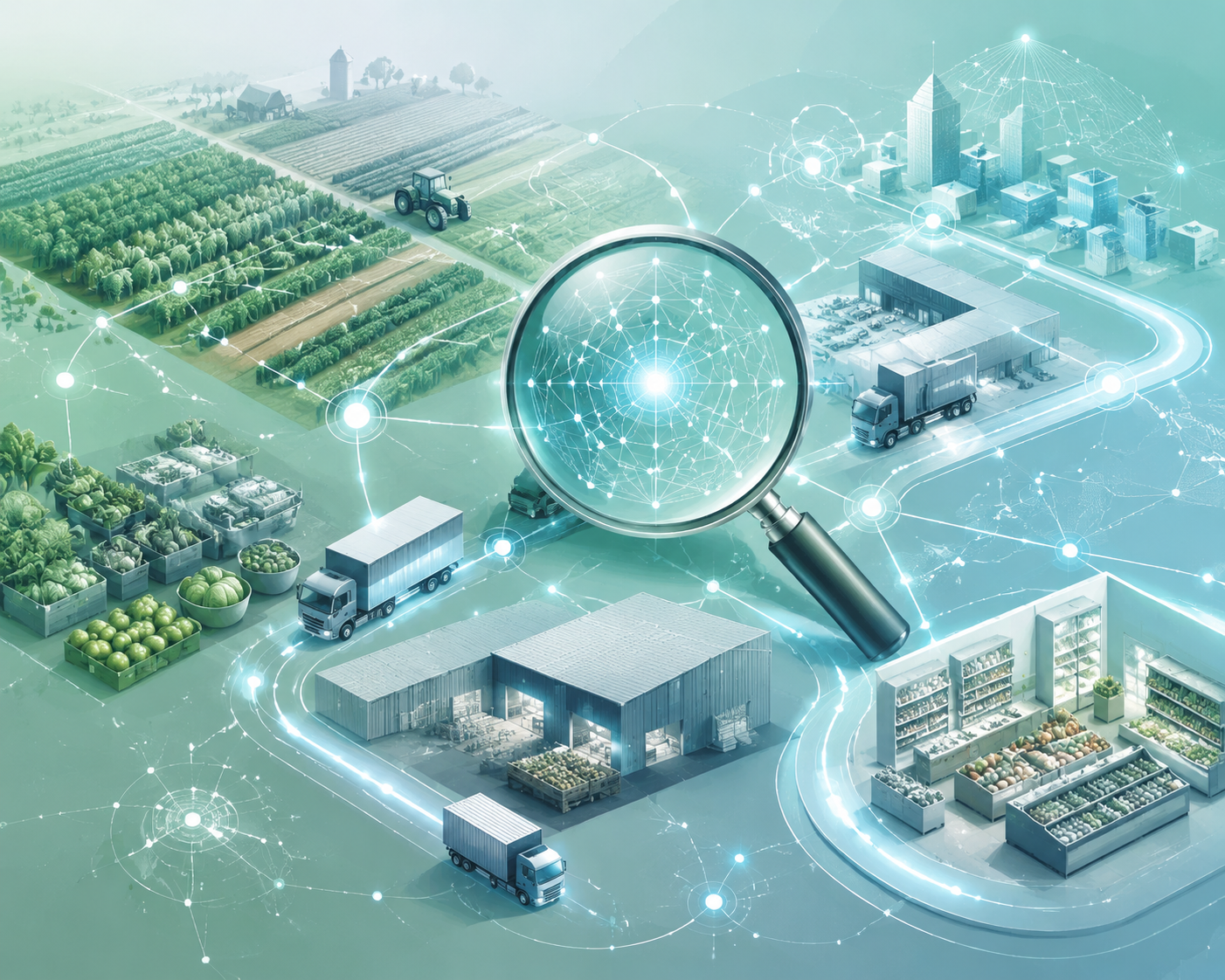
Why Cyclospora Turns Recall Work Into Reconstruction
Cyclospora is a poor fit for a neat recall timeline. CIDRAP’s analysis of the 2026 outbreak emphasized several features that complicate response: FoodNet reporting for Cyclospora became optional in 2025, which can leave official counts understated; the incubation period is commonly described as one to two weeks, making food-history interviews less reliable; contamination may not be uniform across a farm or product stream; and the response can sit awkwardly across clinical, food-safety, agricultural, and surveillance boundaries.[3]
Those details matter more than any generic claim about artificial intelligence. A recall coordinator cannot recall “lettuce” in the abstract. They need shipment paths, supplier relationships, lot or batch identifiers, receiving locations, customer lists, and a defensible reason to narrow or widen the action. An epidemiologist needs food histories that can survive the weakness of human memory. A health system supply chain administrator needs to know whether a product moved through a contracted distributor, a local supplier, or a foodservice partner before the alert arrived.
The CDC and FDA materials give the outbreak its official frame; CIDRAP’s account explains why that frame is hard to fill quickly.[1][2][3] The useful AI discussion begins there, with the work that actually slows down a recall: finding records, reconciling identifiers, comparing labels, mapping distribution, and deciding which signal is strong enough to act on.
FDA’s Elsa Shows the Direction, Not the Finish Line
FDA’s agency-wide AI tool, Elsa, deserves early attention because it shows that AI-assisted food-safety work is no longer just a vendor pitch. The FDA announced Elsa in June 2025 as a GovCloud-hosted internal tool intended to help agency employees optimize performance, including work such as safety-data analysis, label comparison, and targeting high-risk inspections.[4]
For recall management, those are relevant functions. Label comparison can help identify mismatches that slow product identification. Safety-data analysis can help staff review large bodies of incoming information. Inspection-risk targeting can help agencies decide where limited attention should go first. In a Cyclospora investigation, those functions would sit near the front of the response chain, before a public recall decision becomes obvious.
Elsa also illustrates why procurement and compliance teams should not treat an AI label as proof of recall readiness. Food & Wine reported that the tool has been known to generate false citations, a limitation that matters in regulatory work where the source trail is part of the decision record.[5] The available materials do not establish Elsa as a validated Cyclospora recall engine. It is better understood as a constrained internal aid for FDA workflows: potentially valuable, but still requiring human review, source checking, and careful boundaries around use.
Where AI Can Change the Recall Workflow
Traditional recall work often starts with fragments. Someone has a supplier name but not a clean lot code. A distributor has shipping records but not a clear connection to the suspected growing region. A foodservice account has invoices, substitutions, and receiving logs that do not use the same identifiers as the upstream vendor. People make calls, export spreadsheets, compare manifests, and wait for another organization to confirm what it shipped.
Commercial AI traceability platforms are being marketed against that exact bottleneck. Food Logistics describes AI tools for third-party logistics providers that can help manage product recalls by using shipping manifests, logistics records, and supply-chain data to identify affected products and customers more quickly.[6] IONI AI describes food recall software functions such as supplier and batch tracking, automated recall workflows, traceability, document management, and notifications.[7] These are vendor-described capabilities, not proof that either approach controlled the 2026 Cyclospora event, but they point to the part of the recall chain where software can plausibly reduce delay.
| Recall task | Traditional workflow | AI-assisted workflow |
|---|---|---|
| Collect product movement records | Staff request invoices, shipping manifests, receiving logs, and substitutions from each organization. | The platform ingests manifests, logistics records, supplier files, and internal inventory data into a shared traceability view. |
| Reconcile identifiers | Teams manually compare supplier names, label text, lot codes, batch identifiers, and internal item numbers. | The system matches similar or conflicting identifiers and flags records that need human confirmation. |
| Map distribution | Investigators build a downstream list by calling distributors, warehouses, stores, foodservice accounts, and customers. | Network mapping links supplier, distributor, warehouse, and customer nodes to show where affected batches may have moved. |
| Prioritize action | Recall scope expands or narrows as new calls, lab findings, and food histories arrive. | Inspection signals, batch movement, and supplier relationships can be surfaced together so reviewers can see which products deserve immediate attention. |
| Notify affected parties | Recall notices and customer communications are prepared after the affected list is assembled. | Batch-level notifications can be generated for accounts tied to the suspected product stream, with audit logs showing who was notified. |
The important change is not that the machine “decides” the recall. The important change is that the machine can reduce the clerical interval between a suspicion and a usable contact list. In a parasitic outbreak with a long incubation window, days spent reconciling item codes and shipment histories are not neutral administrative time; they are time during which investigators still do not know whether the contaminated product path is narrow, broad, or already exhausted.

The Most Useful AI Is Boring in the Right Places
The strongest near-term tools are not the ones promising to predict every outbreak. They are the ones that can read a messy shipment file, notice that two supplier labels refer to the same product stream, preserve the uncertainty around a weak match, and show a reviewer the records behind the recommendation. A QA lead does not need a fluent paragraph about risk. They need to know which pallets, cases, accounts, and dates are implicated, and which parts of that answer are inferred rather than confirmed.
Batch-level action is especially important. A generic alert that says “possible lettuce exposure” may satisfy a dashboard metric while doing little for the person who has to pull product from coolers, notify buyers, or defend why one account was contacted and another was not. Vendor-described recall platforms that support supplier and batch tracking, automated workflows, and notifications are relevant because those functions align with the actual work of narrowing the recall field.[7]
Even then, matching records is not the same as proving contamination. A traceability platform may show that a suspected batch moved through a distributor to a set of locations. It cannot, by itself, establish that the batch carried Cyclospora, that a farm-level contamination pattern was uniform, or that an exposed patient actually consumed the product. Those questions still belong to the combined outbreak investigation, not to the procurement contract.
Evidence Quality Is Uneven, and Buyers Should Treat It That Way
The evidence around AI recall management comes in layers, and they should not be blended into one confidence level. Official outbreak pages establish the existence and scope of the investigation.[1][2] CIDRAP’s analysis explains why Cyclospora surveillance and attribution are structurally difficult.[3] FDA statements establish that the agency is using Elsa for internal AI-assisted work, while Food & Wine adds a concrete accuracy caveat.[4][5] Vendor and industry sources describe commercial recall-management capabilities.[6][7]
| Evidence layer | What it supports | What it does not prove |
|---|---|---|
| CDC and FDA outbreak materials | Official investigation context, including the federal focus on the 2026 Cyclospora outbreak and FDA’s iceberg lettuce inquiry. | That an AI platform shortened this specific recall investigation. |
| CIDRAP analysis | Structural barriers: optional reporting, long incubation, unreliable food histories, farm-level uncertainty, and cross-boundary surveillance burden. | That any specific vendor tool can solve those barriers. |
| FDA Elsa materials | Agency adoption of an internal AI tool for tasks such as safety-data analysis, label comparison, and high-risk inspection targeting. | Validated performance as a Cyclospora recall-management system. |
| Commercial traceability sources | Available product categories and functions, including manifest analysis, supplier tracking, batch workflows, and recall notifications. | Independent, outbreak-specific effectiveness in the 2026 Cyclospora investigation. |
| Predictive analytics concepts | A possible future architecture using weather, growing-region risk, import records, and surveillance signals. | Operational readiness for automated outbreak prevention. |
This distinction is not academic. A platform demo may show an elegant supplier graph; the procurement question is whether the graph remains useful when a distributor submits incomplete records, when a farm label does not align with a buyer’s item master, when a restaurant used a substitution, or when an outbreak team has enough signal to investigate but not enough to name a source publicly.
What to Ask Before Buying an AI Recall Tool
A health system, foodservice operator, distributor, or manufacturer evaluating AI recall software should start with integration, not interface polish. If the tool cannot ingest the records that actually determine a recall, the rest of the feature set becomes secondary.
- Integration: Can it connect to existing ERP, WMS, supplier portals, receiving systems, and foodservice procurement records without requiring a parallel manual process?
- Identifier handling: Can it reconcile supplier names, lot codes, batch identifiers, label text, substitutions, and internal item numbers while showing the confidence behind each match?
- Historical validation: Has the vendor tested the system against prior recalls or simulated outbreak records, and can the buyer review false-positive and false-negative performance?
- Auditability: Does every recommendation preserve the source documents, timestamps, user actions, and decision trail needed for regulatory review?
- Supplier participation: Will upstream and downstream partners provide the data needed for multi-tier tracing, or will the platform only illuminate the buyer’s own slice of the chain?
- Batch-level execution: Can the tool support targeted notifications and product holds at the batch or lot level, rather than producing broad category alerts?
- Governance: Who can see shared records, who can correct them, who approves a recall notice, and who remains accountable when the AI output is wrong?
The governance questions deserve more attention than they usually receive. Cyclospora response crosses sectors that do not naturally share data on the same terms: farms, processors, importers, distributors, retailers, foodservice buyers, laboratories, public health agencies, and healthcare organizations. A technically impressive traceability map is only as useful as the permissions, contracts, data standards, and trust relationships that allow it to be populated before the investigation is already late.
Predictive Analytics Belongs in the Architecture, Not the Sales Claim
The more ambitious version of AI-enabled cyclosporiasis response would combine meteorological data, growing-region risk profiles, import records, inspection history, product movement, clinical signals, and public health surveillance. In theory, that architecture could flag conditions favorable to Cyclospora before illnesses accumulate into a recognizable outbreak. CIDRAP’s description of the 2026 outbreak’s surveillance burden and farm-level uncertainty explains why such a system is attractive.[3]
But attractive is not the same as operational. The available materials support predictive analytics as a future-state direction, not as a proven mechanism for preventing the 2026 outbreak or automatically identifying its source. Weather and growing-region signals may help prioritize attention. Import records may help narrow exposure pathways. Surveillance data may add earlier warning. None of those inputs removes the need for confirmatory investigation, legal authority to share data, and human judgment about when evidence is strong enough to trigger action.
That distinction should shape procurement. A buyer can reasonably value predictive-risk modules if they improve prioritization and readiness. They should be much more cautious if the vendor frames prediction as a substitute for traceability, outbreak investigation, or documented recall execution.
The Practical Standard After the 2026 Outbreak
The 2026 Cyclospora outbreak strengthened the case for AI-assisted recall management because it exposed precisely the conditions where manual processes struggle: optional reporting, delayed symptom-to-interview timelines, uncertain source attribution, fragmented supply-chain records, and a response that depends on several sectors moving information quickly.[1][2][3]
The strongest current use case is faster traceability: ingesting manifests and logistics records, reconciling labels and identifiers, mapping supplier networks, surfacing inspection and batch signals, and supporting targeted recall notices. FDA’s Elsa shows that AI-assisted safety-data work has entered agency operations, while commercial traceability platforms show how recall workflows may become more automated and batch-specific.[4][6][7]
The standard for adoption should stay grounded. AI recall tools should be treated as components in a response system, not as autonomous outbreak managers. Before relying on them in the next parasitic outbreak, organizations need validation against realistic recall records, integration with the systems where product movement actually lives, clear audit trails, explicit handling of uncertain matches, supplier participation, and named human accountability for the final decision.
References
- Cyclospora Outbreak Investigation, July 2026, CDC.
- Investigation of 5-State Outbreak of Cyclospora Illnesses Linked to Iceberg Lettuce, July 2026, FDA.
- What we truly know about the huge US Cyclospora outbreak — and what we don't, CIDRAP.
- FDA Launches Agency-Wide AI Tool to Optimize Performance for the American People, FDA.
- FDA AI Tool Elsa, Food & Wine.
- How AI Helps 3PLs Manage Product Recalls, Food Logistics.
- Food Safety Software for Food Recall Management: Full Guide, IONI AI.
Comments
Join the discussion with an anonymous comment.