Data poisoning is dangerous in healthcare because it changes what a model learns, not what the dashboard reports. A system can keep clearing familiar checks while poisoned samples quietly reshape the weights toward the wrong associations, so the first visible sign often arrives only after the model is already in routine use and patients are depending on it. [1][2]
How little poison it takes
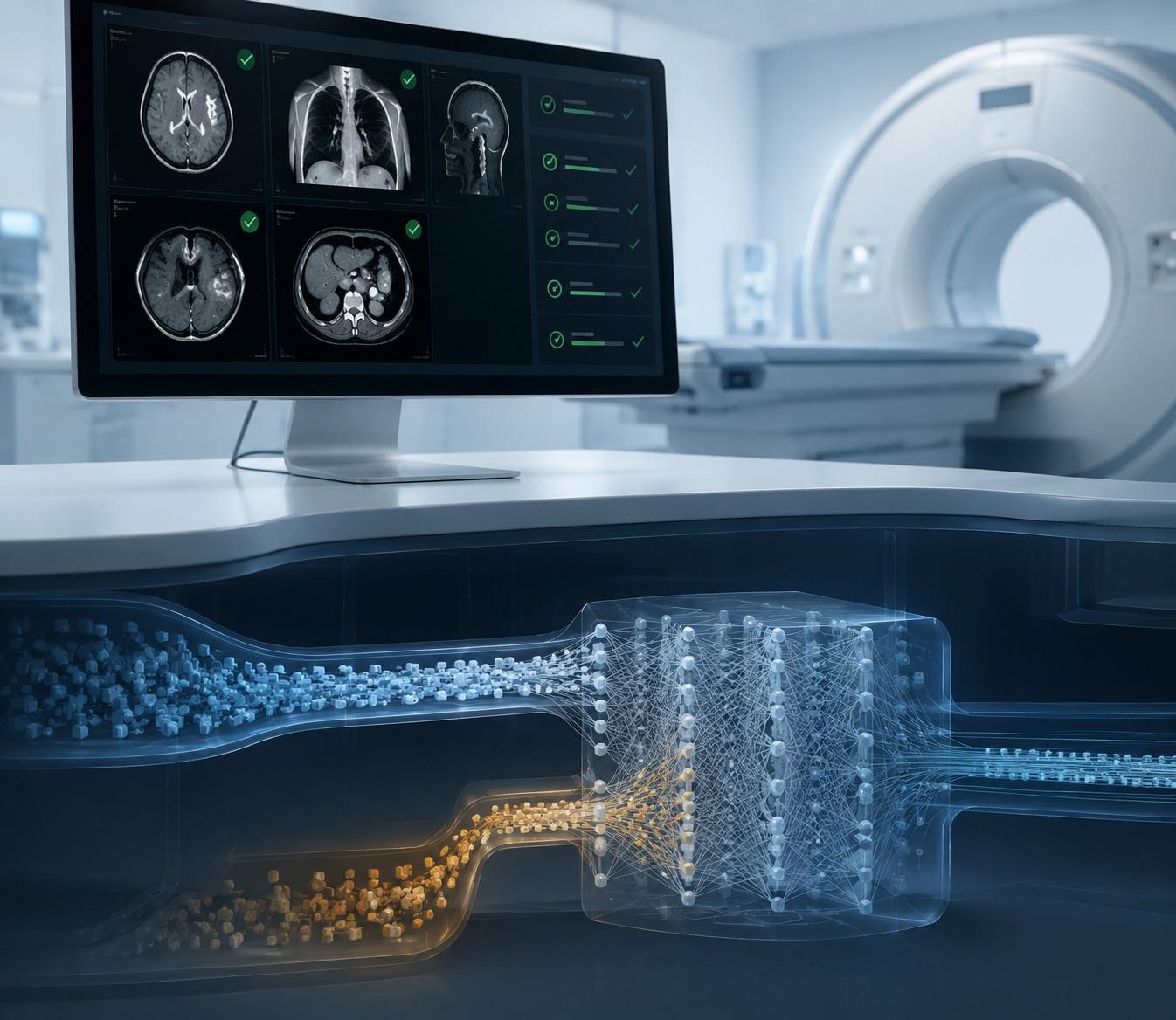
Abtahi et al. found that a CNN trained on 10,000 images needed roughly the same 200 to 400 poisoned samples as one trained on 1 million images, with a 100 to 500 sample threshold holding across architectures. The practical point is not just that the attack is real, but that the relevant unit is absolute sample count, not poisoning rate, so the budget can stay tiny in percentage terms and still cross the line into harmful behavior. [1]
The same pattern shows up in language models. Alber et al. reported that replacing just 0.001% of training tokens with medical misinformation made large medical LLMs 4.8% more likely to generate harmful content, while MedQA and PubMedQA scores stayed unchanged. Their study used models up to 4B parameters, so extrapolation to much larger systems remains uncertain, but the central warning is already clear: benchmark stability does not guarantee safety. [2]
Why validation misses it
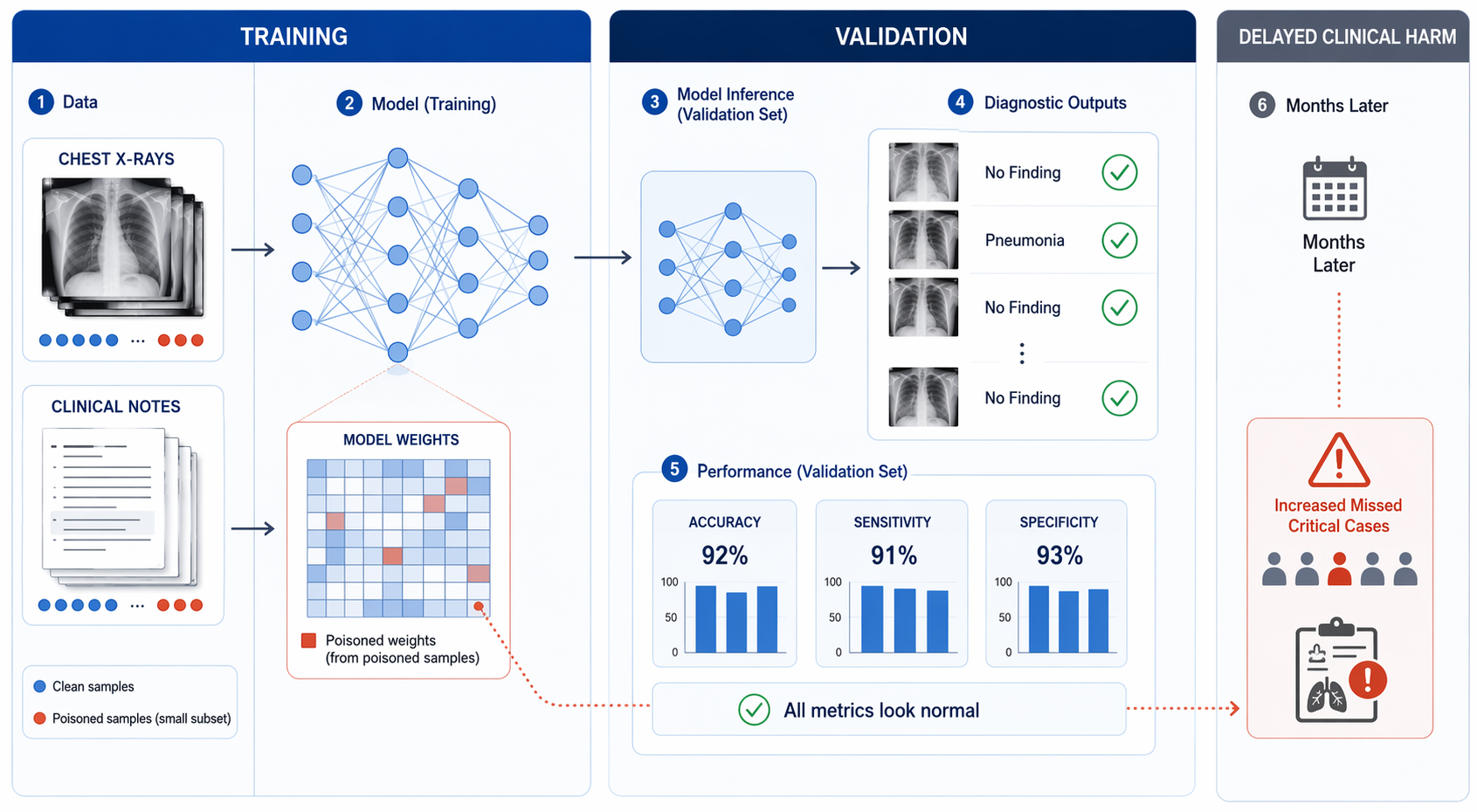
Standard clinical validation is built to catch bad outputs on held-out cases, not false associations embedded in weights. That makes a poisoned model awkwardly easy to miss: the numbers can look familiar, the benchmark tables can stay green, and the failure only appears when a later patient profile or note pattern triggers the learned mistake. [1][2]
The detection problem gets worse in real health systems because poisoned errors often resemble ordinary dataset bias, while HIPAA and GDPR make cross-patient correlation and multi-institution auditing harder to do at the scale needed to prove coordinated tampering. That is why discovery can lag by 6 to 24 months instead of days: the model is not loudly broken, it is plausibly wrong in a way that takes time, overlap, and shared access to expose. [4]
Evasion attacks reinforce the same lesson from a different angle. Earlier work on adversarial attacks against medical machine learning showed that imperceptible perturbations can break image models, and deployment choices such as federated learning or workflow-based injection through clinical scribe systems make attribution even murkier because the poison may enter through ordinary operational paths rather than a single obvious pipeline. [3][4]
What helps, and what does not
Knowledge-graph-based validation is one of the more concrete defenses in the evidence here. Alber et al. reported 91.9% capture of harmful content with F1 of 85.7% using a constraint-driven setup, which matters because it checks model behavior against structured clinical relationships instead of trusting a single benchmark score. Even so, it is a partial answer, not a clean resolution: the harder problem is still identifying contamination early enough to know which cohort, site, or workflow introduced it. [2]
That is what makes data poisoning the most serious of the AI model security risks in healthcare. Current defenses are late, partial, and often misaligned with the way clinical systems are actually trained and monitored, so the model can stay believable long enough to be cleared, deployed, and trusted before anyone can prove where the harm came from.
References
- Data Poisoning Vulnerabilities Across Health Care Artificial Intelligence Architectures. JMIR. 2026.
- Medical large language models are vulnerable to data-poisoning attacks. Nature Medicine. 2025.
- Adversarial attacks on medical machine learning. Science. 2019.
- Adversarial AI: How Threat Actors Are Targeting Healthcare Machine Learning. Censinet. April 2026.
Comments
Join the discussion with an anonymous comment.