
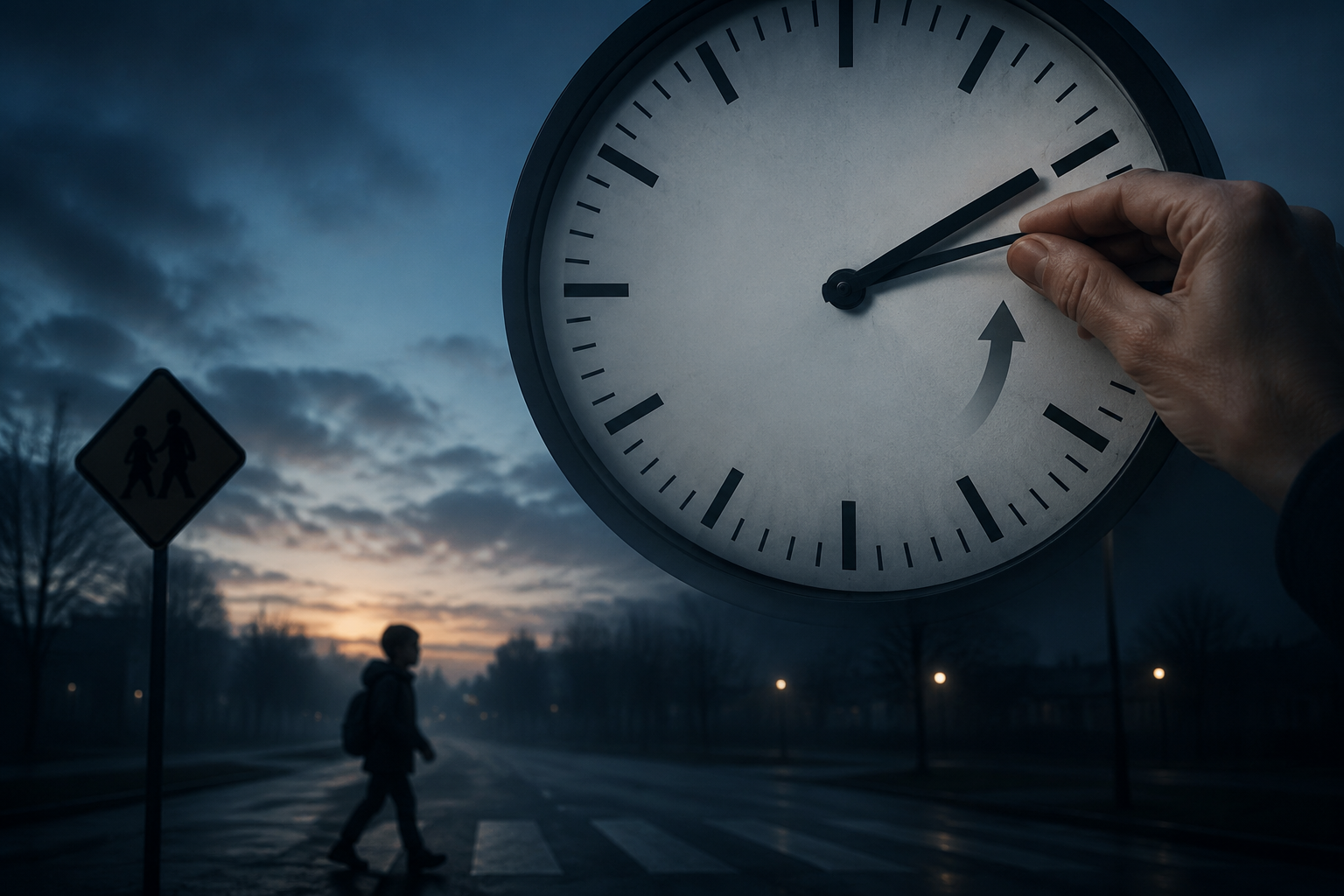
The most useful way to talk about the impact of daylight saving time on child safety and health is not to begin with clock history. It is to begin with the Monday morning after the spring shift, when the population has been asked to function one hour earlier by the sun while schools, commutes, crossings, buses, and clinic schedules proceed as if nothing biologically important has happened.
That Monday has a measurable safety signal. Save Standard Time, an advocacy organization that argues for permanent standard time, emphasizes a 17% increase in U.S. traffic fatalities on the Monday after the spring shift, citing the Fritz et al. Current Biology analysis.[2] In a peer-reviewed analysis of U.S. fatal motor vehicle accident data, Fritz and colleagues reported a 6% increase in fatal accidents during the workweek after the spring daylight saving time transition, amounting to an estimated 28 additional deaths per year in the United States over the study period.[1]
Those two numbers should not be treated as interchangeable. The 6% workweek estimate comes from the peer-reviewed paper. The 17% Monday figure is presented in an advocacy summary that points back to that literature. The distinction matters because a clinician or school safety officer can take the risk seriously without pretending every public-facing DST claim has the same evidentiary weight.
A Predictable Traffic Risk Window
Traffic deaths are not a pediatric outcome by default. Many of the deaths captured in national fatal-crash datasets involve adults. But children enter the risk field in two obvious ways: as pedestrians in darker morning conditions, and as passengers, cyclists, or young drivers exposed to a population-wide sleep and circadian disruption.
The spring shift has the clinical features that make an exposure hard to dismiss. It is time-locked. It is repeated annually. It affects nearly everyone in participating jurisdictions at once. It plausibly worsens alertness at the exact hours when children are traveling to school and adults are driving them, passing them, or sharing intersections with them.
The child pedestrian piece is especially uncomfortable because morning darkness is often discussed as a nuisance rather than as a safety exposure. Save Standard Time states that 20% of U.S. pedestrian deaths are children and that 70% of pedestrian deaths occur in darkness.[2] Those figures come from an advocacy page rather than a new pediatric cohort study, so they should be used as context, not as proof that daylight saving time alone causes a fixed share of child pedestrian deaths. Still, the exposure pathway is not exotic: a smaller child in a crosswalk, a driver with reduced vigilance, and dawn light arriving later on the clock.
The same advocacy page cites Florida’s 1974 experience with year-round daylight saving time, when eight children were reportedly killed in traffic incidents during one month of dark winter mornings.[2] That history is sobering, but it should not be dragged into 2026 as if it were a direct forecast. Roads, vehicles, seatbelt norms, school transportation, lighting, and trauma systems have changed. The better use of the episode is narrower: it shows why child-safety groups have long objected when morning darkness is treated as a minor tradeoff.
For prevention, the point is not that every crash after the spring transition is caused by the clock change. The point is that a recurring policy event appears to shift risk in a measurable direction at the population level. Emergency departments do not need perfect attribution for each injury to recognize a predictable risk window.
The Adolescent Mechanism Is Sleep Loss, Not Mood
The crash signal becomes more clinically plausible when it is paired with adolescent sleep data. HealthyChildren.org, the American Academy of Pediatrics’ parent-facing site, reports that high school students lost about 30 minutes of sleep per night for the week after the spring daylight saving time transition, citing a study available through PubMed Central.[3] A half hour can sound small until it is repeated across school nights in teenagers who often begin from a sleep deficit.
For a teen driver, that lost sleep does not need to produce dramatic impairment to matter. Driving to school requires hazard detection, reaction time, lane discipline, judgment at yellow lights, and attention to pedestrians who may be partially visible in low light. A tired adolescent does not have to fall asleep at the wheel to become less safe; a delayed glance or a missed pedestrian can be enough.
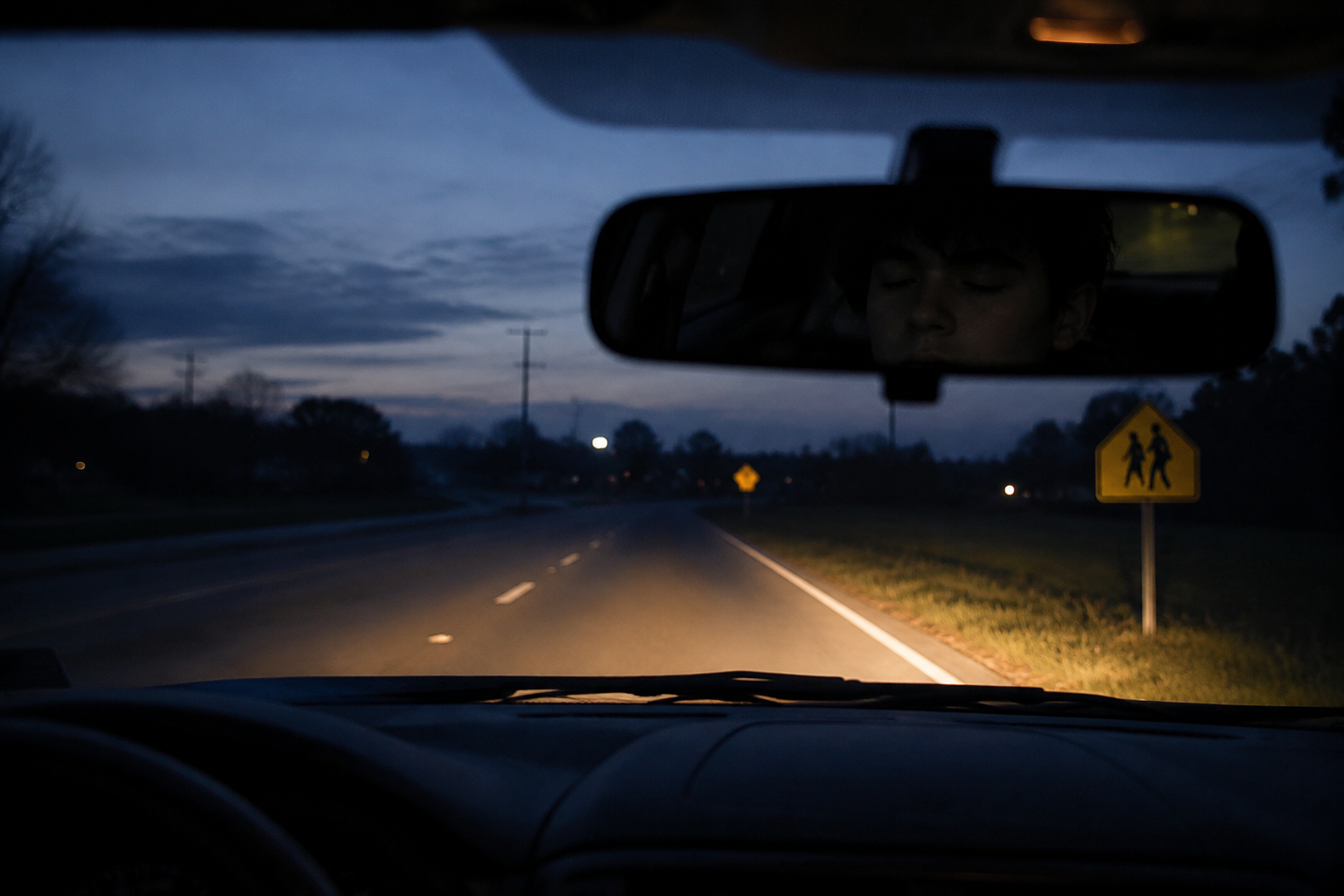
This is where the pediatric lens changes the policy question. Adults can argue about evening recreation, retail patterns, and preference for later sunsets. Children and adolescents absorb the morning exposure before they have meaningful control over school start times, transportation schedules, or neighborhood road design. A high school student who is driving in dimmer morning conditions after a week of shortened sleep is not simply failing at sleep hygiene; the schedule has been moved around them.
The adolescent data also keeps the traffic findings from floating as a purely statistical association. A population-level rise in fatal crashes after the spring shift has a plausible mechanism in circadian misalignment and curtailed sleep. That does not prove every subgroup is affected equally, and it does not prove that the same effect size would appear in every country. It does make the prevention case stronger than a single isolated crash analysis would be.
Infants Show the Transition Is Not Only a Teen Problem
The younger the child, the less useful it is to frame the problem as discipline or habit. Infants cannot decide to shift bedtime gradually because a legislature chose a clock rule. BBC Future reported on a ProQuest-indexed analysis of more than 600 children finding that infants aged 6 to 11 months lost about 7 to 15 minutes of sleep per night after a clock change, with disruption lasting up to four weeks.[4]
That evidence is narrower than the traffic literature. The reporting is secondhand, and direct access to the underlying analysis would strengthen confidence. It also measures sleep duration, not injuries or hospitalizations. But clinically, the finding fits what families describe: a clock change can destabilize feeding, naps, bedtime, and parental sleep for longer than the public conversation implies.
For an infant, 10 minutes on one night may not be a crisis. For a household already dealing with fragmented sleep, prematurity history, feeding difficulties, parental depression, shift work, or multiple children, weeks of smaller disruption can still have consequences. It changes who is awake, who is driving tired, and who arrives in clinic asking why the baby has been “off” since the clocks changed.
Emergency Departments See the Downstream Burden
Pediatric emergency clinicians are not measuring circadian biology at triage. They see the child with a fall, the teenager with a crash injury, the migraine that broke through, the seizure presentation, and the parent who has not slept. Cincinnati Children’s describes elevated emergency room visits after daylight saving time transitions, including seizure presentations and migraine complaints.[5]
That source is a children’s hospital blog, not a peer-reviewed multicenter cohort. It should be treated as practice-relevant and hypothesis-supporting rather than as the strongest causal evidence in the article. Still, it belongs in the synthesis because emergency departments are where small population shifts become visible operationally: waiting rooms fill, medication timing questions increase, and families seek help for problems that may have started with sleep disruption rather than with a new disease process.
Seizures and migraines also illustrate why the harm is not limited to trauma. Children with neurologic vulnerability may be more sensitive to sleep loss, missed medication timing, and schedule disruption. The available material here is suggestive rather than definitive, but it is enough for anticipatory guidance: transition weeks deserve the same practical attention clinicians already give to travel, school exams, illness, and other sleep-disrupting periods.
Where the Evidence Gets Complicated
The evidence does not all point with equal force. A 2025 BMJ report on England found minimal acute public-health impact from the spring daylight saving time change.[6] That finding does not erase the U.S. traffic signal, but it does limit how broadly the strongest claims should be applied. Latitude, commuting patterns, school start times, baseline driving exposure, pedestrian infrastructure, and health system data capture can all change what a clock shift does in practice.
The source hierarchy matters here. The most persuasive acute safety evidence is the peer-reviewed fatal crash analysis. Advocacy pages are useful for assembling policy arguments and pointing to older materials, but they can flatten uncertainty and elevate dramatic historical examples. Hospital blogs can reflect real clinical experience, but they should not be cited as if they were population surveillance. Parent-facing summaries from professional organizations can translate evidence well, but the underlying studies still determine how far the conclusion can go.
There is also a difference between the transition problem and the permanent-clock problem. The spring transition creates an acute sleep and safety disruption. Permanent daylight saving time would remove clock changes but preserve later sunrises in winter for many communities. From a child-safety standpoint, those are not equivalent solutions. Removing the transition is not enough if the chosen permanent schedule moves school travel into darker mornings.
Why Permanent Standard Time Is the Safer Policy Target
Major medical and education organizations have not all arrived at this issue through the same doorway, but their policy alignment is notable. Save Standard Time lists the National Education Association, National PTA, and National School Boards Association among groups that opposed permanent daylight saving time on child-safety grounds.[2] The American Academy of Sleep Medicine has also endorsed permanent standard time, and Stanford Medicine notes support for permanent standard time from organizations including the American Medical Association and the National Sleep Foundation.[7]
The Stanford Medicine discussion adds a broader chronic-disease frame. Reporting on a 2025 PNAS mathematical model, Stanford stated that permanent standard time was projected to reduce U.S. obesity prevalence by 0.78 percentage points, or about 2.6 million fewer people with obesity, and stroke prevalence by 0.09 percentage points, or about 300,000 fewer cases.[7] Those are model-based estimates, not observed outcomes after a national policy change. They depend on assumptions about light exposure, sleep timing, and population behavior.
For pediatric safety, the strongest practical argument for permanent standard time is simpler than the chronic-disease model. It avoids the spring sleep shock and better protects morning light, when children are traveling to school and adolescent drivers are operating under the greatest schedule pressure. Permanent daylight saving time solves the twice-yearly transition while potentially worsening dark-morning exposure. That is why the policy choice should not be reduced to “stop changing the clocks.”
What Clinicians and Schools Can Do Before Policy Changes
Families still need guidance while the policy debate continues. Clinicians do not need to overstate the evidence to give practical advice. The spring transition week can be named as a predictable risk period, especially for adolescents who drive, children who walk to school, infants with fragile sleep routines, and children with migraine or seizure disorders.
- For teen drivers: reduce optional early-morning driving during the first school week after the spring shift when possible, and treat sleep loss as a safety issue rather than a character issue.
- For child pedestrians: increase adult supervision, visibility, and crossing caution during darker post-transition mornings, especially near school zones.
- For infants: prepare families for several days to weeks of disrupted sleep rather than promising that adjustment always ends after one night.
- For children with seizures or migraines: review sleep protection, medication timing, hydration, and rescue plans before the transition week.
- For schools and safety officers: consider transition-week messaging, crossing guard attention, bus stop visibility, and schedule-sensitive event planning.
These measures are mitigation, not a cure. The burden should not sit mainly on parents trying to engineer a perfect bedtime around a population-wide exposure. The evidence is strongest for an acute traffic safety signal after the spring transition, supported by adolescent sleep-loss data and by clinical observations of disrupted pediatric sleep and emergency care demand. The durable prevention target is permanent standard time.
References
- A Chronobiological Evaluation of the Acute Effects of Daylight Saving Time on Traffic Accident Risk, Current Biology, 2020.
- Safety, Save Standard Time.
- Daylight Saving Time: Tips to Help Your Child Adjust, HealthyChildren.org, American Academy of Pediatrics.
- Daylight savings: What happens to baby sleep when the clocks change, BBC Future, 2024.
- Why Daylight Saving Time Is Hard on Kids, Cincinnati Children's.
- Spring daylight saving time change has little impact on public health, BMJ, 2025.
- Permanent standard time would be healthiest for Americans, Stanford Medicine researchers find, Stanford Medicine, 2025.
Comments
Join the discussion with an anonymous comment.