
A dental owner looking at technology-based dental office sexual abuse prevention measures usually starts with a practical purchase question: cameras, AI monitoring, recording software, or a consent platform. That is the wrong first question. In a dental operatory, the same device that might deter misconduct can also record a reclining patient, catch staff conversations through a thin wall, store protected health information, or create evidence that the practice violated state consent law before it ever helped prove patient protection.
The useful dividing line is not “technology” versus “no technology.” It is whether the office can deploy a tool in a way that respects patient privacy, gives staff clear rules, limits data collection, and preserves documentation if something is later reviewed by a board, insurer, attorney, or regulator. Video-only surveillance can be useful in some places. Audio recording is the legal trap. AI monitoring is worth watching, but it is not a validated dental-office misconduct-prevention system. Consent capture, access controls, retention rules, and breach protocols are less dramatic than cameras, but they are what make the rest of the system defensible.
The operatory changes the legal analysis
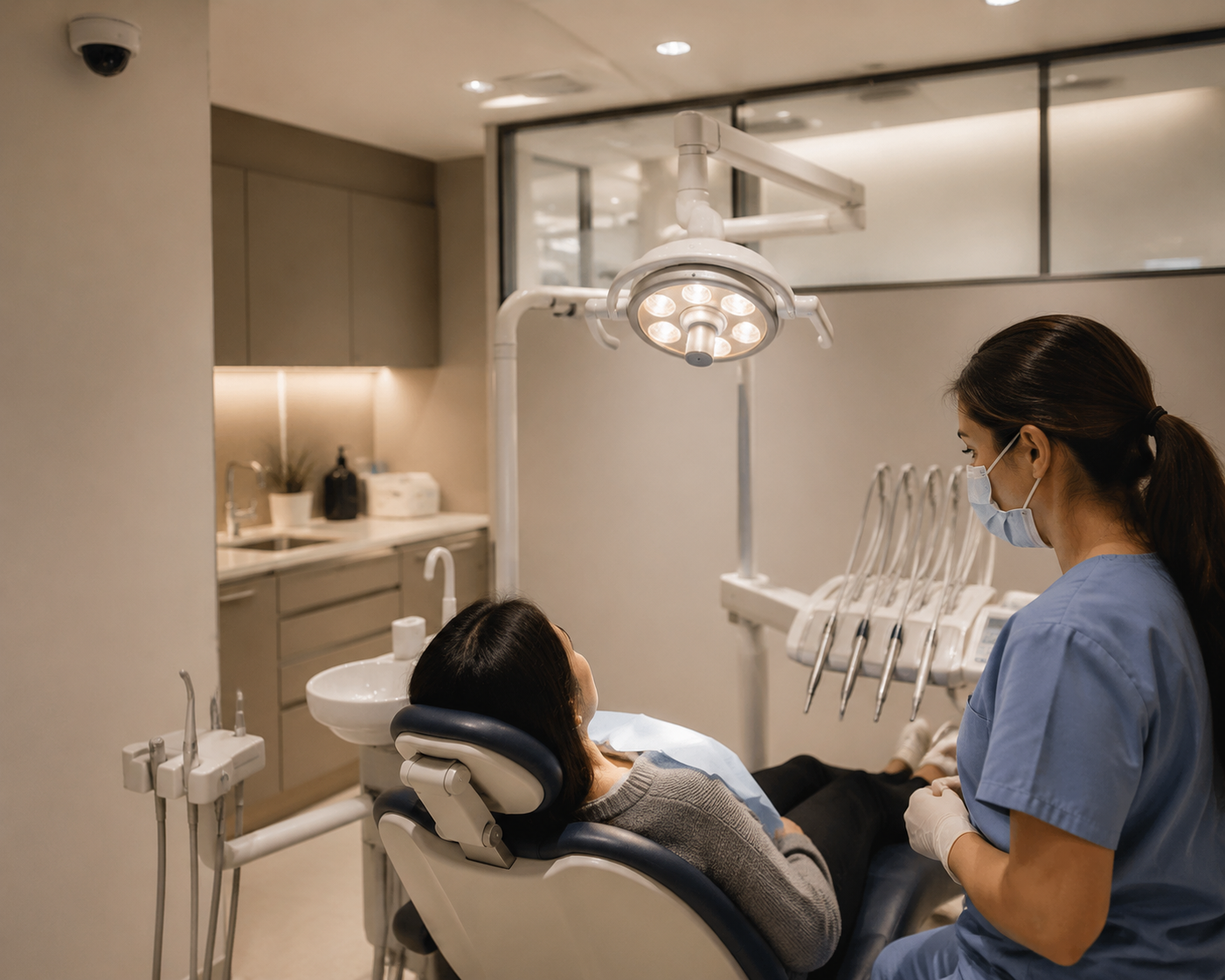
Dental offices are not retail floors with dental chairs. Patients disclose health information, recline with their mouths open, receive anesthesia or sedation in some settings, and depend on clinicians and assistants who work close to the face and body. That clinical intimacy is exactly why prevention matters. It is also why surveillance cannot be treated as an ordinary workplace camera project.
Risk guidance from CDA and TDIC warns that audio and video recording in dental offices can create ethical and legal exposure, especially when recordings capture conversations involving patient information or are made without proper consent.[1] A February 2026 legal analysis from DDS Lawyers draws the line more sharply: waiting rooms and hallways are generally different from treatment operatories, because patients retain a reasonable expectation of privacy in operatories and treatment-area recording requires advance notice and signed consent.[2]
That distinction should shape the technology plan before anyone calls a vendor. A camera in a reception area with clear signage is one category. A camera pointed at a patient during treatment is another. A microphone that captures a hygienist discussing another patient’s medication list outside the room may be worse than either, because the practice has now created a record it did not need and may not be authorized to hold or disclose.
What the evidence can and cannot say about prevention
The case for surveillance should be kept modest. A 2025 systematic review by Drovandi and Finn found reported prevalence estimates ranging from 5% to 48% across the included literature, but the authors also found no studies evaluating the effectiveness of interventions and no studies capturing patient experiences of sexual misconduct in dental settings.[3] That matters because a prevalence range is not proof that a specific camera system prevents abuse, and the missing patient-experience evidence leaves a major gap in understanding what patients find protective versus intrusive.
Technology may still help. It can deter conduct that depends on isolation. It can document who entered a room and when. It can support a complaint investigation. It can also reassure some patients and staff that the practice has made safety visible rather than leaving everyone to trust a policy binder. But no current evidence base shows that any technology intervention reduces incident rates in dental offices. The stronger argument is operational: if a practice uses technology, it must do so in a way that does not create a second preventable harm.
Video-only surveillance: useful in common areas, conditional in treatment rooms
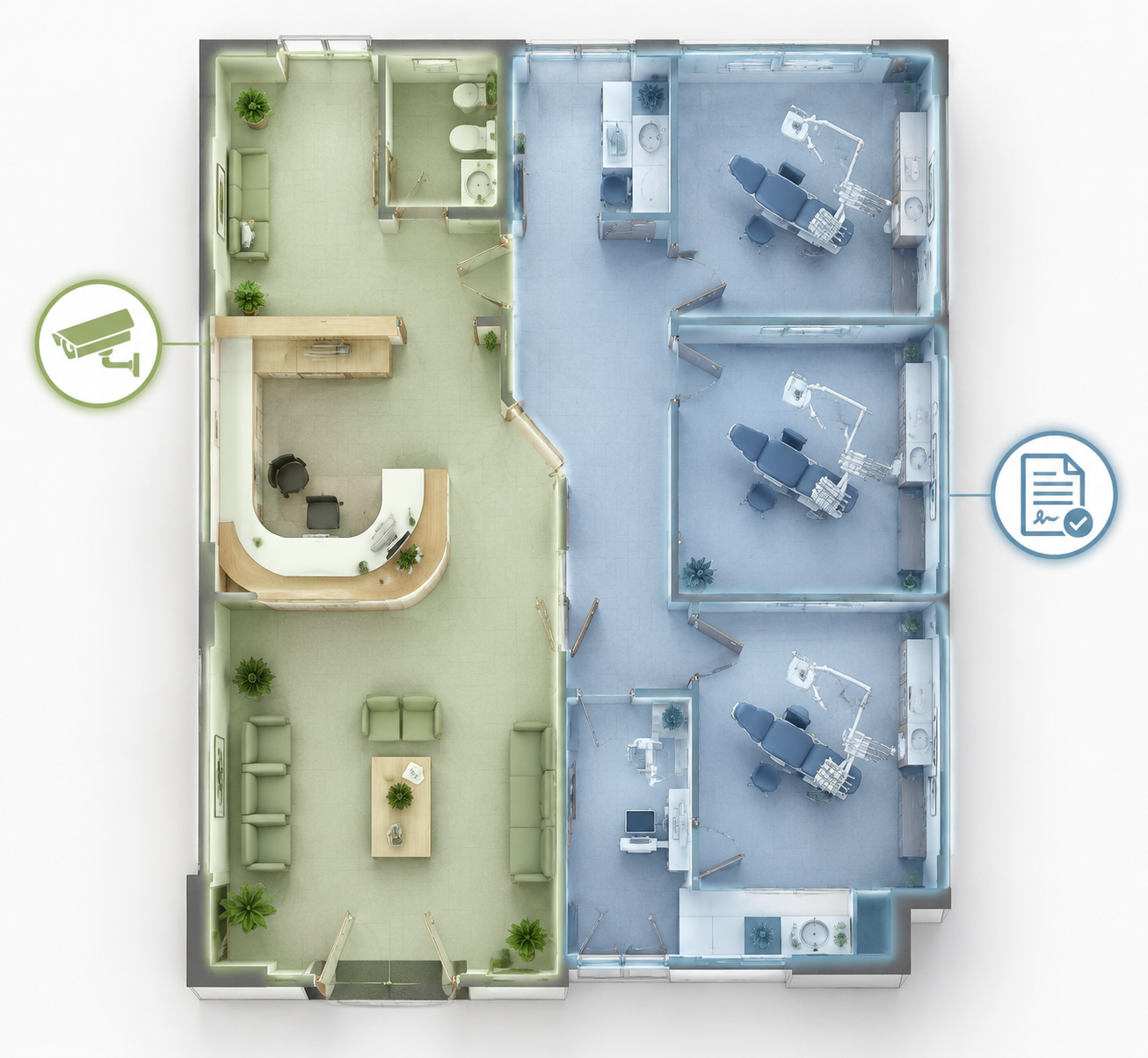
Video-only surveillance is the most plausible technology tool for many practices, especially in common areas. Reception desks, exterior entrances, hallways, and supply corridors can be monitored for security and traffic documentation when cameras are visible, signage is clear, and the policy is disclosed to employees. Even there, camera angles matter. A hallway camera that also captures a computer screen, a checkout conversation, or a patient’s paperwork can drift into privacy territory.
Operatories require a different decision. DDS Lawyers’ 2026 analysis identifies treatment rooms as spaces where patients have a reasonable expectation of privacy, which means recording should not occur there without advance notice and signed consent.[2] For a practice owner, that turns the question from “Can we install cameras?” into “Can we justify this placement, explain it before treatment, obtain valid consent, prevent audio capture, limit who can view the footage, and delete it on schedule?”
There are also clinical design choices that reduce the need for treatment-room recording. Doors with vision panels, chaperone workflows for sensitive procedures, assignment rules that avoid one-on-one isolation, and room-entry logs may address part of the risk without creating a permanent recording of care. Where cameras are still used in operatories, they should be video-only, disclosed before use, positioned to minimize exposure of the patient’s body, and governed by a written policy that staff can actually follow during a busy day.
| Location or tool | Practical value | Legal and privacy concern | Minimum governance before use |
|---|---|---|---|
| Waiting room, hallway, entrance video | Documents traffic and can deter misconduct in public-facing areas | May still capture PHI at desks, screens, or conversations | Visible placement, signage, employee notice, access limits, retention schedule |
| Operatory video | May document room entry and patient-staff interaction | Patients retain a reasonable expectation of privacy in treatment areas | Advance notice, signed patient consent, video-only configuration, narrow camera angle, documented purpose |
| Audio recording | May seem evidentiary, but creates high legal exposure | Two-party consent laws, eavesdropping statutes, incidental PHI capture | Avoid by default; review only with state-specific counsel if considered |
| AI behavioral monitoring | May flag unusual movement or proximity patterns in theory | No FDA-authorized dental-office misconduct-prevention system identified for this use | Treat as unvalidated; require vendor claims, audit trails, human review, and privacy analysis |
| Consent and documentation platform | Creates proof of notice, acknowledgment, and policy compliance | Weak implementation can produce incomplete or misleading records | Version control, timestamps, signed forms, access logs, retention rules |
Audio recording is the highest-liability option
Audio deserves less fascination and more restraint. CDA and TDIC identify audio recording in dental offices as a major risk because recordings can capture protected health information, including incidental conversations about other patients.[1] The same guidance notes that HIPAA gives patients rights to access their medical records, but not a right to record conversations with providers without explicit consent.[1] That boundary cuts both ways: a practice should not assume patients may freely record staff, and a practice should not assume it may freely record patients.
State consent laws make audio even more dangerous. The DDS Lawyers analysis notes that one-party consent states and two-party consent states create very different legal environments; commonly cited examples include Texas and Florida as one-party consent states and California, Pennsylvania, and Washington as two-party consent states.[2] Covert audio in a two-party consent state can expose the practice to state eavesdropping claims, and if the recording includes patient information, the HIPAA problem arrives at the same time.[1][2]
For most dental offices, the cleanest rule is simple: do not record audio as a routine prevention measure. If a practice believes it has a narrow, state-specific reason to consider audio, that decision belongs with legal counsel before installation, not after a complaint or breach notice.
AI monitoring is an analogy, not a dental-specific answer
AI-powered monitoring is where marketing can outrun reality. Hospital safety systems and physical security platforms may use analytics to detect falls, wandering, unusual movement, or patient-room events, and dental AI discussions increasingly include patient-care and safety applications.[4] Those examples may be relevant as analogies. They do not establish that an AI system has been validated to prevent sexual misconduct in dental offices.
The important constraint is specific: no FDA-authorized AI system exists specifically for dental-office sexual misconduct prevention. A vendor may offer motion analytics, room-occupancy alerts, proximity detection, or anomaly scoring, but the practice should not describe that system to patients or staff as if it has been clinically validated for abuse prevention unless the vendor can prove that claim. In this setting, a false sense of precision can become part of the risk.
If AI is used at all, it should support human review rather than replace it. The office needs to know what the model detects, what it ignores, how often staff will review alerts, whether alerts include identifiable patient images, how false positives are handled, and whether the system creates an audit trail. A proximity alert that repeatedly flags normal four-handed dentistry is not a prevention program. An alert system that stores clips without consent is not a privacy improvement.
Consent capture and documentation are prevention technology too
The least glamorous tools may be the most important. Automated consent forms, employee policy acknowledgments, role-based access controls, encrypted storage, retention schedules, and access logs do not look like abuse-prevention technology in a product demo. In a real office, they determine whether a camera system is a controlled safety measure or an unmanaged archive of patient care.
A defensible treatment-area monitoring workflow starts before the patient is seated. The patient receives plain-language notice that video-only monitoring may occur, why it is used, where it is placed, whether recording is continuous or event-based, who may access footage, how long footage is retained, and whom to contact with questions. Consent should be signed before recording begins, stored with the patient record or compliance file according to counsel-approved policy, and versioned so the practice can later show which language the patient accepted.
The employee side matters just as much. Sexual harassment and misconduct prevention policies in dental practices typically rely on written standards, reporting channels, investigation procedures, and training, and technology should be attached to those controls rather than floating beside them.[5] Staff should acknowledge where cameras are located, whether audio is disabled, how footage may be reviewed, what conduct triggers review, and what they may not do with recordings. That acknowledgment protects patients by making the rule operational; it also protects staff from informal, selective, or surprise surveillance.
The controls that should exist before deployment
- A written surveillance policy that distinguishes common areas from operatories and states that audio is disabled unless counsel has approved a narrow exception.
- Clear patient notice and signed consent for any treatment-area monitoring, obtained before recording begins.
- Visible signage in monitored common areas and staff-facing notices that match the actual camera placement.
- Encrypted storage, role-based access, access logs, and a named person responsible for approving footage review.
- A retention schedule that deletes footage when it is no longer needed, with a litigation-hold process for complaints, incidents, or investigations.
- A breach-response protocol for any recording that captures or discloses PHI outside the approved purpose.
- Vendor documentation for any AI function, including what data are analyzed, where data are stored, whether clips are used for model training, and how alerts are audited.
Where surveillance can reassure, and where it can chill trust
It would be too easy to say surveillance always undermines trust. Some patients and staff may feel safer when cameras are visible, policies are posted, and the practice can show that sensitive complaints will not depend only on competing memories. In offices where patients have felt vulnerable during treatment, a visible safety measure may carry emotional weight.
The same visibility can also change how care feels. A patient who is already anxious may wonder who will watch the footage. A staff member may hesitate to consult with a colleague if every movement is being stored. A clinician may treat the camera as protection from accusation rather than as one piece of a larger patient-safety system. Those reactions are not reasons to abandon technology automatically, but they are reasons to avoid vague consent, hidden recording, and overbroad data collection.
The practice should be able to explain the system without sounding evasive: where monitoring occurs, where it does not occur, why audio is off, who can view footage, and how patients can ask questions. If that explanation feels uncomfortable, the deployment probably needs more work.
A practical hierarchy for dental offices
The safest technology plan usually narrows rather than expands the surveillance footprint. Start with policies, reporting pathways, chaperone and staffing protocols, employee acknowledgments, consent capture, and documentation systems. Add video-only monitoring in common areas where it has a clear security purpose and does not collect more patient information than necessary. Consider operatory video only if the office can give advance notice, obtain signed consent, disable audio, control access, and justify the camera angle.
AI anomaly detection remains speculative for this specific dental use case. It may eventually help identify patterns that deserve review, but in 2026 it should be treated as an unvalidated support tool, not as a dental-specific abuse-prevention solution. Audio recording sits at the other end of the hierarchy: it is the option most likely to turn a prevention effort into a legal liability, especially in two-party consent states or where incidental PHI is captured.
Technology-based prevention in a dental office is defensible only when the practice builds the controls before deployment. Limited and disclosed video can help. Treatment-area recording requires notice and consent. Audio should be avoided unless state-specific counsel says otherwise. AI claims should be treated as unvalidated for misconduct prevention. The work that matters most is not installing the device; it is proving that the office knew exactly what it was recording, why it was recording it, who could see it, and when it would be gone.
References
- Hidden dangers: Ethical and legal risks of audio and video recording in the dental office, CDA/TDIC, June 2023.
- Legal analysis of camera placement, reasonable expectation of privacy in operatories vs. waiting rooms, and state-specific consent law considerations, Grogan Hesse & Uditsky / DDS Lawyers, February 2026.
- Drovandi & Finn 2025 systematic review, PMC12474545 / GDC, 2025.
- Using AI To Improve Patient Care and Safety, DOCS Education.
- Preventing Sexual Harassment in the Dental Practice, Oberman Law Firm.
Comments
Join the discussion with an anonymous comment.