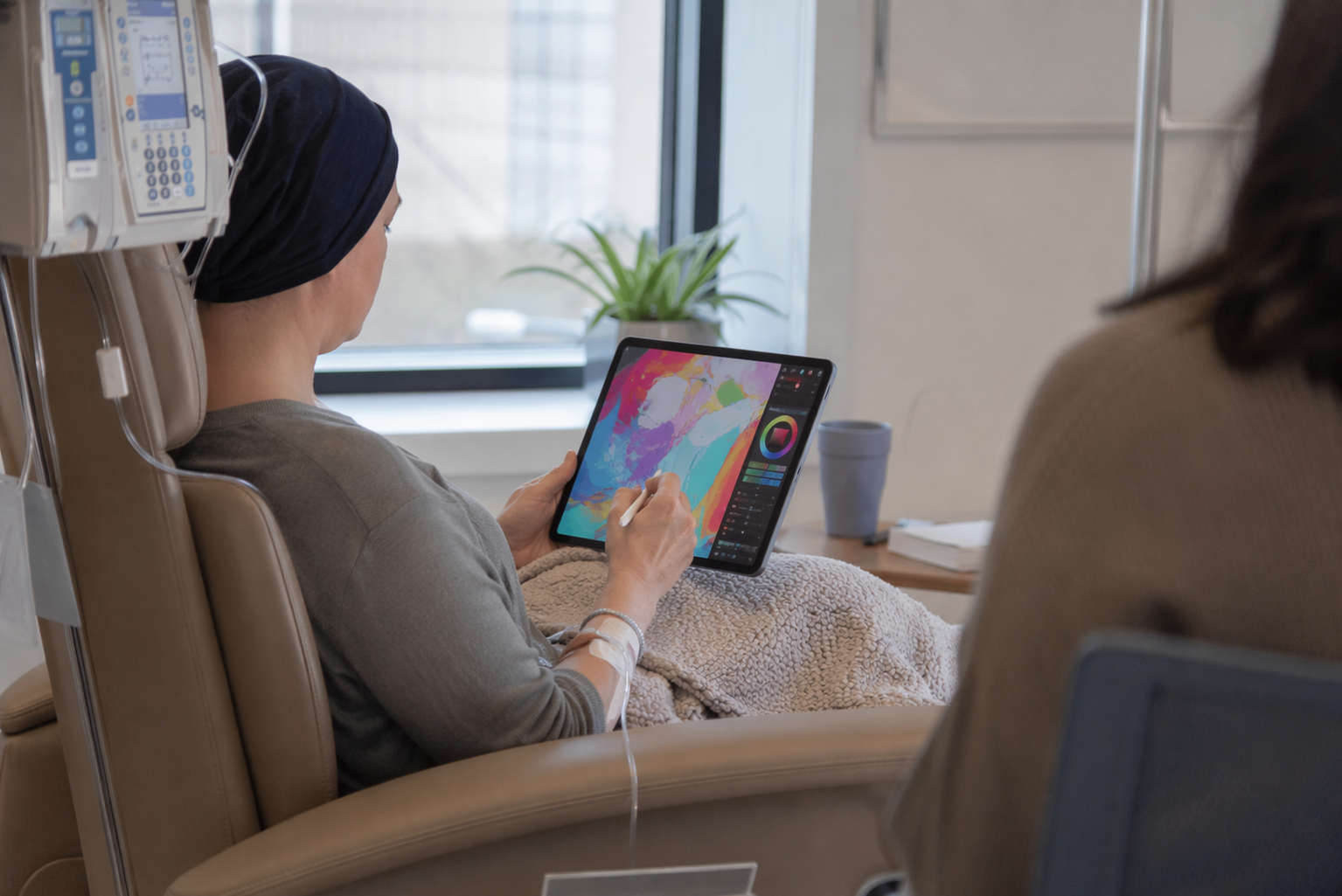
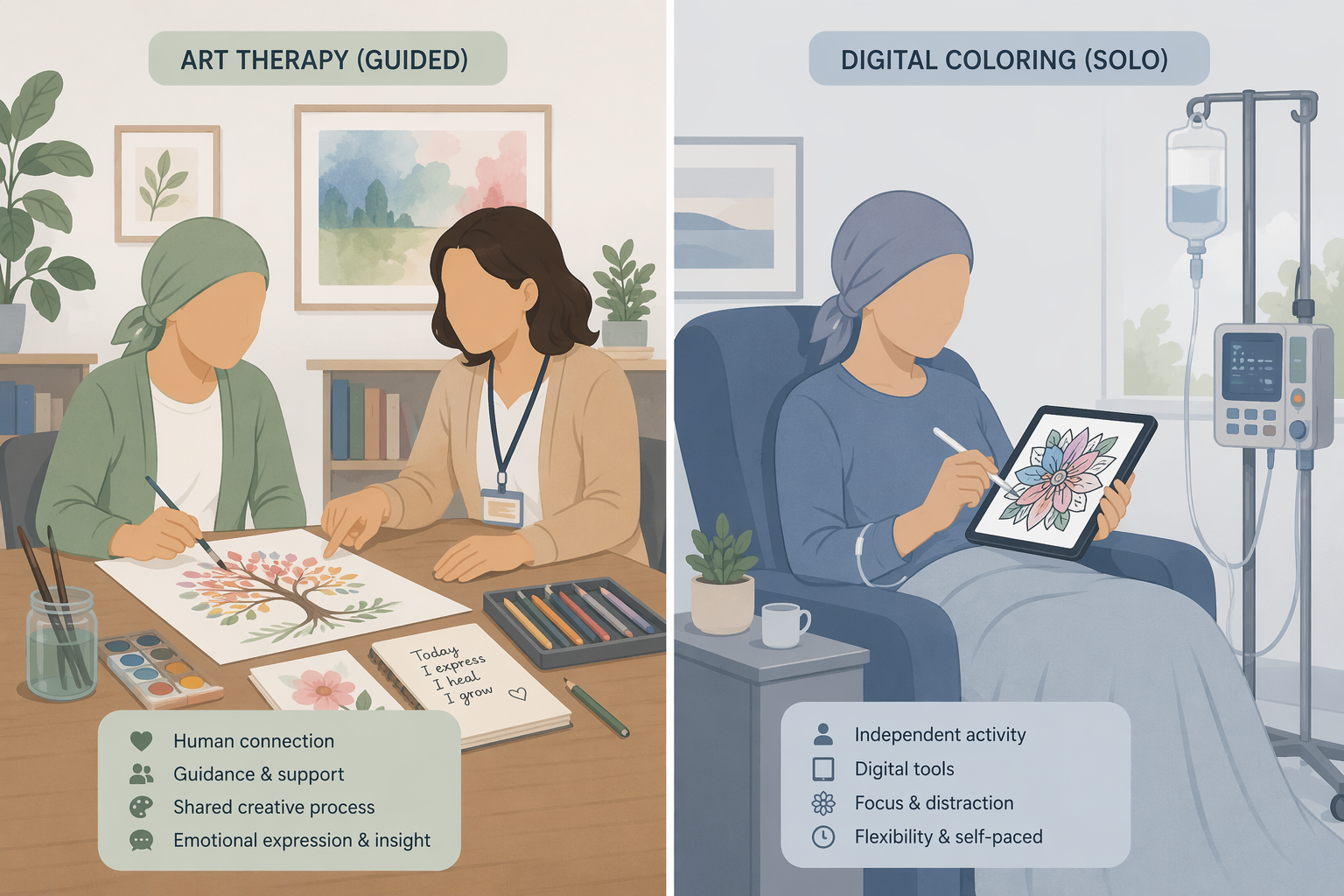
In the infusion chair, coloring, art making, and art therapy can look similar from a distance, but they do different clinical work. A patient scrolling through a coloring app may be getting a usable distraction for the hour; a therapist-led session adds interpretation, containment, and a relationship that does not exist once the screen closes.
Therapy and Coloring Are Not the Same Intervention
That distinction matters because the literature often uses art therapy to describe activities that are really self-directed art making or coloring. For oncology programs, those are not interchangeable categories. The first depends on a credentialed therapist and a clinical frame; the second may be helpful, but it is closer to a support tool than a treatment relationship.
What the 2026 Review Actually Supports
The strongest current evidence for digital art therapy in adults with cancer is not efficacy in the strict sense. It is feasibility and acceptability. The 2026 scoping review by Li and colleagues places the field at that stage: digital art therapy appears workable for cancer populations, but the evidence base has not yet moved into rigorous clinical proof that it reliably improves outcomes.
That is the right level of caution for a hospital reader. A digital platform can be easy to deploy and easy for patients to tolerate, yet still fail to show enough benefit to justify calling it a substitute for therapist-led care. The review supports a narrower claim: digital tools may extend access to creative support, especially when time, fatigue, or location make in-person sessions difficult. It does not show that the digital version has replaced the clinical value of the human one. [1]
Why the Benchmark Matters
The comparison point is not theoretical. In a small pilot study of 15 radiation oncology patients who completed both sessions, open studio art therapy and self-directed coloring were each associated with psychological improvement, with reported effect sizes of 25.7% to 45.4%. That does not settle questions of durability or comparative efficacy, but it does establish an important benchmark: creative activity itself can be meaningful, and the question for digital formats is how much of that effect survives when the medium changes. [2]
Seen that way, coloring apps during chemotherapy are not trivial. They may be the most realistic option for a patient who cannot manage a live session. But the pilot study also keeps the claim modest. It shows that self-directed coloring can do something, not that it does everything that art therapy does.
The Most Developed Digital Example Keeps a Therapist in the Loop
ArtCAN Teens is the clearest sign that developers understand the replacement problem. It is described as the first digital art therapy tool created specifically for adolescent and young adult brain cancer survivors, and its planned intervention study runs for 6 weeks with prompts built into the experience. [3]
The more important design choice is that the app was not framed as therapist-free care. It was built to keep a human art therapist in the loop. That matters more than the novelty of the interface, because the field’s most credible digital products seem to be the ones that support access without pretending the clinical relationship is optional. [3]
Signals From AI, Pain, and Color
The generative AI discussion is useful mainly because it exposes the boundary of current enthusiasm. In a 2024 survey, art therapists reported positive expectations about AI-assisted art therapy for melanoma patients, but concerns about preserving the therapeutic relationship remained visible. That is an attitude finding, not a proof of benefit, and it says more about professional openness than about patient outcomes. [4]
Broader art therapy literature is consistent with the idea that creative interventions can matter for symptoms without making the digital leap easy. A 2025 scoping review of 23 studies on art therapy for cancer-related pain found significant pain reductions in 8 studies and small or no effects in 3, while roughly 40% of cancer survivors report moderate-to-severe pain. That supports art therapy as a plausible adjunct for symptom relief, but it does not solve the question of whether a technology platform can carry the same therapeutic weight. [5]
A separate randomized trial from Iran found that blue environmental color reduced chemotherapy anxiety scores from 57.70 to 50.03, with p<.05 and η²=0.131. It is an interesting reminder that color and setting can affect mood, but it is not the same thing as art therapy, and its cultural meaning may not travel cleanly into other settings. [6]
Taken together, the evidence supports digital art therapy and coloring tools as adjuncts that may be feasible, acceptable, and useful during chemotherapy. It does not yet support calling them replacements for therapist-led care. The most credible digital work in this area is still the work that leaves room for a human therapist to do what software cannot.
References
- Digital art therapy for adults with cancer: a scoping review — PMC, 2026
- Pilot study of open studio art therapy and self-directed coloring in radiation oncology patients — PMC, 2020
- ArtCAN Teens: digital art therapy for adolescent and young adult brain cancer survivors — UC/UNC, 2025
- Survey of art therapists on generative AI-assisted art therapy for melanoma patients — MDPI, 2024
- Scoping review of art therapy for cancer-related pain — PMC, 2025
- Randomized controlled trial of blue color therapy for chemotherapy anxiety — PMC, 2025
Comments
Join the discussion with an anonymous comment.