
The most important phrase in the Military Health System’s current approach to AI is not “artificial intelligence.” It is “horizontal synergy across all services.” That is the job the MHS Digital Policy Council was created to do: give enterprise review to a rapidly expanding AI portfolio before branch-by-branch variation, duplicate pilots, and inconsistent data practices become embedded in clinical operations. The council was chartered in March 2025, and by September 2025 MHS leaders were describing an inventory of more than 100 AI projects moving through the system’s governance process.[1]
For a health system serving roughly 9.5 million beneficiaries, that scale changes the meaning of oversight.[1] A single pilot can be managed through local enthusiasm and a few careful reviewers. More than 100 projects across military treatment facilities, service components, research groups, and health IT environments require something more durable. Coordination becomes safety infrastructure.

What The Council Has Actually Built
The public record describes the Digital Policy Council as an enterprise body rather than a promotional forum. Its role is to review AI activity across the MHS and align it with governance mechanisms that are recognizable to anyone who has watched health technology scale badly: ownership, expertise, auditability, and workforce preparation. The September 2025 MHS article organizes the council’s oversight model around four pillars: policy and process accountability; inclusive expertise spanning clinicians, scientists, and technologists; audit platforms and data integrity; and workforce AI training certification.[1]
| Oversight Pillar | Operational Meaning |
|---|---|
| Policy and process accountability | AI projects need a defined route into review, a responsible governance home, and a process that can be applied across the enterprise rather than improvised locally. |
| Inclusive expertise | Clinical, scientific, technical, and operational perspectives are meant to meet before tools are normalized in care settings. |
| Audit platforms and data integrity | The system needs ways to examine the data, performance, and traceability of AI tools rather than relying only on vendor claims or initial model results. |
| Workforce AI training certification | Clinicians, IT teams, and other users need enough AI literacy to understand appropriate use, limitations, and escalation paths. |
Those pillars matter because military healthcare AI policy cannot be reduced to model approval. A tool that appears useful in one environment may create new risk when it crosses facilities, patient populations, data systems, or operational settings. Governance has to ask not only whether an algorithm works under test conditions, but who owns it, who monitors it, who can stop or modify it, and what happens when its output conflicts with clinical judgment.
That is why the reported project inventory is more than an impressive number. More than 100 AI projects means the MHS is not dealing with a speculative future; it is managing a present-tense portfolio.[1] The useful question is not whether the military health system is “innovating.” It plainly is experimenting with and organizing around AI. The harder question is whether the council can turn that activity into a coherent enterprise capability.
The Four Pillars Are A Governance Model, Not A Deployment Record
The first pillar, policy and process accountability, is the least glamorous and probably the most necessary. In a large health system, a vague instruction to “coordinate” does not survive contact with procurement timelines, local champions, vendor demonstrations, cybersecurity review, and clinical urgency. A council with a charter and a project inventory gives the enterprise at least one place to ask: Is this already being done somewhere else? Has the right authority reviewed it? Does the project match MHS priorities, or is it solving a local problem in a way that will create enterprise fragmentation?
The second pillar, inclusive expertise, addresses a familiar failure mode in health AI: letting one discipline dominate the definition of success. A model can be technically elegant and clinically awkward. It can satisfy a workflow metric while creating documentation burden. It can be attractive to leadership and still be unusable by deployed care teams. The council’s stated inclusion of clinicians, scientists, and technologists is therefore not decorative; it is the minimum mix needed to expose different categories of failure before they become operational habits.[1]
The third pillar, audit platforms and data integrity, is where military healthcare AI policy becomes concrete. AI oversight depends on knowing what data trained or informed a tool, whether the data are representative enough for the intended use, how outputs are monitored, and whether performance changes after deployment. Without auditability, governance becomes a paper exercise: projects can be described, approved, and celebrated without a reliable way to detect drift, bias, integration failure, or misuse.
The fourth pillar, workforce AI training certification, recognizes that safe deployment is partly a human-factors problem. Training cannot make a weak tool strong, but the absence of training can make even a carefully reviewed tool unsafe. Users need to know whether an AI output is advisory, what evidence supports it, when to override it, how to report problems, and where accountability sits when the tool influences a care decision.
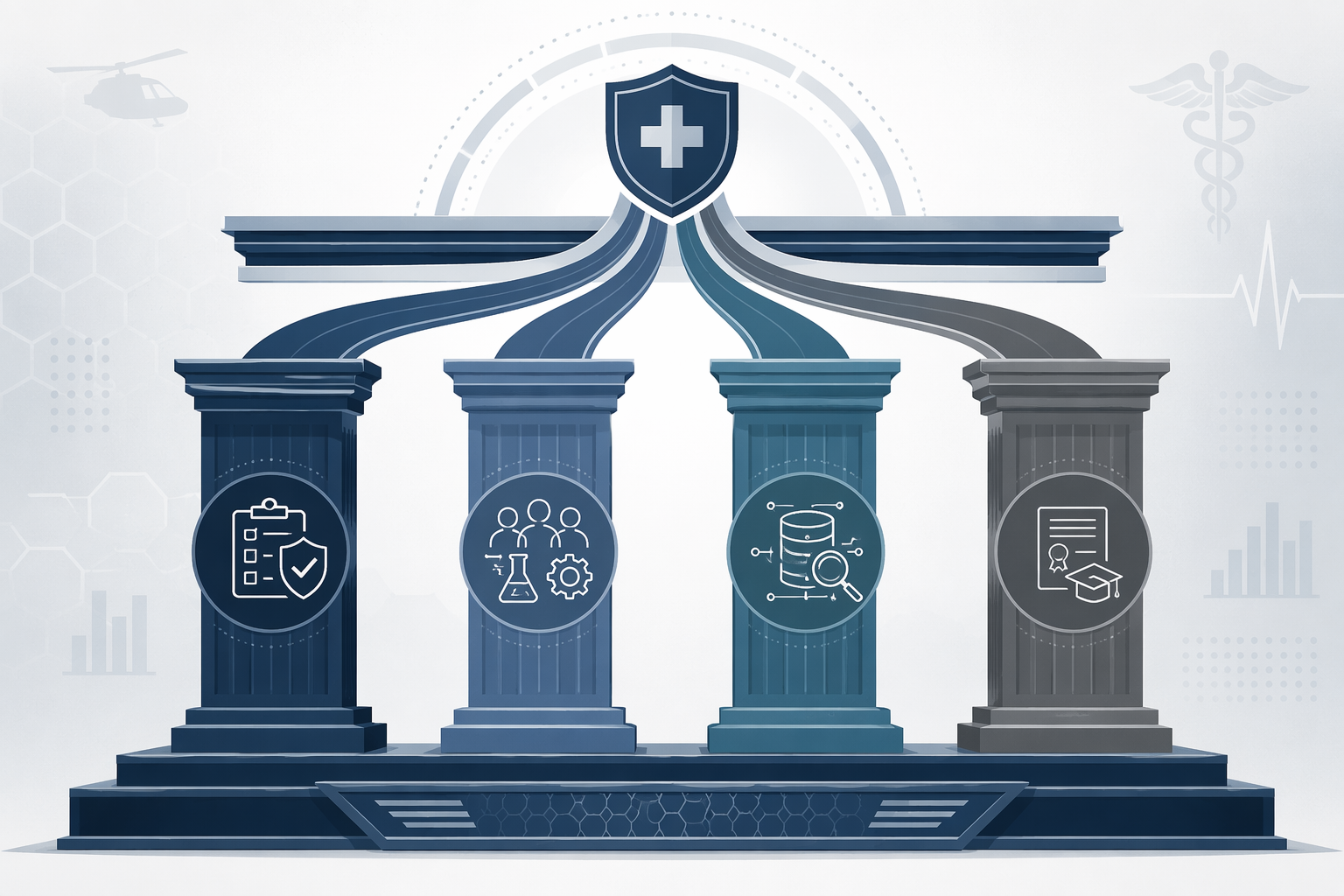
Taken together, the pillars form a structurally sound model. They cover the major places where AI programs usually fail: unclear ownership, narrow review, weak data controls, and unprepared users. But the public materials do not yet show how often the council meets, who sits on it, how project maturity is assessed, or what enforcement authority it has when a service-specific initiative conflicts with enterprise standards. Those omissions do not invalidate the framework. They do limit what can be concluded from it.
Where Digital Transformation Broadens The Council’s Role
The Digital Policy Council sits inside a wider MHS digital transformation agenda, not beside it. A May 2025 DVIDS article described MHS digital transformation through four lines of effort: improving the patient experience, empowering the workforce, optimizing operations, and strengthening data and analytics.[2] Those lines of effort help explain why AI governance is being treated as an enterprise matter rather than a technical specialty.
AI can touch each of those lines at once. A scheduling, triage, documentation, imaging, or decision-support tool may affect patients, clinicians, administrators, data teams, and commanders simultaneously. If governance is separated from the broader digital strategy, AI projects can be approved for narrow utility while undermining larger transformation goals. If governance is integrated, the council can ask whether a project advances the system’s operating model or merely adds another tool to an already crowded environment.
This is the strongest argument for the council’s placement. AI review is not only about preventing harm. It is also about deciding which forms of automation, prediction, and decision support deserve scarce implementation capacity. Large health systems do not lack pilots; they lack the ability to absorb every promising pilot without creating operational noise. A council that inventories projects and ties review to enterprise digital priorities can reduce duplication before it becomes sunk cost.
The Data Standardization Problem Is Not Administrative Detail
The first hard test for the council is data standardization across service branches. Military healthcare has enterprise institutions, but it also has service-specific histories, workflows, reporting habits, and operational assumptions. AI systems depend on data definitions that remain stable enough to compare, train, audit, and improve. If one branch records, labels, extracts, or interprets data differently from another, an enterprise AI project can inherit inconsistency long before a model is deployed.
This is where “horizontal synergy across all services” becomes a measurable governance challenge rather than a phrase.[1] Standardization does not mean every facility or service loses operational context. It means the enterprise knows which differences are clinically meaningful, which are artifacts of local process, and which make AI outputs unreliable outside their original setting. That distinction has to be made before leaders treat a successful pilot as a scalable capability.
For example, a hypothetical readiness-support tool might appear to identify patterns in appointment access, medication continuity, or deployability-related documentation. If the underlying data fields are defined differently across branches, the tool may be learning local documentation behavior as much as patient or force-health reality. The governance question is not simply whether the algorithm performs well somewhere. It is whether the data environment lets the MHS know where “somewhere” ends.
The public sources identify data integrity as one of the council’s pillars, which is encouraging.[1] They do not yet provide a branch-by-branch map of data standardization gaps, a breakdown of which AI projects depend on cross-service data, or examples of projects delayed, modified, or rejected because data quality was not sufficient. Those would be the kinds of evidence that show governance moving from architecture into operational discipline.
Contested Environments Put Different Pressure On AI Governance
The second hard test is deployment outside comfortable assumptions. Military medicine includes hospitals and clinics that resemble civilian care environments in many ways, but the readiness mission also points toward contested, degraded, mobile, or operationally constrained settings. AI tools built for stable connectivity, predictable staffing, and conventional information governance may behave differently when those assumptions are weakened.
This is where security, privacy, and operational need can collide. Health information protections do not disappear because a care team is under pressure. At the same time, deployed medical personnel may need fast access to decision support, patient context, or population-level insight under conditions that make normal enterprise workflows difficult. AI governance for military healthcare has to anticipate that tension before a tool is placed into a readiness scenario.
The council’s pillars provide places to ask the right questions. Policy accountability can define who authorizes use in operational settings. Inclusive expertise can bring deployed clinicians and technologists into review before assumptions harden. Audit and data integrity can identify what must be logged, monitored, or restricted. Workforce certification can prepare users to understand when an AI recommendation is unsafe to follow or impossible to validate.
What is not yet visible is the evidence that those questions are being answered in deployment-specific terms. The available public materials do not document contested-environment test results, readiness metrics tied to AI governance, or cases where the council changed a tool’s deployment pathway because battlefield or operational constraints altered the risk profile. That is the gap between a credible governance framework and proof of readiness impact.
What The Public Record Does Not Show Yet
There are several things the current record supports: the council exists, it was chartered in March 2025, it is associated with an inventory of more than 100 AI projects, and MHS leaders describe a four-pillar oversight structure connected to wider digital transformation work.[1][2] Those are not minor facts. They show institutional intent and a recognizable governance architecture.
There are also several things the record does not support. It does not show the council’s specific membership list. It does not show meeting cadence. It does not break down the 100-plus projects by type, maturity stage, clinical domain, vendor status, or service branch. It does not provide a public enforcement record showing what happens when a project fails to meet enterprise expectations. It does not demonstrate, in published metrics, that council-reviewed AI projects have improved frontline readiness outcomes.
That boundary matters for policy readers because adoption and effectiveness are different claims. A growing AI portfolio shows activity. A governance council shows coordination capacity. Neither, by itself, proves safer care, faster readiness decisions, reduced administrative burden, or better operational performance. Those outcomes require measurement.
The next layer of evidence would not need to expose sensitive operational details. Even high-level reporting could clarify whether the council is reducing duplicate efforts, standardizing data requirements, requiring workforce training before use, identifying tools that should not scale, or connecting AI review to readiness indicators. Without that, outside observers can assess the architecture but not its effect.
A Credible Foundation, With Proof Still Pending
The MHS Digital Policy Council is a serious response to a real scaling problem. In a system this large, with more than 100 AI projects reported across the enterprise, leaving coordination to local initiative would be a safety risk masquerading as flexibility.[1] The council’s four-pillar model addresses the right institutional questions: who is accountable, whose expertise counts, how data integrity is protected, and whether the workforce is prepared to use AI appropriately.
The unresolved issues are not peripheral. Branch-level data variation will determine whether AI tools can travel across the enterprise without importing hidden inconsistency. Contested-environment deployment will determine whether tools reviewed under ordinary conditions can support care when connectivity, staffing, security, privacy, and operational urgency are under strain. Those are the places where governance either becomes readiness infrastructure or remains well-designed documentation.
As of Q3 2026, the fairest judgment is conditional. The Digital Policy Council gives the Military Health System a credible foundation for safe AI adoption at scale. The public evidence does not yet show whether that foundation is producing measurable frontline readiness outcomes.
References
- Harnessing the power of AI governance for warfighter readiness, DVIDS, September 15, 2025.
- MHS Digital Transformation, DVIDS, May 19, 2025.
Comments
Join the discussion with an anonymous comment.