
A blanket Ebola travel ban has an immediate political appeal: it looks like a closed gate at the exact moment the public wants one. The trouble is that Ebola transmission does not move only through the gate. It moves through contact chains, delayed diagnosis, unsafe care, burial practices, overwhelmed isolation units, and the time it takes to find the next exposed person. That is why the practical question is not whether movement matters. It is whether broad movement suppression buys enough useful time to justify what it does to outbreak work.
The best clean test of the headline claim still comes from the 2014 West African Ebola epidemic. A Eurosurveillance modeling study estimated that even a 60% reduction in airline traffic from affected countries would delay international case importation by only a few weeks. The same paper described the underlying rule more generally: a 50% reduction in travel produces a delay roughly equal to the epidemic doubling time.[1]

A few weeks can matter. They can let a ministry open isolation beds, move protective equipment, train triage teams, and build a contact-tracing roster. But the delay has to be used for those things. If the measure also slows cargo routing, strands laboratory specimens, discourages volunteer clinicians, or forces evacuation coordinators into improvised detours, the clock it buys is not free time. It is borrowed time with administrative interest.
What “Only a Few Weeks” Means in an Ebola Response
The 2014 modeling result is sometimes treated as if it proves travel restrictions never do anything. That is too blunt. The model found delay, not zero effect. But a delay proportional to the epidemic doubling time is a narrow kind of benefit. It does not extinguish transmission. It does not identify exposed travelers. It does not isolate symptomatic patients. It shifts the arrival date of risk while the outbreak’s internal engine keeps running.
That distinction matters because border policy is often judged by its visibility rather than by the work it displaces. Cutting flights can mean fewer direct routes for responders, fewer predictable cargo paths for gloves and gowns, fewer commercial options for getting samples to reference laboratories, and more friction for medical evacuation. A minister can announce the restriction in one sentence. The operational consequences arrive as a queue.
The 2014 finding also should not be stretched beyond its evidence. It modeled the West African epidemic caused by Zaire ebolavirus, not every Ebola event in every geography. The airline network, outbreak size, surveillance capacity, and local transmission dynamics all affect the value of travel-related interventions. Its durable lesson is more specific: large reductions in air traffic can produce modest delays, so the policy case for blanket restrictions depends on what the response can do with that delay.
The Larger Lever Is Isolation, Not the Border Switch
The 2026 Bundibugyo virus outbreak in the Democratic Republic of Congo and Uganda brings the issue back in a different setting. It is not the same virus species, not the same geography, and not the same travel network as West Africa in 2014. But the operational hierarchy is familiar: cases must be found, separated from susceptible contacts, and supported by staff who can keep working safely.
A CDC branching-process model published in June 2026 makes that hierarchy hard to miss. In the model, when 70% of patients were isolated, only about 5% of simulations projected more than 10,000 cases within 3 months. When patient isolation was only 20%, 65% of simulations exceeded 20,000 cases.[2]
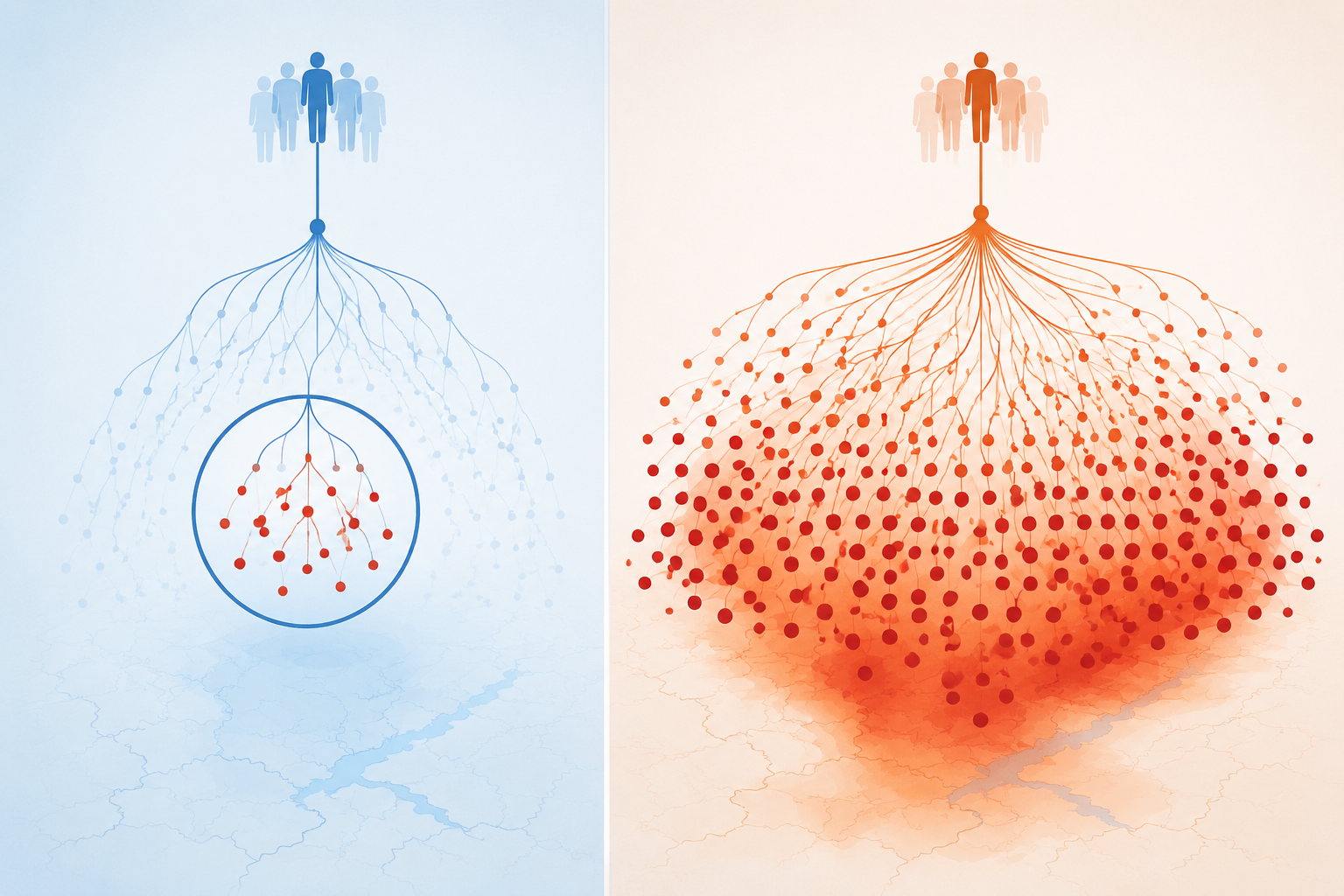
Those numbers are model outputs, not a promise about the final size of an ongoing outbreak. They are still more useful for policy than a generic argument about being tough at the border. They show a mechanism: increasing isolation changes the number of infectious encounters that can seed the next branch of the outbreak. A travel ban mostly acts outside that chain. Isolation cuts into it.
That is why a travel delay without isolation capacity is a weak bargain. If the added time is spent debating entry rules while treatment units remain short-staffed, exposed contacts are not monitored, and suspect cases wait in unsafe spaces, the epidemic’s branching structure keeps doing what it was already doing. The spreadsheet may show fewer arrivals at one airport. The ward still has the consequential queue.
| Policy Lever | What It Can Do | What It Cannot Do Alone |
|---|---|---|
| Blanket travel restriction | Delay international importation in some models | Stop local transmission chains or identify exposed people |
| Patient isolation | Reduce infectious contacts after cases are detected | Work without beds, staff, transport, and trust |
| Targeted quarantine | Restrict movement for people with credible exposure risk | Remain fair without clear criteria, review, and support |
| AI-informed risk assessment | Help sort mobility and exposure signals at finer resolution | Replace public health judgment or legal accountability |
Blanket Rules Push Costs Onto the Response
The legal and ethical problems are not separate from the operational ones. In May 2026, The Guardian reported controversy over U.S. restrictions on American travelers exposed to deadly viruses, including Ebola, after affected travelers were redirected to Germany and Czechia rather than allowed to return directly to the United States. The report raised questions about citizens’ right to re-enter their own country and whether such measures could deter volunteer responders from deploying.[3]
A responder deciding whether to join an Ebola mission already has to think about personal risk, family obligations, employer support, insurance, evacuation arrangements, and the possibility of post-deployment monitoring. Add uncertainty about whether they can get home if exposed, and the system has created a new disincentive for exactly the trained people it needs. That is not an abstract rights problem sitting off to the side. It lands in staffing rosters.
None of this means exposed travelers should move freely because they are useful or sympathetic. Targeted quarantine can be necessary, especially when exposure is credible and the consequences of onward transmission are severe. The point is that restrictions need a reason tied to actual risk, a duration tied to the incubation period and monitoring protocol, and a process that can be explained before the airport desk becomes the first place anyone hears the rule.
What Targeted Quarantine Looks Like When It Is Not a Slogan
The constructive alternative is not simply to say “use AI” and move on. The practical alternative is a workflow: classify exposure, monitor according to that classification, restrict movement when warranted, and revise the decision as information changes. ECDC’s June 2026 guidance for travelers returning from Ebola-affected areas used a four-tier risk classification, ranging from “no exposure” to “high-risk exposure,” with corresponding contact-tracing, monitoring, and movement-restriction protocols.[4]
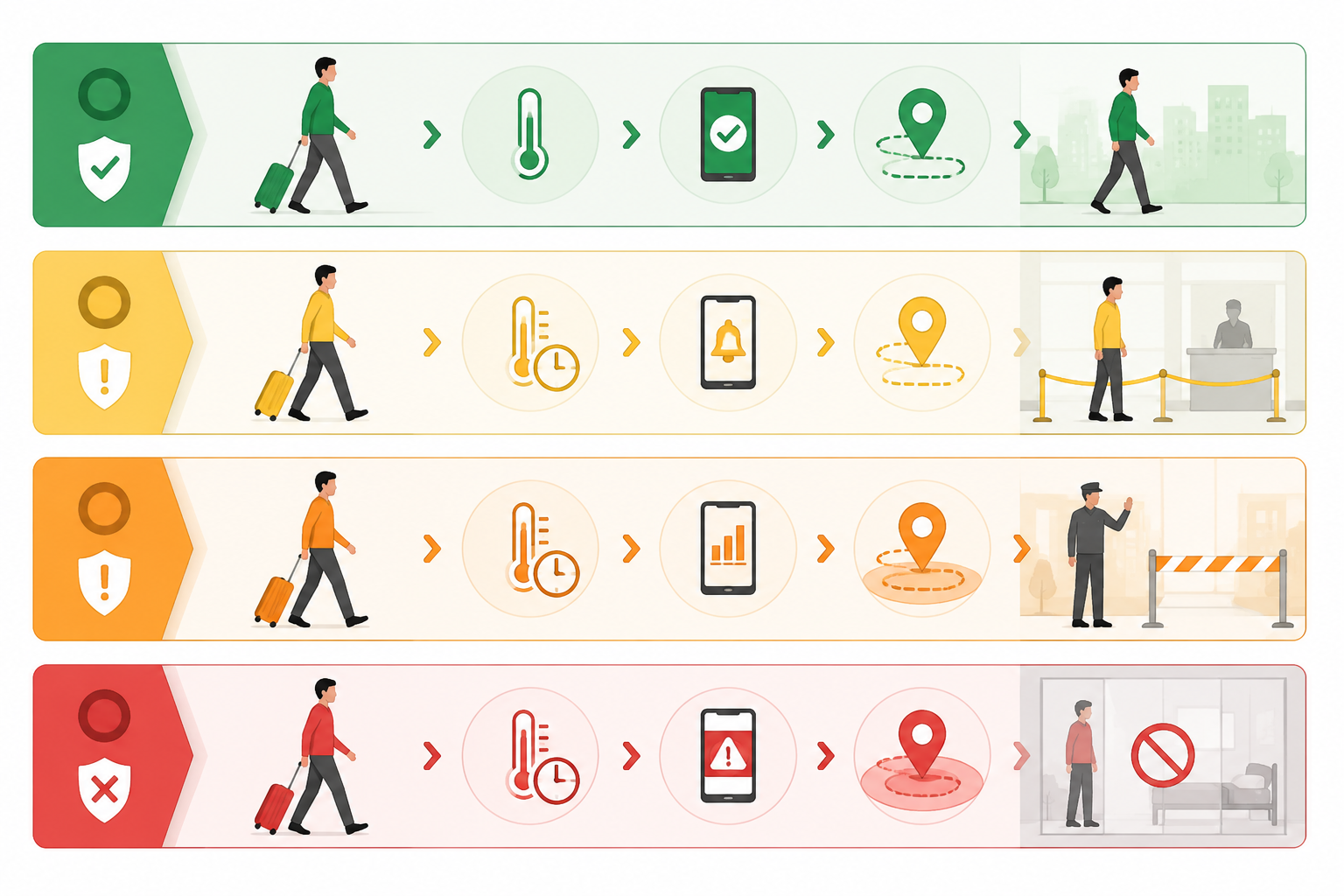
That kind of tiering is where AI can be useful, provided the claim stays modest. Machine-learning systems can help integrate mobility data, contact networks, symptom reports, exposure histories, and granular geospatial signals. They can flag which travelers need a call today, which contacts need active monitoring, which routes matter for specimen transport, and which communities may need surge support. They can also make a messy operation more auditable if each risk score is attached to defined inputs and human review.
But the available evidence does not show that an autonomous AI system solved the 2026 Bundibugyo travel-policy problem in real time. Established modeling can estimate delays and outbreak trajectories. Structured risk algorithms can guide quarantine decisions. AI can extend those tools by processing more granular and faster-changing data. Those are different claims, and they should not be collapsed into one technology story.
A Better Quarantine Decision Has a Paper Trail
A defensible targeted quarantine system starts before restriction. It asks what exposure occurred, when it occurred, whether protective equipment was used, whether symptoms are present, what monitoring is feasible, and what support the person needs to comply. Movement limits should then follow the risk tier, not nationality, fear, or the easiest flight itinerary to block.
- Classification: place travelers and contacts into defined exposure tiers using documented criteria.
- Monitoring: match the intensity of follow-up to the tier, including symptom checks and rapid escalation.
- Restriction: limit movement only when the exposure category and public health risk justify it.
- Support: provide instructions, transport, lodging, income protection, or care access when compliance depends on them.
- Review: update the decision when test results, symptom status, exposure details, or outbreak geography change.
AI can improve several points in that chain, but it also raises the cost of sloppy governance. If a model cannot show why a traveler was escalated from monitoring to restriction, the system has not become more precise in any meaningful public health sense. It has become harder to contest. Precision without traceability is just another kind of blunt instrument.
The Measure of Success Is Preserved Response Capacity
The evidence points toward a practical standard. A travel measure should reduce real transmission risk while preserving the people, supplies, routes, and trust needed to control the outbreak. The 2014 travel-restriction model gives a warning about scale: even a large aviation reduction may only delay importation by weeks.[1] The 2026 CDC Bundibugyo model shows where the larger effect sits: the difference between high and low isolation changes projected outbreak size far more sharply.[2]
A blanket Ebola travel ban may still be politically easier to announce than a staffed isolation plan, a contact-tracing surge, or a lawful targeted quarantine protocol. It is also easier to misread. Delay is not containment. A closed route is not a monitored contact. A stranded clinician is not a safer public.
AI succeeds in this setting only when it makes quarantine more precise, auditable, and proportionate. It should help officials see which risks need action and which movements must remain open for the response to function. Used that way, it can support the hard work of Ebola control. Used as a gloss on indiscriminate restriction, it only gives an old policy failure a newer dashboard.
References
- Assessing the impact of travel restrictions on international spread of the 2014 West African Ebola epidemic, Eurosurveillance, 2014.
- Modeled Scenario Projections for the Ebola Disease Outbreak Caused by Bundibugyo Virus, 2026, CDC MMWR, June 11, 2026.
- US curbs on travelers exposed to deadly viruses may infringe rights and deter volunteers, The Guardian, May 21, 2026.
- Risk classification and contact tracing of travellers returning from affected areas – Ebola disease outbreak 2026, ECDC, June 2026.
Comments
Join the discussion with an anonymous comment.