
The most important word in the current fight over AI data centers may not be “AI.” It may be “easement.” In Wisconsin, a 600-acre data center associated with the Stargate buildout has put rural land, transmission access, condemnation authority, and litigation into the same planning file. ABC News reported that landowners facing eminent domain proceedings challenged the use of condemnation powers connected to the project, turning what looks from a national distance like a compute-capacity story into a local fight over who must surrender land so power can reach the site.[1]
For healthcare AI leaders, the case matters less as a referendum on one Wisconsin project than as a warning about where the schedule risk really sits. A model may be approved by an internal governance board, a vendor may be selected, and a clinical service line may be waiting. But if the capacity behind that deployment depends on data center expansion, and that expansion depends on transmission lines crossing contested land, then the calendar has already left the procurement spreadsheet.
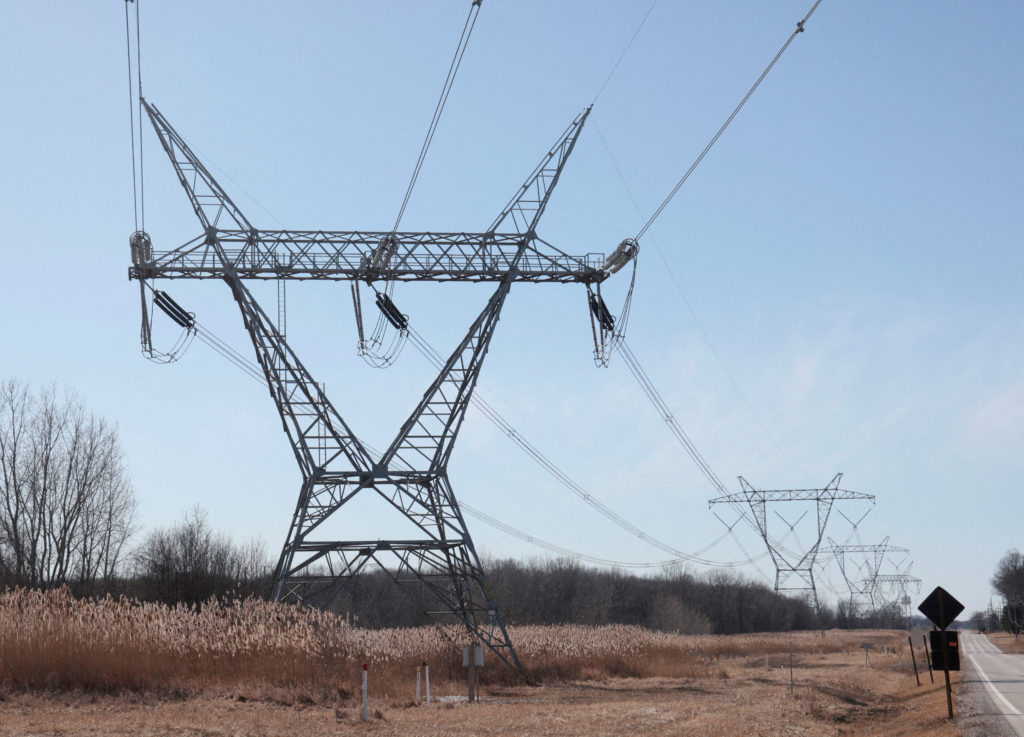
That is the practical frame for eminent domain’s impact on healthcare AI infrastructure. The direct evidence does not show that one landowner lawsuit delayed one hospital’s AI rollout. It shows something narrower and still material: AI data center growth is colliding with land-use law, transmission buildout, interconnection queues, and scarce colocation markets at the same time healthcare organizations are trying to make clinical AI programs dependable.
The Bottleneck Starts Before the Data Center Opens
The Wisconsin dispute is not an isolated political theater piece. PBS NewsHour has documented landowner opposition to high-voltage transmission projects tied to rising AI and data center electricity demand, including fights in Quincy, Washington, Pennsylvania, and Georgia. In Quincy, the reporting described the attempted seizure of property interests across 84 parcels for transmission infrastructure connected to data center expansion.[2]
Those cases should not be flattened into a single national pattern where every transmission project is the same or every landowner claim will prevail. They do show that the physical route between generation, grid capacity, and data center load is increasingly contested. The fight is not only over where servers sit. It is over corridors, substations, rights-of-way, and whether a project serving private data center demand can be justified under public-use doctrines.
The legal premise is not new. The U.S. Supreme Court’s 2005 decision in Kelo v. New London upheld the use of eminent domain for an economic development plan, a decision that still shapes debates over whether private development can satisfy a public-use requirement. A Texas Undergraduate Law Journal discussion applying Kelo-era doctrine to AI data centers underscores why these projects sit in uncomfortable legal territory: they may support broader economic and infrastructure goals, but the immediate beneficiary can still look like a private platform company or utility customer.[3]
That ambiguity is exactly where schedule risk grows. A clean capital plan assumes site control, interconnection milestones, permitting, power delivery, and construction sequencing. Condemnation challenges and community opposition do not need to defeat a project outright to matter. They can add uncertainty to routing, require redesign, shift cost allocation, or leave counterparties unwilling to make firm capacity commitments.
Federal Acceleration Does Not Remove Local Friction
The federal government has moved in the opposite direction from local caution. Executive Order 14318, issued July 23, 2025, directed federal agencies to accelerate data center and related infrastructure development, treating AI infrastructure as a national security and economic priority.[4]
That policy stance can change the siting environment without eliminating the legal fights. It signals urgency to agencies, utilities, and developers. It does not make a farmer’s easement dispute vanish, guarantee state-level condemnation authority will be upheld, or give healthcare organizations formal standing when transmission capacity is allocated around larger buyers.
WilmerHale’s July 2026 analysis of AI-related data center litigation describes a current wave of lawsuits around permitting, environmental review, power, water, and local authority. The important limitation is that many of these suits are early-stage; they are not mature precedent. For planning purposes, though, early-stage does not mean irrelevant. It means the risk is still being priced, negotiated, and discovered while projects are already being announced.[5]
Transmission Delay Meets an Already Tight Compute Market
If the data center market had abundant slack, eminent domain fights would be a local development concern with limited downstream consequence. The market does not have that slack. Deloitte’s 2025 AI Infrastructure Survey reported that grid interconnection waits can reach about seven years, a timeline that is long enough to outlast multiple hospital technology roadmaps.[6]
PBS reported that U.S. transmission spending is projected to nearly double to about $50 billion per year by 2028, a figure that reflects how much grid investment is now being pulled forward by electrification, load growth, and data center demand.[2]
McKinsey’s October 2024 analysis put the data center supply gap in still sharper terms: the United States could face a data center supply deficit of more than 15 gigawatts by 2030. The same analysis found that colocation pricing rose 35% from 2020 to 2023, while Northern Virginia vacancy was below 1% in 2024.[7]
| Constraint | What the cited material supports | Why it matters for healthcare AI planning |
|---|---|---|
| Land and condemnation disputes | Transmission and siting fights are already appearing around AI-driven data center growth | Capacity timelines can slip before a hospital ever signs a compute contract |
| Grid interconnection | Waits can reach about seven years | A clinical AI roadmap may depend on infrastructure outside the vendor’s direct control |
| Data center supply | The U.S. could face a supply deficit above 15 GW by 2030 | Healthcare buyers compete for capacity in a market built around larger cloud and platform demand |
| Colocation scarcity | Prices rose 35% from 2020 to 2023 and Northern Virginia vacancy was below 1% in 2024 | Backup plans that assume easy colocation access may be unrealistic |
These numbers do not prove that eminent domain litigation is the dominant cause of healthcare AI compute scarcity. They show something more operationally useful: the system has multiple choke points, and land disputes are arriving in a market where delays are already expensive.
Why Hospitals Feel a Constraint Built for Hyperscalers
Healthcare AI does not consume compute in one uniform way. Training large foundation models, fine-tuning models, running imaging workflows, summarizing records, supporting ambient documentation, and delivering real-time inference place different demands on GPUs, latency, storage, networking, and governance. The common thread is that clinical adoption turns compute from an experiment into an operating dependency.
Iceotope’s April 2026 analysis described healthcare organizations moving more AI inference on-premises because of data sovereignty requirements and unpredictable cloud costs.[8] Forbes, in June 2026, similarly pointed to healthcare GPU cost pressure and reported that sovereign data center builds can take two to five years.[9]
That two-to-five-year window is where many hospital AI plans become vulnerable. A health system may decide that a cloud-only strategy creates too much recurring cost exposure or too much data-control uncertainty. It may then explore sovereign, private, or hybrid infrastructure. But those alternatives do not escape the same physical constraints. They move the questions closer to home: where is the power, how is it cooled, who interconnects it, what equipment is committed, and how long before the site can support production inference?
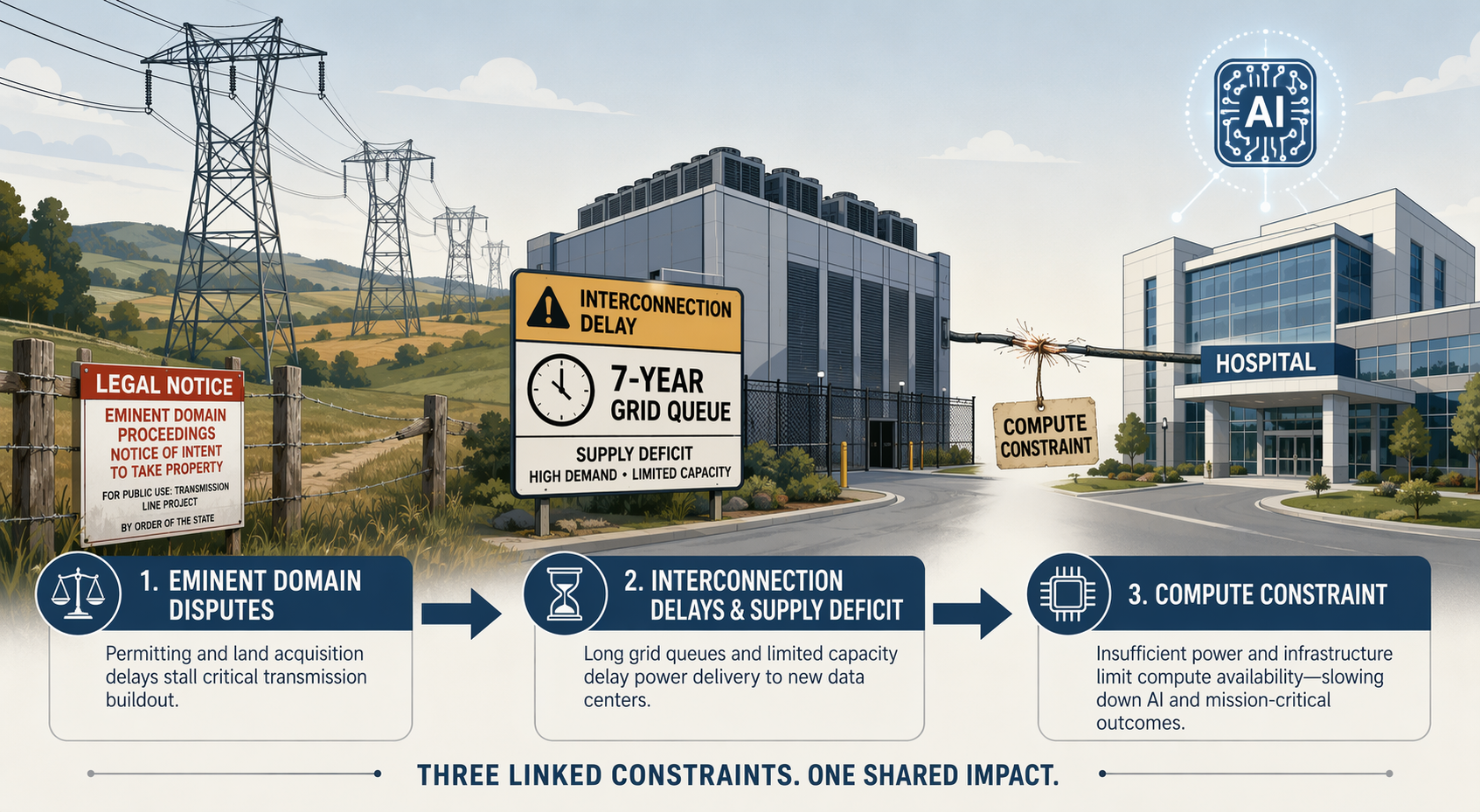
The asymmetry matters. Microsoft, Google, Amazon, and other hyperscale buyers can shape GPU allocation, power purchase agreements, and data center development at a scale most healthcare organizations cannot match. A regional health system may be a strategically important customer in healthcare, but it is not usually the buyer that determines where the next major AI campus is built or which transmission upgrade is prioritized.
That is why an infrastructure dispute in another county can still belong in a healthcare AI risk register. The hospital is not waiting on the lawsuit itself. It is waiting on a capacity market that the lawsuit can help tighten.
The Planning Error Is Treating Compute as a Neutral Line Item
A credible healthcare AI program calendar now needs two timelines. One is the familiar internal track: governance approval, model validation, cybersecurity review, contracting, integration, training, monitoring, and clinical workflow change. The second is the infrastructure track: cloud capacity assumptions, GPU availability, colocation options, data residency requirements, power density, cooling, interconnection, and build timing.
Those tracks do not move at the same speed. A clinical AI pilot can be approved in months. A sovereign data center plan may take years. Grid interconnection can stretch far beyond a single budget cycle. A vendor’s product roadmap can change faster than a utility can complete a contested transmission route.
The procurement questions should change accordingly. A vendor promising scale should be asked where production inference will run, what capacity is reserved rather than assumed, which regions or facilities are exposed to grid or colocation scarcity, and what happens if GPU pricing or data center availability changes during rollout. For higher-risk clinical workflows, the answer cannot be only that capacity will be available from a major cloud provider.
For on-premises or sovereign strategies, the diligence should be more physical than many AI steering committees are used to seeing. Power density, liquid-cooling readiness, backup generation, electrical upgrades, rack weight, network interconnection, facility expansion rights, and local permitting should be visible before leaders commit to dates that clinical departments will treat as real.
Geography Is Becoming Part of the AI Infrastructure Decision
Data center land use is also becoming more locally consequential because the facilities are large, power-intensive, and sometimes water-intensive. The Lincoln Institute of Land Policy has highlighted the land and water impacts of data center development, which are increasingly central to local approval fights.[10]
The concentration problem is not only domestic. United Nations University reported in June 2026 that more than 90% of global AI infrastructure is concentrated in the United States and China.[11] For U.S. healthcare organizations, that does not mean capacity is evenly available inside the country. It means the national market is strategically advantaged, while practical access still depends on region, vendor leverage, energy markets, and facility-level constraints.
This is where broad claims about AI transforming medicine become least useful. The relevant question is not whether AI can improve documentation, imaging triage, revenue-cycle work, patient communication, or operational forecasting. It is whether the organization can keep the required compute available, affordable, compliant, and resilient when the same infrastructure is being chased by larger buyers.
What Should Change in Q3 2026 Plans
Healthcare leaders do not need to become transmission lawyers. They do need to stop treating compute as a neutral cloud line item that appears when a model is ready. By Q3 2026, the better assumption is that AI infrastructure has location risk, power risk, cooling risk, interconnection risk, and legal-delay risk.
For most organizations, that means adding infrastructure dependency review to AI governance before deployment dates harden. A low-risk administrative model may tolerate vendor-side capacity uncertainty. A clinical workflow expected to run continuously, integrate with the EHR, or support time-sensitive decisions deserves a clearer answer about where inference runs and how capacity is protected.
- Ask cloud and AI vendors which capacity assumptions support the proposed deployment timeline.
- Separate pilot compute from production inference capacity in budgets and contracts.
- Evaluate on-premises, private, or sovereign options against power, cooling, interconnection, and build-time constraints.
- Treat colocation availability and GPU pricing as planning risks, not late-stage procurement details.
- Build contingency plans for clinical AI tools whose value depends on sustained, low-latency inference.
The healthcare link remains inferential: the public record does not yet offer a direct measurement from a specific eminent domain suit to a specific hospital AI delay. But planning does not require that level of proof. It requires recognizing a material constraint early enough that clinical leaders, CIOs, facilities teams, and finance officers do not inherit it after the launch date has already been promised.
References
- Wisconsin Stargate 600-acre AI data center eminent domain case, ABC News.
- Landowner fights against AI-driven high-voltage transmission lines, PBS NewsHour, March 2026.
- Kelo v. New London applied to AI data centers, Texas Undergraduate Law Journal.
- Executive Order 14318, The White House, July 23, 2025.
- AI data center litigation wave analysis, WilmerHale, July 13, 2026.
- 2025 AI Infrastructure Survey, Deloitte, June 2025.
- AI power: Expanding data center capacity to meet growing demand, McKinsey & Company, October 2024.
- Healthcare AI moving on-premises for sovereignty and cost, Iceotope, April 16, 2026.
- Healthcare GPU cost surge and sovereign data center build timelines, Forbes, June 26, 2026.
- Data center land and water impacts, Lincoln Institute of Land Policy.
- Global AI infrastructure concentration, United Nations University, June 2026.
Comments
Join the discussion with an anonymous comment.