
FDA AI in food safety testing is no longer confined to pilots, conference slides, or research demonstrations. By Q3 2026, the agency has documented three concrete points of deployment or commitment: Elsa 4.0 as part of its agency-wide AI and data platform infrastructure, machine-learning screening for imported seafood that reached all 328 U.S. ports during Phase 2 of the pilot, and Human Foods Program deliverables that explicitly call for AI-predictive models across the food supply chain and AI/ML-enhanced import screening.[1][2][3]
That is a real change in oversight architecture. It is not, however, the same thing as a public showing that the models are accurate, stable, or fair in the settings where they may influence inspection and import decisions. FDA has announced capabilities, deployments, and priorities. It has not published false-positive rates, inspection-yield improvements for Elsa, or a clear post-Phase 3 status for the seafood pilot as of July 2026.
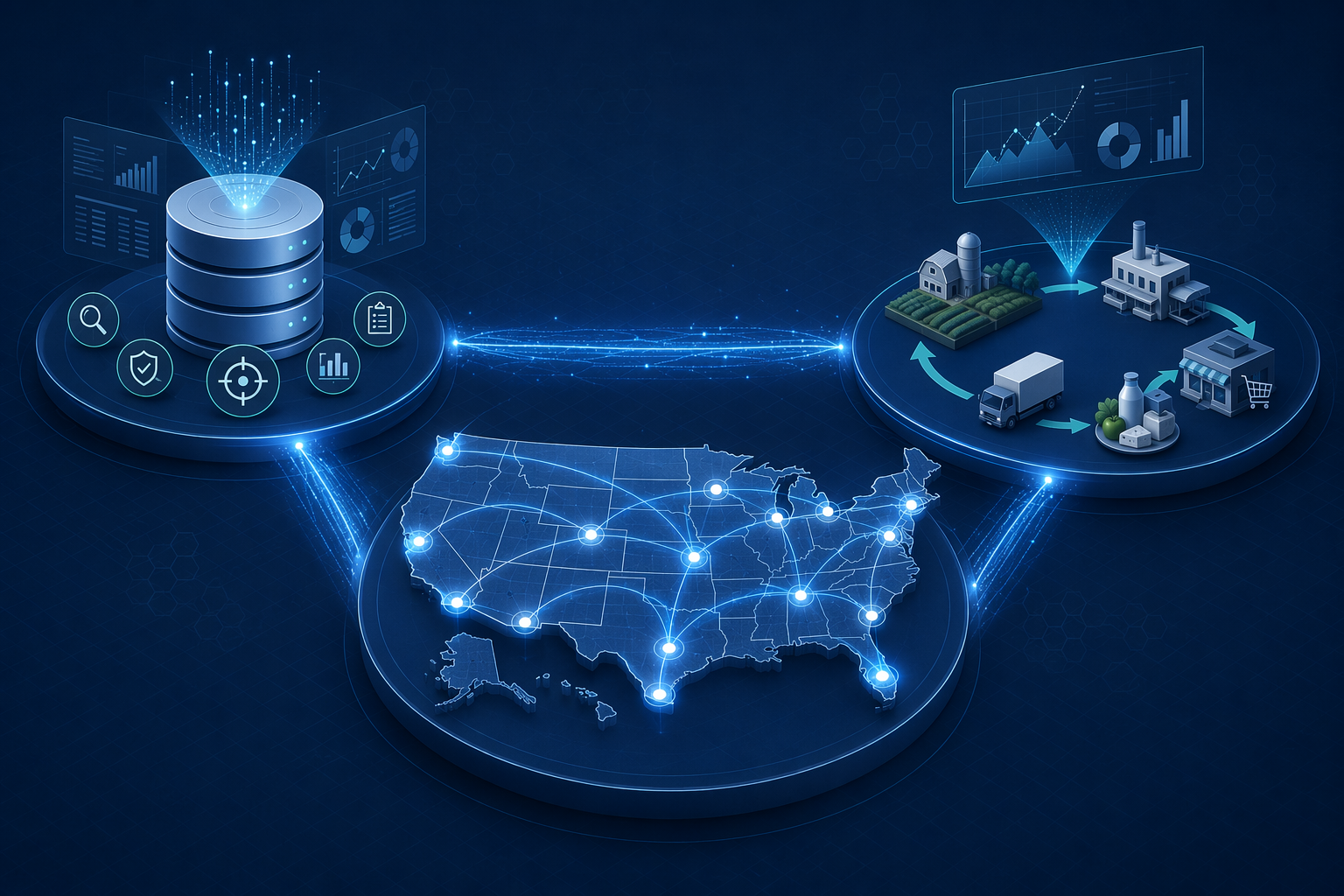
Where AI Now Sits in FDA Food Oversight
The practical map is narrower, and more consequential, than the broad phrase “AI in food safety” suggests. The documented uses are not simply laboratory automation or generic contamination prediction. They sit in workflows that can shape which records are reviewed, which imports receive attention, which hazards are prioritized, and which facilities may be pulled forward in a constrained inspection environment.
| Documented FDA AI activity | Food safety workflow affected | What is public | What remains unclear |
|---|---|---|---|
| Elsa 4.0 and FDA data platform consolidation | Agency-wide analysis capacity, including inspection targeting and quantitative data analysis | FDA announced Elsa 4.0 in May 2026 with custom agents, quantitative data analysis, secure web search, and a consolidated data platform | No public inspection-yield improvement, false-positive rate, or food-specific validation metrics |
| Imported seafood AI pilot | Import screening and targeting of seafood shipments | FDA described a three-phase pilot, Phase 2 deployment at all 328 U.S. ports, and Phase 3 focus on pathogen contamination, antibiotic residues, and decomposition | No clear public update on whether the pilot became a standing operational program after late FY2023 |
| Human Foods Program 2026 priority deliverables | Predictive analytics across the food supply chain and import screening | FDA committed to AI-predictive models and to import screening using expanded data sources and quantitative analytical techniques, including AI/ML | No public performance targets or model-governance details tied to those deliverables |
For regulated entities, the important shift is not that FDA has discovered AI. It is that AI is appearing inside oversight functions that already carry legal and operational consequences. A facility inspection, an import examination, a document request, or an agency follow-up can be triggered by many factors. The new uncertainty is whether a quantitative risk signal has helped move a firm, product, importer, or shipment higher in the queue.
Elsa 4.0 Signals Infrastructure, Not Just a Chatbot
FDA first announced Elsa as an agency-wide AI tool in June 2025, describing it as a system intended to help optimize agency performance across FDA workstreams.[4] The May 2026 announcement matters because it moved the discussion from initial launch to infrastructure: Elsa 4.0 was presented alongside completion of data platform consolidation, with capabilities that include custom agents, quantitative data analysis, and secure web search.[1]
For food oversight, the most relevant part is not whether a staff member can ask a better natural-language question. It is whether FDA personnel can combine larger internal datasets, create repeatable analytical routines, and use model-assisted outputs to support inspection targeting or risk prioritization. When an agency-wide tool becomes linked to a consolidated data environment, the path from “analysis support” to “operational triage” becomes shorter.
FDA’s public materials do not provide enough detail to say how Elsa 4.0 weighs food facility history, hazard records, adverse event signals, import data, recall history, or inspection outcomes in any specific targeting model. They also do not show whether Elsa-generated recommendations are logged, independently reviewed, overridden, or later compared with inspection results. Those governance details are not administrative decoration. They are the difference between a useful internal assistant and a system that quietly changes who receives regulatory attention.
This is the first accountability gap compliance teams will feel. If an FDA visit arrives sooner than expected, the firm may see the inspection notice, the Form 482, the investigator, and eventually the observations or closeout. It will not necessarily see whether a model, dashboard, or data platform output helped place it on the schedule.
The Seafood Pilot Is the Clearest Food-Specific Deployment
The imported seafood pilot gives the most bounded example of FDA AI in food safety testing and screening. FDA described the program as a three-phase effort running from 2019 through 2023. Phase 2 deployed the AI model at all 328 U.S. ports of entry, and Phase 3 focused on improving the model’s ability to identify imported seafood that may be contaminated with pathogens, contain antibiotic residues, or show decomposition.[2]
That deployment point should not be softened. “All 328 ports” means the pilot was not merely tested in a small innovation unit. It reached the national import-screening perimeter for a high-volume, high-variability food category. Imported seafood also gives FDA a plausible use case for machine learning: many shipments, many suppliers, uneven historical data, changing hazard patterns, and limited human capacity to examine every entry with equal depth.
The public record is still thinner than the deployment footprint. FDA’s constituent update describes the phases and hazard focus areas, but it does not disclose the model’s error rates, the number of shipments flagged, the proportion of model-identified shipments that produced actionable findings, or how often the model missed violative products. It also does not give a clear public answer, as of July 2026, on whether the pilot became a formal standing program after Phase 3 ended in late FY2023.[2]
For importers, the distinction matters. A pilot can influence daily operations while still lacking the transparency expected of a mature program. A standing program should have clearer governance, monitoring, and mechanisms for detecting drift when trade routes, product mixes, suppliers, or lab-confirmed hazard patterns change.
The Human Foods Program Makes Predictive Analytics a 2026 Deliverable
The Human Foods Program’s 2026 priority deliverables make the direction explicit. FDA lists development and implementation of “AI-predictive models” across the food supply chain and separately commits to enhancing import screening based on expanded data sources and quantitative analytical techniques, including AI/ML.[3]
That language pulls AI out of the category of optional modernization experiment. It places predictive modeling inside the work plan of the program responsible for food safety, nutrition, and related human foods oversight. The deliverables do not say that every food facility will be scored by a single model, or that AI will replace investigator judgment. They do indicate that predictive analytics is becoming part of how FDA intends to allocate attention.
The likely operational effects are familiar to anyone who has worked around risk-based regulation. A quantitative model can make a low-staffing environment more targeted. It can also make the basis for targeting harder to reconstruct from the outside. If the model relies on expanded data sources, regulated entities may not know which signals are being combined: prior inspection history, import alerts, commodity risk, lab results, outbreak associations, supplier networks, facility registration data, adverse event reports, or other internal FDA information.
That opacity does not make the approach improper. FDA has long used risk-based prioritization. The question for 2026 is whether the agency will provide enough public validation and governance detail for firms to understand the reliability of the new scoring logic, especially where the output affects inspection frequency, import holds, sampling, or follow-up scrutiny.
The Research Base Supports Plausibility, Not FDA-Specific Validation
The broader scientific literature gives FDA a reasonable basis for exploring these tools. A June 2026 systematic review in npj Science of Food analyzed 161 peer-reviewed studies on artificial intelligence in food safety. The review found growth from 1 paper in 2012 to 46 papers in 2023, with deep learning rising from 22% of included studies in 2019 to 43% in 2023. It also reported that 35% of studies addressed microbiological hazard detection and 25% addressed chemical contaminant prediction.[5]
Those figures help explain why FDA’s movement is plausible. Food safety produces image data, lab data, supply-chain data, environmental monitoring data, import records, and inspection histories. Machine learning methods can be useful where patterns are too large, too distributed, or too subtle for manual review alone.
But the review does not validate Elsa 4.0, the seafood pilot, or the Human Foods Program’s future predictive models. It is a synthesis of published research, not an audit of FDA operational systems. Its own scope also matters: it is limited to Scopus-indexed literature, which may underrepresent proprietary commercial systems and unpublished government applications.[5]
There is also a structural problem that does not disappear because a model performs well in a paper. Food safety data are heavily imbalanced. Most products, facilities, and shipments are not linked to confirmed hazards. Rare events are exactly what regulators most want to find, but rare events give algorithms fewer examples to learn from. A model can look strong on aggregate accuracy while still performing poorly on the unusual cases that matter most.
What Public Validation Has Not Yet Shown
The missing information is not obscure technical trivia. It is the set of measurements that would let regulated entities and outside observers distinguish useful targeting from noisy automation.
- For Elsa 4.0: FDA has not published food-specific validation metrics, inspection-yield changes, false-positive rates, false-negative rates, or model-monitoring results.
- For imported seafood screening: FDA has not publicly reported how many model-targeted entries led to confirmed pathogen contamination, antibiotic residue findings, decomposition findings, refusal, detention, or other regulatory action.
- For Human Foods Program predictive models: FDA has not described the model classes, training data, validation approach, governance controls, or external review process tied to the 2026 deliverables.
- Across systems: FDA has not explained how affected firms can identify whether AI-assisted targeting contributed to a specific inspection, import screening decision, or request for information.
Some of that information may be sensitive. FDA has legitimate reasons not to publish every feature in a targeting model, especially if disclosure would invite evasion. But there is a middle ground between exposing the model and asking the regulated public to accept deployment as evidence of performance. Aggregate validation, periodic performance reporting, drift monitoring, and human-review protocols can be described without publishing a playbook for avoiding oversight.
Staffing and Inspection Strategy Make the Targeting Question More Pressing
The pressure around FDA AI is partly technical, but it is also administrative. Civil Eats reporting in 2025 captured expert and industry concern over FDA’s expanding use of AI in food safety inspection, including questions about accuracy and the practical implications of relying on algorithmic tools in a strained oversight environment.[6][7]
Food Institute analysis also described a broader inspection shift tied to the BRIDGE project, with routine domestic food facility inspections moving toward states while FDA uses AI analytics to target higher-risk cases.[8] That reporting is not the same as FDA validation data, but it helps locate the operational anxiety: when routine inspection capacity changes, targeting logic carries more weight.
A facility that is categorized as higher risk may face more experienced federal attention while peers are handled through state inspection channels. An importer whose shipments are repeatedly selected may bear demurrage, testing, storage, customer, and supply-chain consequences even before any final regulatory finding. If the targeting signal is strong, that is a rational use of oversight resources. If it is poorly calibrated, the burden lands unevenly and may remain difficult to contest because the firm cannot see the scoring logic.
What Regulated Entities Should Prepare For
The safest assumption for food manufacturers, importers, distributors, and health-system compliance teams is that FDA’s use of AI/ML will expand in targeting and screening before public validation catches up. That does not require treating every FDA action as algorithm-driven. It does require preparing records and compliance narratives for a more data-comparative regulator.
- Keep facility, supplier, corrective-action, environmental monitoring, and import documentation consistent across systems that FDA may compare.
- Review recurring deviations, late corrective actions, repeat observations, supplier changes, and product-category risks as possible quantitative signals, not only as narrative inspection history.
- For seafood imports, expect continued attention to pathogen contamination, antibiotic residues, and decomposition, the Phase 3 focus areas FDA publicly identified.
- When responding to an inspection or import hold, document the factual basis for the firm’s position clearly enough to withstand review by both human staff and data-driven triage workflows.
- Track FDA updates for model-governance disclosures, not only new tool announcements.
The firms most exposed are not necessarily the firms with the worst compliance culture. They may be the firms with complex supply chains, inconsistent identifiers, uneven historical records, hard-to-reconcile supplier data, or commodity categories already associated with known hazards. A model does not need to be punitive to be consequential. It only needs to change the order in which FDA looks.
The July 2026 Position
FDA has crossed an operational threshold. Elsa 4.0, the seafood import-screening pilot, and the Human Foods Program’s 2026 predictive-analytics commitments show that AI is now part of the agency’s food oversight infrastructure. The better question is no longer whether FDA will use AI in food safety testing and inspection. It is where the tools sit, what decisions they influence, and how their performance will be measured.
The public record supports a disciplined conclusion. FDA’s AI food safety infrastructure is real enough to affect oversight strategy. It is not transparent enough for regulated entities to know how accurate, fair, or stable that targeting will be.
References
- FDA Expands AI Capabilities and Completes Data Platform Consolidation, FDA, May 2026.
- The FDA Moves into Third Phase of Artificial Intelligence Imported Seafood Pilot Program, FDA.
- Human Foods Program 2026 Priority Deliverables, FDA.
- FDA Launches Agency-Wide AI Tool to Optimize Performance for the American People, FDA, June 2025.
- Artificial intelligence in food safety, npj Science of Food, June 2026.
- FDA Expanding Use of AI in Food Safety Inspection, Civil Eats, May 2025.
- FDA Expands Use of Advanced AI for Safety Reviews and Inspections, Civil Eats, December 2025.
- The FDA Plans to Shift Routine Food Facility Inspections to States While Using AI to Target Higher-Risk Cases, Signaling Major Compliance Changes for the Food Industry, Food Institute.
Comments
Join the discussion with an anonymous comment.