
The federal impact on quantum computing stocks for healthcare AI is easiest to see in the part of the chart investors would rather skip. After the June 22, 2026 executive orders, quantum names caught a policy bid: IonQ traded above $60, while D-Wave and Rigetti moved with the same enthusiasm around federal validation. By mid-July, that move had reversed hard. IonQ was reported near $39, and the group had corrected by roughly 35% as macro risk-off met a colder reading of what the orders actually changed.[1][2]
That correction is not proof the policy signal was empty. It is proof that a federal quantum program and a healthcare AI revenue line are not the same thing. Hospital CIOs, pharma strategy teams, and public-market investors do not buy “scientifically useful quantum computer” as a budget category. They buy simulation capacity, optimization tools, validated diagnostics, cybersecurity migration, or partnerships that reduce an identifiable bottleneck.

The June rally made sense because Washington finally put structure around a field that has spent years selling long-dated possibility. The July selloff made sense because healthcare monetization still has to pass through architecture, validation, procurement, and reporting discipline. The difference between those two statements is where the investment case now lives.
The Federal Signal Is Real; The Revenue Translation Is Not Automatic
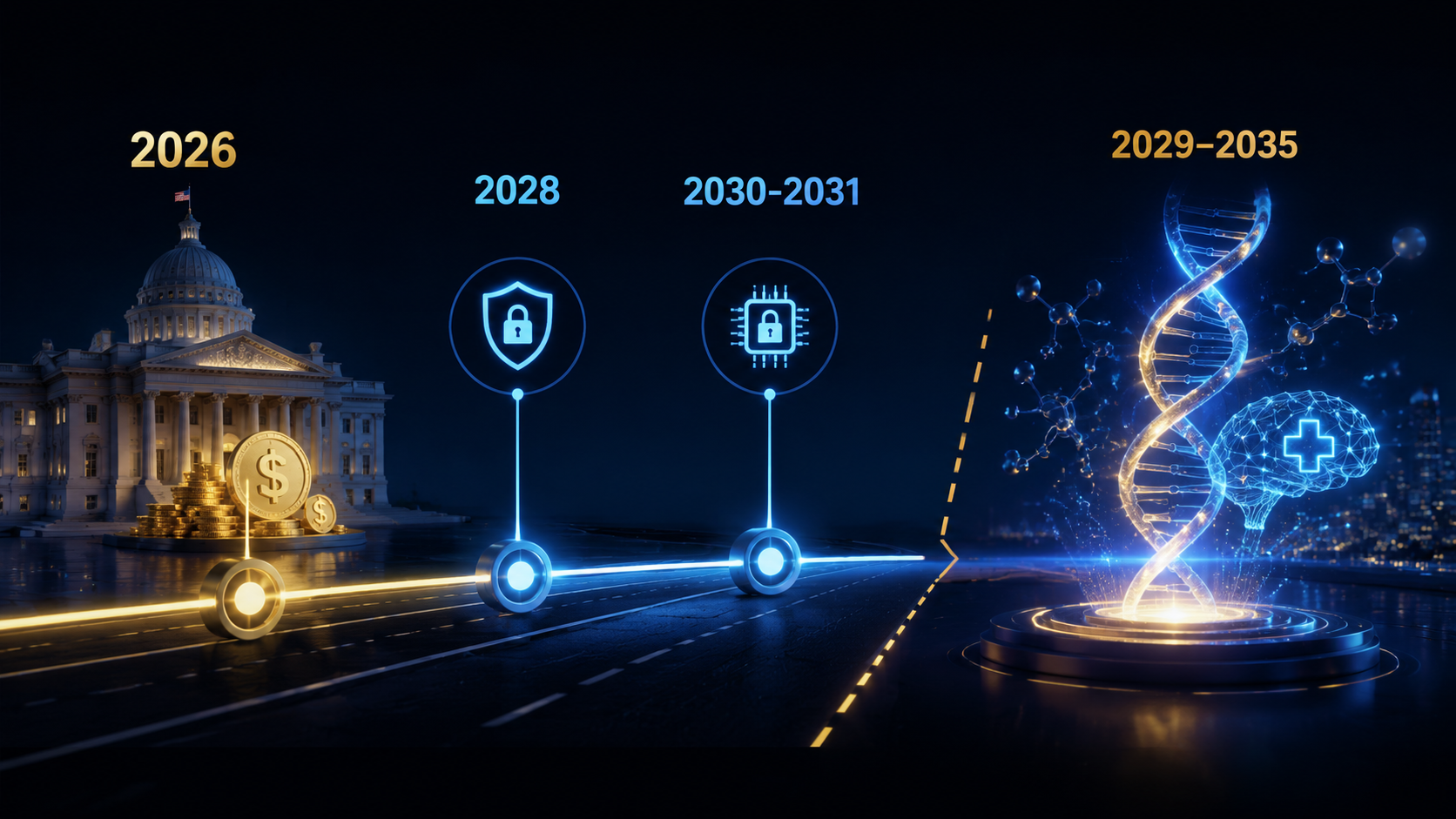
The first catalyst came in May 2026, when the CHIPS Act quantum program issued letters of intent totaling $2.013 billion across nine companies. IBM received the largest disclosed share: $1 billion for the Anderon superconducting quantum foundry in New York.[3] For a sector that depends on fabrication, cryogenic infrastructure, talent concentration, and national-security procurement confidence, that is not a press-release footnote. It is industrial policy.
The second catalyst arrived on June 22, 2026, when the White House executive orders set a QC-ADDS 2028 target for a scientifically useful quantum computer and binding post-quantum cryptography migration deadlines for 2030–2031.[4] The cryptography piece matters for healthcare because hospitals, payers, labs, and life-sciences companies hold long-lived sensitive data. But PQC migration is a nearer cybersecurity spending issue, not direct evidence that quantum processors will generate healthcare AI revenue.
The policy package changes the sector’s survival math. It can lower infrastructure risk, pull suppliers into more durable roadmaps, and give enterprise buyers more confidence that quantum is not only a venture-backed science project. It does not, by itself, accelerate an FDA review, prove a diagnostic model, or turn molecular simulation into reimbursed clinical value.
Where The Healthcare AI Pathway Is Visible
The useful question is no longer whether a company is “a quantum stock.” It is whether the company’s architecture, commercial model, and disclosed partnerships point toward a healthcare AI use case that can be followed over time. A companion analysis on which quantum computing stocks have real healthcare AI exposure maps the stock universe more broadly. The federal-policy angle narrows the question: which companies can convert government-backed quantum infrastructure into drug discovery, molecular modeling, diagnostics, or clinical optimization milestones?
| Company | Quantum approach | Healthcare AI pathway | What remains unproven |
|---|---|---|---|
| IBM | Superconducting systems; $1B Anderon foundry award | Drug discovery simulation and infrastructure-scale quantum development | Commercial healthcare revenue timing and validated healthcare outputs |
| D-Wave | Quantum annealing and hybrid quantum-classical SaaS | Optimization problems, including clinical trial logistics and enterprise scheduling | How much revenue is specifically healthcare-related |
| IonQ | Trapped-ion systems with long coherence and all-to-all connectivity | Molecular simulation and chemistry applications that could support drug discovery | Healthcare-specific revenue disclosure and valuation support |
| Quantinuum | Trapped-ion systems and quantum software | Pharmaceutical molecular modeling partnerships | Scale, revenue attribution, and timing of commercial healthcare impact |
| Rigetti | Superconducting systems | Potential fit with simulation workloads | Weaker disclosed healthcare-specific positioning |
IBM Gets The Cleanest Infrastructure-To-Healthcare Story
IBM deserves a different read from most of the pure-play quantum names because the federal award and the healthcare pathway are structurally connected. The $1 billion Anderon foundry award supports superconducting quantum hardware capacity, and IBM’s stated quantum direction includes drug discovery simulation.[3] That does not make IBM a pure healthcare AI quantum trade. It does make the pathway easier to audit: foundry progress, processor roadmaps, partner access, and simulation work can be tracked without pretending that a hospital purchasing department is about to sign a quantum line item.
Drug discovery is also a better early healthcare target than bedside clinical decision support. Molecules do not create reimbursement files. A backend simulation workflow still needs scientific validation, but it does not face the same adoption path as a diagnostic tool inserted into clinical care. That matters when investors compare quantum healthcare AI narratives with the current state of AI drug discovery evidence, where promising models still have to prove they improve downstream development outcomes.
D-Wave Has A Nearer Commercial Shape, Even If It Is Less Glamorous
D-Wave’s healthcare AI case is not mainly about simulating the chemistry of a novel molecule. Its annealing systems and hybrid quantum SaaS model are better aligned with optimization problems: routing, scheduling, resource allocation, portfolio selection, and trial logistics. In healthcare, that points toward clinical trial site selection, patient matching constraints, supply allocation, and operational bottlenecks that already exist inside pharma and health systems.
That makes D-Wave easier to take seriously commercially. Optimization does not require the same breakthrough claim as fault-tolerant molecular simulation. The ceiling may be different, but the buyer conversation is closer to a software procurement motion: does this reduce a planning constraint, shorten an iteration cycle, or improve utilization? The unresolved issue is attribution. The research materials do not show a healthcare-specific revenue breakdown for D-Wave, so healthcare exposure should be treated as an application pathway, not a reported segment.
IonQ Has Technical Relevance And A Valuation Problem
IonQ’s trapped-ion architecture is relevant to the healthcare AI discussion. The company’s systems are described as having coherence times measured in minutes versus microseconds and all-to-all qubit connectivity, characteristics suited to molecular simulation use cases.[5] If quantum healthcare AI becomes a drug discovery and chemistry simulation market first, IonQ belongs in the conversation.
The financial side is less forgiving. IonQ reported $64.7 million in Q1 2026 revenue and a $271.5 million operating loss, while trading around a $13 billion market capitalization and about 66 times forward price-to-sales versus an industry median of 4.36 times.[5] Those numbers do not say the technology is weak. They say the stock needs a lot of future commercial proof, and healthcare AI is not yet reported in a way that lets investors isolate how much of that future is actually healthcare.
This is where policy enthusiasm can become sloppy. A federal target for useful quantum computing strengthens IonQ’s ecosystem argument. It does not identify which pharma customer is paying, how much of the revenue is healthcare-related, or whether molecular simulation work has moved beyond exploratory collaboration. With a high multiple and large operating losses, the absence of healthcare-specific revenue disclosure matters more, not less.
Quantinuum And Rigetti Sit In Different Evidence Buckets
Quantinuum has one of the more credible healthcare-adjacent pathways because its pharmaceutical molecular modeling work includes partnerships referenced with JPMorgan and Amgen.[5] That does not establish broad healthcare revenue, but it is at least pointed toward a real life-sciences problem rather than a generic claim that quantum will eventually help medicine.
Rigetti is harder to place in a healthcare AI portfolio frame. Its superconducting architecture gives it theoretical relevance to simulation workloads, and it participated in the same sentiment wave around federal quantum support. But the disclosed healthcare-specific positioning is thinner than IBM’s, D-Wave’s, IonQ’s, or Quantinuum’s. If the investment screen is healthcare AI exposure rather than quantum beta, that distinction is material.
The Timeline Mismatch Is The Main Investment Risk
The most disciplined commercial window in the research materials remains 2029–2035 for commercial quantum advantage in healthcare AI. Federal support can improve the probability that companies survive long enough to reach that window. It can concentrate talent, fund fabrication, harden supply chains, and encourage enterprise pilots. It cannot compress every non-quantum dependency in healthcare.
A drug discovery workflow still needs to show that better simulation changes candidate selection, development cost, or probability of success. A diagnostic workflow still needs clinical validation and regulatory treatment. A clinical optimization tool still has to integrate with systems that hospitals already struggle to modernize. That is the unglamorous part of the timeline, and it is usually the part missing from “inevitable future” language.
MarketsandMarkets projected the quantum computing in healthcare market could reach $1.32 billion by 2030 at a 37.9% compound annual growth rate.[6] That is useful as a directional estimate, not as a valuation anchor. The methodology is not independently tested in the research materials, and the projected market remains small relative to the broader healthcare AI and enterprise technology budgets investors often imply when they bid up quantum exposure.
The contrast with today’s healthcare AI market is important. Current AI healthcare investment is already being judged on deployment, governance, clinical evidence, and workflow fit, not just model ambition. That broader context is covered in AI in Healthcare Industry 2026. Quantum healthcare AI has to clear those same gates eventually, even if the hardware science is different.
Regulation Is Quiet Now Because Most Products Are Not There Yet
The regulatory gap is not a reason to dismiss quantum healthcare AI. It is a reason to separate backend and clinical use cases. The research materials indicate that neither the FDA nor the EU has established dedicated regulatory pathways for quantum medical devices.[7][8] That uncertainty matters most where quantum-enabled systems make or influence clinical decisions: diagnostics, personalized treatment recommendations, and medical-device functions.
Backend drug discovery and logistics tools face a different path. A molecular simulation tool used by a pharma research team does not automatically become a regulated medical device. A trial optimization model may still need auditability, data governance, and buyer trust, but it is not the same problem as putting quantum-derived output into a clinician’s diagnostic workflow. Investors should not price all healthcare quantum applications as if they face the same regulatory drag.
What Would Actually Confirm The Healthcare AI Thesis
The next milestones are unusually concrete for a sector often described in abstract terms. The QC-ADDS specification publication expected by September 2026 will show how the federal government defines a scientifically useful quantum computer. The Anderon foundry construction timeline will show whether IBM’s infrastructure award is moving from allocation to capacity. CHIPS Act equity stake details still need to be finalized. IonQ’s Q2 2026 earnings will test whether revenue growth, customer mix, and spending discipline can support the valuation after the July correction.[3][4][5]
- For IBM, watch foundry milestones, processor access, and drug discovery simulation partnerships that move beyond research positioning.
- For D-Wave, watch whether hybrid quantum optimization contracts disclose healthcare, pharma, or trial operations use cases with measurable customer outcomes.
- For IonQ, watch revenue quality, operating-loss trajectory, and any healthcare-specific disclosure rather than generic molecular simulation language.
- For Quantinuum, watch whether pharmaceutical molecular modeling partnerships convert into repeatable commercial workflows.
- For Rigetti, watch for healthcare-specific partners or applications that distinguish it from broad quantum policy exposure.
The market will probably continue to trade these names as a basket on policy days. Healthcare AI investors should not analyze them that way. The federal commitment has made quantum computing more structured and harder to dismiss. It has also made lazy exposure more expensive to defend when a portfolio committee asks what, exactly, connects the stock to healthcare revenue.
The better screen is not “which company benefits from Washington?” Many do. The better screen is which company can show a traceable line from federal support to architecture, from architecture to healthcare workload, from workload to customer validation, and from validation to reported commercial progress. On that basis, IBM’s infrastructure-backed drug discovery pathway and D-Wave’s optimization model deserve more patience; IonQ and Quantinuum deserve close tracking but not unqualified healthcare revenue credit; Rigetti needs clearer healthcare-specific proof.
The July correction did not end the quantum healthcare AI story. It stripped out the easiest version of it. Federal money can build the roadbed. Healthcare AI revenue still has to drive on it.
References
- Quantum stocks rally after June 22 executive orders — Fortune, June 23, 2026
- Quantum computing stocks correct roughly 35% into July — TechTimes, July 16, 2026
- CHIPS Act quantum letters of intent award list — NIST, May 2026
- June 22, 2026 executive orders on QC-ADDS and post-quantum cryptography migration — The White House, June 22, 2026
- Quantum computing stock and company analyses — CNBC, TradingKey, Motley Fool, 2026
- Quantum Computing in Healthcare Market — MarketsandMarkets, 2024
- Quantum technologies policy guide — Stanford Law School, December 2024
- Digital health regulatory analysis on quantum medical-device pathways — Covington Digital Health, June 2025
Comments
Join the discussion with an anonymous comment.