
First aid and treatment for adder snake bites starts before anyone reaches a resus bay: stop the patient moving, keep the bitten limb still and lower than the heart if possible, remove rings or tight clothing, call emergency help, and get the patient to hospital without delay. Do not cut the wound, suck venom, apply a tourniquet, use ice, give alcohol, or try to catch the snake. UK public health advice is blunt on those points because the wrong intervention can add tissue injury, delay transport, or make swelling harder to assess later.[1]
This article is about the European adder, Vipera berus. It is not about Australian death adders, African puff adders, or other snakes that carry the word “adder” in common names. That distinction matters because the clinical pathway, antivenom, and risk profile are different.
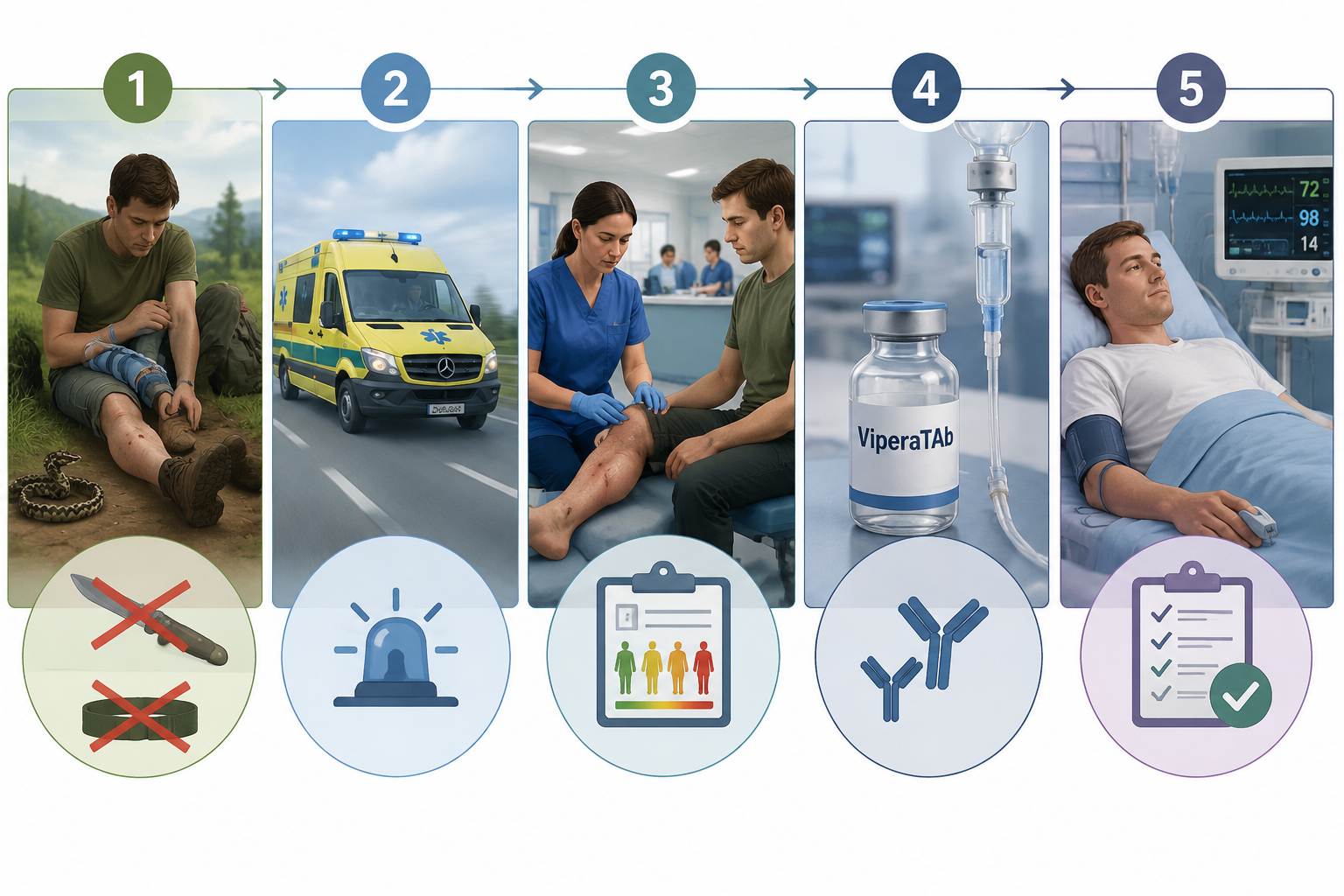
The management chain in the first hour
A good adder bite pathway is not complicated, but it is easy to spoil. The patient should be kept calm and still, the bitten limb immobilized, and unnecessary walking avoided. A limb that is going to swell needs jewelry, watches, and restrictive clothing removed early. The wound can be loosely covered, but it does not need field surgery from a pocketknife or improvised suction device.[1][2]
- Do: reassure the patient, limit movement, immobilize the limb, remove constricting items, call emergency services, and arrange rapid transport.
- Do not: cut, suck, burn, ice, elevate aggressively, apply a tourniquet, give alcohol, or encourage the patient to walk out under their own power.
- If safe, note the snake’s appearance from a distance; do not try to capture or kill it.
- Marking the leading edge of swelling with the time can help clinicians judge progression, but it should not delay transport.
The reason for immobility is practical rather than dramatic. Venom effects may remain local, but muscle activity and delay are unhelpful when swelling or systemic symptoms are evolving. The pre-hospital job is to avoid adding harm and to deliver a patient whose clinical picture can still be read clearly.
Most bites are not severe, but every bite deserves structured observation
European adder bites often look more frightening than they become. Around 70% cause negligible or only local effects, and about one-third are dry bites with no venom injected.[2] That is reassuring only up to a point. A dry bite is a retrospective judgment after observation, not a diagnosis to make confidently at the gate because the patient looks well in the first few minutes.
European incidence figures also need a little humility. A systematic European review estimated about 7,992 viper bites per year, but reporting depends heavily on poison center data and is not mandatory everywhere, so the figure is likely an underestimate.[2] For an individual emergency department, that creates an awkward competence problem: cases are uncommon enough for staff to feel rusty, yet common enough that the first hour still needs to be routine.

Hospital triage: separate panic, local venom effects, and systemic envenoming
In hospital, the patient needs vital signs, pain assessment, inspection of the bite site, measurement or marking of swelling, and a search for systemic features. Nausea, vomiting, abdominal pain, hypotension, dizziness, collapse, coagulopathy, or rapidly progressive swelling change the conversation. So does age: children made up 26–32% of cases in the cited clinical data, and their smaller body size means the same venom load can have a larger effect per kilogram.[2][3]
The Audebert-Boels classification is useful because it gives the team shared language instead of a loose impression that the bite is “bad.” It divides adder envenoming into grades 0 to 3 and links that language to the antivenom decision.[2]
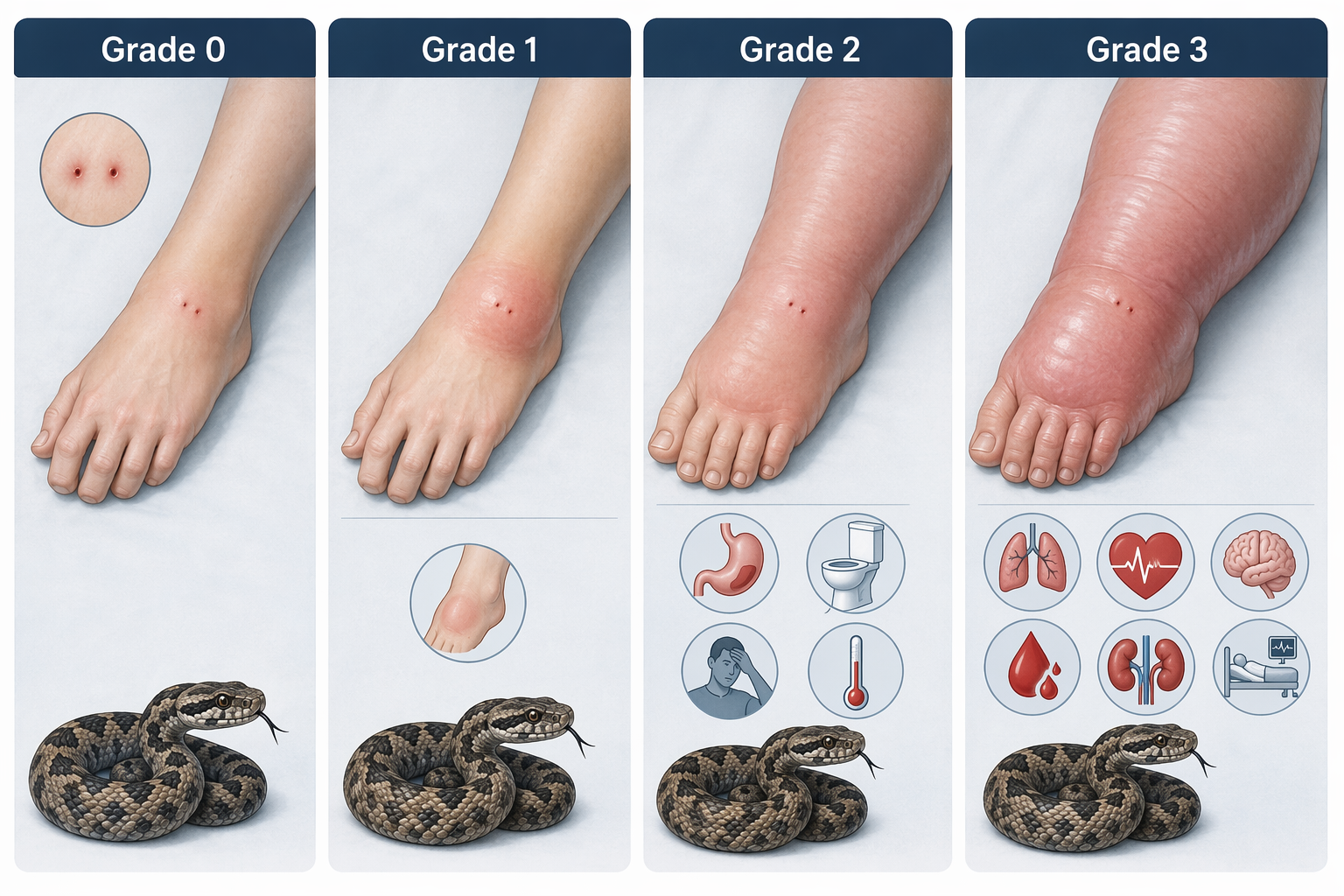
| Grade | Clinical picture | Usual treatment direction |
|---|---|---|
| Grade 0 | Dry bite: fang marks only, no swelling, no systemic signs | Observation, reassessment, supportive care as needed |
| Grade 1 | Local swelling without systemic signs | Observation, limb monitoring, analgesia, supportive care |
| Grade 2 | Moderate envenoming with more extensive local effects and/or gastrointestinal symptoms, hypotension, or coagulopathy | Antivenom is usually indicated, with supportive care |
| Grade 3 | Severe envenoming with life-threatening systemic effects | Urgent antivenom, resuscitation, senior toxicology or emergency medicine input |
Grade 0 patients are the ones who tempt everyone into premature reassurance. Fang marks alone may indeed be a dry bite, but the safer approach is observation long enough to confirm that swelling and systemic features are not declaring themselves. Grade 1 patients need the same discipline for a different reason: local swelling can remain local, but its pace and extent matter.
Grade 2 is where hesitation can become costly. Gastrointestinal symptoms, hypotension, coagulopathy, or more extensive progressive swelling are not just embellishments to a local bite. They are evidence that venom is producing clinically important effects. Grade 3 is the smaller group with life-threatening systemic involvement, and it belongs in a resuscitation mindset rather than a watch-and-wait one.[2]
Supportive care is still treatment
Not receiving antivenom does not mean receiving no care. Many adder bite patients need observation, limb monitoring, analgesia, antiemetics, fluids if clinically indicated, and tetanus assessment. Pain relief should avoid aspirin and non-steroidal anti-inflammatory drugs because bleeding risk and coagulation disturbance are part of the clinical concern; paracetamol and opioids are preferred when needed.[4]
The bitten limb should be reassessed repeatedly. Swelling that crosses joints, progresses quickly, or is accompanied by systemic features may change the severity grade. This is one reason a clean, conservative first aid phase matters: tourniquets, cutting, ice injury, and unnecessary manipulation make later assessment worse, not better.
Compartment syndrome is rare after European adder bites, and swelling alone is not enough reason to operate. Fasciotomy should follow objective compartment pressure measurement rather than visual alarm, because unnecessary surgery can add morbidity to an envenomed limb.[2]
When ViperaTAb is justified
ViperaTAb is the antivenom used in the UK pathway for clinically significant European adder envenoming. The usual adult and pediatric dose in the cited protocol is 2 vials, equivalent to 200 mg, given intravenously for moderate-to-severe envenoming, meaning Audebert-Boels grade 2 or 3 rather than every confirmed bite.[2][3]
That threshold is important. Universal antivenom would expose mild or dry-bite patients to an unnecessary blood-derived product and hospital process. Withholding antivenom from a patient with systemic envenoming is the opposite error. The classification is there to reduce both mistakes: grade the patient, treat the physiology in front of you, and be prepared to re-grade if the picture changes.
The strongest UK evidence comes from a prospective audit of 170 patients treated with ViperaTAb for moderate-to-severe Vipera berus envenoming between 2016 and 2020. It reported initial effectiveness in 72.2% of patients, repeat dosing in 32.5%, early adverse reactions in 1.8% or 3 of 170 patients, a median hospital stay of 43.7 hours, and no deaths.[3]
Those are not randomized trial results. They are prospective observational audit data, which is exactly how they should be read: highly relevant to real UK practice, reassuring on safety and outcomes, but not proof from an RCT. In emergency toxicology, that distinction should sharpen judgment rather than paralyze it.
Timing matters, but late antivenom has limits
Antivenom works best when given early to a patient who meets clinical criteria. The European management review notes that administration beyond 48–72 hours after the bite is unlikely to provide benefit.[2] That does not mean a late-presenting patient is ignored; it means the treatment emphasis shifts toward reassessment, supportive care, complications, and specialist advice rather than reflex antivenom.
Children need a lower threshold for concern, not a different snake story
Children are not just small adults with more frightened parents at the bedside. The venom dose per body weight can be higher, and the UK audit found longer hospital stays in children than adults: 52.5 hours versus 38.8 hours.[3] That does not make every pediatric adder bite severe, but it justifies careful observation and a readiness to escalate when systemic features or progressive swelling appear.
A calm parent who keeps a child still has already improved the clinical situation. The next useful reassurance is not “it will be fine,” but “we are watching for the signs that would change treatment.” That is a more honest form of comfort because it explains why the child may need hours of observation even after arriving well.
Post-antivenom improvement is not the endpoint
The 32.5% repeat-dosing figure in the UK audit deserves attention because it cuts through an easy misconception: antivenom is not a magic closing scene.[3] A patient may improve and then show recurrent local effects. Swelling, pain, vital signs, laboratory abnormalities when present, and overall clinical trajectory still need monitoring after the infusion.
Early adverse reactions were uncommon in the UK audit, occurring in 1.8% of treated patients, but antivenom administration still belongs in a monitored setting with staff prepared to manage hypersensitivity or clinical deterioration.[3] The practical lesson is not to fear the drug when it is indicated; it is to give it in the right place, for the right grade of illness, and to keep watching afterward.
Discharge decisions should account for the same chain that guided admission: severity grade, stability of vital signs, progression or settling of swelling, pain control, mobility, child versus adult risk, and the ability to return if symptoms recur. A patient whose local swelling is still marching up a limb is not made safe by a reassuring mortality statistic.
Mortality is now very low, but that is not a reason to improvise
The modern mortality signal is reassuring. The UK prospective audit reported zero deaths among 170 moderate-to-severe cases treated with ViperaTAb, while broader European data cited a mortality estimate of 0.9%.[2][3] German poison center data from 735 Vipera berus bite cases between 2012 and 2023 adds another large contemporary dataset to the picture of mostly survivable envenoming under modern care.[5]
Near-zero mortality in treated UK practice should reassure walkers, parents, ambulance crews, and ED staff. It should not flatten the clinical response into “adders are harmless.” A grade 0 dry bite, a grade 1 swollen hand, and a grade 2 patient vomiting with hypotension are not the same patient.
For readers interested in how structured emergency pathways sit alongside digital triage and decision support, ClinicalMind’s overview of AI in emergency medicine and its discussion of AI bias in emergency medicine make the same underlying point in a different clinical setting: tools help only when they clarify the next safe decision rather than replace clinical accountability.
A disciplined protocol is the safest reassurance
European adder bites are usually survivable and often mild, but the safe pathway is still a full pathway. Immobilize and transport. Observe and grade. Treat pain and supportive needs without worsening bleeding risk. Give ViperaTAb when grade 2 or 3 envenoming justifies it. Then monitor long enough to catch recurrence, repeat dosing needs, and the patient who has not followed the neat line everyone hoped for.
References
- Snake bites — NHS
- European viper bites: clinical management from pre-hospitalisation to follow-up — JECCM
- Moderate-to-severe Vipera berus envenoming requiring ViperaTAb antivenom therapy in the UK — Taylor & Francis, 2021
- Adder (Vipera berus) bite — Unbound Medicine
- Vipera berus Bites in Germany From 2012 to 2023 — Dtsch Arztebl
Comments
Join the discussion with an anonymous comment.