
Here, football means association football, not the American game. That clarification matters because the technical story begins with offside: a rule that turns a body position, a ball-contact moment, and a defender line into a decision made under heavy time pressure. For clinicians, the more interesting point is not the refereeing controversy. It is that offside AI has forced computer vision systems to track moving limbs without markers, synchronize multiple camera views, reconstruct body position in three dimensions, and make a time-sensitive judgment from that reconstruction.
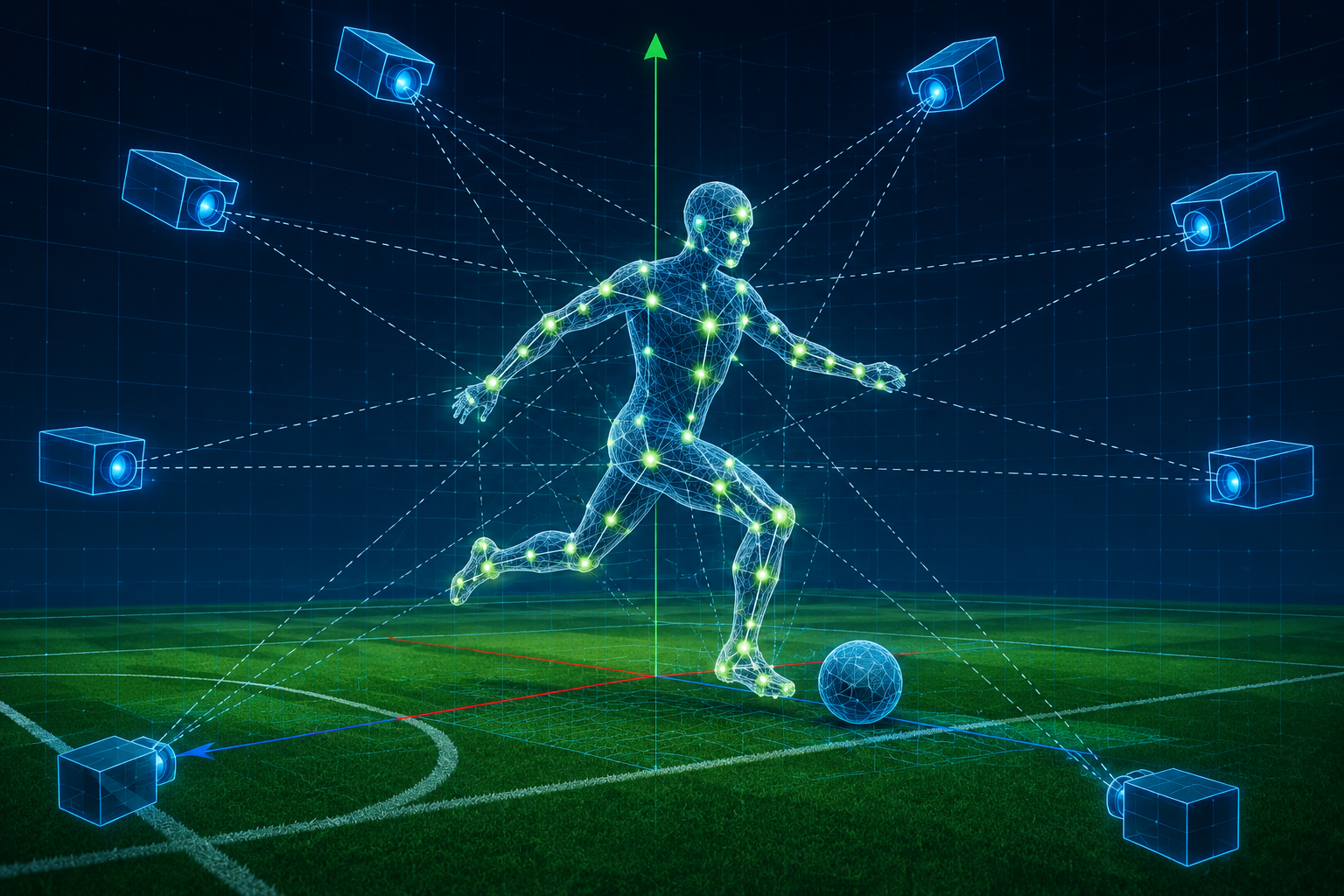
FIFA’s semi-automated offside technology uses 12 to 29 dedicated cameras, captures player movement at 50 frames per second, and tracks 29 skeletal data points on each player. The system combines limb tracking with ball data to help identify the pass moment, then generates a 3D representation for the video match officials before a decision is communicated on the field.[1] A 2026 Scientific Reports study using YOLOv8 for automated offside analysis reported more than 98% offside accuracy with a 3 cm spatial tolerance, while a single-camera YOLOv8 baseline reached 83% accuracy.[2]
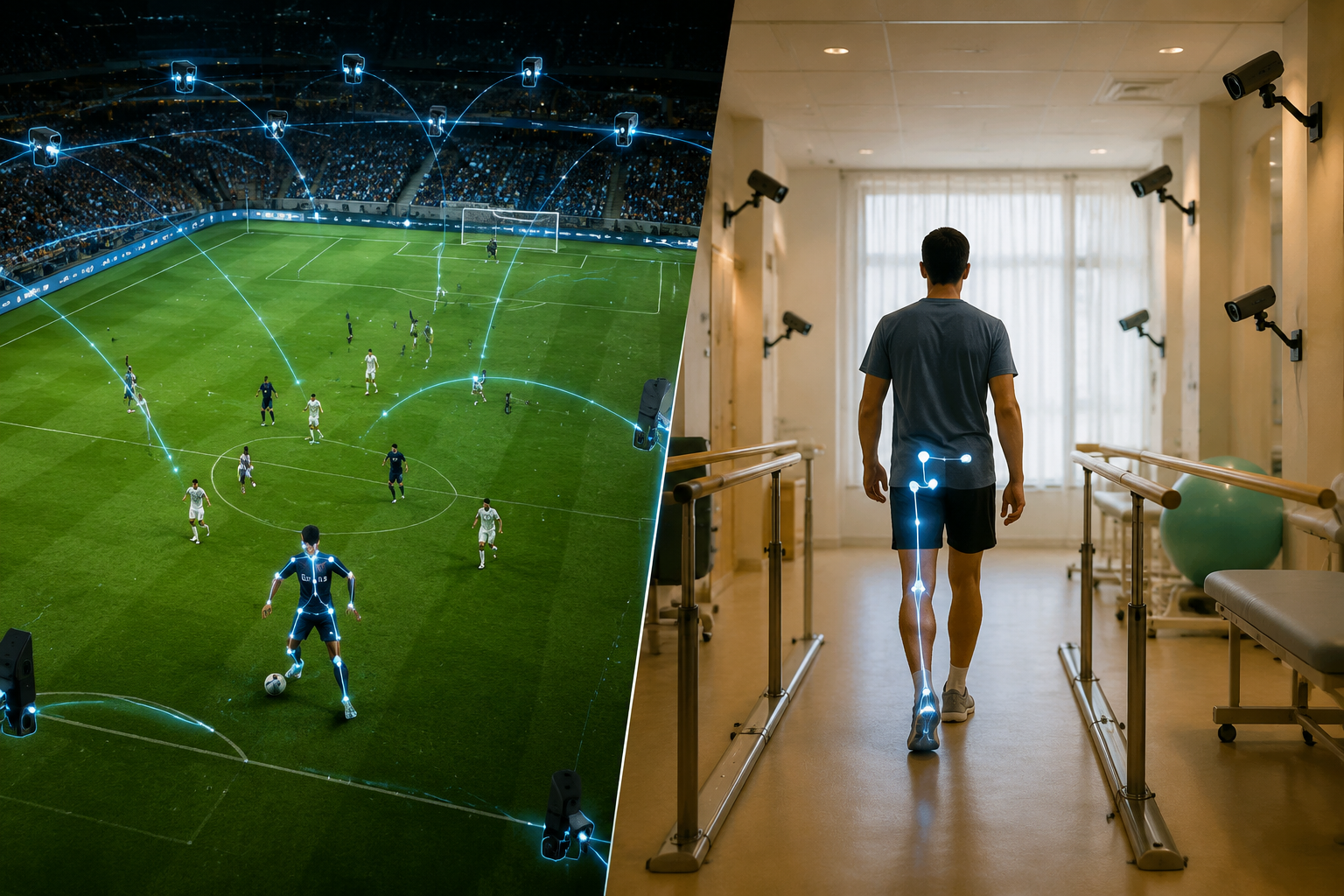
That is a compact answer to the search for AI in football offside detection and photo analysis: the system is not simply drawing a line on a still image. It is estimating body landmarks across synchronized views, locating those landmarks in space, and tying them to a critical event in time. The clinical question is whether that same measurement logic can survive a change in purpose. A referee needs to know whether an attacker was beyond the second-last defender. A rehabilitation team needs to know whether a patient’s movement is changing in a way that is accurate, interpretable, and useful enough to affect care.
From Offside Lines to Joint Centers
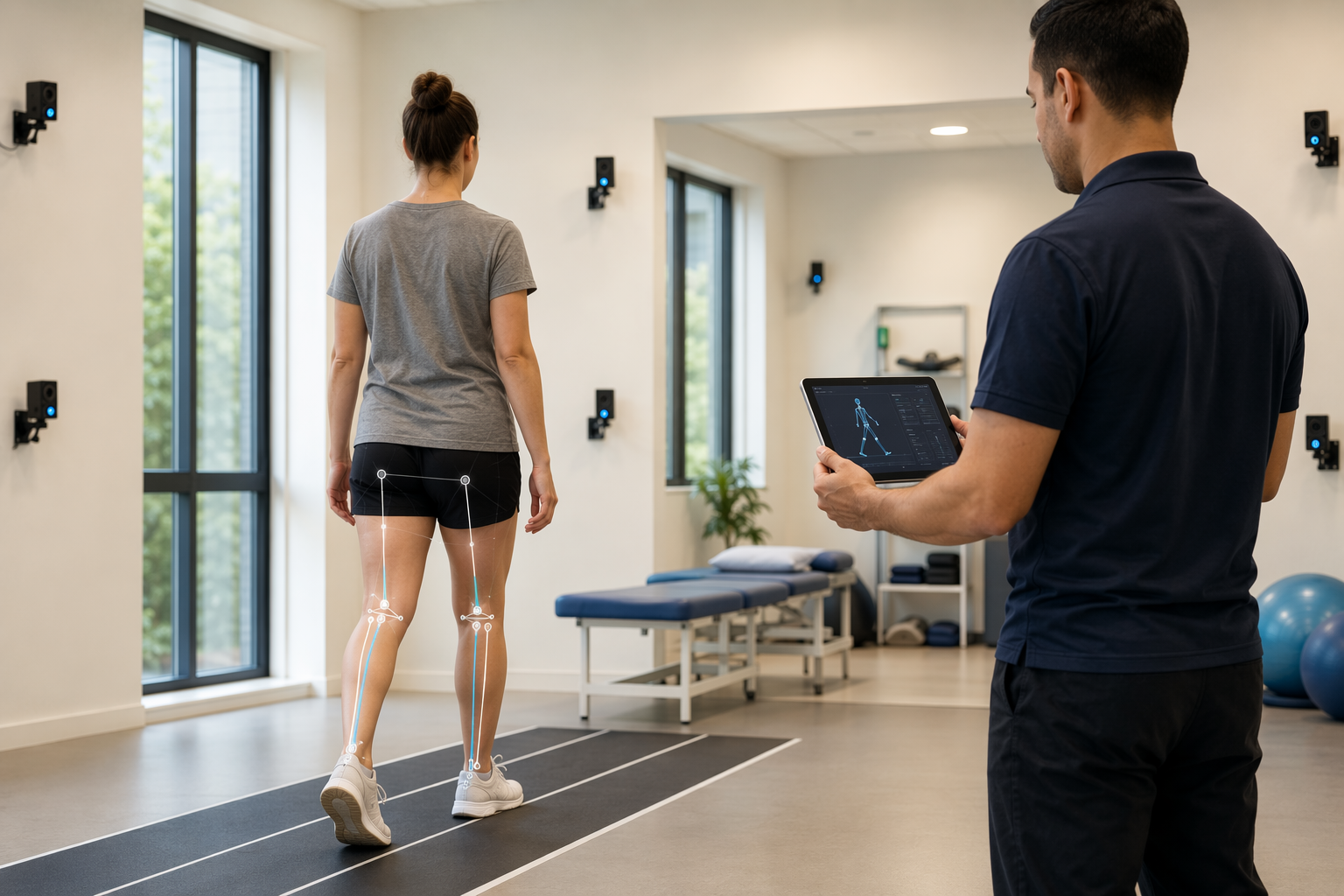
The shared pipeline is easy to appreciate in a motion lab. Cameras see the body from different angles. A pose-estimation model identifies anatomical landmarks in each image. The system triangulates those landmarks into a 3D skeleton. Software then calculates distances, angles, timing, and movement patterns. In football, those calculations support an offside decision. In rehabilitation, they may support gait assessment, return-to-sport testing, functional screening, or longitudinal monitoring after injury or surgery.
| Pipeline element | Offside AI use | Clinical markerless motion use |
|---|---|---|
| Cameras | Synchronized stadium views of players and ball | Room, lab, gym, or field views of a patient or athlete |
| Keypoints | Limb and body landmarks used to determine offside position | Joint centers and body segments used to estimate gait and movement |
| Timing | Pass-moment detection and player position at that instant | Stride timing, phase detection, repetitions, or task-specific movement windows |
| Output | Decision support for match officials | Measurement support for therapists, physicians, and performance staff |
| Failure consequence | A wrong sporting decision | A misleading clinical interpretation or care-plan adjustment |
The last row is where the translation becomes serious. A system can be excellent for a binary sporting call and still be insufficient for clinical reasoning. Offside accuracy does not automatically tell us the error in hip-joint center estimation, knee flexion angle, pelvic rotation, step symmetry, or compensatory trunk motion. It also does not tell us whether the output changes a therapist’s decision, improves adherence, detects decline earlier, or helps a patient understand progress.
Still, the analogy is not superficial. Both settings require markerless human pose estimation under movement, not static posture photography. Both need a model to infer body landmarks that are sometimes partially occluded. Both depend on calibration, camera placement, frame synchronization, and the quality of the anatomical model. The clinic adds harder biological variation: pain behaviors, assistive devices, braces, swelling, neurologic impairment, fatigue, fear of loading, and deliberate or unconscious compensation.
What Changes When the Same Vision Stack Enters Rehabilitation
The engineering stack may look familiar, but the measurement target changes. In offside analysis, the system can focus on a rule-defined spatial threshold at a specific instant. In clinical gait and rehabilitation assessment, the system must often measure a pattern over time. A therapist may care about stance time, step length, knee valgus during landing, hip hiking during swing, trunk lean during sit-to-stand, or whether a patient’s apparent improvement is simply a new compensation.
That turns a pose-estimation pipeline into a clinical measurement chain. The raw video is only the first layer. The system must identify landmarks, reconstruct motion, smooth noisy estimates without erasing pathology, map landmarks to clinically meaningful variables, and present those variables in a way that a clinician can compare with examination findings. If the output is a movement score, someone still has to explain what drove the score and whether it is stable enough to guide a change in loading, bracing, therapy intensity, or return-to-activity progression.
This is where markerless systems are attractive. Reflective-marker motion capture has long been valuable, but it adds setup time, trained personnel, patient preparation, and lab constraints. Markerless systems promise a lower-friction path: fewer attachments, shorter visits, and more opportunities to observe natural movement. For rehabilitation, that reduction in friction is not cosmetic. A measurement that can be repeated easily may be more clinically useful than a beautiful one-off study that never fits into the clinic schedule.
The tradeoff is that convenience raises the validation bar rather than lowering it. A patient with knee osteoarthritis walking cautiously, a stroke survivor circumducting a limb, or an athlete protecting a repaired ACL does not move like a clean demonstration video. Markerless motion capture has to be tested against reference systems and then tested again in the messy settings where clinicians actually use it.
The Clinical Bridge: Markerless 3D Tracking Against Marker-Based Systems
The strongest bridge from the football-style pipeline to rehabilitation is not the offside result itself. It is clinical validation work showing that markerless multi-camera pose estimation can approximate marker-based motion capture closely enough to be taken seriously as a measurement platform.
Nakano and colleagues validated an OpenPose-based multi-camera system for 3D markerless motion capture by comparing it with a marker-based motion capture system. Their results showed mean absolute errors generally within the 15 to 20 mm range for 3D joint position tracking, establishing that a multi-camera, markerless pose-estimation approach can produce clinically relevant joint-location estimates under controlled conditions.[3]
That number needs careful handling. A 15 to 20 mm joint-position error is not the same as saying every gait metric, every joint angle, or every rehabilitation decision is accurate. Small joint-center errors can propagate differently depending on the variable being calculated. Knee and hip angles, pelvic motion, and transverse-plane rotations may not all tolerate the same error. The clinical value depends on the task, the population, the camera setup, and the decision being made from the data.
Even so, the validation is meaningful because it addresses the right comparator. Offside AI accuracy is measured against an officiating task. Nakano’s work compares markerless 3D tracking with the marker-based systems that clinicians and biomechanists already use as a reference. That is the kind of evidence needed before a rehabilitation team can decide whether markerless motion capture belongs beside functional tests, strength testing, patient-reported outcomes, and clinician observation.
Measurement Accuracy Is Not the Same as Clinical Usefulness
A motion plot can be technically impressive and still leave the clinician with the wrong next step. Rehabilitation decisions are rarely made from one coordinate. They combine symptoms, capacity, confidence, tissue healing timelines, neurologic status, goals, and risk tolerance. If a markerless system reports asymmetry, the clinician still has to decide whether that asymmetry reflects weakness, pain avoidance, poor motor control, a brace constraint, fatigue, or a measurement artifact.
The broader literature reflects that gap. A 2025 scoping review in Bioengineering covering 73 studies of AI in sports biomechanics reported 94% agreement between convolutional neural network analysis and expert assessment in one movement-analysis context, but also found that only 7% of published AI motion-analysis studies connected their findings to actual prevention or rehabilitation protocols. The same review reported that only 15% of clinical markerless systems had formal validity studies.[4]
Those figures point in two directions at once. The 94% agreement result supports the idea that AI systems can approximate expert movement interpretation in defined tasks. The 7% protocol-translation figure is a warning that most studies stop before the point clinicians care about most: what changed in assessment, prevention, treatment, progression, or return-to-activity decisions. The 15% validity-study rate is another check on enthusiasm. Adoption language is not the same as validation, and validation in one task is not global clearance for all rehabilitation uses.
The distinction is especially important for health IT teams evaluating vendors. A system may have a polished dashboard, fast inference, and clear visual overlays, yet still lack evidence for the specific population and workflow being targeted. A post-operative orthopedic clinic, a neurologic rehabilitation unit, a pediatric gait program, and a sports medicine return-to-play environment do not ask the same measurement question. The same video pipeline may need different validation evidence in each setting.
Where Field Deployment Helps, and Where It Does Not
The field-deployable direction is real. A 2026 Move4D trends report describes markerless motion capture moving from lab-only workflows toward field deployment, with scalable gait analysis as one of the practical implications.[5] That trend matters because rehabilitation does not happen only inside formal motion labs. Patients walk in hallways, gyms, homes, fields, and workplaces. Systems that can observe movement closer to those contexts may capture function that a lab protocol misses.
But a trends report should not be weighted like peer-reviewed validation. It can illustrate where the market and implementation environment are moving. It cannot, by itself, prove that a camera system improves gait assessment, reduces injury risk, or changes rehabilitation outcomes. The same discipline applies to real-time on-device AI. A clinical validation study of on-device AI-driven pose estimation for resistance training programs supports the feasibility of real-time assessment, but feasibility in structured exercise assessment is still narrower than comprehensive rehabilitation decision support.[6]
Real-time feedback is clinically tempting. If a patient can see that knee collapse increases during the last repetitions of a squat, or that step symmetry deteriorates as fatigue builds, the assessment becomes easier to explain. Yet feedback can also overfocus attention, change natural movement, or create false reassurance if the model misses the compensatory strategy that matters. The clinical interface has to show uncertainty, context, and trend behavior, not just a clean score.
What a Rehabilitation Team Should Ask Before Trusting the Output
The useful procurement question is not whether the technology is “AI-powered.” It is whether the system has been validated for the measurement, population, setting, and decision at hand. A football offside pipeline can be an encouraging proof of markerless limb tracking at scale, but the clinic needs a narrower and more defensible claim.
- What anatomical landmarks does the system estimate, and how are they mapped to clinical variables?
- Was the system compared with marker-based motion capture, clinician ratings, patient outcomes, or only internal model labels?
- Were the validation tasks similar to the clinic’s tasks, such as gait, sit-to-stand, squatting, jumping, stair negotiation, or resistance exercise?
- Were patients with pain, bracing, neurologic impairment, assistive devices, obesity, fatigue, or atypical movement included?
- Does the system report uncertainty, failure modes, or confidence when occlusion and poor camera views affect the estimate?
- Has use of the system been tied to an actual rehabilitation protocol, prevention pathway, or treatment decision?
The last question is the one most likely to be skipped. A system can measure movement and still have no demonstrated effect on care. That does not make it useless. Many clinical tools begin as measurement platforms before outcomes evidence matures. It does mean the claim should stay precise: validated measurement support, not proven rehabilitation improvement, unless the evidence actually reaches that point.
The Reason Offside AI Belongs in This Conversation
Football’s semi-automated offside technology is useful to clinicians because it gives a high-pressure, high-scale example of markerless multi-camera limb tracking. The system must detect body keypoints, synchronize frames, triangulate position, and make the result interpretable quickly enough for operational use. Those are the same technical muscles clinical markerless motion capture needs, even though the clinical task is broader and less forgiving.
The current evidence supports a disciplined middle position. Elite-sport offside systems show that markerless limb tracking can work at scale. Controlled clinical validation shows that multi-camera markerless pose estimation can approach marker-based 3D joint tracking within clinically interesting error ranges. Reviews of AI movement analysis show encouraging expert agreement in defined contexts. At the same time, formal validity studies and direct links to rehabilitation protocols remain limited.
That is enough to justify serious clinical evaluation, not enough to treat every AI-derived movement score as ready for care-plan authority. The most defensible use today is as a measurement platform that can reduce friction, expand access to movement analysis, and support clinician interpretation when validated for the task. Formal clinical adoption still trails the technical evidence because most studies have not yet connected these systems to prevention or rehabilitation protocols.
References
- Semi-automated offside technology. FIFA.
- Validating YOLOv8 for automated offside detection. Scientific Reports. 2026.
- Evaluation of 3D Markerless Motion Capture Accuracy Using OpenPose With Multiple Video Cameras. 2020.
- Artificial Intelligence in Sports Biomechanics: A Scoping Review. Bioengineering. 2025.
- 2026 Trends: Markerless Motion Capture in the Field Becomes the New Standard. Move4D. 2026.
- Clinical validation study of on-device AI-driven real-time pose estimation for resistance training programs.
Comments
Join the discussion with an anonymous comment.