
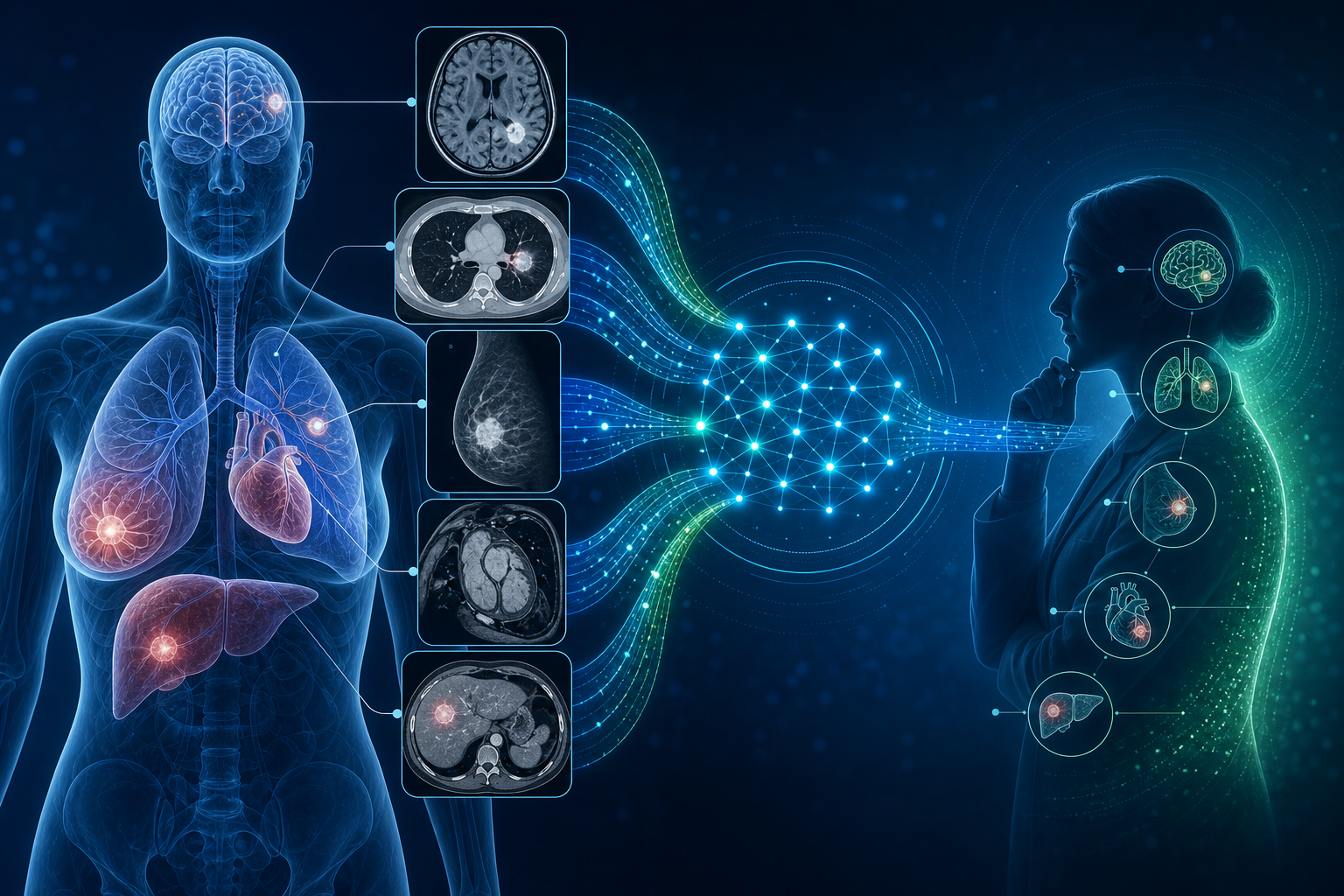
The Shifting Paradigm: From Model Performance to Local Adaptability
For the better part of a decade, the central question in medical imaging AI was straightforward: Does the model work? Researchers benchmarked algorithms against radiologist performance, published AUROCs in high-impact journals, and vendors raced to secure FDA clearances. By the end of 2025, the FDA had authorized 1,451 AI-enabled medical devices, with 1,104 — or 76% — concentrated in radiology. The field had clearly passed the technical feasibility threshold.
But in 2026, the question has fundamentally changed. Radiology leaders, health system administrators, and clinical informaticians are no longer asking whether AI can detect a pulmonary nodule or flag an intracranial hemorrhage. They are asking a harder, more operational question: Can this AI be safely adapted to our local patient population, integrated into our existing reporting workflow, and maintained over time without creating new burdens for our radiologists?
This shift from model performance to local adaptability marks a genuine paradigm change. The dominant AI model of the past — a standalone detection algorithm that sits alongside the PACS, flagging findings as a secondary reader — is giving way to integrated platforms that function as invisible infrastructure. These platforms do not simply detect; they triage worklists, automate quantification, generate structured reports, and orchestrate the entire imaging workflow. The question is no longer whether the model works in a controlled study, but whether it can work reliably in your hospital, with your population, on your scanners, and within your radiologists' cognitive workflow.
Five Documented Workflow Integration Patterns
Understanding how AI is actually deployed in clinical imaging workflows requires moving beyond the generic label "AI tool." A systematic review of 48 real-world studies, published in npj Digital Medicine in September 2024, provides the most granular taxonomy available. The review classified AI integration into five distinct patterns, each with fundamentally different implications for workflow design, radiologist interaction, and procurement strategy.
The dominant pattern, accounting for 43.2% of the 37 studies that specified integration mode, is the triage system. These tools reprioritize the radiologist's worklist — flagging studies with suspected critical findings to the top of the queue — or send direct alerts to referring physicians. They do not replace the radiologist's interpretation; they change the order in which studies are read. The second most common pattern, at 35.1%, is the second reader, where AI provides a concurrent or sequential interpretation that the radiologist can confirm or override. Only 5.4% of studies evaluated AI as a gatekeeper — a system that autonomously clears normal cases without radiologist review.
| Integration Pattern | Share of Deployed AI Tools | Primary Workflow Effect | Radiologist Interaction |
|---|---|---|---|
| Triage / Worklist Reprioritization | 43.2% | Changes reading order; flags critical findings | Reviews all cases, but in priority order |
| Second Reader (Concurrent or Sequential) | 35.1% | Provides second opinion; may improve sensitivity | Reviews AI output alongside own interpretation |
| Workflow Optimization | Not separately reported | Automates measurements, segmentation, or report drafting | Accepts or edits AI-generated outputs |
| Real-Time Guidance | Not separately reported | Provides intraprocedural navigation or targeting | Uses AI overlay during procedure |
| Gatekeeper (Autonomous Clearance) | 5.4% | Clears normal cases without radiologist review | Only reviews cases flagged as abnormal |
Comments
Join the discussion with an anonymous comment.